

 Apple Podcasts
 Spotify
 Amazon Music
 iHeartRadio
 Overcast
 PocketCasts
  RSS Feed
 Winter
Winter... Now if you are in the northern hemisphere maybe think of this as a form of aural air conditioning. But if, like me, you are near the bottom of the planet then the music will be bringing up sensations you are all too familiar with. I hope that wherever you are listening to this you are not shivering too much or sweating too much and that for the next hour and a quarter some wintery music will bring you some pleasure. Music from Geirr Tveitt, Pyotr Tchaikovsky, Frederic Delius, Frederic Chopin, Sergei Prokofiev, Benjamin Britten, Josef Haydn, Johannes Brahms, Jabra Latham, Morten Lauridsen, Henry Purcell and Franz Schubert. [Episode Image: Central Park NY.]
And here is a link to a playlist on Spotify with the music from this episode:
https://open.spotify.com/playlist/5kE0bThpKzTWrqwtQBH0Zh?si=a1272e6fd72d4565
https://interlude.hk/30-pieces-of-classical-music-about-winter/
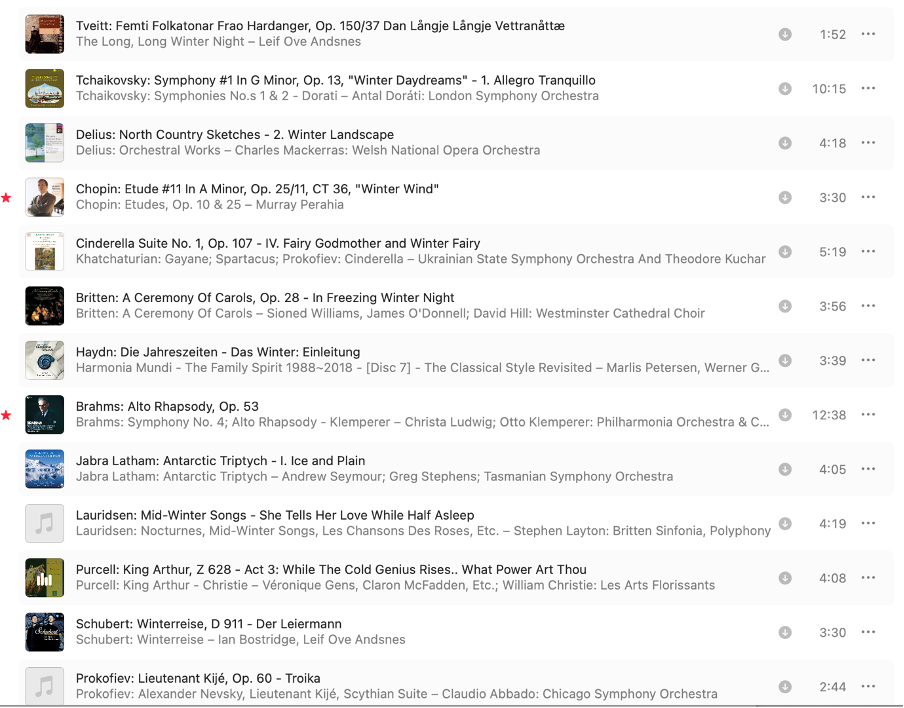
The Music
The Words
Hello everyone. Welcome to another episode of the ‘Classical For Everyone’ Podcast… five hundred years of incredible music. My name is Peter Cudlipp and… If you enjoy any music at all then I’m convinced you can enjoy classical music. All you need are ears. No expertise is necessary. If you’ve ever been curious about classical music… or explored it for a while once upon a time… or just quietly wondered what all the fuss was about… then this is the podcast for you.
And because there’s a lot of music out there each episode has a theme. And for this one it is… Winter. Now if you are in the northern hemisphere maybe think of this as a form of air conditioning. If, like me, you are near the bottom of the planet then the music will be bringing up sensations you are all too familiar with. As I think about it I realise this is perhaps a no win situation. But I hope that wherever you are listening to this you are not shivering too much or sweating too much and that for the next hour and a quarter some wintery music will bring you some pleasure.
I want to credit the Hong Kong based website Interlude.hk. This is a terrific resource filled with thematic posts, biographical articles and reviews and it was their list of music inspired by winter that pointed me in the direction of music I didn’t know and some I had forgotten. I’ll put a link to it on this episode’s page at classcialforeveryone.net.
As you might expect with a theme as broad as ‘winter’ there is quite a range out there and I’m going to play you some ballet music, choral music, piano music, orchestral music and a little bit of operatic music. I could list all the composers but today, let’s just get started.
The 20th century Norwegian composer Geirr Tveitt has been championed by the pianist Leif Ove Andsnes and here he is playing one of Tviett’s 50 miniatures for piano ‘Folk Tunes from Hardanger’. This one is about 2 minutes long and is called ‘The Long, Long Winter Night’. The pianist ‘Leif Ove Andsnes’.
A
That was Leif Ove Andsnes performing ‘The Long, Long Winter Night’ by Geirr Tveitt.
Ok. In 2014 the critic Tom Service wrote in The Guardian Newspaper in the UK that… "Pyotr Tchaikovsky's first symphony written in 1866 remodelled the form into a truly Russian style" and additionally serves as "one of the most irresistibly attractive first symphonies ever written".
Tchaikovsky gave the entire symphony the title ‘Winter Daydreams’ and it is thought that at a particularly stressful time in his life (He had at the age of 26 just been appointed a professor at the Moscow Conservatory) he reached back to memories of winter in the Russian countryside of his childhood.
Of the opening he said it carried impressions of a journey across an icy landscape. It is about 10 minutes long. The opening section of Tchaikovsky’s 1st Symphony performed by the London Philharmonic conducted by Antal Dorati.
B
That was Pyotr Ilyich Tchaikovsky’s 1st Symphony performed by the London Symphony Orchestra conducted by Antal Dorati.
Frederic Delius wrote his four part North Country Sketches in 1914. The second section called 'Winter Landscape’ recalls his exploration of the Yorkshire moors with his sister as a child.
This is a different kind of winter to Tchaikovsky’s. A more contained and maybe contemplative music. Here is Charles Mackerras conducting the Welsh National Opera Orchestra. It is about 4 minutes long. Frederic Delius ‘North Country Sketches’… ‘Winter Landscape’.
C
That was Charles Mackerras conducting the Welsh National Opera Orchestra with Frederic Delius ‘Winter Landscape’. From ‘North Country Sketches’.
The composer Frederic Chopin was loathe to give nicknames to his solo piano pieces. So over the decades in order to differentiate them performers, promoters and most particularly music publishers have seized on names and terms applied by ‘authorities’ and affixed them to particular pieces. So when the composer Robert Schumann described Chopin’s piece with the formal title of ‘Study No 11 in A minor Opus 25’ as containing passages resembling ‘the howling winter wind’… it became Chopin’s ‘Winter Wind’ study.
So, is it a bit of a stretch to include it in a show with a ‘Winter’ theme? Not if you like Chopin and the fabulous pianist Murray Perahia.
D
That was Murray Perahia with Frederic Chopin’s Winter Wind Study.
The Russian Sergei Prokofiev’s compositional output during the 2nd World War was quite incredible. He wrote the opera War And Peace, his 5th Symphony, two piano sonatas, the score for the film Ivan The Terrible… and his utterly gorgeous music for the ballet ‘Cinderella’. Which includes a dance for the reveal that the old beggar woman is the Fairy Godmother and the introduction of the Winter Fairy. Here is the Ukrainian State Symphony Orchestra conducted by Theodore Kuchar.
E
That was the Ukrainian State Symphony Orchestra conducted by Theodore Kuchar with The Dance of the Fairy Godmother and the Winter Fairy from Sergei Prokofiev’s ballet ‘Cinderella'.
Whilst Prokofiev lived out WWII in relative safety having been evacuated to Ivanovo about 150 miles east of Moscow, the English composer Benjamin Britten found himself in the USA at the beginning of the war but in 1942 decided to return to the UK… Which was neither an easy or a safe thing to do. He found passage on a Swedish cargo ship that over a five week journey managed to elude German U-Boats, aircraft and battleships and get Britten back to England.
On the way the ship docked briefly in Halifax, Nova Scotia, where in a bookshop Britten found a copy of The English Galaxy of Shorter Poems, compiled by Gerald Bullett. The medieval and early English poems in this anthology fired his imagination to write a Christmas work he called ‘A Ceremony of Carols’. It is set for solo harp and boys’ voices.
There are eleven parts and I am going to play you the one titled ‘In Freezing Winter Night’. The text is by the 16th century English Jesuit poet Robert Southwell and begins…
Behold, a silly tender babe, / in freezing winter night, /In homely manger trembling lies
Alas, a piteous sight!
Here is the Choir of Kings College Cambridge directed by Stephen Cleobury and the harp is played by Rachel Masters.
F
That was ‘In Freezing Winter Night’ from Benjamin Britten’s ‘Ceremony of Carols’. The text was by the 16thcentury English Jesuit poet Robert Southwell and the Choir of Kings College Cambridge was directed by Stephen Cleobury and the harp was played by Rachel Masters.
In his late 60s Joseph Haydn wrote a number of grand oratorios… which are dramatic concert works for soloists, chorus and orchestra. The man who had codified the string quartet and popularised the symphony took another musical form and elevated it to a new height.
In 1801 his colleague Gottfried van Swieten took some English Poems by James Thomson on the theme of the four seasons and Haydn turned them into an Oratorio. Now the name ‘The Four Seasons’ was already taken so Haydn settles for ‘Die Jahrezeiten’ or just ‘The Seasons’. Or at least that is my guess. And now is the moment to mention that I have resisted the urge to include ‘Winter’ from the Vivaldi ‘Four Seasons’ in this show… There was a little bit of ‘Spring’ in the last episode.
Back to Haydn. From the 130 minutes of music that make up ‘The Seasons’ here is the introductory orchestral piece from the Winter section. It is about three minutes long and is played by the Freiberg Baroque Orchestra conducted by Rene Jacobs.
G
That was the introduction to ‘Winter’ from Josef Haydn’s ‘The Seasons’. The Freiberg Baroque Orchestra was conducted by Rene Jacobs.
So this winter themed episode has been dominated by relatively short pieces but next is something a little more substantial. This is Johannes Brahms ‘Alto Rhapsody’ from 1869, written as a wedding gift for Clara and Robert Schumann’s daughter Julie.
Brahms took a strangely dark poem, considering the occasion, written by Johann Wolfgang von Goethe titled ‘Winter Journey in the Harz Mountains’ and set it to music for alto soloist, male choir and orchestra. To be fair the three parts of the poem Brahms set and the music he wrote move from darkness to light so perhaps there is a metaphor there for people who find each other and are able to celebrate their love.
Whilst this piece with its slightly unusual performer requirements is not often performed these days, it has been recorded a bunch of times. The one I’ve chosen features the soloist Christa Ludwig, the Philharmonia Orchestra and Chorus and the conductor Otto Klemperer. It is about 13 minutes long. The Alto Rhapsody by Johannes Brahms.
H
That was Christa Ludwig, the Philharmonia Orchestra and Chorus and the conductor Otto Klemperer performing the Alto Rhapsody by Johannes Brahms.
Now there has been a focus on the northern hemisphere winter in this show so far but now we head a long way south.
Three years ago the Tasmanian composer and performer Jabra Latham wrote a work he called Antarctica Triptych for solo clarinet and strings.
Here is the first section called ‘Ice and Plain’. Andrew Seymour plays the clarinet and Greg Stephens conducts the Tasmanian Symphony Orchestra. It is about 4 minutes long. Jabra Latham’s ‘Antarctica Triptych’.
I
That was ‘Ice and Plain’ from Jabra Latham’s ‘Antarctica Triptych’. Andrew Seymour played the clarinet and Greg Stephens conducted the Tasmanian Symphony Orchestra.
Ok. Next another wintery piece from a living composer, the American Morten Lauridsen. I’m going to play one of the pieces from his choral cycle ‘Mid-Winter Songs’ which are settings of poems by Robert Graves. This is the text…
She tells her love while half asleep,
In the dark hours,
With half-words whispered low:
As Earth stirs in her winter sleep
And puts out grass and flowers
Despite the snow,
Despite the falling snow.
This is the group Polyphony, the Britten Sinfonia and Stephen Layton conducts. Morten Lauridsen's ‘She tells her love while half asleep’.
J
That was the group Polyphony, the Britten Sinfonia and Stephen Layton conducting Morten Lauridsen's ‘She tells her love while half asleep’ written in 1980.
Ok. Let’s go back three hundred years. For something that is I think perhaps a little light-hearted because some of this winter music can, maybe understandably, be a little sombre.
In the third act of Henry Purcell's sort of opera ‘King Arthur’ from 1691, an evil sorcerer tries to woo Arthur’s betrothed by showing her that love can conquer the coldest heart. And he stages a magical scene in which Cupid has just descended to a frozen landscape and commands the reluctant, shivering Cold Genius (the spirit of Winter) to wake and rise from his icy sleep. The Cold Genius sings with stuttering, trembling vocal lines that musically depict him shuddering awake against his will.
Here is ‘While the cold genius rises’ sung by Petteri Salomaa with William Christie conducting Les Arts Florissants from Henry Purcell’s opera ‘King Arthur’.
K
That was ‘While the cold genius rises’ from Henry Purcell’s opera ‘King Arthur’.
sung by Petteri Salomaa with William Christie conducting Les Arts Florissants.
My name is Peter Cudlipp and you have been listening to the ‘Classical for Everyone’ Podcast. I have another couple of pieces coming up but before I get to them I want to give you a little information that I hope you find useful…
If you would like to listen to past episodes or get details of the music I’ve played please head to the website classicalforeveryone.net. That address again is classicalforeveryone.net
On the individual episode pages of the website there are links to Spotify playlists with the full versions of most of the music played in each of the episodes.
I hope you have enjoyed this Winter focused episode of ‘Classical For Everyone’. And if you want to get in touch then you can email… info@classicalforeveryone.net.
Alright, to finish this episode…
A few weeks back in the episode on the early works of Franz Schubert I mentioned the central place that Lieder had in his work. This German word just means songs but is more specifically in this context thought of as settings of poetry for singers accompanied by a piano.
Schubert wrote hundreds of lieder in his short life but his best remembered is the setting of a group of 24 poems by the writer Willhelm Müller called ‘Winter Journey’ or ‘Winterreise’.
The premise of the cycle is that the singer’s lover has left him for another and his grief leads him out into a cold, dark and barren world… the winter journey mirroring his isolation and despair.
In the final three and a half minute song the wanderer meets a mysterious street musician… ‘Der Leiermann’… ‘the Hurdy Gurdy Man’… Here is a rather evocative description of the scene from Wikipedia…
“At the edge of the village stands a hurdy-gurdy man, cranking his instrument with frozen fingers. His begging bowl is always empty; no one listens, and the dogs growl at him. But his playing never stops.”
At the conclusion the wanderer sings…
Wunderlicher Alter, / Soll ich mit dir geh'n?
Willst zu meinen Liedern / Deine Leier dreh'n?
"Strange old man / Shall I come with you?
Will you play your hurdy-gurdy / To accompany my songs?"
Here is the singer Ian Bostridge and the pianist Lief Ove Andsnes with Franz Schubert’s ‘Der Leiermann’ from ‘Winter’s Journey’.
L
That was the singer Ian Bostridge and the pianist Lief Ove Andsnes with Franz Schubert’s ‘Der Leiermann’ from ‘Winter’s Journey’.
Thanks for your time and I look forward to playing you some more incredible music on the next ‘Classical For Everyone’.
This podcast is made with Audacity Software for editing, Wikipedia for Research, Claude for Artificial Intelligence and the music played is licensed through AMCOS / APRA. Classical For Everyone is a production of Mending Wall Studios and began life thanks to the enthusiasm and encouragement of Mr Jeffrey Sanders.
And if you have listened to the credits… here is a bit more music for you…
It would have been unreasonable to leave you at the end of this episode with the bleak conclusion of Schubert’s Winter Journey so perhaps what is called for is a fast ride in a horse drawn carriage through the snow drifts of the Russian countryside wrapped in furs.
In 1934 Sergei Prokofiev was asked to compose the music for a film called ‘Lieutenant Kije’. Like so much Soviet art of the time it was about how much worse everything was back in the days before the communist revolution. The film was a satire about bureaucrats being so terrified of the Tsar that they invented a fictional soldier to take the blame for various palace stuff-ups… the Lt Kije of the title. In one of the scenes the characters ride through the snow in a carriage drawn by three horses called a ‘troika’ and that is what the section of music is called.
And this is Claudio Abbado conducting the Chicago Symphony Orchestra. ‘Troika’ by Sergei Prokofiev from ‘Lt Kije’.
Thanks again for listening.
M