

 Apple Podcasts

 Spotify

 Amazon Music

 iHeartRadio

 Overcast

 PocketCasts
 RSS Feed
War Remembered

In much of the English-speaking world, along with France and Belgium, the 11th of November… the day World War One hostilities ceased in 1918… has become a day to remember the fallen, honour those who served and returned, and reflect on the human cost of all wars… called variously Armistice Day or Veterans Day or Remembrance Day. It is worth noting that many nations set aside a different day... In South Korea it is 6th June, In Russia there are two dates 9th May and 22nd June, In Japan it is the 15th of August. In Germany, 15th November. So, whilst the timing of this episode says something about my background, as does the music I am going to play, please don't interpret this as elevating any particular nation or conflict. I suspect you may have already worked out that there is going to be some intense music in this show and whilst I am genuinely a very big fan of the joy and delight so much music can give... this is music written for a different purpose. I hope you find the gravity and emotion in it as affecting and powerful as I do. War is a subject that has figured in the work of many, many composers but I only have music for you from five. Frederick Kelly, Dmitri Shostakovich, Josef Haydn, Richard Struass and Benjamin Britten.
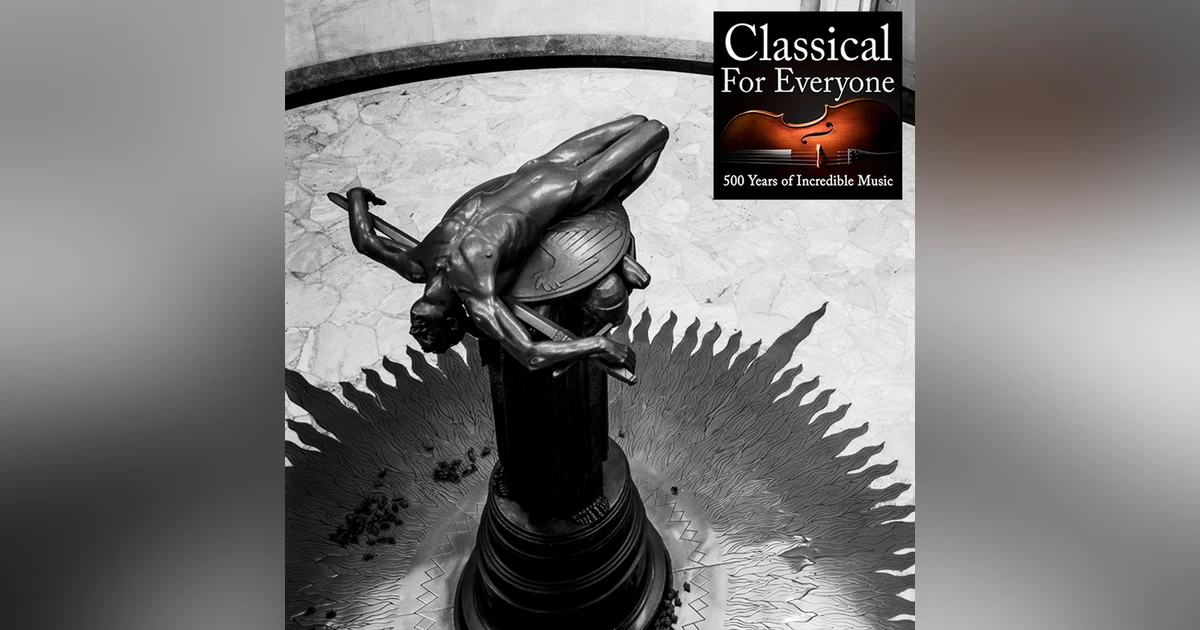
[Episode Image: 'Sacrifice' by George Rayner Hoff, Hall of Silence Anzac Memorial, Sydney]
Here is a link to a playlist on Spotify with the music in the episode:
https://open.spotify.com/playlist/0Qd5eBMJPLX1eMvuyvYWfc?si=c942fdcc10694a16
Benjamin Okopnik’s translation of Yevgeny Yevtoshenko’s ‘Babi Yar’:
The Music
The Words
Hello everyone. Welcome to another episode of the ‘Classical For Everyone’ Podcast… five hundred years of incredible music. My name is Peter Cudlipp and… If you enjoy any music at all then I’m convinced you can enjoy classical music. All you need are ears. No expertise is necessary. If you’ve ever been curious about classical music… or explored it for a while once upon a time… or just quietly wondered what all the fuss was about… then this is the podcast for you. And because there’s a lot of music out there each episode has a theme. And for this one it is… music written in response to war.
As I started to write this episode, two days earlier in much of the English Speaking World, along with France and Belgium, it was Armistice Day or Veterans Day or Remembrance Day…. the 11th of November… the date on which the fighting World War One came to an end in 1918. This date has become a day to remember the fallen, honour those who served and returned, and reflect on the human cost of all wars. But it is worth noting that many nations set aside a different day... In South Korea it is 6th June, In Russia there are two dates 9thMay and 22nd June, In Japan it is the 15th of August. So, whilst the timing of this episode says something about my background, as does the music I am going to play, please don’t interpret this as elevating any particular nation or conflict.
I suspect you may have already worked out that there is going to be some intense music in this show and whilst I am genuinely a very big fan of the joy and delight so much music can give... this is music written for a different purpose. I hope you find the gravity and emotion in it as powerful and as affecting as I do.
War is a subject that has figured in the work of many, many composers but I only have music for you from five. Frederick Kelly, Dmitri Shostakovich, Josef Haydn, Richard Struass and Benjamin Britten. And even though there are only five pieces of music it is going to be a long episode but there is a convenient mid-point to pause the show… and I will point it out.
The first piece I am going to play actually memorialises just one person. But like much art that is intended to be very specific, its afterlife can become expansive and inclusive. The piece is “Elegy for Strings (In Memoriam Rupert Brooke)” by Frederick Kelly. The name Rupert Brooke might be familiar to some listeners. He was an English poet whose best known work was published just as World War One began. He is remembered most for writing…
"If I should die, think only this of me, / That there's some corner of a foreign field / That is forever England."
After the war the patriotism of his poetry was judged harshly for its tone and for the role it may have played in encouraging others to enlist. But he was not alone at the beginning of the war in imagining battle as some sort of bright and shining adventure. A quick gentlemanly skirmish and then home for Christmas.
For Brooke himself the lines I quoted proved eerily prophetic. He died in April 1915 from an infection on the way to fight on the Gallipoli peninsula and was buried on the Greek island of Skyros… a very foreign field.
At the burial was his close friend the Australian / British composer Frederick Kelly and in the following weeks Kelly wrote his Elegy… which is a term borrowed from poetry to describe verse of serious reflection, expressing feelings of melancholy, grief or extreme sorrow.
If the name Frederick Kelly is unfamiliar to you it is perhaps because he was killed in action in France in 1916 at the age of 35.
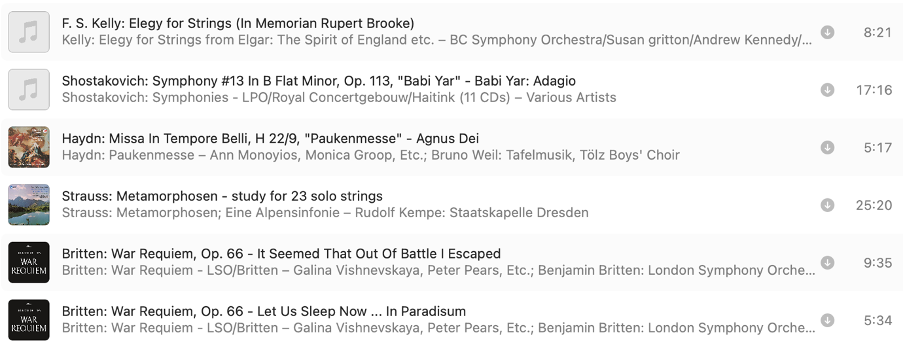
Here is his “Elegy for Strings (In Memoriam Rupert Brooke)”. It is about eight minutes long and David Lloyd-Jones conducts the BBC Symphony Orchestra.
A
That was Frederick Kelly’s “Elegy for Strings (In Memoriam Rupert Brooke)”. David Lloyd-Jones conducted the BBC Symphony Orchestra.
In 1961 the Soviet poet Yevgeny Yevtushinko, already a leading figure in the USSR, unleashed a massive controversy with the publication of his poem ‘Babi Yar’. It begins… in the translation by Benjamin Okopnik:
“No monument stands over Babi Yar.
A steep cliff only, like the rudest headstone.
I am afraid.
Today, I am as old
As the entire Jewish race itself.”
The poem is nominally about a massacre that took place in Ukraine in September 1941 when the invading Germans murdered over 33,000 Jewish civilians in two days. The poem is also about the Soviet Union’s refusal to acknowledge the massacre of the Jews, more broadly it challenges the virulent centuries old Russian anti-semitism.
The poem was banned by the authorities shortly after its publication and it would be 22 years before it was allowed to be included in collections of Yevtushenko’s works. But before the total bans the composer Dmitri Shostakovich called Yevtushenko, who he did not know, and asked if he could use the poem ‘Babi Yar’ and four others for what would be his 13th symphony.
Shostakovich wrote the work for solo male voice, male choir and orchestra. It’s premiere almost didn’t happen with state pressure forcing the original conductor and soloist to bow out. And Yevtushenko at the last minute had to rewrite two verses to note that Russians and Ukrainians were also slaughtered at the Babi Yar ravine. Which was certainly the case in the two years of German occupation. But these new words were very much at odds with the poem’s explicit anti-racist message. And subsequently (though the symphony was effectively banned in the USSR after a handful of performances) the original words were restored. The poem as originally written and set by Shostakovich concludes…
“I become a gigantic, soundless scream
Above the thousands buried here.
I am every old man shot dead here.
I am every child murdered here.”
Here is the first section of Dmitri Shostakovich’s 13th Symphony. It is about 17 minutes long. Bernard Haitink conducts the Concertgebouw Orchestra and Chorus with the bass soloist Marius Rintzler.
B
That was the first section of Dmitri Shostakovich’s 13th Symphony… known as ‘Babi Yar’. Bernard Haitink conducted the Concertgebouw Orchestra and Chorus with the bass soloist Marius Rintzler.
Contemplating atrocity even with the passing of decades can be confronting and I confess I sometimes erect a mental barrier between the past and the present. Maybe as an act of protection or a way to put my head in the sand. But the Babi Yar ravine or, in Ukrainian ‘Babyn Yar’, is not a place lost in the past. It is about a twenty minute drive from the centre of Kyiv. Russian rockets have smashed into the cliffs around it during the current war. And this conflict reminds me of a quote from the Polish British mathematician and philosopher Jacob Bronowski from his 1970’s TV series ‘The Ascent of Man’:
“War, organized war, is not a human instinct. It is a highly planned and cooperative form of theft.” I don’t think Bronowski intended to include people legitimately defending themselves but it is I think entirely apt for the reasons most wars are launched.
Ok, musically at least, the next piece is a little lighter. It is by Joseph Haydn. I’m going to play you the final section of his ‘Mass in time of War’… ‘Missa in tempore belli’. In 1796 in the fallout from the French Revolution it seemed that Vienna was about to be occupied. It would actually not happen until 1805 and again in 1809 but the sense of imminent attack was very real and a few months after the premiere Napoleon Buonaparte and the French army would reach just 110 miles from the city before an armistice was agreed to.
Critics argue about whether there is any anti-war agenda to Haydn’s Mass. It is a relatively traditional setting of the Catholic Mass in Latin. And not all the music is tinged with a sense of battle. But the Agnus Dei (the ‘lamb of God’) section has repetitive timpani beating out a martial rhythm and I don’t think it is hard to hear the merciless advance of troops. And whilst this piece might not have been intended as a remembrance of war, certainly all who heard it would have known what memories those drums were conjuring up.
Here is Bruno Weill conducting the group Tafelmusik and the Tölz Boys Choir with the final section, the Agnus Dei, from Joseph Haydn’s ‘Mass in time of War’. It is about 5 minutes long.
C
That was Bruno Weill conducting the group Tafelmusik and the Tölz Boys Choir with the final section, the Agnus Dei, from Joseph Haydn’s ‘Mass in time of War’.
As this is a bit longer than normal episode I just want to let you know this is about the halfway point. Here’s a few seconds for you to hit pause if you like.
…
Ok. Now this is probably a good place to mention one of the inspirations for the content of this episode. A couple of years back the American music critic and academic Jeremy Eichler wrote a book called ‘Time’s Echo’ which the book’s publisher described as ‘A stirring account of how music bears witness to history and carries forward the memory of the wartime past.’ Frankly I think they are underselling it. It is an incredible book.
I’ll put a link in the show notes to Jeremy Eichler’s website. In the book he dives deeply into four pieces of music that came out of events in World War Two. I’ve already featured one… the Shostakovich… and another two make up the 2nd half of this episode. Incidentally, the fourth is Arnold Schoenberg’s ‘A Survivor Form Warsaw’. In his introduction Eichler has a phrase that I think elegantly summarises what I think the music in this episode does… He calls the pieces ‘shifting constellations of sound and meaning that reach across time’.
In 1944 an 80 year-old German composer wrote to a colleague… “In my shattered life, family is the last and only ray of light. My life’s work is destroyed, German opera ruined, German music consumed in the inferno of a machine, where it’s tortured soul ekes out a miserable existence.” Later on in the letter he wryly suggests he has lived too long.
The man who wrote those words was Richard Strauss. For the first half of the twentieth century, he was probably the most famous and certainly the most successful living composer in the world. His operas filled theatres from Dresden to New York. Concert halls across the globe presented his tone poems. But whilst he rode the waves of success, much of Germany, already a basket case after WWI, imbibed racist and expansionist poisons that would lead to the murder of millions and ultimately the almost total destruction of the nation itself.
And it was this that Richard Strauss was faced with in 1944. He would live another five years and write some of his most powerful music but the piece I am going to play came from this one critical moment… the mounting realisation that essentially his world had been obliterated.
‘Metamorphosen’ or metamorphoses is the title of a 25 minute long work for 23 solo string instruments… essentially separate voices that weave in and out as the music slowly builds and then falls away. And that is just way too simple a way to describe this work with its almost hypnotic richness and complexity. Strauss gave away nothing about any explicit meaning of the title. Metamorphoses at its simplest means ‘transformations’. Did Strauss mean the death of his culture? Did he mean the looming end of his own life? Was there a very slight hope that, in the same way the Latin poet Ovid concludes his poem called ‘Metamorphosis’ he will live on in his works? That he will be transformed into part of the lifeblood of his culture? I think it is a blessing that Strauss did not leave any clear answers. But in the handwritten score he did write the words ‘In Memoriam’.
Here is Rudolf Kempe conducting the Staatskapelle Dresden with the 25 minute ‘Metamorphosen’ by Richard Strauss. It starts pretty quietly.
D
That was Rudolf Kempe conducting the Staatskapelle Dresden with ‘Metamorphosen’ by Richard Strauss.
Until recent years Strauss’s reputation suffered from his connection to Hitler and the Nazis. In 1933 at the age of 69 he was appointed, without consultation, to the position of President of the Reich Music Chamber. The regime wanted the gloss of his international reputation though Joseph Goebbels would write in his diary…
“Unfortunately we still need him, but one day we shall have our own music and then we shall have no further need of this decadent neurotic”.
Strauss would be dismissed two years later for essentially refusing to follow instructions and he would continue to use his influence to protect colleagues where he could and was ultimately successful in saving the lives of his Jewish daughter-in-law and his grandchildren.
Before I move on from Richard Strauss, here is what he wrote in his diary just after completing ‘Metamorphosen’:
“The most terrible period of human history is at an end, the twelve year reign of bestiality, ignorance and anti-culture under the greatest criminals, during which Germany's two thousand years of cultural evolution met its doom.”
At the beginning of this episode I noted some of the different dates that nations use to remember the toll of wars and conflicts. Germany’s ‘Volkstruaertag’ – the People’s Day Of Mourning… for all victims of war and tyranny, not only soldiers… falls two weeks before Advent, the liturgical season leading up to Christmas… and this year it is 15th of November. Which is the day this episode will go out into the world.
Alright, in keeping with what has been a pretty sombre tone to this episode I am going to skip the credits and usual associated ramblings. And finish with just music…. the final fifteen minutes of Benjamin Britten’s ‘War Requiem’ completed in 1962. Incidentally the same year as Shostakovich’s 13th Symphony from which I played the opening section earlier in the show. But a couple of minutes of background first.
In November 1940 the 14th century Coventry Cathedral in the west midlands of England was largely destroyed by German aerial bombing. It would be twenty years before a new cathedral, designed to stand beside the ruins of the original, was completed… and the composer Benjamin Britten would be commissioned to write a work for the consecration of the new building. He chose to use the text of the Latin Mass of the Dead… the requiem… as the starting point for the work.
If you remember at the beginning of the episode I talked about the British poet Rupert Brooke and mentioned that his reputation suffered as the utterly savage realities of modern trench warfare became known.
Britten would use the words of another World War One poet for passages to interrupt and in some ways undercut the grandeur and acceptance embodied by a traditional mass for the dead. This poet’s name was Wilfred Owen. Like Rupert Brooke he too would not survive what was at the time called The Great War. He was killed in battle just a week before the November 11th armistice that stopped the fighting. But his poetry, unlike Brooke’s was fully informed by the horrors he experienced.
Britten uses a number of Owen’s poems through the War Requiem and the last he uses is the chilling ‘Strange Meeting’. It begins with a tenor singing:
“It seemed that out of battle I escaped
Down some profound dull tunnel, long since scooped
Through granites which titanic wars had groined.”
And the poem concludes with a baritone singing:
“I am the enemy you killed, my friend.
I knew you in this dark; for so you frowned
Yesterday through me as you jabbed and killed.
I parried; but my hands were loath and cold.
Let us sleep now..."
And the whole work finishes with a choral section from the Latin Mass for the Dead the final words of which are:
Requiescant in pace. Let them rest in peace.
The singers are Peter Pears and Dietrich Fischer-Dieskau, joined by Galina Vishnevskaya in the final section, and the composer conducts the Bach Choir, the Highgate School Choir, the Melos Ensemble and the London Symphony Chorus and Orchestra.
Here is the final fifteen minutes of Benjamin Britten’s ‘War Requiem’. Thanks very much for listening.
E