


Very Old (Incredible) Music


If from time to time you happen to listen to a podcast with the subtitle ‘Five Hundred Years Of incredible Music’ then it would be a reasonable expectation to hear some five hundred year old music. I’ve played a few pieces from the 1500s and 1600s but as you might expect the focus of the show has been sort of the music of Johann Sebastian Bach and Antonio Vivaldi onwards… call it from the early 1700s until today. That means I’ve left out a good 175 years of music. This episode is going to be a step toward redressing that neglect.
4567And here is a link to a playlist on Spotify with the music from this episode:
https://open.spotify.com/playlist/0fdHtofmxbACQUpCeI7OWP?si=e4758df8f16e4d34
The Music

The Words
Hello everyone. Welcome to another episode of the ‘Classical For Everyone’ Podcast… five hundred years of incredible music. My name is Peter Cudlipp and… If you enjoy any music at all then I’m convinced you can enjoy classical music. All you need are ears. No expertise is necessary. If you’ve ever been curious about classical music… or explored it for a while once upon a time… or just quietly wondered what all the fuss was about… then this is the podcast for you. And because there’s a lot of music out there each episode has something of a theme. And for this one it is… very old incredible music.
If from time to time you happen to listen to a podcast with the subtitle ‘Five Hundred Years Of incredible Music’ then it would be a reasonable expectation to hear some five hundred year old music. Now I’ve certainly played a few pieces from the 1500s and 1600s but as you might expect the focus of the show has been sort of the music of Johann Sebastian Bach and Antonio Vivaldi onwards… call it 1700 until today. That means I’ve left out a good 175 years of music. This episode is going to be a step toward redressing that neglect. And it is also for listeners who have been frustrated by having to listen to music from composers who are still amongst the living… like the focus of last week’s episode, Philip Glass.
This is going to be slightly different from past shows. In attempting to survey over close to two centuries of music largely from composers who are not exactly household names, I’ve opted for fifteen shortish tracks. And I’m not going to say much… other than introduce the tracks and maybe add a small bit of background.
There’s a couple of reasons for this. By keeping a certain flow I want to give you a slightly immersive experience. I think this can be a way to get into unfamiliar music. The other reason is that in many instances there is just not a lot of good information available. Which is not to say academics and performers have not done a massive amount of work to reconstruct scores, research biographies and study performance practice but the information is limited, frequently contradictory and from time to time just good old guesswork.
Before we get going I want to make one suggestion. Don’t expect your ears to tune into this music immediately. I won’t go into too much of the technicalities but some of this music can sound jarring at first to modern ears. Notes are put together and instruments are tuned in ways that fell out of favour as the centuries went by. I think it would be a surprise if music from 500 years ago didn’t sound at times quite strange.
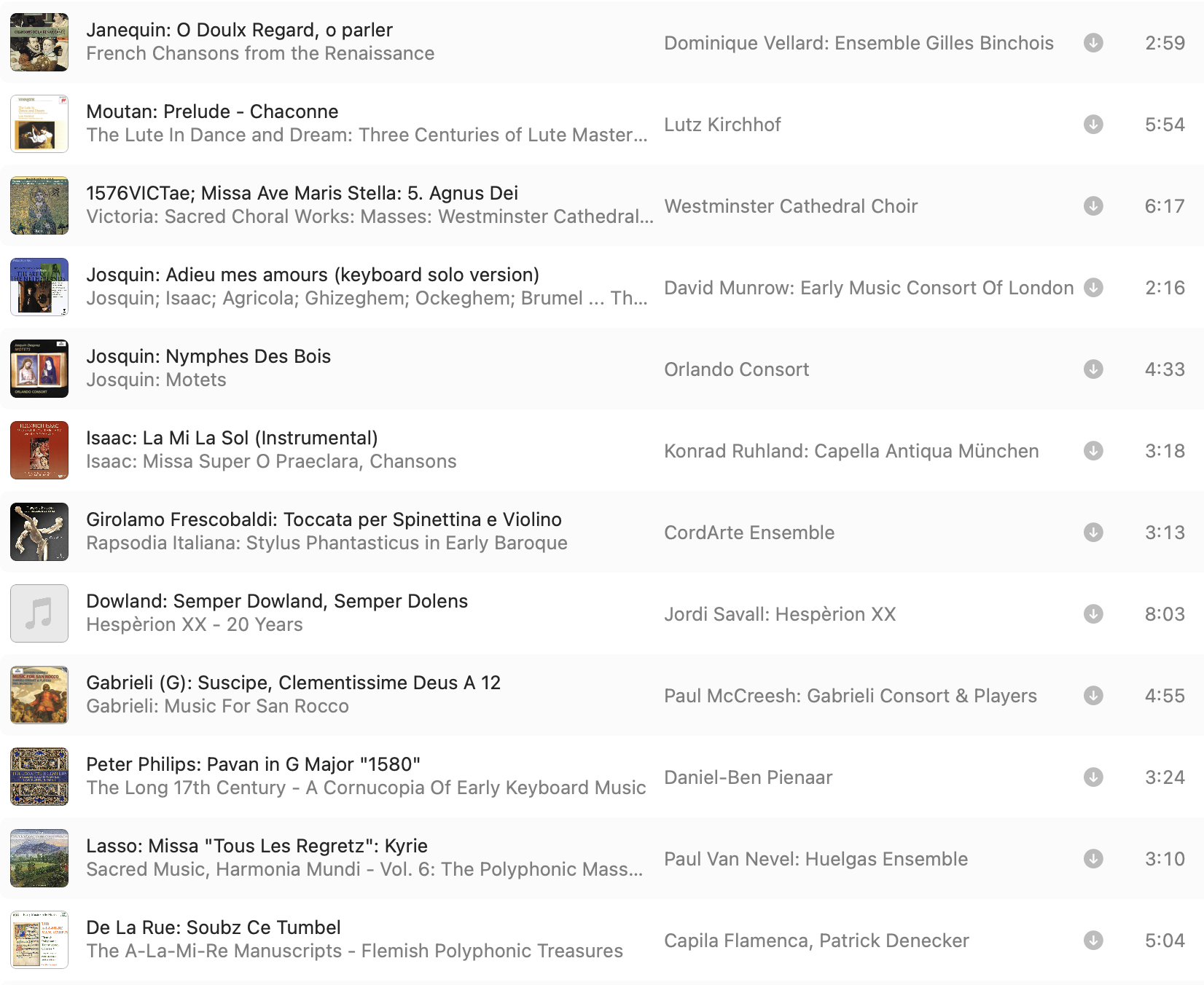
In the 1520’s in Paris one of the most popular composer of ‘chansons’, which is French for ‘songs’ and by then meant multi-part non-religious songs sung in French, was Clément Janequin. Here is his song ‘O doux regard’, or ‘O sweet gaze’. It is about three minutes long and here are the Jules Binchois Ensemble.
A
That was ‘Oh Sweet Gaze’ by Clément Janequin performed by the Jules Binchois Ensemble.
One thing about music of this period is that the human voice had in some ways a more central role than it does in classical music today. Looking ahead I think about 50% of the show is music centred on the voice… much of it from music written for the church. But there is also a substantial body of music for solo instruments and one of the most popular was the lute… an instrument that was supplanted in the 1700s by the louder and easier to play classical guitar. Here is a dance called a ‘chaconne’ for the Lute by Charles Mouton based in France in the early 1600s. It is about six minutes long and is performed by Lutz Kirschof.
B
That was Lutz Kirschof playing a dance called a chaccone by Charles Mouton.
The Roman Catholic Mass — a service inspired by the Last Supper — remains the central rite of worship for millions today. For centuries, music has been integral to the service, and some of the most beautiful choral music ever written has been composed for the Mass. This was certainly true in the 1500s and 1600s.
Tomás de Luis Victoria was a Catholic Priest, an organist, a singer and is considered one of the most important composers of the second half of the 1500s. And not surprisingly his specialty was sacred music for groups singing separate vocal lines… sometimes as many as twelve different lines. Over twenty of his settings of music for the Mass have survived.
Here is the ‘Agnus Dei’ or ‘Lamb of God’ section from his Mass ‘Ave Maris Stella’ or ‘Hail Mary, star of the Sea’. The Westminster Cathedral Choir is led by David Hill. It’s about 6 minutes long.
C
That was The Westminster Cathedral Choir is led by David Hill with the Agnus Dei from the Ave Maris Stella Mass by Tomas de Luis Victoria.
Josquin de Prez was a Franco-Flemish composer active in the early 1500s in both sacred and secular music. Here is a setting of his song ‘Adieu mes amours’, ‘Goodbye my loves’ And here just quickly is one of those examples of the complex musicology of this very old music. No one can decide from the surviving music if this was an instrumental piece or a choral piece. So both versions exist. I’ve got both but I have chosen the one for organ.
Organs have been part of European musical life for over a thousand years — they were already well-established instruments in Josquin's time, found in major churches and cathedrals across Europe. Here is Christopher Hogwood. ‘Adieu mes amours’ by Josquin Des Prez. A bit over two minutes.
D
That was Christopher Hogwood playing. ‘Adieu mes amours’ by Josquin Des Prez. Sort of accidentally, Des Prez has become the only composer in this show to get two pieces but his importance sort of deserves it. Living from about 1450 to 1522 he’s actually just before my arbitrary 500 year cut off but he influenced most who followed him. Josquin’s ‘Nymphs of the Woods’ is a song written to a poem mourning the death of an earlier composer Johannes Ockeghem in 1497. It has five melodic lines and here is the Orlando Consort. It is about 4 minutes long.
E
That was the Orlando Consort with ‘Nymphs of the Woods’ by Josquin Des Prez.
Heinrich Isaac was a contemporary of Des Prez and here is his ‘La Mi La Sol’. Which is not a very imaginative title as it is just a list of musical notes… as in do, re, me so etc. Perhaps Isaac was not expecting Musica Antiqua Munich to make a recording so it could be played to you more than five centuries after he wrote it. And this is the first example in the show of music for a small group of instruments. It is about three minutes long.
F
That was Musica Antiqua Munich with ‘La Mi La Sol’ by Heinrich Isaac.
Here is a little more music for a small group of instruments. This is by Girolamo Frescobaldi who was most active in the late 1500s. This is his Toccata for Spinet, Violin and Viola Da Gamba. It is about 4 minutes long. Here are the Cordate Ensemble. And by the way a spinet is small harpsichord and a viola da gamba is an early version of a cello.
G
That was the Cordate Ensemble with the Toccata for Spinet, Violin and Viola Da Gamba by Girolamo Frescobaldi. We have had very old music from northern France, Spain and Italy. Next is the English composer John Dowland. He was a highly regarded player of and composer for the lute and gave the instrument a central place in many of his compositions including this one he titled… ‘Semper Dowland, Semper dolens’ which is Latin for ‘always Dowland, always doleful or sad’. Perhaps a half humorous reference to his reputation for melancholy music. Here is Jordi Savall and Hesperian XX. It is about 6 minutes long.
H
That was Jordi Savall leading the group Hesperian XX with John Dowland’s ‘Semper Dowland, Semper dolens’.
There was a massive amount of music written for the different keyboards of this era… music for small organs, harpsichords… and the lesser known today… spinets, virginals and the very quiet and intimate clavichord. One of the ways this body of music has been kept alive into our time is by performances of it on modern pianos. The English composer Peter Philips was exiled to the Spanish Netherlands in the 1580's and remained there for the rest of his life. But his keyboard works in particular continued to the collected, and you’d have to suppose, played in England.
From one of those collections here is his ‘Pavane’, which takes its name from a slow Spanish courtly dance, performed by Daniel-Ben Peinaar on a modern piano. It is about 3 minutes long.
I
That was Peter Philps Pavane from 1580 performed by Daniel-Ben Peinaar.
I hope one of the things this episode is demonstrating that even five centuries ago there were quite diverse genres of music being developed, performed and refined. And that this was a time of experimentation as I hope the next piece will show.
In 1615 in Venice the composer Giovani Gabrielli wrote a religious song that he described as being for ‘13 voices’. Now that is not thirteen different lines of intermingling vocal music. He wrote the work for six male vocalists, six trombones and an organ. A really I think, to our ears, eccentric combination. And if like me you are thinking, hang on trombones... in the 1600’s? Let me pass on the results of the research fuelled by my scepticism. The mechanics of sliding sections of the tubing of a brass musical instrument to vary the pitch of the note produced, dates back to the 1400s. So, yes, trombones.
Here is Paul McCreesh conducting the Gabrieli Consort with ‘Suscipe, clementissime deus’ or ‘Receive O merciful God’ by Giovani Gabrielli. It is about 5 minutes long.
J
That was Paul McCreesh conducting the Gabrieli Consort with ‘Suscipe, clementissime deus’ or ‘Receive O merciful God’ by Giovani Gabrielli.
In the 1580s the composer Orlando di Lasso also known widely as Orlande de Lassus, took the lyrics and melody from an earlier composer’s short song titled ‘Tous les regretz’ or ‘All the regrets’ and used it to create a setting for a five part Mass and it ended up with the name ‘Missa Tous Les Regretz’. Now incidentally, this sort of thing would become an ongoing issue that would vex the Papacy and the broader Catholic church hierarchy as they were annoyed that composers might be being a little subversive by taking popular tunes and repurposing them for church music. Think perhaps of singing praises to God to the tune of ‘Stairway To Heaven’.
Ok. Here is the opening section of Lasso or Lassus’ Mass Tous Les Regretz (all the regrets) performed by the Huelgas Ensemble directed by Paul van Nevel. It is about 3 minutes long.
K
That was the opening section of Lasso or Lassus’ Mass Tous Les Regretz (all the regrets) performed by the Huelgas Ensemble directed by Paul van Nevel.
Although the printing press was already causing a decline, the art of the illuminated manuscript was still surviving in the late 1400s and early 1500s. This thousand year old tradition of making beautiful hand crafted books filled with lavishly coloured and meticulously detailed illustrations and textual embellishments that were amongst the most valuable objects an aristocrat, a bishop or a princess could own, had by this time gone far beyond religious texts and would every so often include sheet music.
So the piece from the Flemish composer Pierre De La Rue who died in 1518 which I am going to play next came down to us as a page in a book made by Pierre Alamire whose clients included Henry VIII of England and Pope Leo X. The rarity and value of Alamire’s books is probably what saved the music.
This is the song ‘Soubz ce tumbel’ which is old French for ‘Under this tomb’ with music by Piere De La Rue and it is performed by Capila Flamenca led by Patrick Denneker. It is five minutes long.
L
That was the song ‘Soubz ce tumbel’ which is old French for ‘Under this tomb’ with music by Piere De La Rue performed by Capila Flamenca led by Patrick Denneker.
My name is Peter Cudlipp and you have been listening to the ‘Classical for Everyone’ Podcast. I have one final piece coming up but before I get to it want to give you a little information that I hope you find useful… If you would like to listen to past episodes or get details of the music I’ve played please head to the website classicalforeveryone.net. That address again is classicalforeveryone.net. And on the individual episode pages of the website there are links to Spotify playlists with the full versions of most of the music played in each of the episodes.
Ok. There is an early music vocal ensemble based in the UK called Stile Antico. And a few years back they released a CD titled ‘In A Strange Land… Elizabethan Composers In Exile’. It is filled with quite astonishingly beautiful music tinged with a certain sadness as much of it reflects the damaged lives of composers who remained true to their catholic faith courting charges of heresy and worse in Elizabeth I’s aggressively protestant kingdom.
The composer William Byrd is an especially complex example. In his early career he had royal patronage and some sort of monopoly on the printing of music in London. But then in the 1580s he converted to Catholicism. His circle then came to include men who would ultimately be executed for their beliefs and allegations against them of conspiracies against the life of the Queen. Byrd would survive but would lose his positions and licences and spend the final third of his life living in a sort of exile in rural Essex.
It was at this time that he wrote a song for five voices titled ‘Tristitia et anxietas’ or ‘Sadness and Anxiety’.. It is the setting of a penitential Latin text expressing profound sorrow, sinfulness, and a plea for divine mercy.
It is about 10 minutes long and is performed by Stile Antico. William Byrd’s ‘Tristitia et anxietas’ or ‘Sadness and Anxiety’. Thanks for your time and I look forward to playing you some more incredible music on the next ‘Classical For Everyone’.
M
This podcast is made with Audacity Software for editing, Wikipedia for Research, Claude for Artificial Intelligence and Apple, Sennheiser, Sony, Rode and Logitech for hardware… The music played is licensed through AMCOS / APRA. Classical For Everyone is a production of Mending Wall Studios and began life on Radio 2BBB in Bellingen NSW, Australia thanks to the late, great Mr Jeffrey Sanders.
Here’s one final piece for folks who stay for the credits. In the centuries that followed the music I’ve played in this episode, one instrument would reach such dominance in classical music that at most orchestral concerts today there will be about 50 of them on stage.Here is a couple of minutes of solo violin music by Giovanni Bassano from the 1590s performed by Daniel Deuter. Bassano’s Ricercare No. 1. Thanks again for listening.
N