

 Apple Podcasts
 Spotify
 Amazon Music
 iHeartRadio
 Overcast
 PocketCasts
  RSS Feed
 The Other Russians
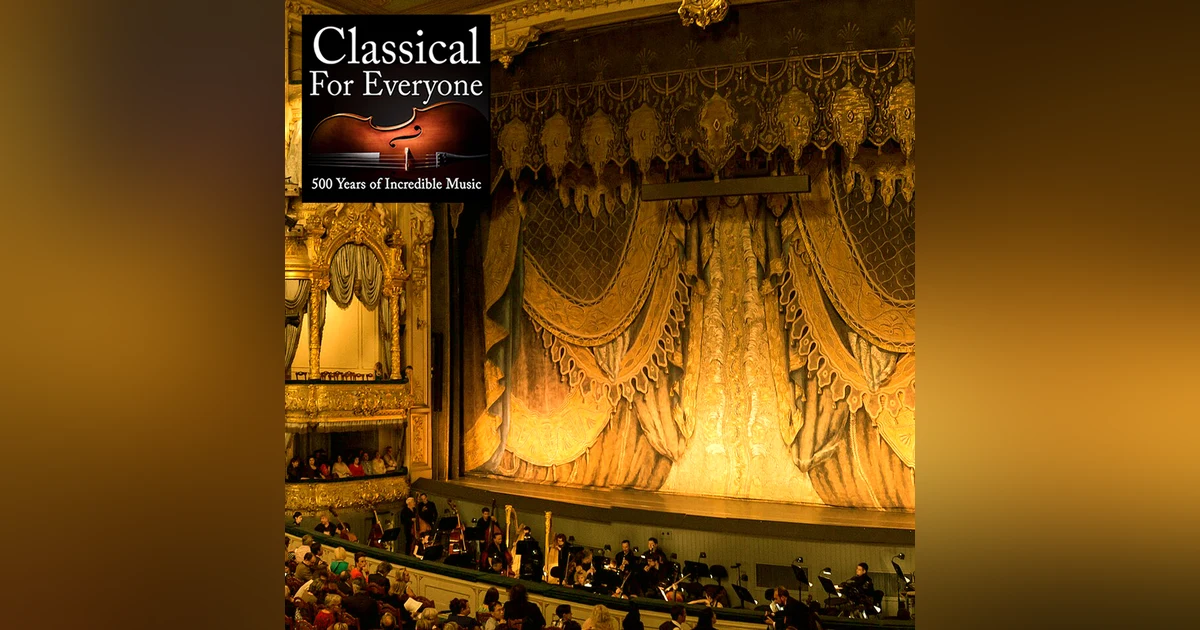
Who are 'the other Russians’? Well, I’ve played a fair bit of music by Russian and Soviet era composers in the show. Tchaikovsky got two whole episodes and there has been relatively frequent appearances by Rachmaninoff, Rimsky-Korsakov, Prokofiev, Stravinsky and Shostakovich. But there are a quite a number of other composers more than worthy of a good listen who I have largely ignored… ‘the other Russians’. So for this episode I have music by Glinka, Balakirev, Borodin, Mussorgsky and Scriabin. Most of it is orchestral but there is nine minutes of opera and some very sweet miniatures for solo piano at the end of the show. [Episode Image: The curtain of the Mariinsky Theatre in St Petersburg – Wikimedia Commons]
And here is a link to a playlist on Spotify with the music from this episode:
https://open.spotify.com/playlist/0j0YEnTTTr2CBnFnJbNZB0?si=6b61fd47bf674237
And this is the YouTube clip of the Bolshoi Ballet with Borodin’s ‘Polovtsian Dances’:
https://www.youtube.com/watch?v=_D06rsbKGBc
The Music
The Words
Hello everyone. Welcome to another episode of the ‘Classical For Everyone’ Podcast… five hundred years of incredible music. My name is Peter Cudlipp and… If you enjoy any music at all then I’m convinced you can enjoy classical music. All you need are ears. No expertise is necessary. If you’ve ever been curious about classical music… or explored it for a while once upon a time… or just quietly wondered what all the fuss was about… then this is the podcast for you. And because there’s a lot of music out there each episode has a theme. And for this one it is… ‘The Other Russians’
Who are the ‘other Russians’? Well, I’ve played a fair bit of music by Russian and Soviet era composers in the show. Tchaikovsky got two whole episodes and there has been relatively frequent appearances by Rachmaninoff, Rimsky-Korsakov, Prokofiev, Stravinsky and Shostakovich. But there are a quite a number of other composers more than worthy of a good listen who I have largely ignored… ‘the other Russians’. So for this episode I have music by Glinka, Balakirev, Borodin, Mussorgsky and Scriabin. Most of it is orchestral but there is nine minutes of opera and some very sweet miniatures for solo piano at the end of the show.
If there is a composer who is thought of as the founder of a Russian classical music tradition it is Mikhail Glinka who lived from 1804 to 1857. He is considered the first composer who looked for Russian themes and musical source material from within the vast empire at a time when the cultural focus was almost entirely on western Europe. Outside of Russia today he is best known as the composer of two operas… ‘A Life For the Tsar’ and ‘Ruslan and Lyudmilla’.
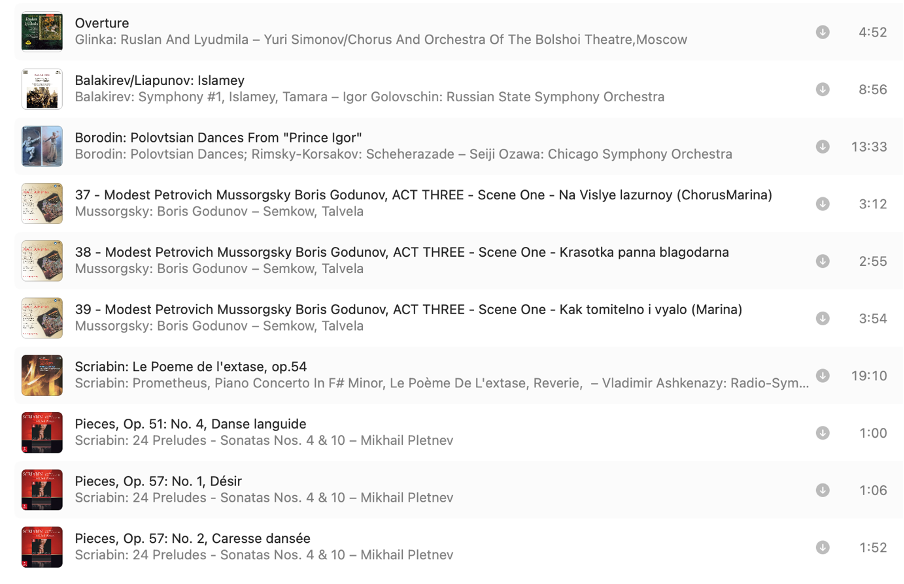
And of that music it is the Overture from Ruslan and Lyudmila from 1842 that is still frequently performed. With its energy and exuberance and at just 5 minutes it remains a perfect way to show off just how good your orchestra is. And the orchestra I’m going to play you is a pretty good one… and pretty familiar with the music. The Bolshoi Theatre has staged the opera over 700 times in the last 165 years. And Here is the Orchestra Of The Bolshoi Theatre conducted by Yuri Simonov with the Overture from Mikhail Glinka’s ‘Ruslan and Lyudmilla’.
A
That was the Orchestra Of The Bolshoi Theatre conducted by Yuri Simonov with the Overture from Mikhail Glinka’s ‘Ruslan and Lyudmilla’.
Now there is a writer whose work will hover in the background of a number of the compositions I’m going to play in this episode and that is Alexander Pushkin. His fairy tale poem from 1820 is the basis of Glinka’s ‘Ruslan and Lyudmilla’ and his story ‘The Queen of Spades’ and the poetic novel ‘Eugene Onegin’ were both turned into operas by Tchaikovsky. For me, if there is one black mark against his name it is that he took 30 years of Viennese rumour-mongering and was the first person to dramatize the ‘Salieri poisoned Mozart’ story in a one act play. Though Pushkin was not to know that Peter Schaffer’s play Amadeus and the subsequent film would popularise the idea for our time.
Ok. Mily Balakirev is not much known these days. Well maybe the name but not so much his music. In piano circles he is perhaps remembered as the composer of what was in its day regarded as if not the hardest piano piece to play then at least one of them. He called it ‘Islamey’ which was the title of a song played to him when he was visiting Circassia on the north-eastern shore of the Black Sea. He wrote it in 1869. Now at the risk of annoying pianists I am going to opt for a version for orchestra that was made in 1912 by Sergei Lyapunov who was a younger colleague of Balakirev’s. I’d never heard this until I started listening for this episode and it is I think a compelling example of great Russian music.
It’s about nine minutes long and about two and a half minutes in is the ‘Islamey’ melody. Which is pretty beautiful. Here is Igor Golovschin conducting the Russian State Symphony Orchestra. Balakirev’s ‘Islamey’ orchestrated by Lyapunov.
B
That was Igor Golovschin conducting the Russian State Symphony Orchestra with Mily Balakirev’s ‘Islamey’ orchestrated by Sergei Lyapunov.
It’s fun stumbling across odd bits of biography putting these shows together and when I was reading about Mikhail Glinka whose work began this episode I discovered that as a young man from a wealthy family he took a job to basically please his father and was for a while… an Assistant Secretary of the Department of Public Highways.
Whilst Glinka apparently didn’t take his ‘day job’ that seriously the next composer in today’s show, Alexander Borodin, did. His scientific research and teaching duties as an Adjunct Professor of Chemistry in the Medico-Surgical Academy at St. Petersburg are the main reasons that he took so long to compose his music and probably why he never finished his opera Prince Igor which he started in 1869 and was completed after his death in 1887 by his friends Rimsky-Korsakov and Glazunov.
Prince Igor is set in the year 1185 and follows real events and historical figures in what is now Eastern Ukraine. Prince Igor and his army set out to battle the neighbouring Polovtsian tribes despite the bad omen of an eclipse at the start of their campaign. And the expedition went badly wrong. Igor and his son were captured by the Khan of the Polovtsians and held for two years.
In the opera at the end of the 2nd act the Khan has decided that Prince Igor is not just any old prisoner but an honourable man who should be treated more as a guest and so he summons his courtiers and his slaves and a series of dances ensue. In the opera there are some chorus bits mixed with the dancing but a version exists for concert performance without the singing and this is the one I want to play you.
This is Seiji Ozawa conducting the Chicago Symphony Orchestra in a pretty spectacular recording of Alexander Borodin’s ‘Polovtsian Dances’ from his opera Prince Igor. It is about 13 minutes long.
C
That was Seiji Ozawa conducting the Chicago Symphony Orchestra with Alexander Borodin’s ‘Polovtsian Dances’ from his opera Prince Igor. Incidentally if you want to watch a pretty spectacular video of the dances, I’ll put a link to a Bolshoi Ballet production on this episode’s page at www.classicalforeveryone.net
Ok. I hope you are enjoying this ‘The Other Russians’ show. Modest Mussorgsky’s suite for Piano called ‘Pictures At An Exhibition’ in a version orchestrated by Maurice Ravel has kept the composers name alive. But I have played some of it in the past as well as his ‘Night On Bald Mountain’ used in the Disney film ‘Fantasia’. So what I have for you is a section from his opera ‘Boris Godunov’.
I’ve played excerpts from two operas with no actual singing and the time has come to rectify that and mention in passing again Russian dynastic politics and the writer Alexander Pushkin.
Whilst in exile between 1824 and 1826 for his provocative liberalism and other misbehaviours Pushkin wrote a play in blank verse about the rise and fall of the 17th century figure Boris Godunov who became Tsar briefly during what is known as the Time of Troubles. Pushkin’s play never explicitly says that Boris has used the murder of his rival for the throne to become Tsar or to maintain his rule, but his own paranoid responses to guilt and complicity in a murderous court of vicious intrigues drive the play.
When Mussorgsky wrote the libretto for the opera he left out one of Pushkin’s great characters… the scheming Polish noblewoman Marina… who will pretty much do anything to become the wife of a Tsar.
But then once the opera was finished the Imperial Theatre refused to stage it and one of the reasons was that there wasn’t a decent role for a woman singer… for a prima donna.
So, in the revised version completed in 1872, the character of Marina is added and at the beginning of Act III she has a scene with her ladies in waiting fussing around her singing a conventionally pretty tune. Marina cuts them off and sings of her boredom with all the superficialities of her world and declares her burning ambition for more.
Here is that scene. It is about nine minutes long. The Polish National Radio Symphony Orchestra is conducted by Jerzy Semkow and Bożena Kinasz sings Marina. Modest Mussorgsky’s ‘Boris Godunov’.
D
That was the Polish National Radio Symphony Orchestra conducted by Jerzy Semkow with Bożena Kinasz singing Marina’s Act III aria from Modest Mussorgsky’s opera ‘Boris Gounov’.
My name is Peter Cudlipp and you are listening to the ‘Classical for Everyone’ Podcast. I have another couple of pieces coming up but before I get to them I want to give you a little information that I hope you find useful… If you would like to listen to past episodes or get details of the music I’ve played please head to the website classicalforeveryone.net. That address again is classicalforeveryone.net. On the individual episode pages of the website there are links to Spotify playlists with the full versions of most of the music played in each of the episodes. I hope you are enjoying this ‘Other Russians’ episode of ‘Classical For Everyone’. And if you want to get in touch then you can email… info@classicalforeveryone.net.
Alright, to finish this episode I have something that I think connects the mid to late 19th century music I’ve been playing you with the new and, for some, challenging pathways music would take in the early 20th century. Without getting too technical, the piece I am going to play you, which is Alexander Scriabin’s ‘The Poem Of Ecstasy’ written between 1905 and 1908, is using harmonies… that is… the way notes are put together, the sorts of chords that melodies are based on and the way the music moves from one apparently stable ‘home’ to other unsettling areas… that would prefigure something of the volatility of much of the twentieth century.
And there is a connection between this musical instability and the increasing intellectual uncertainty of the age. Scriabin was a convert to the religion, though that’s not really the right word, maybe ‘belief system’, of Theosophy which had been founded in the US in the 1870s ironically by an expatriate Russian woman named Helena Blavatsky. Blavatsky had graduated from channelling the spirits of the dead to sharing ancient wisdom conveniently only revealed to her. Her book ‘The Secret Doctrine’ is 1,500 pages attempting, in the words of her subtitle, to synthesise ‘science, religion and philosophy’. Blending the esoteric and the occult, it had an extraordinary impact. Many intellectuals or perhaps a slice of the class of people with the economic wherewithal to take the time to ponder the meaning of their existence, were drawn to Theosophy and similar quasi-cults that sat well apart from traditional state-endorsed versions of Christianity.
For Scriabin, Theosophy was one of a number of passionate pursuits that inspired his music. Indeed in his later years his compositional output would slow as his belief that he had a central role to play in events that would fundamentally transform the spiritual lives of humanity came to dominate his life. But that was some years after his ‘Poem of Ecstasy’.
Please don’t let my digression get in the way of this quite remarkable piece of music which I would argue is a little unfairly neglected. And whilst Scriabin claims that the ecstasy he describes is essentially spiritual, music is of itself a physical action… soundwaves moving through air… so I can’t imagine that Scriabin was not conjuring a certain physical ecstasy as well.
Here is Vladimir Ashkenazy conducting the Radio Symphony Orchestra of Berlin with Alexander Scriabin’s The Poem of Ecstasy’. It is about 19 minutes long.
E
That was Vladimir Ashkenazy conducting the Radio Symphony Orchestra of Berlin with Alexander Scriabin’s The Poem of Ecstasy’. Thanks for your time and I look forward to playing you some more incredible music on the next ‘Classical For Everyone’. This podcast is made with Audacity Software for editing, Wikipedia for Research, Claude for Artificial Intelligence and the music played is licensed through AMCOS / APRA. Classical For Everyone is a production of Mending Wall Studios and began life thanks to the enthusiasm and encouragement of Mr Jeffrey Sanders.
And if you have listened to the credits… here is a little more music for you…Three very short pieces for solo piano by Scriabin. They are titled… Languid Dance, Desire and Dancing Caress. Playing them is Mikhail Pletnev. Thanks again for listening.
F