

 Apple Podcasts
 Spotify
 Amazon Music
 iHeartRadio
 Overcast
 PocketCasts
  RSS Feed
 The Oboe


Time for some music from one of the oldest instruments in the orchestra. True to the Old French word its English name came from… ‘hautbois’ with ‘haut’ meaning both high and loud and ‘bois’ meaning wood… the oboe found its place as the earliest woodwind instrument through its high range and penetrating volume. And whilst it can be piercing when required, it can also be playful, can manage a soaring lyricism and can epitomise grace and beauty. Music from Jennifer Higdon, Josef Haydn, Wolfgang Amadeus Mozart, Camille Saint-Säens, Richard Strauss, Samuel Barber, Ross Edwards and Antonio Vivaldi. Plus… musicians with knives.
And here is a link to a playlist on Spotify with the music from this episode:
https://open.spotify.com/playlist/6W1wKxHJ4TRaAJct4PVqXg?si=54001a5def8f4b4b
And here are links to the two YouTube videos about making the oboe’s double reeds:
Double Reed making with Jen Shark.
https://www.youtube.com/watch?v=gsxUsJZxYos&t=288s
The making of a historical double reed. Marcel Ponseele & Stefaan Verdegem.
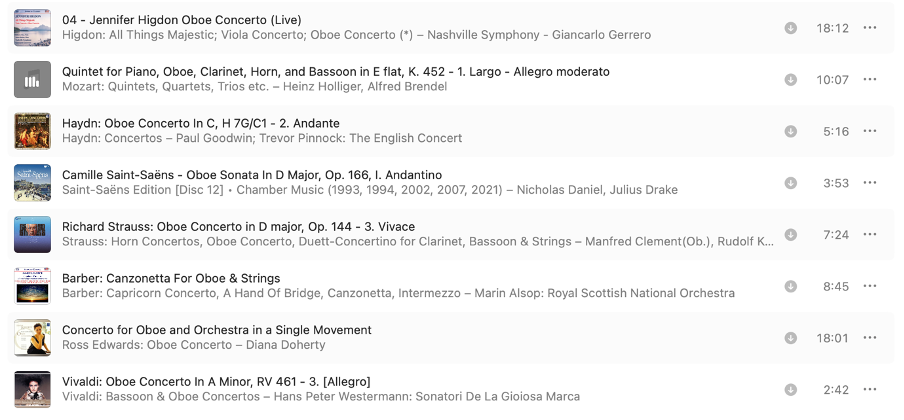
The Music
The Words
Hello everyone. Welcome to another episode of the ‘Classical For Everyone’ Podcast… five hundred years of incredible music. My name is Peter Cudlipp and… If you enjoy any music at all then I’m convinced you can enjoy classical music. All you need are ears. No expertise is necessary. If you’ve ever been curious about classical music… or explored it for a while once upon a time… or just quietly wondered what all the fuss was about… then this is the podcast for you.
And because there’s a lot of music out there each episode has something of a theme. And for this one it is… music written for the oboe. Music by Jennifer Higdon, Josef Haydn, Wolfgang Amadeus Mozart, Camille Saint-Säens, Richard Strauss, Samuel Barber and Ross Edwards.
I’ll weave in a little bit about the instrument itself a little later in the show but now from 2005 here is Jennifer Higdon’s Oboe Concerto. There are a few concertos or excerpts from concertos in the show and most of the composers use the term concerto to describe… ‘a work for one or more solo instruments accompanied by an orchestra, built around the interplay between the soloist's individual voice and the collective weight of the ensemble. The tension between those two forces — intimacy against mass, agility against power — is the engine that drives the form.’
Here is the oboist James Button and the Nashville Symphony Orchestra conducted by Giancarlo Guerrero with Jennifer Higdon’s Oboe Concerto. It is about 18 minutes long and I’ll let the composer introduce the work…
“My oboe concerto gives the instrument a chance to highlight its extraordinary lyrical gift. The beauty of the soaring line intrigued me as a starting point, and then the realization that the oboe makes a great partner for duets within an orchestral texture sent me in the direction of creating interactions with other instruments in the supporting ensemble. This instrument’s playful quality in quick-moving passages set the tone for the faster sections. I have always thought of the oboe as being a most majestic instrument, and it was a pleasure to be able to create a work that would highlight its beauty and grace.”
A
That was the oboist James Button and the Nashville Symphony Orchestra conducted by Giancarlo Guerrero with Jennifer Higdon’s Oboe Concerto.
The oboe was the first woodwind instrument to become a standard independent colour of the orchestra. Its volume, rich timbre, seductive lyricism, and technical agility made it the leading wind instrument from the mid 1700s. The name oboe is a transliteration of a French word for older versions of the instrument…. Hautbois… spelt ‘H A U T B O I S… Literally ‘high/loud wood’ meaning a loud wooden instrument with a high range. Hautbois became oboe. Whilst this episode will largely feature music where the oboe is the dominant instrument I want to play you a little bit of Mozart which shows off how well the oboe integrates with a small group of instruments as a sort of equal partner in the conversation.
This is the opening section of Mozart’s “Quintet for Piano, Oboe, Clarinet, Horn, and Bassoon” It was written in 1784; is about ten minutes long and the players here are Heinz Holliger oboe, Alfred Brendel, piano Eduard Brunner — clarinet
B
That was the opening section of Mozart’s “Quintet for Piano, Oboe, Clarinet, Horn, and Bassoon” from 1784 and the players were Heinz Holliger oboe, Alfred Brendel, piano Eduard Brunner — clarinet
Next is the 5 minute slow section from an oboe concerto written maybe 4 years after the Mozart by maybe Josef Haydn. With not even academic confidence about who wrote the work there is little more to say other than here is The English Concert directed by Trevor Pinnock and the oboe is played by Paul Goodwin… and that I hope you enjoy it.
C
That was the slow section from an oboe concerto written by maybe Josef Haydn. The English Concert was directed by Trevor Pinnock and the oboe was played by Paul Goodwin
Next up is the opening four minute section of a work from the French composer Camile Saint-Säens that he wrote in 1921 for piano and oboe. Saint-Saens was deliberately addressing what he saw as a lack of modern repertoire for the oboe. He actually wanted to write music for each of the wind instruments but did not live long enough to do so and there is no record of this work being performed before his death.
Here is the Andantino from Camille Saint-Saens Oboe Sonata. Nicholas Daniel plays the oboe and Julius Drake accompanies him on the piano.
D
That was the Andantino from Camille Saint-Saens Oboe Sonata. Nicholas Daniel played the oboe and Julius Drake accompanied him on the piano.
Whilst researching this show I was trying to get some detail about the mechanics of what makes the oboe’s distinctive sound and I kept coming back to the ‘double reed’. Now like the clarinet and the saxophone the mouthpiece of the oboe includes a very thin slice of wood, a relative of bamboo cane, that the breath passes through; the vibration of which is the first part of a process of making a musical note.
Now the quirk of the oboe as it has evolved is that it uses two of these slices of cane joined together with a tiny gap between them… hence the term the ‘double reed’. Now the process of making this double reed is such a specific skill and the nuances of the outcome are so critical to the sound of each instrument… that the players generally make the double reeds themselves. On the episode page on the podcast’s website, classicalforeveryone.net, I'll link to a couple of YouTube videos if you are interested. Which I hope you might be. But suffice to say… this is an absurdly complicated piece of woodworking. With very special tools requiring exquisite craftspersonship to get a good result. As a comparison I am tempted to ask you to imagine that every professional football player has to make their own boots. And on one of the videos the oboist Jen Shark explains that the double reed often needs very subtle adjustment during performances and she says something like… Oboists are the ones on stage with knives.
Ok. Some more music. I’ll tell you the quite special story of the work’s genesis after I’ve played you this excerpt. Here is the third and concluding section of Richard Strauss Oboe Concerto written in 1945. Manfred Clement is the oboist and Rudolf Kempe conducts the Stadtskapelle Dresden… the State Orchestra of Dresden.
E
That was the third and concluding section of Richard Strauss Oboe Concerto. Manfred Clement was the oboist and Rudolf Kempe conducted the Stadtskapelle Dresden… the State Orchestra of Dresden.
Richard Strauss’s life and prominence spanned the end of the 19th century and the 1st half of the 20th. After World War II he had something of an Indian summer of creative output… much of it carrying a sombre sense of the world that had been lost… a world he had been central to… in that horrific conflagration. I hope you would agree that the oboe music I played was not characterised by that. But its origin was connected… Here’s Wikipedia:
American oboist John de Lancie was a corporal in the U.S. Army unit which secured the area round the Bavarian town of Garmisch where Richard Strauss was living in April 1945, in the closing days of World War II.[2] As principal oboist of the Pittsburgh Orchestra in civilian life, de Lancie knew Strauss's orchestral writing for oboe thoroughly, visited the composer in his home, and in the course of a long conversation asked him if he had ever considered writing an oboe concerto. Strauss answered simply "No", and the topic was dropped.
But some years later de Lancie was astonished to discover that an oboe concerto had been written and the US premiere rights had been assigned to him by Strauss.
Ok, by some strange accident the next piece of music came at the end of another composer’s life. In 1981 the American composer Samuel Barber started writing an oboe concerto. But as the cancer that would end his life later that year took more and more of a toll, he put the project aside. After his death his student and friend Charles Turner took the oboe line Barber had written and orchestrated it calling it the Canzonetta for Oboe and Strings. I hadn’t heard this until I put this show together. I think it is quite beautiful. It reminds me of the phrase Jennifer Higdon used for the oboe… ‘beauty and grace’.
This is Marin Alsop conducting the Royal National Scottish Orchestra with the oboe played by Stéphane Roncourt. It is about nine minutes long.
F
That was Marin Alsop conducting the Royal National Scottish Orchestra with the oboe played by Stéphane Roncourt with Samuel Barber’s Canzonetta for Oboe and Strings orchestrated by Andrew Turner.
My name is Peter Cudlipp and you have been listening to the ‘Classical for Everyone’ Podcast. I have another couple of pieces coming up but before I get to them I want to give you a little information that I hope you find useful… If you would like to listen to past episodes or get details of the music I’ve played please head to the website classicalforeveryone.net. That address again is classicalforeveryone.net. On the individual episode pages of the website there are links to Spotify playlists with the full versions of most of the music played in each of the episodes. I hope you have enjoyed this oboe focused episode of ‘Classical For Everyone’. And if you want to get in touch then you can email… info@classicalforeveryone.net.
Alright, to finish this episode I have a personal favourite. In 2002 Australian composer Ross Edwards was commissioned to write a concerto for oboe and orchestra. He gave it the title Bird Spirit Dreaming and the composition reflects Edwards’ engagement with the natural world using birdsong as an inspiration for some of the passages of solo writing for the oboe and using much of his distinctive musical language that evokes the Australian bush. Perhaps more importantly it is a dazzlingly virtuosic part for the oboe and there are sections of overtly romantic and joyous music in the piece.
So here is Ross Edwards’ Oboe Concerto called ‘Bird Spirit Dreaming’ It is in three parts and is 19 minutes long. And this performance is by the oboist Diana Doherty… to whom the work is dedicated… the Melbourne Symphony Orchestra and the conductor Arvo Volmer.
G
That was Ross Edwards – Oboe Concerto. the oboist was Diana Doherty… to whom the work was dedicated… the Melbourne Symphony Orchestra was conducted by Arvo Volmer.
Thanks for your time and I look forward to playing you some more incredible music on the next ‘Classical For Everyone’. This podcast is made with Audacity Software for editing, Wikipedia for Research, Claude for Artificial Intelligence and the music played is licensed through AMCOS / APRA. Classical For Everyone is a production of Mending Wall Studios and began life thanks to the enthusiasm and encouragement of Mr Jeffrey Sanders.
And if you have listened to the credits… here is a little more oboe music for you… This is a few minutes from Antonio Vivaldi’s Oboe Concerto with the catalogue number RV 461. Hans Peter Westermann lays the oboe with the Sonatori De La Gioiosa Marca
Thanks again for listening.
H