


The Music of Philip Glass


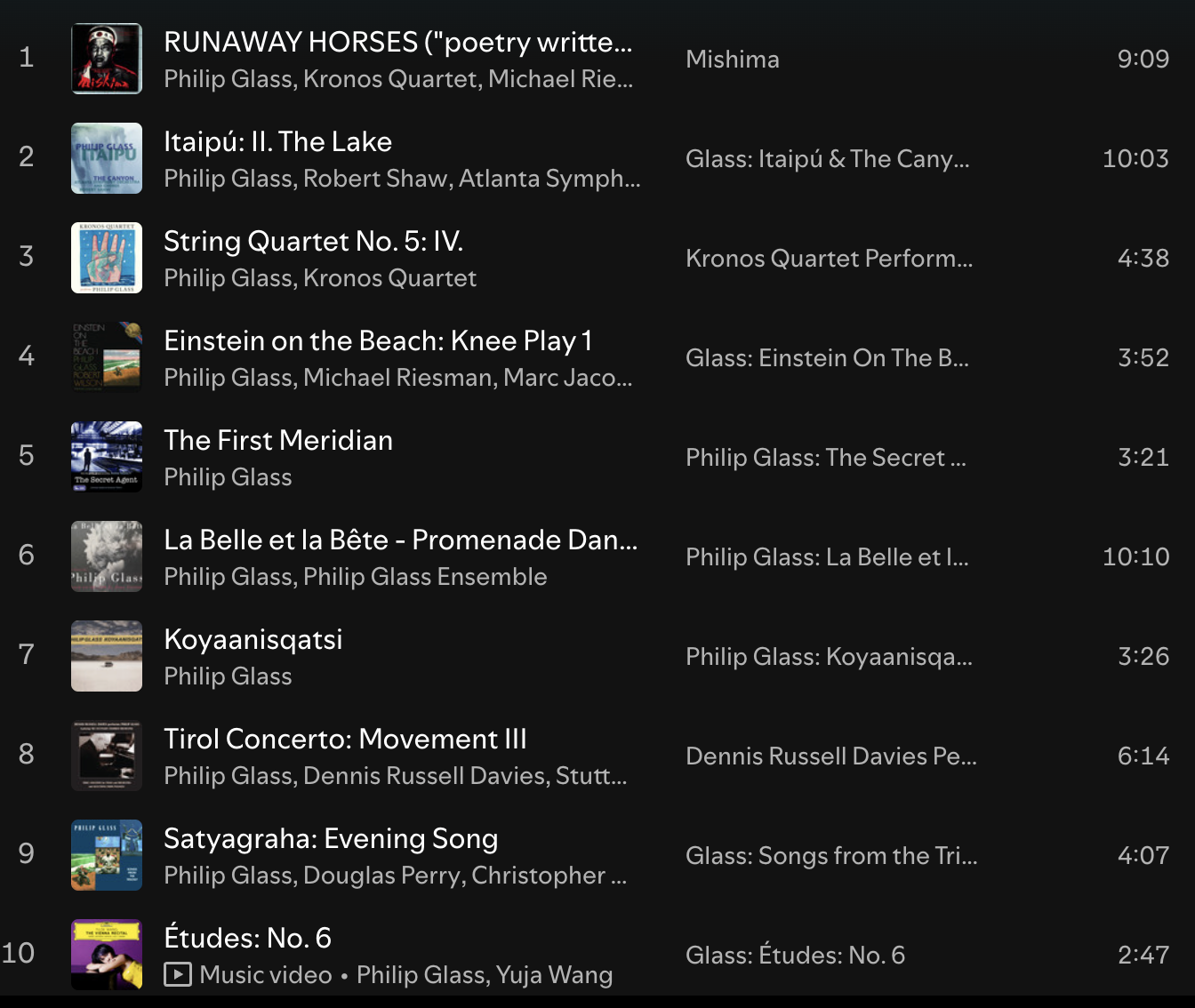
On the day this episode is released, the American composer Philip Glass celebrates his 89th birthday. In a career now lasting well over five decades he has somehow achieved two extraordinarily rare things for a contemporary composer of classical music... a prolific amount of creative output and a degree of broad popularity. For the next hour and a quarter please enjoy a quick survey of five decades of great music… films, operas, concertos, quartets… and an unfairly small section of solo piano music. Happy Birthday!
And here is a link to a playlist on Spotify with the music from this episode:
https://open.spotify.com/playlist/4hao5b3YrEMAcGQ7MBTE39?si=48c5532e3cfd4c71
The Music
The Words
Hello everyone. Welcome to another episode of the ‘Classical For Everyone’ Podcast… five hundred years of incredible music. My name is Peter Cudlipp and… If you enjoy any music at all then I’m convinced you can enjoy classical music. All you need are ears. No expertise is necessary. If you’ve ever been curious about classical music… or explored it for a while once upon a time… or just quietly wondered what all the fuss was about… then this is the podcast for you. And because there’s a lot of music out there each episode has something of a theme. And for this one it is… the music of the American composer Philip Glass… who as this episode is being released will be celebrating his 89th birthday.
In a career now lasting well over five decades he has somehow achieved two extraordinarily rare things for a contemporary composer of classical music... a prolific amount of creative output and a degree of broad popularity. I’ve played a reasonable amount of his music over this first year of the Classical For Everyone podcast and I am going to avoid repeating myself but if you enjoy this episode I’d recommend you listen to the Sunday Night Special from last November which was his entire ‘Low’ Symphony. I’ll give you a little biography as we go but first want to get to some music
And appropriately, this might have been amongst the first Philip Glass music I heard. Like most 20th century composers, opportunities came to Glass with work writing the music for movies.
In 1985 Paul Shrader co-wrote and directed a stylised film biography of the troubled Japanese writer Yukio Mishima. Philip Glass had written music for documentaries and experimental short films but this was the first time he wrote to support dramatic action and character development.
Here is the section called ‘Runaway Horses’ which has the subtitle of ‘poetry written with a splash of blood’. It is conducted by Michael Riesman and is about 9 minutes long.
A
That was the section called ‘Runaway Horses’ from Philip Glass’s score for the film ‘Mishima’ and it was conducted by Michael Riesman.
Ok. A bit of biography. Philip Glass was born in Baltimore, Maryland in 1937, growing up in a household steeped in music—his father owned a record store and brought home unsold records for the family to explore. He showed early promise as a flutist and enrolled at the University of Chicago at just fifteen years old, studying mathematics and philosophy, graduating in 1956.
He continued his musical education at the Juilliard School in New York… but found himself increasingly dissatisfied with the prevailing modernist approaches of composers. He went to Paris in 1964, where he studied with Nadia Boulanger—an experience he would later describe as profoundly influential throughout his life, grounding him in the music of Bach and Mozart.
A turning point in Glass's artistic development came through his encounter with Indian sitar player Ravi Shankar in Paris. This meeting led Glass to temporarily abandon traditional Western concepts of harmony, tempo, and melody, instead exploring the extended repetition of brief melodic fragments and additive rhythmic processes. I think you’ll hear how these remain integral to Glass’s work.
Alright… so whilst Glass has been prolific in symphonies, 15 so far, and stage works, between 20 and 30 depending on how you define them, he has not done that much for chorus and orchestra. But in 1989 for a commission from the Atlanta Symphony Orchestra and inspired by his visit to the Itaipu Dam on the Paraná River between Brazil and Paraguay, Glass wrote what he called a symphonic cantata and named it after the dam.
Its four sections trace the journey of the Paraná River's waters from their source through the dam and on to the ocean. The text is from a creation myth in the indigenous Guarani language and I think it is fair to say Glass is more interesting in the musical effect of the voices than the meaning of the words.
I’m going to play you the section called ‘The Lake’. It’s about ten minutes long and this is for my friend David Otis, one of the most interesting men in the world, who sang in Itaipú’s New York premiere and told me about the work.
Here is the Atlanta Symphony Orchestra conducted by Robert Shaw.
B
That was ‘The Lake’ from the symphonic cantata ‘Itaipú’ (ee-tie-POO) by Philip Glass and the Atlanta Symphony Orchestra was conducted by Robert Shaw. Glass's String Quartet No. 5 was composed in 1991 and represented a shift in his approach to the genre—Before writing it, he reflected on the idea that it is with string quartets, (music for two violins, a viola and a cello), that composers are at their most profoundly and personally expressive. He said “that’s no less true for me… It’s almost as if we say we’re going to write a string quartet, we take a deep breath, and we wade in to try to write the most serious, significant piece that we can.’ …but that he had with his 5th string quartet "really gone beyond the need to write a serious string quartet and that I could write a quartet that is about musicality, which in a certain way is the most serious subject."
This more relaxed attitude resulted in his longest and his most romantically expressive quartet to that point. Here is the fourth section. It is about 4 minutes long and is played here by the Kronos Quartet.
C
That was the fourth section of the fifth string quartet by Philip Glass played by the Kronos Quartet.
The next piece I want to play you is from Glass’s 1976 opera ‘Einstein On The Beach’ which he co-created with the writer / director Robert Wilson. But I want to give you a little more biography first. Glass returned to New York from Europe in 1967, he formed the Philip Glass Ensemble— musicians playing amplified keyboards and woodwinds fed through a mixer—and began developing what would eventually be dubbed "minimalism," though Glass himself rejected the term, preferring to describe his work as "music with repetitive structures." His early pieces were performed at venues like the Whitney Museum and the Guggenheim, often encountering hostile critical reception but generating enthusiasm among younger artists. But it was ‘Einstein on the Beach’ which took his career to another level. It was and to an extent remains a cultural phenomenon. That said, through this period and for some years that followed Glass worked at a series of part-time jobs including plumbing, furniture removals and taxi driving to support his life as a composer. In fact I remember listening to a radio interview where he said that once a passenger riding in his cab had seen his ID plate and asked him if he knew he had the same name as the famous composer.
So, Einstein On The Beach. Wilson and Glass deliberately abandoned conventional narrative in favour of structured visual and musical spaces exploring Einstein as a cultural icon rather than biographical figure. Recurring images—a train, a courtroom, and a spaceship—allude to relativity, nuclear weapons, and space-time, With a libretto of chanted syllables, numbers, and poetry fragments, the opera invites audiences to construct their own meanings. A violinist, onstage and dressed as Einstein throughout, serves as the only really tangible element of the work.
Here is just four minutes from the four hour opera. This is the section called Knee Play 1 from Einstein on the Beach. Michael Riesman conducts the Philip Glass Ensemble and the lead voices are Lucinda Childs and Cheryl Sutton.
D
That was Knee Play 1 from Einstein on the Beach. Michael Riesman conducted the Philip Glass Ensemble and the lead voices are Lucinda Childs and Cheryl Sutton.
I hope you are enjoying this Philip Glass episode of ‘Classical For Everyone’. I mentioned his productivity and popularity at the start of the show. I want to make a quick comment about the impact of this. I think in terms of Glass reputation they have been a mixed blessing. What do I mean? Well, if I can define the ‘classical music establishment’ as the critics, the academics and the heads of artistic programming for orchestras; then I have a very strong feeling that these groups all suffer from three deeply flawed assumptions and they are one ‘new art should be difficult’; two ‘the quality of an artist’s work is the inverse of the quantity of production’ and three ‘success in an artist’s lifetime is a sign of mediocrity’. From these curators, gate-keepers and tastemakers, in their ranking of ‘important’ composers of modern classical music, you will hear names like Schoenberg, Berio, Stockhausen and Boulez extolled far above that of Philip Glass. And that’s not to dismiss works that can be extremely challenging and even confronting but in the words of my AI pal Claude, “when difficulty becomes the primary measure of worth, something's gone wrong."
So, to wrap up this digression, if some of you have this slight sense that the music of Philip Glass is just not quite in the very first rank, then I wonder if the quietly contagious and, to be fair, perhaps unintended snobbery of the music establishment might be to blame.
Ok. In Joseph Conrad’s 1907 novel, The Secret Agent, anarchists wanting to attack global time, order and civilization; target the Royal Observatory at Greenwich in the UK through which runs the first meridian of longitude… the starting point for all global navigation. And ‘The First Meridian’ is the name of the section of Philip Glass’s soundtrack for Christopher Hampton’s 1996 film of the novel I am going to play next. It is about three minutes long and, by the way if you want music to accompany dancers on top of European furniture then this works very well. Here is Harry Rabinowitz conducting the English Chamber Orchestra.
E
That was Harry Rabinowitz conducting the English Chamber Orchestra with ‘The First Meridian’ from the soundtrack to the film ‘The Secret Agent’.
With ‘The Beauty and the Beast’ from the mid 1990s Philip Glass combined his film music and his concert music in a very special way. It was one of three stage works that were based on the films of the Frenchman Jean Cocteau. But this one was the most technically complex and ambitious. Glass had the idea of screening Cocteau’s 1946 film ‘La Belle et la Bête’ live but removing the original soundtrack including the voices of the actors.. and replacing it with his own music and the voices of his singers performing alongside the film.
In order to perfectly match the singing with the movements of the actors' lips on the screen in the original film, he transcribed all the lines of dialogue and precisely located them in his score and then wrote each word of the sung melodies to fit this template. There are a few short clips floating around on the internet and from them you can maybe get a hint of how well this works.
Of course you would need to see this live to get any sense of its power but I hope the music I am going to play will be a little compensation.
One of the many magical properties of Cocteau’s film of the fairytale is the slow building of Belle’s love for the Beast and this change is perhaps best shown in the scene where they walk together through the Beast’s garden. And this is the section from Glass’s music for ‘La Belle et la Bête’ I’ve chosen. It is sung in French but I don’t think that is too much of a barrier to getting the sense of the blossoming of love. I hope you enjoy this very beautiful music.
It is about ten minutes long and here are the singers Janice Felty and Gregory Purnhagen with Michael Riesman conducting the Philip Glass Ensemble. ‘Promenade dans le jardin’, ‘The walk in the Garden’ from ‘La Belle et la Bête’, Beauty and the Beast by Philip Glass.
F
That was ‘The Stroll In The Garden’ from Philip Glass music for his operatic adaptation of Jean Cocteau’s film ‘Beauty and the Beast’ with the singers Janice Felty and Gregory Purnhagen and Michael Riesman conducting the Philip Glass Ensemble.
Ok. One more piece of Glass music for the silver screen. In researching this show I stumbled across an interview with Glass and the filmmaker and social activist Godfrey Reggio. In his early work Reggio warned against the power of technology being used for the surveillance and manipulation of the population at large. If that seems a relevant theme today… he did this in the 1970s. Half a century ago. Maybe we should have been paying more attention.
In the 1980’s in his trilogy of films with music by Philip Glass, Reggio used non-narrative documentary imagery without any dialogue to build slow hypnotic montages contrasting the built world with the natural world. He argued that he wanted audiences to reach their own conclusions but it was hard not to miss the idea that we damage and lose connection with the natural world at our peril. I think even the very stoned people in the Valhalla cinema in Sydney where I first saw the films probably got that message. Here is the opening four minutes of Glass’s music from the best known of the three films… ‘Koyaanisqatsi’ which is a native American word meaning ‘Life Out Of Balance’. And this is the Philip Glass Ensemble.
G
That was the opening four minutes of Glass’s music from the film ‘Koyaanisqatsi’, a native American word meaning ‘Life Out Of Balance’. The Philip Glass Ensemble was conducted by Michael Riesman.
Now maybe something with a little more bounce. Since the early 2000s Glass has written a number of concertos for various solo instruments and orchestras. One of his most engaging and actually a little out of character has come to be known as his ‘Tirol’ concerto for piano and strings… the name coming from the Tyrol region of Southern Austria and it was their tourist board, of all people, who commissioned the work. Glass studied the region’s traditional folk music and incorporated some melodies from it into his music. Here is the pianist and conductor Dennis Russell Davies with the Stuttgart Chamber Orchestra. With the third and final section of the Tirol concerto by Philip Glass. It is about 6 minutes long.
H
That was the pianist and conductor Dennis Russell Davies with the Stuttgart Chamber Orchestra performing the third and final section of the Tirol concerto by Philip Glass.
I think one can say that Glass does not shy away from big ideas with his operas. Satyagraha, which literally means ‘truth force’ is a word created by Mahatma Ghandi to describe the principles of non-violent protest and an ethical lifestyle.
In his opera ‘Satyagraha’ which Glass describes as ‘semi-narrative’, he deals with Mahatma Gandhi’s early years in South Africa and his development of non-violent protest into a political tool. He also incorporates Leo Tolstoy and Martin Luther King as characters. The libretto, co-written by Glass and Constance DeJong, is in Sanskrit, the language Ghandi used to create the word ‘satyagraha’. This is ‘Evening Song’ from Act III of the opera where Ghandi is quoting Lord Krishna from the Bhagavad Gita explaining that he will return whenever righteousness is threatened. Douglas Perry sings Ghandi and Christopher Keene conducts the New York City Opera Orchestra. ‘Satyagraha’ by Philip Glass.
I
That was Douglas Perry singing Ghandi and Christopher Keene conducting the New York City Opera Orchestra with ‘Evening Song’ from ‘Satyagraha’ by Philip Glass.
My name is Peter Cudlipp and you have been listening to the ‘Classical for Everyone’ Podcast. If you would like to listen to past episodes or get details of the music I’ve played please head to the website classicalforeveryone.net. That address again is classicalforeveryone.net. And on the individual episode pages of the website there are links to Spotify playlists with the full versions of most of the music played in each of the episodes.
I hope you have enjoyed this Philip Glass focused episode of ‘Classical For Everyone’. And if you want to get in touch then you can email… info@classicalforeveryone.net.
This podcast is made with Audacity Software for editing, Wikipedia for Research, Claude for Artificial Intelligence and Apple, Sennheiser, Sony, Rode and Logitech for hardware… The music played is licensed through AMCOS / APRA. Classical For Everyone is a production of Mending Wall Studios and began life on Radio 2BBB in Bellingen NSW, Australia thanks to the late, great Mr Jeffrey Sanders. The producers do not receive any gifts or support of any kind from any organisation or individual mentioned in the show. But, never say never.
And if you have listened to the credits… here is a little more music. I’ve played this once before but it is just too good not to include. And it is only three minutes of solo piano. With a curiously abrupt ending. Here is Yuja Wang with the ‘Etude’ or ‘Study’ No. 6 by Philip Glass. Thanks for your time and I look forward to playing you some more incredible music on the next ‘Classical For Everyone’.
J