



The Clarinet... Masters and Masterworks.




An episode back in late May 2025 featured music written for the clarinet from the 20th century. This is a companion show goes back to close to the invention of the clarinet with a work from 1755 and then finishes up with a gem from 1894. Music from Johann Stamitz, Wolfgang Amadeus Mozart, Ludwig van Beethoven, Carl Maria von Weber and Johannes Brahms. My AI friend Claude came up with the title of the episode and I hope you find ‘The Clarinet... Masters and Masterworks’ a pretty accurate description.
And here is a link to a playlist on Spotify with full versions of the music excerpted in this episode:
https://open.spotify.com/playlist/7K3thDVhvXoqzOf4U5YTWP?si=7180a421aabf4b8b
The Music
The Words
Hello everyone. Welcome to another episode of the ‘Classical For Everyone’ Podcast… five hundred years of incredible music. My name is Peter Cudlipp and… If you enjoy any music at all then I’m convinced you can enjoy classical music. All you need are ears. No expertise is necessary. If you’ve ever been curious about classical music… or explored it for a while once upon a time… or just quietly wondered what all the fuss was about… then this is the podcast is for you.
And because there’s a lot of music out there each episode has something of a theme. And for this one it is… the clarinet. Now I did an episode back in late May featuring music written for the clarinet in the 20th century. This is a sort of companion show goes back to close to the invention of the clarinet with a work from 1755 and then finishes up with a gem from 1894. I have got music from Johann Stamitz, Wolfgang Amadeus Mozart, Ludwig van Beethoven, Carl Maria von Weber and Johannes Brahms. My AI friend Claude came up with the title of the episode and I hope you find ‘The Clarinet... Masters and Masterworks’ a pretty accurate description. I’m confident there will be some great music to enjoy.
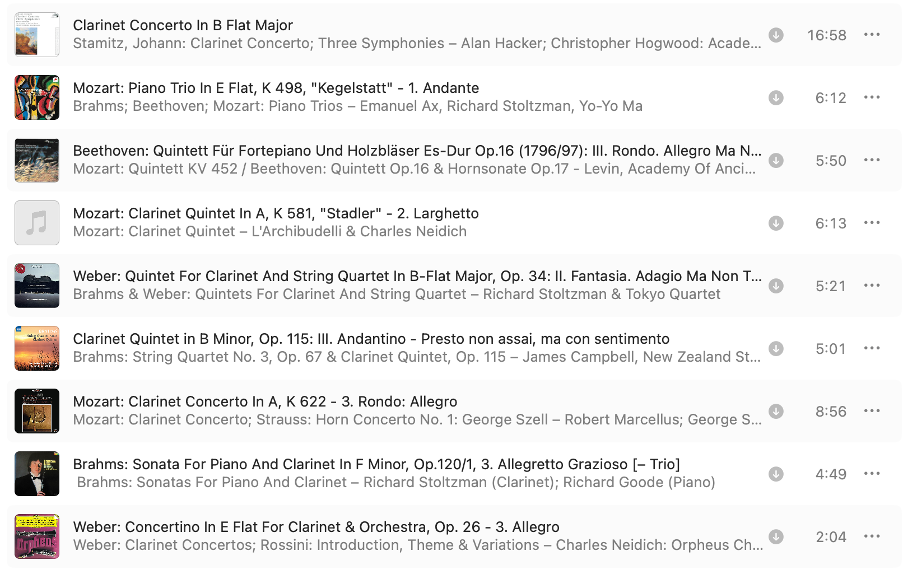
First up is the final section of Johann Stamitz’ clarinet concerto from around 1755. I’ll tell you a little more about Stamitz and the piece in about five minutes. Here is the clarinettist Alan Hacker and the Academy of Ancient Music led by Christopher Hogwood.
A
That was the clarinettist Alan Hacker and the Academy of Ancient Music led by Christopher Hogwood with the concluding section of Johann Stamitz’ clarinet concerto from around 1755. Which was probably the earliest concerto written for the clarinet.
Now Stamitz is actually better known as a prolific writer of early symphonies and his style and compositional devices, which have been given the name ‘the Mannheim school’ from the court where Stamitz was employed, was highly influential on the later and better known composers Haydn and Mozart.
So at the time Stamitz was at Manheim, the clarinet was quite a new instrument on the scene. It had evolved from a recorder-like instrument called a ‘chalameau’ and this is one of those rare instances where the key innovations can be traced to one particular family. Over about a forty year period from the late 1600s Johann Christoph Denner and then his son Jacob, instrument makers in Nuremburg, added mechanical features to give the chalameau a bigger range… to allow it to play more notes.
Now, the note played by a cylindrical instrument depends on the length of the vibrating air column: a longer column produces a lower note, while a shorter column produces a higher note. A player changes the pitch by opening and closing finger holes along the instrument's body. When a hole is opened, it effectively shortens the air column by allowing air to escape at that point, making the note higher. Close all the holes and you get the lowest notes; open more holes moving up the instrument and the notes get progressively higher. The Denner family added more holes and experimented with adding keys, which are metal levers that reached additional holes in places on the body of the instrument that were awkward for the players’ fingers to reach on their own. And by the middle of the 1700’s the clarinet had kind of stabilised though there would continue to be changes. And the name came from the Italian words ‘clarino’ and ‘clarinetto’ both alluding to an imagined similarity to the sound of a small trumpet.
Ok. A bit more music. I’ve played you part of this in previous episodes but not this bit. Here’s the opening section of Mozart’s Trio for Clarinet, Viola and Piano from 1786, known by its nickname ‘Kegelstatt’… given to it because people thought Mozart whipped it up whilst playing a popular Viennese version of ten-pin bowling… ‘Kegel’ being German for ‘Pins’. Turns out the musicologists had the wrong piece. But the name stuck. The first clarinettist who played the piece was Mozart’s friend Anton Stadler who was really the leading virtuoso of the time. Someone you could call a ‘master’ if you were linking the narrative back to the title of this episode. But that term will equally apply to the remarkable selection of clarinettists I’m featuring in this episode, including the next one, the American Richard Stoltzman. Here he is joined by the pianist Emmanuel Ax and the viola part is in fact played on a cello… by Yo-Yo Ma. The opening 6 minute section of Mozart’s ‘Kegelstatt’ Trio.
B
That was the opening section of Wolfgang Amadeus Mozart’s ‘Kegelstatt’ Trio. The performers were… clarinet - Richrd Stoltzman, cello - Yo-Yo Ma and piano - Emmanuel Ax.
Ten years after that piece was written a 26 year old composer starting to make a name for himself in Vienna, Ludwig van Beethoven, wrote a quintet for woodwind instruments (that is oboe, clarinet, bassoon and horn) and piano. I’m going to play the third section. It is about six minutes long. The performers are… Antony Pay - clarinet, Frank De Bruine – oboe, Danny Bond - bassoon, Anthony Halstead - horn, and Robert Levin – Piano. Although to be more accurate Levin is playing the fortepiano a slightly earlier version of the modern piano. In fact all these musicians are playing instruments essentially identical to those that Beethoven would have written for. So apart from being some lovely performances this recording has the added benefit of recreating the sound world of 1796.
C
That was Beethoven’s 1796 Quintet for Woodwind Instruments and Piano and the players were Antony Pay - clarinet, Frank De Bruine – oboe, Danny Bond - bassoon, Anthony Halstead - horn, and Robert Levin – Fortepiano.
So part of the title for this episode is ‘masterworks’ and I’m going back to Mozart for another quintet. This time for the more normal grouping for a ‘quintet’ of putting a string quartet (that is 2 violins, a viola and a cello) together with an additional instrument… in this case a clarinet.
I mentioned the clarinettist Anton Stadler a little earlier and he played such an important role as Mozart’s colleague and friend that this quintet, the only one Mozart wrote for the clarinet, is known as the ‘Stadler Quintet’. Here are the clarinettist Charles Neidich and the ‘L’Archibudelli Quartet’ with the slow section. It is about six minutes long.
D
That was the clarinettist Charles Neidich and the ‘L’Archibudelli Quartet’ with the slow section of Wolfgang Amadeus Mozart’s ‘Stadler Quintet’ from 1789.
One of the surprising similarities between virtually all the pieces I’m playing in this clarinet focused episode of ‘Classical For Everyone’ is that they grew out of a relationship between an incredibly gifted instrumentalist and a composer.
In 1811 the clarinettist of the Munich Court Heinrich Bärmann met the 25 year old composer Carl Maria von Weber who was already making a name for himself as an opera conductor and virtuoso pianist. This relationship would lead to some of the best regarded music ever written for clarinet. Apart from his opera ‘Die Freischutz’ or ‘The Marksman’; his works for the clarinet are what Weber is best remembered for today. One of the reasons for that is perhaps that he died at the relatively young age of 39 from tuberculosis. But the other reason is because the pieces are incredibly good.
Here is again the clarinettist Richard Stoltzman and this time he is joined by the Tokyo String Quartet with the second section of Weber’s Clarinet Quintet. It is about five minutes long.
E
That was the clarinettist Richard Stoltzman and the Tokyo String Quartet with the second section of Carl Maria von Weber’s Clarinet Quintet.
So, now for the third player / composer relationship that generated amazing music for the clarinet. And this is perhaps in a way the most extraordinary. In 1891, the composer Johannes Brahms was 58 years old. He had essentially retired from composing a year earlier, feeling he had done enough… especially as he was a notorious perfectionist for whom composition was an extremely intense process... and maybe knowing that he would not live much longer (and he died only four years later) and wanting some peace. But then he heard the clarinet played by Richard Mühlfeld and was inspired to compose again. He would write four pieces specifically for Mühlfeld. And of these works Brahms’ lifelong friend, the composer and pianist Clara Schumann would write to him saying
"This man plays so wonderfully, he might have been specially created for your works. I marvelled at his profound simplicity and the subtlety of his understanding."
Here is the third section of Brahms Clarinet Quintet from 1891. It is performed here by the New Zealand String Quartet joined by the clarinettist James Campbell. It is about 5 minutes long.
F
That was the third section of Johannes Brahms Clarinet Quintet from 1891. It was performed by the New Zealand String Quartet joined by the clarinettist James Campbell.
It’s worth noting that Brahms coming out of his retirement thanks to Richard Mühlfeld also gave the world another six pieces including some of his most moving piano music. So we have a fair bit to thank Herr Mühlfeld and his clarinet for.
So, the majority of music I’ve played in this episode has been for small groups of instruments… trios and quintets. But there is one work for clarinet and orchestra that really needs to be included in this episode if it’s title ‘masters and masterworks’ is going to have any credibility. It is today, as far as the Internet can be trusted, the most popular clarinet concerto by a long way. It is by Mozart. It is the only clarinet concerto he wrote and it was again for his friend Anton Stadler. It was written in 1791… so exactly a century before the Brahms I just played you. I’m going to play the third and final section. It is about nine minutes long. Here is the Cleveland Orchestra conducted by George Szell and the clarinet is played by Robert Marcellus.
G
That was the third and final section of Wolfgang Amadeus’ Mozart’s Clarinet Concerto. It was performed by the Cleveland Orchestra conducted by George Szell and the clarinet as played by Robert Marcellus.
My name is Peter Cudlipp and you have been listening to the ‘Classical for Everyone’ Podcast. I have another couple of pieces coming up but before I get to them I want to give you a little information that I hope you find useful… If you would like to listen to past episodes, of which there are more than forty, or get details of the music I’ve played please head to the website classicalforeveryone.net. That address again is classicalforeveryone.net And on the individual episode pages of the website there are links to Spotify playlists with the full versions of most of the music played in each of the episodes. I hope you have enjoyed this clarinet focused episode of ‘Classical For Everyone’. If you want to make sure you don’t miss the shows as they are released then please Subscribe or Follow wherever you get your podcasts. And if you want to get in touch then you can email… info@classicalforeveryone.net.
Alright, to finish this episode I have another piece of very late Brahms. Another work written for Richard Mühlfeld. There’s a temptation to hear the late clarinet works as musical farewells and whilst that might be a legitimate response to a composer’s final expressions, it can obscure the fact that they're also simply superb examples of Brahms doing what he did best—writing music of concentrated beauty and formal ingenuity. I’ll give you the catalogue details of this piece as it doesn’t have a nickname. It is the Sonata for Clarinet and Piano Opus 120 No. 1. And I am going to play you the third section. It is about five minutes long and here is the pianist Richard Goode and the clarinettist Richard Stoltzman.
G
That was the third section of Johannes Brahm’s Sonata for Clarinet and Piano Opus 120 No. 1 played by the pianist Richard Goode and the clarinettist Richard Stoltzman.
Thanks for your time and I look forward to playing you some more incredible music on the next ‘Classical For Everyone’. This podcast is made with Audacity Software for editing, Wikipedia for Research, Claude for Artificial Intelligence and Apple, Sennheiser, Sony, Rode and Logitech for hardware… The music played is licensed through AMCOS / APRA. Classical For Everyone is a production of Mending Wall Studios and began life on Radio 2BBB in Bellingen NSW, Australia thanks to the late, great Mr Jeffrey Sanders. The producers do not receive any gifts or support of any kind from any organisation or individual mentioned in the show. But, never say never. And if you have listened to the credits… here is a bit more music.
This is the final two minutes from Carl Maria von Weber’s ‘Concertino for Clarinet’ from 1811. It is performed by the clarinettist Charles Neidich and the Orpheus Chamber Orchestra.
Thanks again for listening.