

 Apple Podcasts

 Spotify

 Amazon Music

 iHeartRadio

 Overcast

 PocketCasts
 RSS Feed
Sviatoslav Richter - Part Two
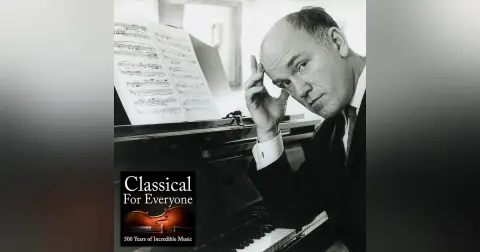
The pianist Sviatoslav Richter's life can somewhat conveniently be broken up into two parts… before he was allowed to tour outside the Soviet bloc in 1960 when he was in his mid 40s… and after. This episode is mostly about that second part; and touches on Richter's expanded interest in Chamber Music, some famous recordings, his influence on piano repertoire and his later career. Plus there will be sensational music from Schumann, Schubert, Liszt, Mozart, Beethoven and Prokofiev.
[Episode Image: Richter c.1960s – photographer: Arje Plas]
Here is a link to a playlist on Spotify with the music in the episode:
https://open.spotify.com/playlist/3uAyYmgy8XO16ReRkhu6pP?si=c3665664dada4db4
The Music
The Words
Hello everyone. Welcome to another episode of the ‘Classical For Everyone’ Podcast… five hundred years of incredible music. My name is Peter Cudlipp and… If you enjoy any music at all then I’m convinced you can enjoy classical music. All you need are ears. No expertise is necessary. If you’ve ever been curious about classical music… or explored it for a while once upon a time… or just quietly wondered what all the fuss was about… then this is the podcast for you.
And because there’s a lot of music out there each episode has a theme. And for this one it is… the second of two episodes devoted to the Soviet pianist Sviatoslav Richter. There’ll be a little more biography but mainly there will be recordings of astonishing performances of music by Robert Schumann, Franz Schubert, Franz Liszt, Wolfgang Amadeus Mozart, Ludwig van Beethoven and Sergei Prokofiev.
In the first episode on Richter I referred to the ‘iron curtain’; a term popularised in a speech Winston Churchill made in 1946 that became shorthand to describe the way the Soviet bloc cut itself off from the West… most dramatically with the Berlin Wall.
But the Iron Curtain was sometimes strangely permeable. In the late 1950’s the West German record company Deutsche Gramophone, under the extraordinary direction of Elsa Schiller came to arrangements with the Government of Poland, which at the time had been granted some limited autonomy by Moscow, to make recordings in Warsaw. Deutsche Gramophone covered the expenses and technology with the rights to distribution being shared with a local Polish label. And that is the origin of the first perhaps ‘mainstream’ recordings by Sviatoslav Richter that reached Western Europe and the US and I guess the British Commonwealth.
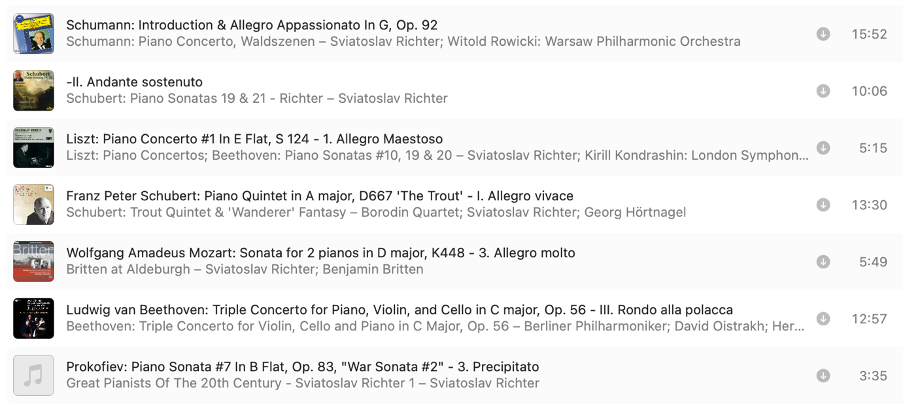
And one of them was Robert Schumann’s Introduction and Allegro appassionato for piano and orchestra from 1849. At about 15 minutes in length but being a sort of piano concerto it falls through the cracks for concert programmers and is rarely heard.
But Schumann was one of the central composers in Richter’s life and he had a habit of exploring the neglected corners of composers’ outputs. Which may explain why he recorded it at his second session in Warsaw for Deutsche Gramophone in 1959.
Stanislaw Wislocki conducts the Warsaw Philharmonic Orchestra and Sviatoslav Richter is the pianist in Robert Schumann’s Introduction and Allegro Appassionato.
A
That was Stanislaw Wislocki conducting the Warsaw Philharmonic Orchestra and Sviatoslav Richter was the pianist in Robert Schumann’s Introduction and Allegro appassionato.
In the final year of his short life, he died at the age of 31, Franz Schubert completed three piano sonatas… large scale multi part works for solo piano. They were as long, as challenging and as beautiful as anything his idol Beethoven had ever written for the piano. But whereas Beethoven enjoyed extraordinary professional success, Schubert was known to only a small circle and it would be years after his death before the three sonatas were performed.
They are now pretty popular but it was I think Richter’s interpretations that did a great deal to put Schubert’s sonatas into the centre of the piano repertoire. And I think he did this in part by the entirely counter-intuitive approach of playing some sections of these long pieces surprisingly slowly. For me, the stateliness and restrained emotion of this pace (and Richter was a master of silences and pauses) adds enormous weight and power to Schubert.
This is the slow second section of Franz Schubert’s final piano sonata, No. 21. It is about ten minutes long; it starts pretty quietly. Here is Sviatoslav Richter. Schubert gave the section the name, or more accurately the performance instruction, of ‘andante sostenuto’ which literally translates into ‘at a sustained walking pace’ but might more accurately be tweaked to ‘a walking pace but with every note held’.
B
That was the slow second section of Franz Schubert’s final piano sonata, No. 21, played by Sviatoslav Richter.
So, if that was something of the majestic but intimate tone Richter could summon and would become justly famous for; there were plenty of people who just wanted the absolute virtuosic brilliance he could deliver… and with Franz Liszt’s 1st Piano concerto from 1855 he did just that. After his first US tour of 1960 Richter made his first tour of the United Kingdom the following year and during that time he made a recording of the concerto with the London Symphony Orchestra with the conductor Kirill Kondrashin… also somewhat oddly ‘on loan’ to the west from the Soviet Union. Here is the opening six minutes of Sviatoslav Richter playing Franz Liszt’s 1stpiano concerto.
C
That was the opening of Franz Liszt’s 1st piano concerto.
Sviatoslav Richter played the piano and Kirill Kondrashin conducted the London Symphony Orchestra.
So Richter was in his mid 40s when he was finally allowed to regularly tour outside the USSR, though he would significantly prefer the UK and western Europe. At the same time, and this may be the influence of the recording legacy rather than verifiable fact, Richter played more and more chamber music… more music for only a handful of musicians written to be performed in small spaces. And as the first example of this for this episode I want to return to music by Franz Schubert.
I’m going to play you the opening section of his Piano Quintet from 1819, a work he wrote at the age of 22 for the slightly unusual combination of piano, violin, viola, cello and double bass… kind of a piano plus string quartet, but not.
In the final section Schubert quotes from one of his early songs called ‘Die Forelle’ and so the quintet is known as the ‘Forellenquintett’. In English ‘die Forelle’ is ‘the trout’. So, for better or worse this 40 minutes of extraordinary music has been and probably always will be known in the English speaking world as ‘The Trout Quintet’.
Here is the opening section. It is about 13 minutes long and in this recording from 1980 Richter is joined by members of the Borodin Quartet and the bass player Georg Hörtnagel. It is hard to get a bigger contrast from Schubert’s final sonata I played you some of earlier in the show. This music has a sunny joy to it and to me it also feels like you can hear a very happy side to Sviatoslav Richter.
D
That was the opening section of Franz Schubert’s ‘Trout’ piano quintet. Richter was joined by members of the Borodin Quartet and the bass player Georg Hörtnagel.
Richter’s increasing enjoyment of making music with small groups of performers led to him establish chamber music festivals in France in 1964 and in Moscow in 1981. And he became a ‘regular’ at the composer Benjamin Britten and his partner the singer Peter Pears annual festival at Aldeburgh (AWLD-buh-ruh) on the Suffolk coast northeast of London. He performed there five times between 1964 and 1976.
And in 1967 someone was clever enough to record Richter and Benjamin Britten performing Wolfgang Amadeus Mozart’s Sonata in D for Two Pianos written in 1781 when Mozart had only recently moved to Vienna from Salzburg and was now a ‘freelance’ composer / performer. This is the six minute final section. It is from a live recording from the Aldeburgh Festival and I am not at all jealous of the people in that room who got to hear Richter and Britten performing together.
E
That was Sviatoslav Richter and Benjamin Britten performing Wolfgang Amadeus Mozart’s Sonata in D for Two Pianos.
My name is Peter Cudlipp and you have been listening to the ‘Classical for Everyone’ Podcast. I have another couple of pieces coming up but before I get to them I want to give you a little information that I hope you find useful…
If you would like to listen to past episodes or get details of the music I’ve played please head to the website classicalforeveryone.net. That address again is classicalforeveryone.net
On the individual episode pages of the website there are links to Spotify playlists with the full versions of most of the music played in each of the episodes.
I hope you have enjoyed this Sviatoslav Richter focused episode of ‘Classical For Everyone’. And if you want to get in touch then you can email… info@classicalforeveryone.net.
By the 1970s and 80s Sviatoslav Richter was in a position where he could do pretty much anything he wanted… musically at least. Unlike many colleagues including Kondrashin and Rostropovich, Richter did not defect from the Soviet Union. He seemed more and more to shun the adulation that would have kept him on stage in the great concert halls of the world with the great orchestras and conductors performing the ‘standard’ piano concerto repertoire.
He increasingly preferred small towns and modest halls to the prestigious venues. He sometimes drove across Russia and Siberia giving concerts wherever he stopped. And In his final decades, more and more he played in a near-dark hall, with a single desk lamp on the music, so the audience would focus on the sound rather than the performer. He announced programmes late, cancelled often, and refused to be managed.
At the same time as Richter was able to essentially do as he pleased; he was troubled by periodic instances of significant depression and later heart issues and by the mid 1990s these had contributed to the end of his performing career. He died from a heart attack in Moscow in 1997 at the age of 82.
I want to finish by going back to a celebrated recording of some Ludwig van Beethoven. This EMI recording from 1969 brought together the violinist David Oistrakh, the cellist Mstislav Rostropovich, the conductor Herbert von Karajan, the Berlin Philharmonic Orchestra and Sviatoslav Richter. The piece is Beethoven’s Triple Concerto, that is music for piano, violin and cello soloists and orchestra, written around 1804. This is a form that can perhaps be thought of as a concerto for piano trio and orchestra. Beethoven only wrote one triple concerto and not many other composers have wrestled with it. Perhaps because getting all the acoustic balances right whilst creating opportunities for three virtuosic performances is a massive challenge.
When this recording came out it was a sensation and was reviewed glowingly. Three of the best soloists in the world at the height of their powers with the man widely regarded as the greatest living conductor with arguably the world’s best orchestra.
But later in his life, Richter, in his memoirs, looked back with little affection for the recording though this needs the caveat that Richter was notoriously critical of his own performances. There was also a mischievous side to the man… and perhaps he was interested in popping the Herbert von Karajan hype bubble (and there was a big one of those) when he noted that von Karajan seemed more interested in the photo for the LP cover than getting a better take recorded. It may also speak to the fact that Richter did not care much about recording. Certainly for the second half of his life he preferred live recordings over ones made in the studio. That said, it seems that unlike many other players he appeared to care very little for how he was recorded, where he was recorded and sometimes even what was recorded. For a performer who was so ambivalent about the process he ended up being about the most recorded pianist of the 20th century.
But back to the Beethoven Triple Concerto. Here is the conclusion which Beethoven noted was in the style of a polonaise… the aristocratic dance from Poland. It is about 13 minutes long. David Oistrakh is the violinist, Mstislav Rostropovich is the cellist, Sviatoslav Richter is the pianist and the Berlin Philharmonic Orchestra is conducted by Herbert von Karajan.
F
That was David Oistrakh, Mstislav Rostropovich, Sviatoslav Richter and the Berlin Philharmonic Orchestra conducted by Herbert von Karajan with the conclusion to Ludwig van Beethoven’s Triple Concerto.
Thanks for your time and I look forward to playing you some more incredible music on the next ‘Classical For Everyone’. This podcast is made with Audacity Software for editing, Wikipedia for Research, Claude for Artificial Intelligence, Cleanfeed for remote recording; and the music played is licensed through AMCOS / APRA. Classical For Everyone is a production of Mending Wall Studios. The Producers do not receive any gifts, remuneration or support of any kind from any organisation or individual mentioned in the show.
And if you have listened to the credits… here is some more music for you…
This is the finale of Sergei Prokofiev’s 7th Piano sonata. The Seventh is the middle of Prokofiev’s three “War Sonatas,” written during the Second World War. Richter gave the premiere in Moscow in January 1943, having learned it in about four days, and it won Prokofiev a Stalin Prize. The finale is in a disturbing and relentless 7/8 time signature. It is three and a half minutes of hammering momentum. From… Sviatoslav Richter.
Thanks again for listening.
G