

 Apple Podcasts

 Spotify

 Amazon Music

 iHeartRadio

 Overcast

 PocketCasts
 RSS Feed
Sviatoslav Richter - Part One
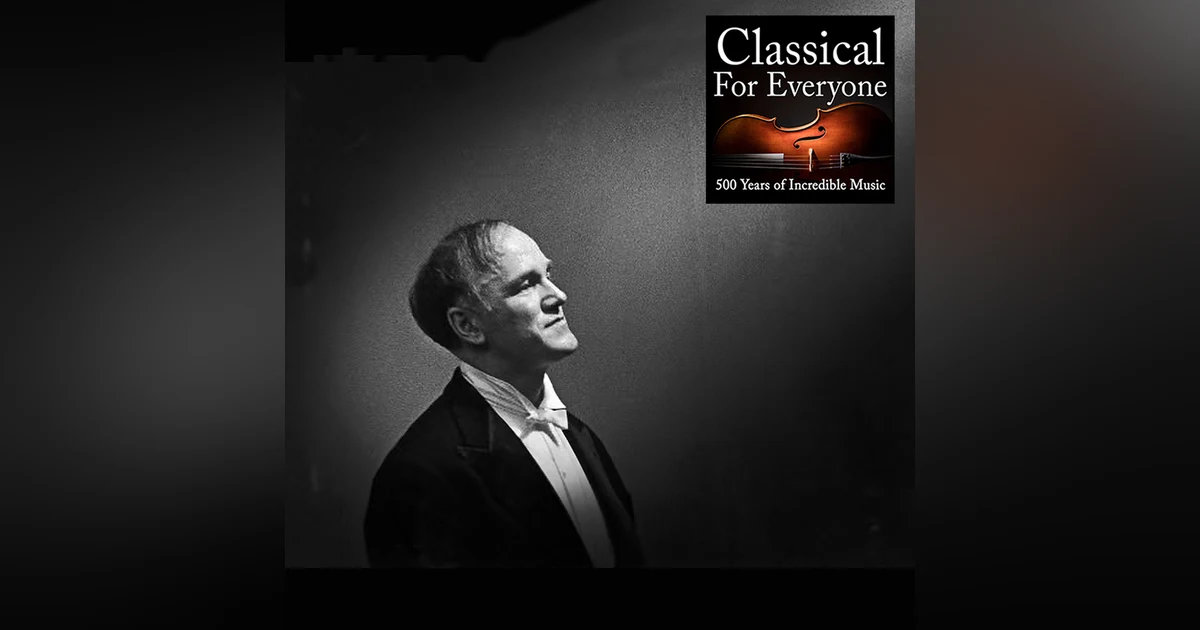

The Soviet pianist Sviatoslav Richter, as I hope this and the following episode will illustrate, is one of the greatest musicians of the recording era… unsurpassed technical expertise matched with a profound depth of musicality. But those clichés (whilst true) could be applied to a not insignificant number of other players. So why Richter? More than most musicians he was touched by history. Born in 1915 and dying in 1997, he outlived the Soviet Union but his life was utterly entangled with that state and the impact its leaders had on the people under their iron fists, Richter included. There is I think something in Richter's absolute immersion in his music that was a result of these extraordinary times and his strategies to protect himself from them. And along with the first part of his story there will be music from Mussorgsky, Prokofiev, Beethoven, Schubert and Rachmaninoff.
[Episode Image: Richter c.1960 Time Life - Walter Sanders]
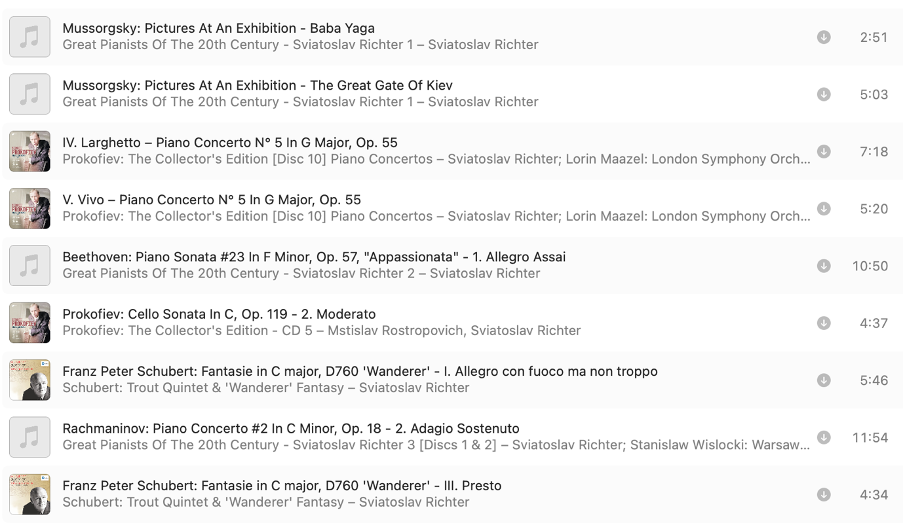
Here is a link to a playlist on Spotify with the music in the episode:
https://open.spotify.com/playlist/2dcRwLthiKeSwTJSuFhj6O?si=f5061cec25804871
The Music
The Words
Hello everyone. Welcome to another episode of the ‘Classical For Everyone’ Podcast… five hundred years of incredible music. My name is Peter Cudlipp and… If you enjoy any music at all then I’m convinced you can enjoy classical music. All you need are ears. No expertise is necessary. If you’ve ever been curious about classical music… or explored it for a while once upon a time… or just quietly wondered what all the fuss was about… then this is the podcast for you.
And because there’s a lot of music out there each episode has a theme. And for this one it is… the first of two episodes devoted to the Soviet pianist Sviatoslav Richter. There’ll be a little biography but mainly there will be recordings of astonishing performances of music by Mussorgsky, Prokofiev, Beethoven, Schubert and Rachmaninoff. With Bach, Schumann, Liszt and Tchaikovsky saved up for the episode that will come out in a couple of weeks. Let’s get to the music. And just a quick aside... Some of these performances were recorded in less than ideal circumstances with rudimentary technology.
The Russian composer Modest Mussorgsky’s 1874 work ‘Pictures At An Exhibition’… a series of short works each describing a painting, sketch or watercolour by Mussorgsky’s friend Viktor Hartmann who had died the previous year… is today best known as an incredible orchestral showcase. But Mussorgsky actually wrote it for solo piano. It was Maurice Ravel’s orchestration 49 years later that gained the work its ongoing fame. But in 1958 a recording of the piano version performed live by a Russian pianist that some people in the west had heard of… but very few had heard a performance by… made its way out from behind the Iron Curtain.
This, for most people, would be their first encounter with Sviatoslav Richter. Here are the two thrilling sections that conclude Mussorgsky’s ‘Pictures At An Exhibition’… The Hut Of Baba Yaga and The Great Gate of Kiev. This is about eight minutes of music and despite the rather poor recording quality I hope you can hear the explosive brilliance of Richter’s playing.
A
That was Sviatoslav Richter live in Sofia in Bulgaria in 1958 performing the two sections that conclude Modest Mussorgsky’s ‘Pictures At An Exhibition’… The Hut Of Baba Yaga and The Great Gate of Kiev.
Ok. A little biography.
Richter was born in 1915 in Zhytomyr, then part of the Russian Empire… now in Ukraine… and grew up in Odessa. His father, Teofil Richter, was a German-born pianist, organist and composer who taught at the Odessa Conservatory and his mother Anna Pavlovna had been a pianist as well. But Sviatoslav was apparently largely self-taught. He was an extraordinary sight-reader with a passion for opera, and as a teenager he worked as a rehearsal pianist at the Odessa Opera, where he hoped to become a conductor. He gave his first solo recital in 1934, an all-Chopin programme, but had no formal training to speak of until he was in his twenties.
In 1937 Richter went to Moscow and auditioned for the acclaimed teacher Heinrich Neuhaus who would be the head of Piano at the Moscow Conservatory for close to five decades. Neuhaus was overwhelmed and is said to have called Richter ‘the pupil he had been waiting for all his life’.
If Richter’s appearance on the turntables of the West had to wait until the late 1950s he had by then been for close to two decades the leading pianist in the Soviet Union and in that time he had become the composer Sergei Prokofiev’s pianist of choice and the dedicatee of much of the composer’s music.
Incidentally I think Prokofiev suffers from a syndrome that I guess afflicts the great majority of composers… the success of a small number of works eclipses… and maybe suffocates is a better term… a lifetime of creative output much of which is incredibly well worth listening to. If I had not been making a show about Richter I would not have paid much attention to his 5th piano concerto written in 1932. Which I think is just quite amazing music.
Here are the two concluding sections.. the slow ‘Larghetto’ and the fast ‘Vivo’. This is Lorin Maazel and the London Symphony Orchestra with Sviatoslav Richter at the piano. It is about thirteen minutes long.
B
That was the two concluding sections of Sergei Prokofiev’s 5th Piano Concerto. Lorin Maazel conducted the London Symphony Orchestra with Sviatoslav Richter at the piano.
By the middle of the 1950’s, following Josef Stalin’s death in 1953 there was thaw in the ‘cold war’ and cultural exchange became a significant part of that process. And finally in 1960, after years of efforts by European and American impresarios to arrange a tour for Richter he was allowed by the authorities to visit the US.
He performed five concerts at Carnegie Hall and the first one was all music by Ludwig van Beethoven including his piano Sonata No.23. known as the ‘Appassionata’ from 1805 which is one of the more technically challenging works from a composer who could be said to define ‘challenging’.
A few weeks later he recorded it in a studio for the RCA label. Here is the opening section. It is about 11 minutes long.
C
That was the opening section of Ludwig van Beethoven’s piano Sonata No.23. known as the ‘Appassionata’… performed by Sviatoslav Richter… the musician featured in this episode of ‘Classical For Everyone’.
Ok.. a little more biography. Whilst the years between Richter’s move to Moscow in 1937 and the Carnegie Hall concert in 1960 were of astonishing professional success they were also years of personal tragedy.
When Germany invaded in 1941, his father, who had stayed in Odessa, was arrested by Soviet authorities on suspicion of German sympathies and shot. His mother later fled to Germany with another man, and Richter didn't see her again for more than two decades… not knowing that she was alive. These losses probably shaped a reportedly private and guarded man, though he found lifelong companionship with the singer Nina Dorliak, his partner and frequent recital collaborator for some fifty years.
Another frequent musical collaborator was the cellist Mstislav Rostropovich. Sergei Prokofiev in 1949, at a time when he was under intense… and potentially lethal… scrutiny by the Soviet authorities, heard the young Rostropovich performing and decided to write a cello sonata, a piece for just cello and piano, and put Rostropovich and Richter together.
The process required to get the work to the public was described by Richter in his memoirs:
We gave the first performance of Prokofiev's Cello Sonata. Before playing it in concert, we had to perform it at the Composer's Union, where these gentlemen decided the fate of all new works. During this period more than any other, they needed to work out whether Prokofiev had produced a new masterpiece or, conversely, a piece that was 'hostile to the spirit of the people.' Three months later, we had to play it again at a plenary session of all the composers who sat on the Radio Committee, and it wasn't until the following year that we were able to perform it in public, in the Small Hall of the Moscow Conservatory on March 1, 1950
That performance was recorded for a radio broadcast and then released commercially, so… with apologies for the audio quality from 76 years ago, here is the five minute long 2nd section from the world premiere of Prokofiev’s cello sonata performed by Mstislav Rostropovich and Sviatoslav Richter.
D
That was the 2nd section from the world premiere of Sergei Prokofiev’s cello sonata performed by Mstislav Rostropovich and Sviatoslav Richter.
In one of the strange ironies of history Prokofiev died on the same day as Josef Stalin and instead of being able to attend the funeral of a colleague whose success had been entwined with his own, Richter had to play at Stalin’s ‘lying in state’ with the dictator’s body on a platform towering over the stage. Richter had been touring in Georgia when he was ordered back, the only passenger on a plane filled with funeral wreaths. He was expected to play something patriotic and stirring but instead played long selection from The Well-Tempered Clavier by Johann Sebastian Bach… a composer Stalin was not a fan of.
Meanwhile in another part of the city the hearse could not get through the crowd of Stalin’s mourners to collect Prokofiev’s coffin from his home. It had to be carried to the cemetery where apparently paper flowers had to be strewn on the grave… the real ones all having been devoted to one of humanity’s greatest monsters. There is a chance that Richter didn’t even know Prokofiev had died. It was only reported in the periodical ‘Soviet Music’ a month after his death and even then the news was on page 116 after 115 pages of tribute to Stalin.
Ok. Back to the music.
Franz Schubert’s ‘Wanderer Fantasy’ is a four-section piece for solo piano composed by in 1822 with themes borrowed from an earlier song he had written called ‘The Wanderer’. It is one of Schubert's most technically demanding compositions for the piano. Schubert himself said “Das Zeug soll der Teufel spielen!”… "let the devil play the stuff," in reference to his own inability to do so properly.
It is easy to focus on Richter’s almost unrivalled technique, but his gift for making the melodies of the music he played really sing is I think of equal importance and this is best displayed in his recordings of the music of Schubert. And there will be quite a bit more of it in Part Two of ‘Sviatoslav Richter’ in a couple of weeks. But for now, here is the opening six minutes of Franz Schubert’s ‘Wanderer Fantasy’ performed by Sviatoslav Richter.
E
That was the opening six minutes of Franz Schubert’s ‘Wanderer Fantasy’ performed by Sviatoslav Richter.
My name is Peter Cudlipp and you have been listening to the ‘Classical for Everyone’ Podcast. I have another couple of pieces coming up but before I get to them I want to give you a little information that I hope you find useful…
If you would like to listen to past episodes or get details of the music I’ve played please head to the website classicalforeveryone.net. That address again is classicalforeveryone.net
On the individual episode pages of the website there are links to Spotify playlists with the full versions of most of the music played in each of the episodes.
And I’m also going to put a link to a two part documentary made about Richter called ‘The Enigma’. If this episode has made you curious to know more about this remarkable musician then this is the place to go. I’d also recommend it as one of the best music / history documentaries you are likely to see. It was made by Bruno Monsaingeon in 1998 and featured an incredibly candid interview with Richter made a year before he died. And it is filled with fascinating archival footage… including an excerpt from the 1952 feature film ‘The Composer Glinka’ in which Richter played the role of Franz Liszt.
I hope you have enjoyed this Sviatoslav Richter focused episode of ‘Classical For Everyone’. And if you want to get in touch then you can email… info@classicalforeveryone.net.
Alright, to finish this episode I have the slow section of Sergei Rachmaninoff’s 2nd Piano Concerto written in 1900. If you consider that the death of classical music is frequently reported it might seem odd that there are over 300 versions of the Rachmaninoff concerto currently available. Maybe things aren’t as bad as they seem.
And of all those recordings.. starting with one made by Rachmaninoff himself in 1929; the one recorded by Sviatoslav Richter with the Warsaw Philharmonic Orchestra conducted by Stanislaw Wislocki in 1959 remains something of an all time champion.
As the recording date falls just on the eve of Richter’s exposure to the world outside the Soviet Union it seems a good spot to end Part One of the story.
Here is twelve minutes of pretty amazing music. The slow section of Sergei Rachmaninoff’s 2nd Piano Concerto.
G
That was the slow section of Sergei Rachmaninoff’s 2nd Piano Concerto. Sviatoslav Richter was the soloist with the Warsaw Philharmonic Orchestra conducted by Stanislaw Wislocki.
Thanks for your time and I look forward to playing you some more incredible music on the next ‘Classical For Everyone’. This podcast is made with Audacity Software for editing, Wikipedia for Research, Claude for Artificial Intelligence, Cleanfeed for remote recording; and the music played is licensed through AMCOS / APRA. Classical For Everyone is a production of Mending Wall Studios. The Producers do not receive any gifts, remuneration or support of any kind from any organisation or individual mentioned in the show.
And if you have listened to the credits… here is some more music for you…
Just four minutes more Schubert. The third section of his Wanderer Fantasy… Here is Sviatoslav Richter. Thanks again for listening.
H