



Sunrise (Music for The New Year)




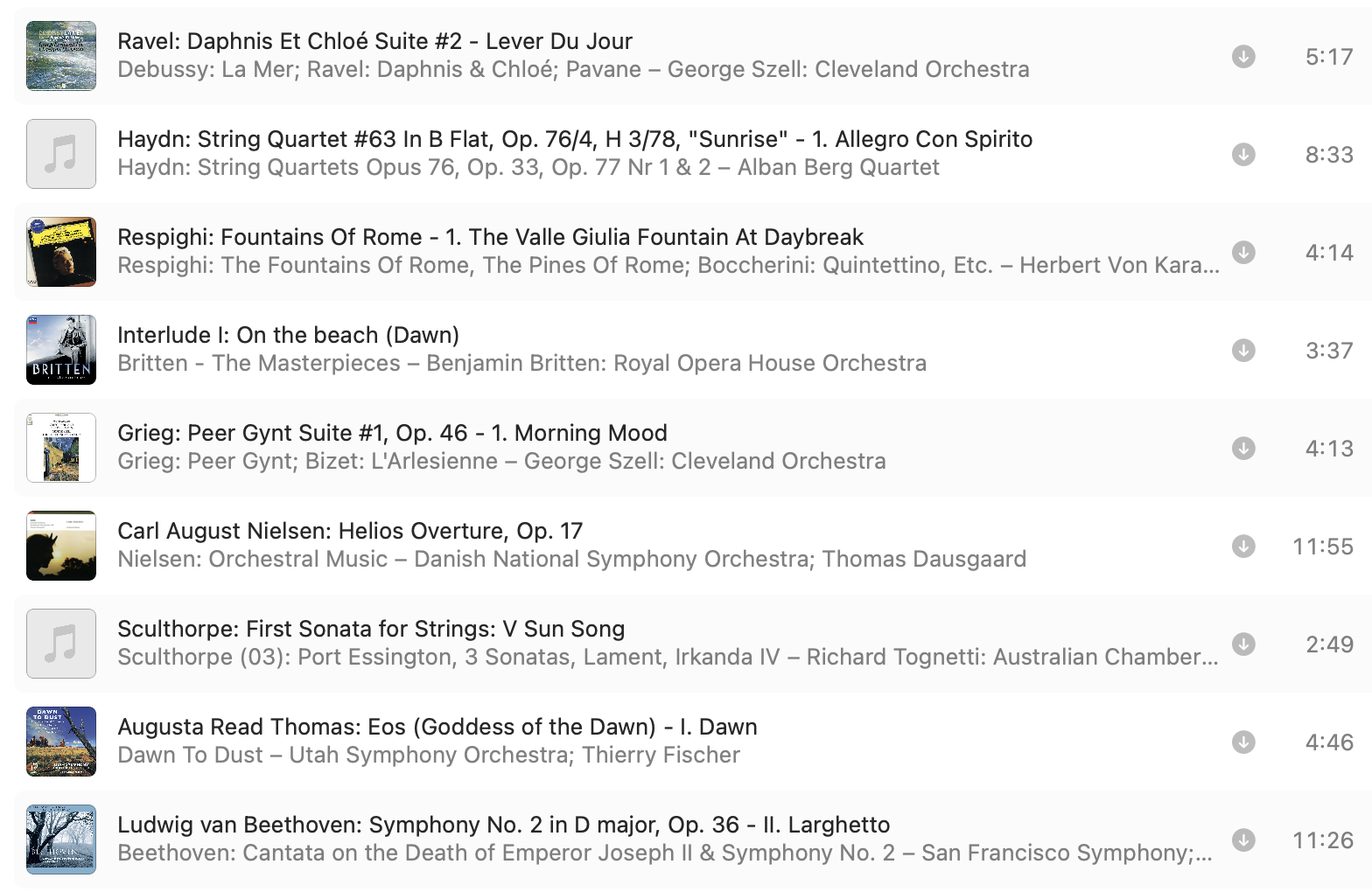
Classical Music for New Years Eve seems to be dominated by nineteenth century Viennese waltzes and eighteenth century music for fireworks. All nice stuff but I wasn’t after something for New Years Eve. I wanted music for New Years Day. And that led to thoughts about renewals, beginnings, clean slates, optimism and second chances. And mysteriously that line of thought led to the idea of dawn and sunrise. So in the next hour and a bit there will be music about that very pretty time of the day... from Maurice Ravel, Joseph Haydn, Ottorino Respighi, Benjamin Britten, Edvard Grieg, Carl Nielsen, Peter Sculthorpe, Augusta Read Thomas and Ludwig van Beethoven. Happy New Year!
And here is a link to a playlist on Spotify with the music from this episode:
https://open.spotify.com/playlist/7rxMpbvRMQKy27edaqIMTS?si=971dd7e5eb004316
The Music
The Words
Hello everyone. Welcome to another episode of the ‘Classical For Everyone’ Podcast… five hundred years of incredible music. My name is Peter Cudlipp and… If you enjoy any music at all then I’m convinced you can enjoy classical music. All you need are ears. No expertise is necessary.
This is perhaps a slightly unexpected episode. After all there was one released only three days ago but I was thinking about the New Year and started to get some ideas. Classical Music for New Years Eve seems to be dominated by nineteenth century Viennese waltzes and eighteenth century music for fireworks. All nice stuff but I wasn’t after something for New Years Eve. I wanted music for New Years Day. And that led to thoughts about renewals, beginnings, clean slates, optimism, second chances. And mysteriously that line of thought led to the idea of dawn and sunrise. So in the next hour and a bit there will be music about that very pretty time of the day from Maurice Ravel, Joseph Haydn, Ottorino Respighi, Benjamin Britten, Edvard Grieg, Carl Nielsen, Peter Sculthorpe, Augusta Read Thomas and Ludwig van Beethoven. It is perhaps a sign of reaching a certain age that the New Year is more about experiencing the dawn of the day that begins the year… than the damage done the night before and the slow recovery required. But whichever way your year is beginning I think this music will work. Largely quiet and contemplative for the early risers. Soothing for those with sore heads.
Here is George Szell conducting the Cleveland Orchestra with the opening section of Maurice Ravel’s ballet suite Daphnis & Chloe. Called ‘Lever Du Jour’ or ‘Daybreak’. It is about 5 minutes long.
A
That was George Szell conducting the Cleveland Orchestra with the ‘Daybreak’ section of Maurice Ravel’s ballet suite Daphnis & Chloe.
The first notes of the fourth of Joseph Haydn’s final group of String Quartets from from around 1798 reminded someone of a sunrise and the whole quartet has been given that name. Here is the opening section that prompted the description performed by the Alban Berg String Quartet. It is about eight minutes long.
B
That was the opening of Joseph Haydn’s ‘Sunrise’ quartet. And it was performed by the Alban Bery String Quartet.
In 1916 the Italian composer Ottorino Respighi wrote a collection of four orchestral works called The Fountains Of Rome… each one describing a particular fountain at a particular time of day. Here is ‘Dawn at the Valle Giullia Fountain’. It is about four minutes long and here is Herbert von Karajan conducting the Berlin Philharmonic Orchestra.
C
That was ‘Dawn at the Valle Giullia Fountain’ from ‘The Fountains of Rome’ by Ottorino Respighi. Herbert von Karajan conducted the Berlin Philharmonic Orchestra.
I have to confess I played the next piece three months back so forgive the repeat but it’s pretty wonderful music. And it is called ‘Dawn’… so it fits in this ‘music for the beginning of New Years Day’ episode. In 1945 Benjamin Britten took four orchestral pieces from his opera Peter Grimes and turned them into a work for the concert hall he called ‘Four Sea Interludes’. Here is the composer conducting the Royal Covent Garden Orchestra with ‘Dawn’
D
That was ‘Dawn’ from the ‘Four Sea Interludes’ from Peter Grimes by Benjamin Britten who conducted the Royal Covent Garden Orchestra. By the way, the rest of those interludes are just sensational and at the website classicalforeveryone.net on the page for this episode there will be a link to a Spotify playlist with the complete versions of most of the music you are listening to… including the Benjamin Britten.
Next is a piece that may be familiar to some of you. I think I recall it being used in a margarine commercial a long time ago. It has certainly been cruelly misapplied to many things over the years but that does not necessarily diminish its beauty. In 1888 the Norwegian composer Edvard Grieg took the incidental music he had written for Henrik Ibsen’s play ‘Peer Gynt’ and reworked it into two orchestral suites and the first one begins with a piece called ‘Morning Mood’. It is about four minutes long and here again is George Szell conducting the Cleveland Orchestra.
E
That was Edvard Grieg’s ‘Morning Mood’ from his first Peer Gynt’ suite and George Szell conducted the Cleveland Orchestra. You might have pictured a misty Norwegian dawn over the fjords when you were listening ... but in the play the music was written for, this music is for a scene where the central character, Peer Gynt, wakes up stranded in the Moroccan desert, abandoned by his companions who stole his boat while he slept.
Ok, staying with Scandinavian composers who were perhaps musically attracted to warmer parts of the world… In 1902 the Norwegian composer Carl Nielsen followed his wife Anne-Marie to Greece. She was a sculptor and was one of the first artists allowed to make copies of the bas-reliefs and statues in the Acropolis Museum. Whilst in Greece Nielsen conceived an orchestral overture describing the sun rising from the Aegean. He called it the ‘Helios Overture’ after the ancient Greek name for the god of the Sun imagined as riding across the sky in a chariot. It is about 12 minutes long and here is Thomas Dausgaard conducting the Danish National Symphony Orchestra
F
That was Thomas Dausgaard conducting the Danish National Symphony Orchestra with The Helios Overture by Carl Nielsen.
If you have ever seen the sun rise in the desert it seems to vault up with tremendous speed and the day arrives with a shock. That is what the next bit of music by the Australian composer Peter Sculthorpe reminds me of. Here is the three minute first section of his Sun Song for Strings from 1984. This is Richard Tognetti directing the Australian Chamber Orchestra.
G
That was first section of Peter Sculthorpe’s Sun Song for Strings. Richard Tognetti directed. the Australian Chamber Orchestra. The Carl Nielsen piece I played you a couple of pieces back took its title from the ancient Greek god identified with the sun, Helios. The next piece takes its name from the Greek goddess of the Dawn, Eos. Spelt E O S. In 2015 the American composer Augusta Thomas Read wrote a work she described as a Ballet for Orchestra and called it ‘Eos (Goddess of the Dawn) Here is the opening section called ‘Dawn’. It is about 5 minutes long and this is the Utah Symphony Orchestra conducted by Thierry Fischer.
H
That was the Utah Symphony Orchestra conducted by Thierry Fischer with ‘Dawn’ from Augusta Thomas Read’s ballet for orchestra called ‘Eos (Goddess of the Dawn)
My name is Peter Cudlipp and you have been listening to the ‘Classical for Everyone’ Podcast. To finish this episode which I’ve called Sunrise (Music for The New Year) is something that has no explicit connection to the dawn and sunrises but I’d been listening to some Beethoven over the last week and I chanced upon the slow section of his 2nd symphony and it has this gradual build and accumulation of energy and a sense of something slowly emerging from quietness into fuller life… for me like the rose colours of the sky just before dawn… building to the sunrise.
Here is Michael Tilson Thomas conducting the San Francisco Symphony Orchestra with the second section of Ludwig van Beethoven’s second symphony from 1802. It is about 12 minutes long.
Happy New Year everyone.