

 Apple Podcasts
 Spotify
 Amazon Music
 iHeartRadio
 Overcast
 PocketCasts
  RSS Feed
 Sunday Night Special … Ralph Vaughan Williams’ Symphony No. 6
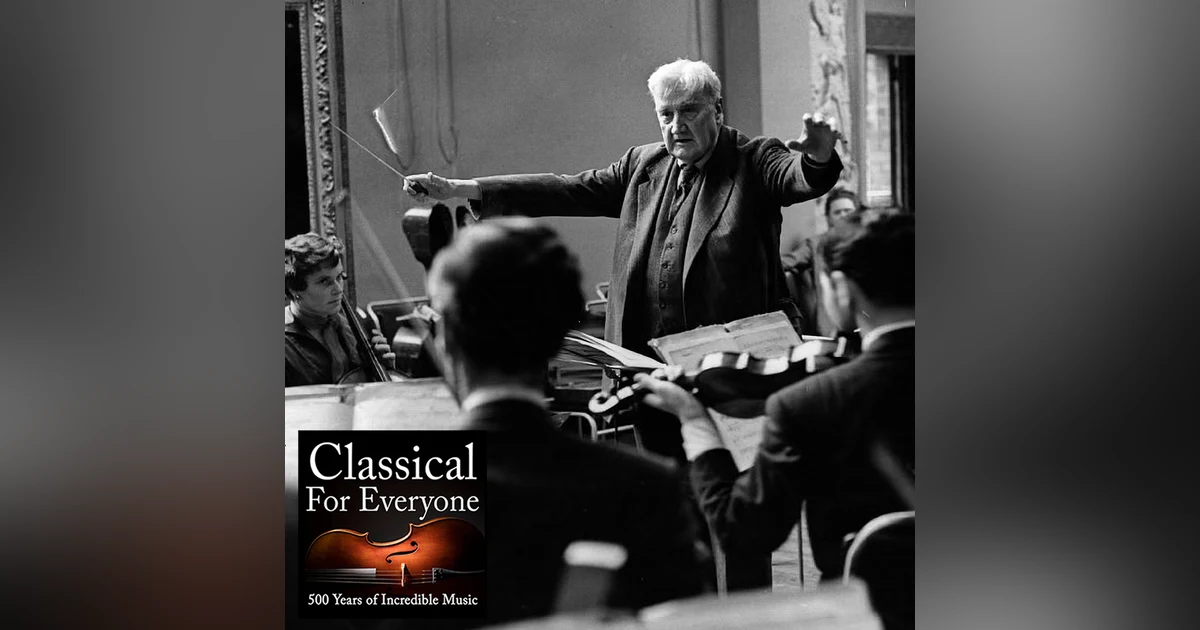
The name comes from the night of the week when for some of us, the frustrations of insomnia hit the hardest… and because my preferred antidote is getting lost in some music. Of course this series is for everyone… but it is perhaps intended a little more for those of you whose sleep has been troubled. The idea of the special is to play just one piece, uninterrupted and in its entirety… with a few minutes of background explained at the end of the episode. This month… Ralph Vaughan Williams’ Sixth Symphony. The BBC Symphony Orchestra is conducted by Andrew Davis. [Episode Image: Ralph Vaughan Williams conducts the Boyd Neel Orchestra in rehearsal.]
Hello Everyone, my name is Peter Cudlipp. Welcome to another in the occasional series of extra episodes of the Classical For Everyone podcast. Episodes which I call Sunday Night Specials.
The name comes from the night of the week when for some of us, insomnia hits the hardest… and for me, and I hope for you, getting lost in some music is a much better thing to do than stare at the ceiling or at a phone screen.
Now I’m not choosing the music with the hope that it will send you to sleep, though it’s fine if it does… this is music to keep you company. And of course this series is for everyone… but it is perhaps intended a little more for those of you whose sleep has been troubled.
The idea of the special is to play you just one piece, uninterrupted and in its entirety… with a few minutes of background explained at the end of the episode.
This week it is Ralph Vaughan Williams’ 6th Symphony.
I want to get to the music without a lot of preamble but I do want to take just 30 seconds to read you a quote from Leopold Stokowski who conducted the New York premiere in 1948…
The more I study Vaughan Williams' 6th Symphony, the more I have the impression that this is music that will take its place with the greatest creations of the masters. [ … ] in this Symphony the world of music has a true picture of today, expressing the turmoil, the dark despair, but also the aspiration of an ideal future. Every listener will find their own meaning in the unique finale of this Symphony – one of the most profound expressions in all music
I first heard this late one night on a car radio in the south island of New Zealand. Maybe 20 years ago. It really moved me at the time and challenged a bunch of preconceptions I had about Vaughan Williams.
Here now is Andrew Davis conducting the BBC Symphony Orchestra. The work is in four parts and the final one is very, very quiet.
Ralph Vaughan William’s 6th Symphony.
A
I hope you enjoyed that performance of Ralph Vaughan William’s 6th Symphony. Andrew Davis conducted the BBC Symphony Orchestra
And now here are a few minutes of background for you. And I have to credit a program note by the Australian composer Gordon Kerry he wrote for the Sydney Symphony Orchestra.
The first performance of the Sixth Symphony was given by Sir Adrian Boult and the BBC Symphony Orchestra at a Royal Philharmonic Society concert in the Royal Albert Hall on 21 April 1948. The work was an immediate success. In the words of the Vaughan Williams’ biographer Michael Kennedy, "The Sixth Symphony caused a sensation and was performed over 100 times in two years. Nothing like that had occurred in English music since Edward Elgar's First Symphony in 1908".
When Vaughan Williams’ Sixth Symphony appeared it surprised many. Its predecessor, the 5th symphony, was a masterpiece of formal elegance, luminous orchestral colour and, ultimately, of peace, that had been completed in 1943 and might have seemed like the final essay in the genre from a composer now in his seventies.
In the work, Vaughan Williams shows himself to be the kind of late-period artist that fascinated the Palestinian-American writer Edward W Said, who wrote that ‘the accepted notion is that age confers a spirit of reconciliation and serenity on late works, often expressed in terms of a miraculous transfiguration of reality…But what of artistic lateness not as harmony and resolution, but as intransigence, difficulty, and contradiction?’
Vaughan Williams strenuously denied that the work had any extra-musical implications, insisting that a composer ‘might just want to write a piece of music’, and his own program note for the work is technical to the point of terseness. But the sophistication of the composer’s craft here is extraordinary, and regardless of ‘meaning’ there is strong argument for it being his symphonic masterpiece.
Nothing quite prepared audiences for the finale — a sustained, almost motionless Epilogue marked pianissimo or very softly throughout, in which the orchestra seems to dissolve into a kind of exhausted nothingness. Vaughan Williams connected it to Shakespeare's Tempest — "We are such stuff as dreams are made on, and our little life is rounded by a sleep" — though he later grew irritated with listeners who wanted the symphony explained. He was, however, charmed when a friend described the Epilogue as "the agnostic's Paradise."
Not that the Sixth was any more a valedictory piece than the Fifth; Vaughan Williams would forge ahead with three more symphonies, and one or two other things, in his final decade.
My name is Peter Cudlipp and I hope you enjoyed this Sunday Night Special of the ‘Classical For Everyone’ podcast. There will be a regular episode in the next few days and another Sunday Night Special in perhaps a few weeks. Thanks for listening.