

 Apple Podcasts
 Spotify
 Amazon Music
 iHeartRadio
 Overcast
 PocketCasts
  RSS Feed
 Sunday Night Special … Camille Saint-Saëns’ Symphony No. 3 (Organ Symphony)
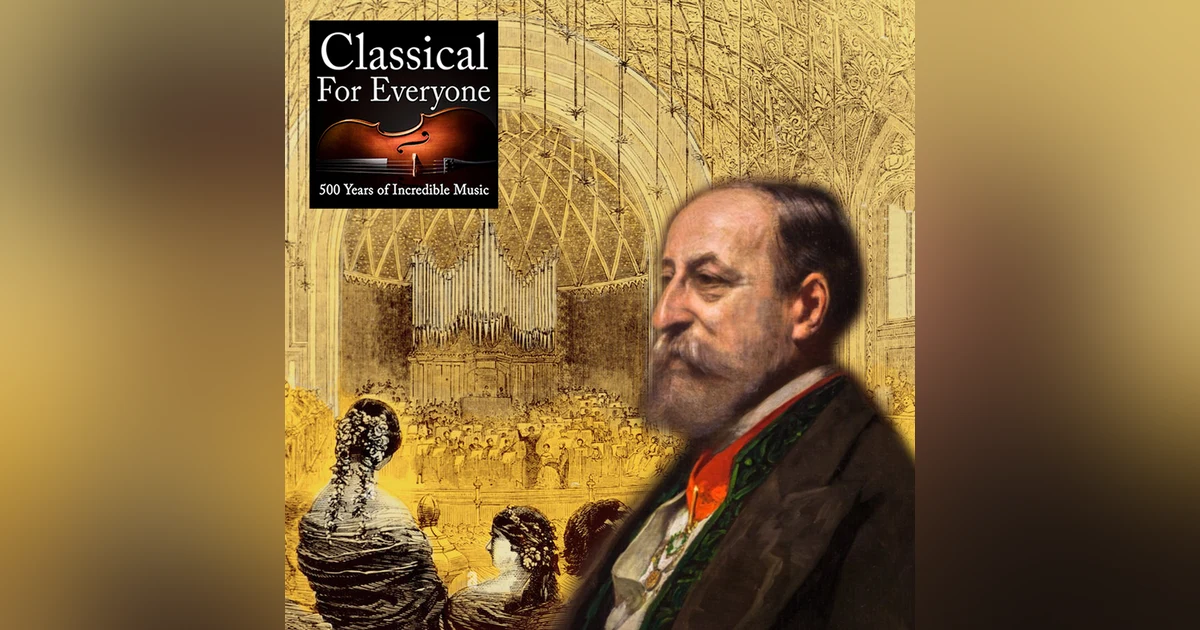
The name comes from the night of the week when for some of us, the frustrations of insomnia hit the hardest… and because my preferred antidote is getting lost in some music. Of course this series is for everyone… but it is perhaps intended a little more for those of you whose sleep has been troubled. The idea of the special is to play just one piece, uninterrupted and in its entirety… with a few minutes of background explained at the end of the episode. This month… Camille Saint-Saën’s 3rd Symphony. Known as the Organ Symphony for reasons that will become pretty obvious. In this performance Daniel Barenboim conducts the Chicago Symphony Orchestra and the organist is Gaston Litaize. [Episode Image: Portrait of Saint-Saëns by Benjamin Constant. Background: Illustration of St John’s Hall, London; where the premiere took place. The Hall was demolished in 1905.]
Hello Everyone, my name is Peter Cudlipp.
Welcome to another in the occasional series of extra episodes of the Classical For Everyone podcast. Episodes which I am calling Sunday Night Specials.
And if it seems odd that this is appearing on a Friday. Well, my apologies for a little schedule juggling and, if you wish, please wait until Sunday night to play it.
Now The name of the series comes from the night of the week when for some of us, the annoyance of insomnia hits the hardest… and for me, and I hope for you, getting lost in some music is a much better thing to do than stare at the ceiling or at a phone screen.
The idea of the special is to play you just one piece, uninterrupted and in its entirety… with a few minutes of background explained at the end of the episode… if you’re interested. But the main thing is to get straight into the music.
A
I hope you enjoyed that performance of Camille Saint-Saën’s 3rd Symphony. Known as the Organ symphony. Daniel Barenboim conducted the Chicago Symphony Orchestra and the organist was Gaston Litaize.
And now here are a few minutes of background for you. And I have to thank my AI pal Claude for the legwork that I am basing this on.
The Symphony No. 3 was commissioned by the Royal Philharmonic Society in London and premiered there on May 19, 1886, with Saint-Saëns himself conducting. By this point he was fifty years old, already a formidable virtuoso organist (he'd held the post at the Madeleine Church in Paris for two decades. The symphony was, in a sense, the culmination of everything he'd been building toward: a lifetime of contrapuntal mastery, a deep love of the organ as an orchestral partner rather than a soloist, and a restless interest in cyclic form, where a single germinal idea returns transformed across the whole work. He dedicated the score to Franz Liszt, who died just weeks after the premiere — making the symphony, whether Saint-Saëns intended it or not, something of a farewell tribute.
This was Saint-Saëns' last symphony, though far from his last major work — he lived another thirty-five years and kept composing almost to the end. But it's the one where his ambitions and his instincts fully aligned.
His earlier symphonies (including two youthful, unnumbered efforts) are accomplished but conventional; here he broke from four-movement orthodoxy entirely, worked the organ and piano into full orchestral textures rather than treating them as guests. It's also the work that most fully vindicates Saint-Saëns' reputation as a craftsman rather than a visionary — a reputation that has sometimes worked against him, since "craftsman" gets used almost as a backhanded compliment. The Organ Symphony is the piece that makes the case he could do both: dazzling technique in service of real emotional sweep.
The London audience loved it immediately — the premiere was a triumph, and Saint-Saëns was already a known quantity there, having toured extensively as a pianist and organist. The Paris reception, when the work arrived there the following year, was warmer still, eventually. But Saint-Saëns himself seems to have understood he'd reached some kind of personal summit with this piece; he's said to have remarked that he'd given everything he had to give, and that he would never write another symphony. He kept that promise.
The design here is one of the piece's great inventions. Instead of the usual four movements, Saint-Saëns writes just two big sections, and each of those splits into two connected parts — so you're really hearing a four-movement symphony, just compressed and fused together, with the joins smoothed over.
The second section opens with a lively, tricky scherzo, including a fiendishly hard passage for piano four hands. Then comes the famous finale: the organ crashes in on a full C major chord, the opening theme returns transformed into a triumphant hymn, and everything — full orchestra, two pianos, organ — builds to an ending that is, by design, as overwhelming as Saint-Saëns could make it.