


Stormy Weather


Representing the weather with music is probably an ancient practice. In our earliest superstitions the percussive blasts of thunder would probably have been mimicked to either flatter or placate the spirit world. And perhaps whoever was organising the noisy tributes to the sky gods got something of the same thrill as composers might when they decide to use the weather for inspiration. In the next hour I’m going to give you a sort of chronological meander through what a handful of composers have done with the idea of storms over the last three hundred years with music from Georg Phillip Telemann, Ludwig van Beethoven, Ethel Smythe, Gustav Mahler, Claude Debussy, Jean Sibelius, Dmitri Shostakovich, Benjamin Britten and John Adams.
And here is a link to a playlist on Spotify with the music from this episode:
https://open.spotify.com/playlist/3KtyPJRTXlN7WpOXLJXtYE?si=01b82fbfb0ae49de
The Music
The Words
Hello everyone. Welcome to another episode of the ‘Classical For Everyone’ Podcast… five hundred years of incredible music. My name is Peter Cudlipp and… If you enjoy any music at all then I’m convinced you can enjoy classical music. All you need are ears. No expertise is necessary. If you’ve ever been curious about classical music… or explored it for a while once upon a time… or just quietly wondered what all the fuss was about… then this is the podcast for you. And because there’s a lot of music out there each episode has something of a theme.
Representing the weather with music is probably an ancient practice. In our earliest superstitions the percussive blasts of thunder would probably have been mimicked to either flatter or placate the spirit world. And perhaps whoever was organising the noisy tributes to the sky gods got something of the same pleasure as composers might when they decide to use the weather for inspiration, either in an attempt to portray nature, or as a way to illustrate an internal emotional state.
When I started working on this episode I was looking at ‘weather’ generally but the more music I listened to, the too vague that seemed, so I thought I’d narrow it down to ‘storms’. In the next hour I’m going to give you a sort of chronological meander through what a handful of composers have done with the idea of storms over the last three hundred years with music from Ludwig van Beethoven, Ethel Smythe, Gustav Mahler, Claude Debussy, Jean Sibelius, Dmitri Shostakovich, Benjamin Britten and John Adams.
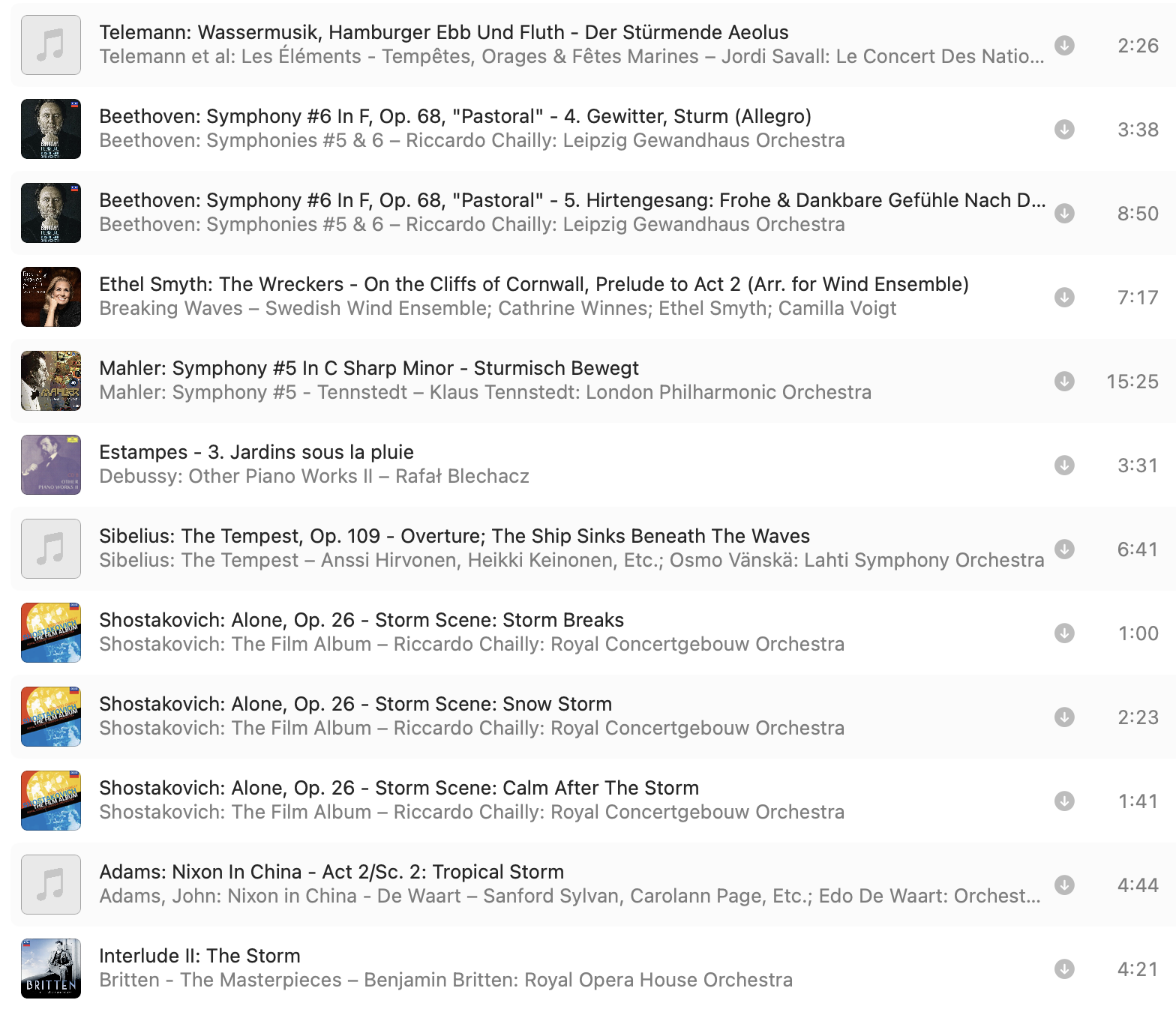
But I am going to start with a couple of minutes from Georg Phillip Telemann. In 1723 he was commissioned to write two works for the centenary of the Hamburg Admiralty... one choral and one orchestral. This is from the orchestral work… Hamburg Ebb and Flood… the section called The Stormy Aeolus, Aeolus being the god of the Wind. Here is Jordi Savall leading The Concert of Nations.
A
That was Jordi Savall leading The Concert of Nations with the section called The Stormy Aeolus from ‘Hamburg Ebb and Flood’ by Georg Phillip Telemann.
Now one of the things that to modern ears perhaps makes that piece a not entirely convincing portrayal of a storm is the limitations of the instruments available to Telemann. But a century later, give or take a few years, Ludwig van Beethoven, when he came to write the section of his 6th Symphony he called ‘Thunder and Storm’, had much more to work with.
Incidentally, this symphony is one of only a handful of instances of Beethoven adding descriptions to his music. All those names for his pieces like ‘Moonlight Sonata’ and the ‘Emperor Concerto’ were added by others often well after Beethoven was dead. He noted in the score of the 6th symphony that the work was "more the expression of feeling than tone-painting," distinguishing it from the literal pictorialism he disliked. But for me there is quite a literal… ‘here is an orchestra making the sounds of a storm’ feel to the section I am going to play. Perhaps it is best to say that Beethoven remained ambivalent about where description should end and pure music begin.
Here is that stormy music performed by the Leipzig Gewandhaus Orchestra conducted by Riccardo Chaiily. It is about 4 minutes long.
B
That was the Leipzig Gewandhaus Orchestra conducted by Riccardo Chailly with the fourth section called ‘Thunder and Storm’ from Beethoven’s sixth symphony.
Cornwall is a peninsula that thrusts out into the Celtic sea at the extreme southwest of the United Kingdom and as you’d expect the coast is rugged and storm-tossed. And in past centureis it was the site of all too common shipwrecks. The locals, generally living in something close to grinding poverty would collect whatever washed ashore for themselves and earned the name ‘wreckers’. This predatory and perhaps macabre cottage industry was then embellished by hearsay into the fiction that villagers would move navigation lamps and fires around the clifftops to lure ships to their doom on the rocks below… and then murder any surviving sailors. And this dark subject became the premise for an opera written in 1904 by the fascinating, gifted and unfairly neglected English composer Ethel Smyth.
Though originally written to words in French, from which a German version was made, it is best known in the English version called ‘The Wreckers’, though when I say ‘best known’ that is a relative thing.
I’d love to be able to play you some of the actual opera but there is only one recording available on CD which is not currently in my possession and there’s nowhere it can be downloaded. So in its place I am going to play you an arrangement of the Prelude to Act II called ‘On the Cliffs of Cornwall’. Here is the Swedish Wind Ensemble led by Cathrine Winnes. It is about 9 minutes long. Ethel Smyth’s ‘The Wreckers’.
C
That was the Swedish Wind Ensemble led by Cathrine Winnes with the Prelude to Act II called ‘On the Cliffs of Cornwall’ from Ethel Smyth’s ‘The Wreckers’
Before I get to the next piece in this ‘Stormy Weather’ episode I want to tell you a little more about Ethel Smyth. A musical prodigy, at the age of nineteen she overcame parental objections and moved to Leipzig to study composition. Whilst in Germany she met Liszt, Tchaikovsky and Brahms amongst other luminaries. And they were impressed by her music.
Her opera 1901 opera ‘Der Wald’ or ‘The Forest’ was the first opera written by a woman staged by the Metropolitan Opera in New York and tellingly it would remain the only one… until 2016. She is now very rarely performed and if remembered at all it is perhaps for her role as a leader of the Women’s suffrage movement in the UK and serving two months in Holloway Prison for her role in a protest where stones were thrown at the house of the Colonial Secretary.
There can be no denying that discrimination and misogyny have played the lion’s share in the disappearance of Smyth’s music. But there was also just some very bad luck. In her memoirs Smyth recalls that the conductor / composer Gustav Mahler wanted to present ‘The Wreckers’ in Vienna in 1907 but he was forced from his job leading the Court Opera before he could do so.
And that leads on to the next piece of music… from Mahler’s 5th symphony. This is the slow section titled by Mahler… Stürmisch bewegt, mit größter Vehemenz (Stormily agitated, with the greatest vehemence). So at the beginning of the episode I said the music today would include instances where composers wanted to literally depict storms and others where they would be trying to capture a tempestuous mental state or perhaps a broader emotional storm. And I think this very much qualifies for the latter category. Here is the ‘stormily agitated’ section from Gustav Mahler’s 5th Symphony from 1901. It is performed by the London Philharmonic Orchestra conducted by Klaus Tennstedt. It is about 15 minutes long.
D
That was ‘stormily agitated’ section from Gustav Mahler’s 5th Symphony from 1901. It was performed by the London Philharmonic Orchestra conducted by Klaus Tennstedt.
Perhaps not surprisingly the music in this episode about composers making sounds like storms is going to feature a lot of orchestral music. But quite a number of composers wrote pieces for solo piano also with a bit of a storm influence. Here is one of them. Jardins sous la pluie or ‘Gardens in the Rain’ by Claude Debussy written in 1903. Debussy was inspired by the translation of an anonymous 16th century Chinese poem that begins…
Je plane au bord du jardin /
in English the whole six-line poem is
I hover at the edge of the garden,
Unsure if I should step into the storm.
Sheets of rain conceal the roses
And the pools overflow.
I hear her voice calling to me
And I must go.
Here is the pianist Rafał Blechacz playing Claude Debussy’s ‘Gardens in the Rain’ It is about 4 minutes long.
E
That was Rafał Blechacz playing Claude Debussy’s ‘Gardens in the Rain’.
In the first scene of William Shakespeare’s play ‘The Tempest’ the ship carrying virtually all of the supporting characters is caught in a violent storm and sinks. In 1925 the Finnish composer Jean Sibelius composed the incidental music for a production of the play. Here is the opening seven minute section titled ‘The Ship Sinks Beneath The Waves’ If you think the final couple of minutes don’t seem to have the finality of the loss of life, that is because the ship and all her crew are not lost… they have in fact only been enchanted by Prospero, the Magician at the centre of the play. Here is the Lahti Symphony Orchestra conducted by Osmo Vanska.
F
That was the Lahti Symphony Orchestra conducted by Osmo Vanska with ‘The Ship Sinks Beneath The Waves’ from Jean Sibelius incidental music for William Shakespeare’s The Tempest from 1925.
Alright. Five years after Sibelius wrote his music for The Tempest, the Soviet filmmakers Gregory Kosintsev and Leonid Trauberg made a silent film called ‘Alone’ about a young schoolteacher sent to work with a backward and superstitious tribe in the Altai Mountains of Siberia. In the climax of the film Yelena, the teacher, is thrown from sleigh and lost in a snowstorm. When they were completing the film, rather than leave it silent or at the mercy of improvising accompanists, Kosintsev and Trauberg approached the twenty four year old Dmitri Shostakovich to write a score for the film.
Here is the section he wrote for the storm and the calm after the storm. Which includes the very first use in a piece of music of that puzzling Soviet invention, the theremin. It’s hard not to hear the science fiction connotations this very strange instrument has accumulated in the last century, but I think Shostakovich was using it to suggest that strange feeling in the atmosphere just before a storm bursts. Here is Riccardo Chailly again, this time with the Royal Concertgebouw Orchestra. Three sections of music by Dmitri Shostakovich for the storm scenes in the film ‘Alone’. It is about five minutes long.
G
That was Riccardo Chailly with the Royal Concertgebouw Orchestra performing three sections of music by Dmitri Shostakovich for the storm scenes in the film ‘Alone’.
My name is Peter Cudlipp and you have been listening to the ‘Classical for Everyone’ Podcast.I have another couple of pieces coming up but before I get to them I want to give you a little information that I hope you find useful… If you would like to listen to past episodes, of which there are more than fifty, or get details of the music I’ve played please head to the website classicalforeveryone.net. That address again is classicalforeveryone.net. And on the individual episode pages of the website there are links to Spotify playlists with the music played in each of the episodes. I hope you have enjoyed this storm focused episode of ‘Classical For Everyone’. And if you want to get in touch then you can email… info@classicalforeveryone.net.
Alright, to finish this episode I have some storm music from an actual living composer, John Adams.… In his and the writer Alice Goodman’s 1987 opera ‘Nixon In China’, inspired by the US President’s visit to the People’s Republic in 1972. During the visit, the American delegation to Beijing was entertained by a performance of a famous Communist ballet-opera called The Red Detachment of Women, in which there is a scene set during a tropical storm. Adams uses that storm scene in his opera and that is what I am going to play you. It is mainly an orchestral interlude but you’ll also for a moment hear Carolann Page singing the role of Pat Nixon as she tries to interrupt what she sees as unnecessary barbarity in what they are watching.
Here is the San Francisco Symphony Orchestra conducted by Edo de Waart with five minutes from John Adams opera ‘Nixon in China’.
H
That was the San Francisco Symphony Orchestra conducted by Edo de Waart with the Tropical Storm scene from John Adams opera ‘Nixon in China’.
Thanks for your time and I look forward to playing you some more incredible music on the next ‘Classical For Everyone’. This podcast is made with Audacity Software for editing, Wikipedia for Research, Claude for Artificial Intelligence and Apple, Sennheiser, Sony, Rode and Logitech for hardware… The music played is licensed through AMCOS / APRA. Classical For Everyone is a production of Mending Wall Studios and began life on Radio 2BBB in Bellingen NSW, Australia thanks to the late, great Mr Jeffrey Sanders. The producers do not receive any gifts or support of any kind from any organisation or individual mentioned in the show. But, never say never.
And if you have listened to the credits… here is a little bonus music for you…
Regular listeners to the podcast will know I am something of a fan of the music of the British composer Benjamin Britten. And I could not do an episode on Stormy Weather without including one of his Four Sea Interludes from his 1945 opera ‘Peter Grimes’. Here is the composer conducting the ‘Storm’ interlude from ‘Peter Grimes’ with the Orchestra of the Royal Opera House Covent Garden.