


Solace… Music To Hold You


I was listening to the conductor Joshua Weilerstein’s podcast ‘Sticky Notes’ the other day. It was an episode on Ludwig van Beethoven’s 8th string quartet. He was playing the second section and he described the music as having a sense of ‘consolation’… and there was something about that which really struck me. So I started looking into music connected to the idea of consolation but the more I delved the more I realised that wasn’t quite what I was hearing in the Beethoven. For me it was not about the small gift or healing gesture to balance a loss… it was more about the small supportive joys that hold us up… keep us going… replenish optimism… and regardless of circumstances makes each day worthwhile. And I think ‘Solace’ is a better word for what the music said to me. And that led to a slightly different search for music for this show and I think the ‘solace’ theme delivers some really wonderful music… that does… as the subtitle says… ‘hold you'.
And here is a link to a playlist on Spotify with the music from this episode:
The Music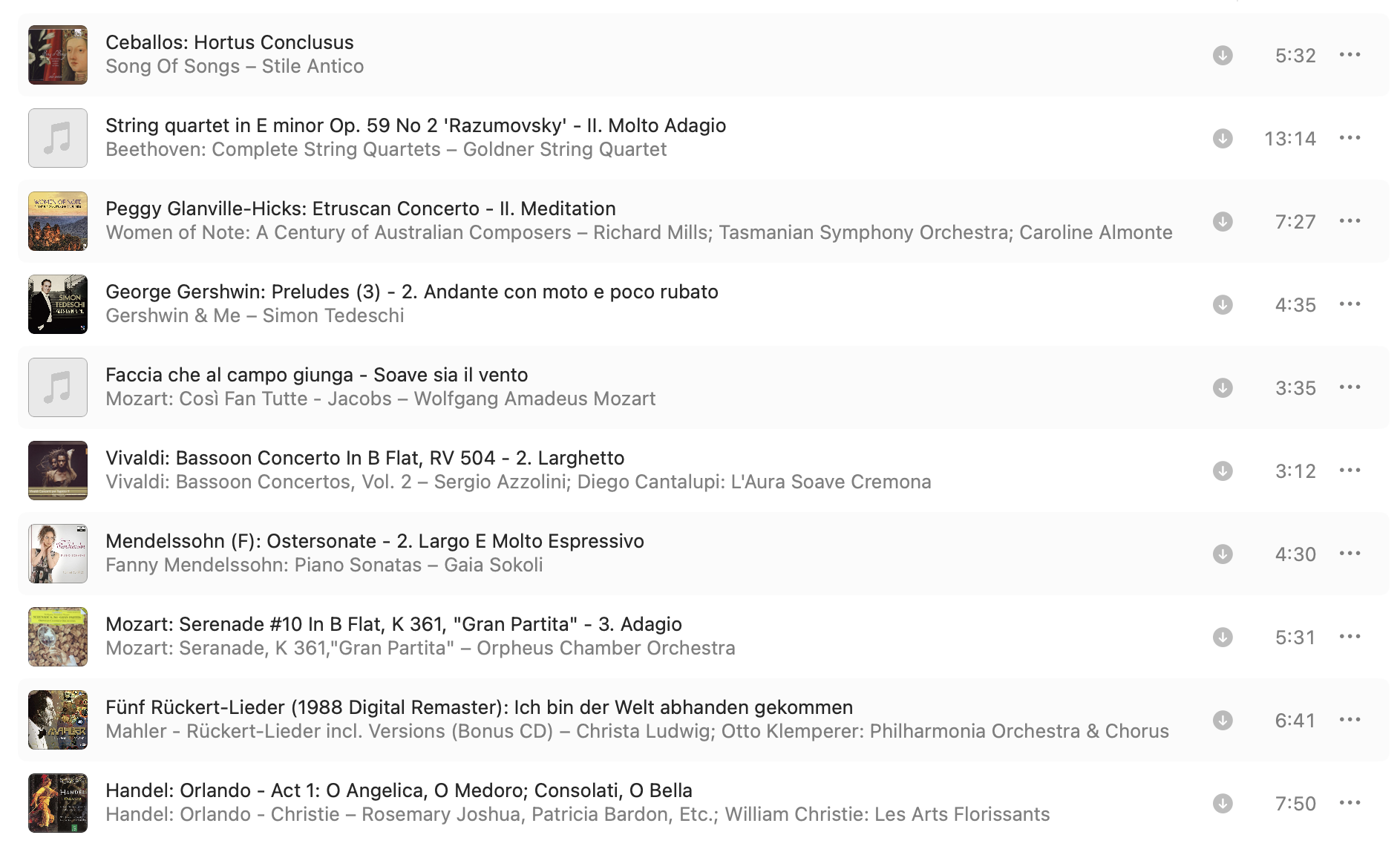
The Words
Hello everyone. Welcome to another episode of the ‘Classical For Everyone’ Podcast… five hundred years of incredible music. My name is Peter Cudlipp and… If you enjoy any music at all then I’m convinced you can enjoy classical music. All you need are ears. No expertise is necessary. If you’ve ever been curious about classical music… or explored it for a while once upon a time… or just quietly wondered what all the fuss was about… then this is the podcast for you.
And because there’s a lot of music out there each episode has something of a theme. And for this one it is… well, I need to give you a little backstory. I was listening to the conductor Joshua Weilerstein’s podcast ‘Sticky Notes’ the other day and he did an episode on Ludwig van Beethoven’s 8th string quartet. I’ll put a link to it on this episode’s webpage at classicalforeveryone.net. Anyway, he was playing the second section and he described the music as having a sense of ‘consolation’… and there was something about that which really struck me.
So I started looking into music connected to the idea of consolation but the more I delved the more I realised that wasn’t quite what I was hearing in the Beethoven. For me it was not about the small gift or healing gesture to balance a loss… it was more about the small supportive joys that hold us up… keep us going… replenish optimism… and regardless of circumstances makes each day worthwhile. And I think ‘Solace’ is a better word for what the music said to me.
And that led to a slightly different search for music for this show and I think this theme is going to deliver some really wonderful music… that does… as the subtitle says… ‘hold you.’
I’m going to start with a 500 year old song about an enclosed garden because gardens are I think overall just very good for the soul. The words taken from ‘The Song of Songs’ are sung in Latin but here they are in English…
A garden enclosed is my bride,
and a sealed fountain.
Open to me my love,
my dove, my undefiled.
Arise my love and come.
Come my fair one, let me see your face.
Your lips distil nectar,
honey and milk are under your tongue.
Come my bride, and you shall be crowned.
Here is the group ‘Stile Antico’ performing ‘Hortus conclusus’ or ‘A Garden Enclosed’ by Rodrigo de Ceballos, a Priest who lived in Southern Spain in the mid 1500s. It is about 5 minutes long.
A
That was the group ‘Stile Antico’ performing ‘Hortus conclusus’ or ‘A Garden Enclosed’ by Rodrigo de Ceballos.
Ok. Next is the Ludwig van Beethoven I mentioned at the beginning of the show. It is the slow section of his 8thstring quartet published in 1808… so written in his late 30’s. Much of the detail of Beethoven’s sources of inspiration for his compositions are from anecdotes and reminiscences recorded decades after his death. So take what follows with a grain of salt.
Beethoven’s student Carl Czerny said that Beethoven’s inspiration for this remarkable fourteen minutes for two violins, a viola and a cello came from staring up at a starry night sky and thinking about the music of the spheres. And as I was lucky enough to do the same last weekend with friends, including one who was clever enough to see a shooting star, I’m going to go with Czerny’s story.
Here is the Goldner String Quartet with the ‘molto adagio’ or ‘very slow’ section of Beethoven’s 8th String quartet. It starts very quietly.
B
That was the Goldner String Quartet with the ‘molto adagio’ or ‘very slow’ section of Beethoven’s 8th String quartet… the second piece in this week’s episode of ‘Classical For Everyone’… ‘Solace… Music To Hold You’.
So I am old enough to remember a time where the massive disparity in access and opportunity for women composers and their almost complete absence from the concert stage and the record store racks seemed like the necessary state of things. It’s embarrassing to confess to such wilful blindness. And one of the genuine joys of putting this podcast together has been opening my ears to the many voices of the other half of human experience.
And in particular to the music of the pioneers like the Australian composer Peggy Glanville-Hicks born in 1912… She was a spectacular concert pianist… and was an incredibly gifted composer but she almost by necessity for that time had to spend most of her working life outside of Australia. Whilst much of her career, primarily as a critic and author, not as a composer, was based in the US; she remained connected to Europe where she had studied and travelled extensively. In 1954 she wrote a piano concerto and called it the ‘Etruscan Concerto’. Taking the title from a non-fiction book by D. H. Lawrence called Etruscan Places, she gave each section of the work a quote from the book. For the second section she called ‘Meditation’ she added from Lawrence:
“There is a queer stillness and a curious peaceful repose about the Etruscan places....”
In this performance Richard Mills conducts the Tasmanian Symphony Orchestra and the soloist is Caroline Almonte.
And whilst I know I just made a fuss about the composer’s gender, I’m going to ask you to listen to the music for the music’s sake. And hear it without any special pleading. It doesn’t need it. Perhaps listen to it with that word ‘solace’ in mind. Here is the 7 minute ‘Meditation’ section from Peggy Glanville-Hicks’ ‘Etruscan Concerto’.
C
That was the ‘Meditation’ section from Peggy Glanville-Hicks’ ‘Etruscan Concerto’. Richard Mills conducted the Tasmanian Symphony Orchestra and the soloist was Caroline Almonte.
So I’ve maybe burdened this show with a somewhat elevated interpretation of the word ‘solace’ but it can also be something more prosaic. Sitting by yourself in a bar sipping a well-made cocktail after a tough day. Just you and the barman. And maybe a guy at the piano in the corner. If you were in the Roosevelt Hotel in New York City one night in 1926 you might have been lucky enough to hear this…
D
That was George Gershwin’s 2nd Piano Prelude. It was played by Simon Tedeschi. And yes, the first performance was in the Roosevelt Hotel in New York in 1926. Maybe in more of a ballroom but I like the quiet empty bar idea.
Sometimes music intended for an ultimately ironic outcome can draw such beauty from a composer that it takes on a far greater life than was perhaps intended. I’ll explain that after this song from Wolfgang Amadeus Mozart and Lorenze Da Ponte’s opera ‘Cosi Fan Tutte’ from 1790. It is a trio… the two lead female characters and an older male companion sing to cheer the two sad male leads who are sailing off to war. Da Ponte’s words are…
Soave sia il vento,
Tranquilla sia l'onda,
Ed ogni elemento
Benigno risponda
Ai nostri desir.
May the wind be gentle,
May the waves be calm,
And may all the elements
Kindly respond
To our desires.
The Orchestra is the Concerto Cologne, the conductor is Rene Jacobs and the singers are Bernarda Fink, Veronique Gens and Pietro Spagnoli.
E
That was the Concerto Cologne, the conductor Rene Jacobs and the singers Bernarda Fink, Veronique Gens and Pietro Spagnoli. With the song ‘Soave sia il vento’.
I mentioned a certain ‘irony’ before I played the music. At the point of the opera where that is sung the audience has information the two young women do not. The men are not going to war. They will return shortly in disguise. And the women who have claimed undying love for the men who have just sailed away… will fall for a couple of Albanians.
Listeners to the podcast will know I am a bit of an advocate for opera librettists and that I hold Lorenzo Da Ponte in pretty high esteem. Yes, without Mozart’s music so perfectly capturing the simple beauty of the wishes we have for our loved ones it would not be the same. But it is also Da Ponte’s comedy that brings a big smile.
Ok I was chatting with some people a few days back and someone in the group was pontificating about what musical instruments sound most like the human voice. I cannot recall what their theory was but I doubt they chose the bassoon. But as I was looking for something a little surprising for this show I went back to the ‘Forgotten Vivaldi’ episode and listened to a section from one of his Bassoon concertos and apart from hearing some music that I think does genuinely ‘hold’ the listener, I was struck by a real quality of a human voice to the bassoon part. All that aside it is one of those instruments that does it’s work admirably up the back of an orchestra and from time to time in a wind ensemble.
I think it’s a bit of a revelation to hear one out front for a change. Here is Sergio Azzolini playing the bassoon and Diego Cantalupe conducting the group L'Aura Soave Cremona. The slow section from Antonio Vivaldi’s Bassoon Concerto in B Flat major. It’s about four minutes long.
F
That was Sergio Azzolini playing the bassoon and Diego Cantalupe conducting the group L'Aura Soave Cremona with the slow section from Antonio Vivaldi’s Bassoon Concerto in B Flat major.
Ok. Here is a little more solo piano music. This is from Fanny Mendelssohn’s Easter Sonata from 1828 . It is the middle section and is about five minutes long and is played by Gaia Sokoli. In one of the meanings of ‘solace’ there might be some for Fanny Mendelssohn in that her sonata which was lost for over a century and then mistakenly attributed to her brother Felix.
And now we can listen to it and enjoy its beauty. And think of her.
G
That was the ‘largo e molto espressivo’ section from Fanny Mendelssohn’s Easter Sonata. The Italian is an instruction to play the music at a slow, dignified pace while focusing on deep, intense emotional expression.
Alright, next I have a piece of music I’ve played before. I’m going to be more than usually prescriptive in my description of it. There are things that make our lives worth living. Mainly the people we love. The people who love us. The memories of the people we’ve lost. The natural world around us. The starry night sky. The light before dawn. Solace. The things that hold us. And this piece of music is one of them. The five minute slow section from Wolfgang Amadeus Mozart’s ‘Gran Partita’. Here is the Orpheus Chamber Orchestra.
H
That was the five minute slow section from Wolfgang Amadeus Mozart’s ‘Gran Partita’. It was played by the Orpheus Chamber Orchestra.
My name is Peter Cudlipp and you have been listening to the ‘Classical for Everyone’ Podcast. I have another couple of pieces coming up but before I get to them I want to give you a little information that I hope you find useful… If you would like to listen to past episodes or get details of the music I’ve played please head to the website classicalforeveryone.net. That address again is classicalforeveryone.net. On the individual episode pages of the website there are links to Spotify playlists with the full versions of most of the music played in each of the episodes. I hope you have enjoyed this ‘solace’ focused episode of ‘Classical For Everyone’. And if you want to get in touch then you can email… info@classicalforeveryone.net.
Ok. Next is a seven minute song the composer Gustav Mahler wrote in 1901 to words by the German poet Friedrich Rückert. The title of the poem is Ich bin der Welt abhanden gekommen — which translates roughly as "I am lost to the world" and it is one of the most purely beautiful things Mahler ever wrote. Unlike much of his music there is no struggle in the music, no striving. Just a profound peace.
I’m going to read you the final verse…
Ich bin gestorben dem Weltgetümmel
Und ruh' in einem stillen Gebiet.
Ich leb' allein in meinem Himmel,
In meinem Lieben, in meinem Lied.
Which in English is something like…
I am dead to the world's tumult and I rest in a quiet place. I live alone in my heaven, in my love, in my song.
The singer is the great German mezzo-soprano Christa Ludwig and the conductor is Otto Klemperer. The orchestra is the Philharmonia.
I
That was the mezzo-soprano Christa Ludwig and the conductor Otto Klemperer the Philharmonia Orchestra with Gustav Mahler’s setting of Friedrich Rückert’s poem ‘I am lost to the world’.
Thanks for your time and I look forward to playing you some more incredible music on the next ‘Classical For Everyone’. This podcast is made with Audacity Software for editing, Wikipedia for Research, Claude for Artificial Intelligence and the music played is licensed through AMCOS / APRA. Classical For Everyone is a production of Mending Wall Studios and began life thanks to the enthusiasm and encouragement of Mr Jeffrey Sanders.
And if you have listened to the credits… here is some more music for you. Now normally I add something short but this is a bit over 7 minutes from Georg Friedrich Handel’s 1733 opera ‘Orlando’. In this scene the characters Medoro, an African prince, and Angelica, a queen of the far East, try to cheer up the shepherdess Dorinda and assure her that she will find love… Medoro sings to her..
Hai l'alma costante
per esser amante.
(You have the steadfast soul / to be a lover.)
This is William Christie conducting his group Les Arts Florissants and the singers are Hilary Summers, Rosemary Joshua and Rosa Mannion. Thanks again for listening.
J