

 Apple Podcasts
 Spotify
 Amazon Music
 iHeartRadio
 Overcast
 PocketCasts
  RSS Feed
 Seville… Love and Dreams

Music from and about Seville, the city of Carmen’s tobacco factory and Figaro’s barber shop; the city of flamenco and fiestas; the city where more operas are set than any other; and the city where almost eight centuries of Spanish dominance does not seem to have been able to erase the sense of the proximity of North Africa and the cultural heritage of the Moorish world. Music by Isaac Albeniz, Joaquin Rodrigo, Georges Bizet, Joaquin Turina, Wolfgang Amadeus Mozart, Francisco Guerrero and Giochhino Rossini. All of whom revel in the shifting mirage and extravagant reality that is Seville.
[The episode image is of La Giralda… the belltower of Seville Cathedral… once the minaret of the Grand Mosque of Islamic Seville.]
And here is a link to a playlist on Spotify with the music from this episode:
https://open.spotify.com/playlist/7tBuKyVFAkSo6b22KVxQrv?si=a5b8803af82a40e8
The Music
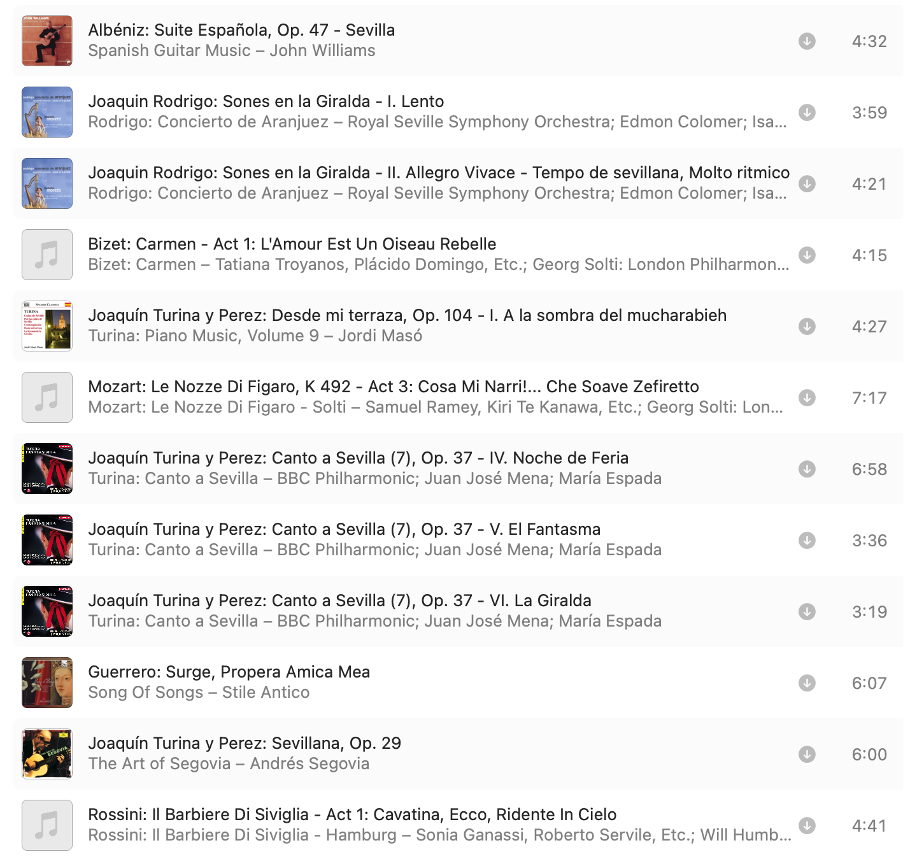
The Words
Hello everyone. Welcome to another episode of the ‘Classical For Everyone’ Podcast… five hundred years of incredible music. My name is Peter Cudlipp and… If you enjoy any music at all then I’m convinced you can enjoy classical music. All you need are ears. No expertise is necessary. If you’ve ever been curious about classical music… or explored it for a while once upon a time… or just quietly wondered what all the fuss was about… then this is the podcast for you.
And because there’s a lot of music out there each episode has a theme. And for this one it is music from and / or about the Spanish city of Seville, or Sevilla, as the 600 million plus Spanish speakers of the globe render it… Now their accents would all be better than mine so I want to apologise in advance for some unintended mangling… especially of names… over the next hour.
More about the city in a while. I want to get into some music.
In 1886 Isaac Albeniz ( ISARK ALBAYNIS ) wrote a group of eight pieces for piano each depicting something of the different qualities of particular parts of Spain. In the 20th century a number of them had a second life as transcriptions for the guitar. Here is the guitarist John Williams with the section of Albeniz’s Spanish Suite No 1. called ‘Sevilla’
A
That was the guitarist John Williams with the ‘Sevilla’ section of Isaac Albeniz’s Spanish Suite No. 1.
Ok. 45 seconds about the city that is the focus of this episode of Classical For Everyone.
Seville, in southern Spain, about 50 miles inland from the Atlantic coast, is the capital of the state of Andalusia, which is the modern version of the Islamic name, Al–Andalus by which the region was known when it was ruled by various Islamic dynasties. The principal civilisations that shaped Seville were the Phoenicians, the Romans, the Visigoths, the Muslims and then the Spanish. But it is perhaps the Muslim influence from 711 to 1248 that gives the city such a unique character. Almost eight centuries of Spanish dominance does not seem to have been able to erase the sense of the city’s proximity to North Africa and the cultural heritage of the Moorish world.
Ok. Next I’m going to play you a piece by Joaquin Rodrigo written for harp and orchestra in 1963 he called ‘Sones en la Giralda’ or ‘Sounds of the Giralda’. The Giralda is the belltower attached to the Cathedral of Seville but the structure was originally the minaret attached to the grand mosque of Seville which began construction in 1184.
When the Christians started building the cathedral in 1402 they kept the minaret and then two centuries later added a Renaissance belltower to the top. And on top of that they added a sculpture which is actually also a weathervane; and from the Spanish verb ‘girar’ meaning ‘to turn’ the bell tower became known colloquially as ‘La Giralda’ and the name has stuck.
I’m going to suggest an explanation for the title of Rodrigo’s piece because it is not about massive tolling bells, which is the primary sound created by La Giralda… but if you climb to the top you are about 80 meters above the centre of old Seville. And from there, were it not for the babble of tour groups today, you could, once upon a time, hear the sounds of Seville… hence ‘Sones en la Giralda’.
Here's a note by the Rodrigo scholar, Graham Wade…
“The work is a tone poem, a work that develops a sequence of imaginative moods. Beginning with aslow section, nocturnal in its dark colours, the piece proceeds to faster speeds, creating the essential spirit of Seville's traditional flamenco dances with their characteristic rhythmic intensity. The work is vividly virtuosic throughout for the harpist in collaboration with a fiery accompaniment from the orchestra.”
Ok. It is about 8 minutes long and here is the harpist Isabelle Moretti; the Royal Seville Symphony Orchestra and the conductor is Edmon Colomer with ‘Sounds of the Giralda’ by Joaquin Rodrigo.
B
That was the harpist Isabelle Moretti, the Royal Seville Symphony Orchestra and the conductor was Edmon Colomer with ‘Sounds of the Giralda’ by Joaquin Rodrigo. And by the way the image I’m using for this episode on the hosting platforms and Instagram is of ‘La Giralda’. In case you were wondering.
One of Seville’s stranger claims to fame is that more operas have been set in the city than any other. And in this show I’m going to play excerpts from three of them… starting with Georges Bizet’s ‘Carmen’ from 1875. One of the comments frequently made about Carmen over the last 150 years, often as a veiled criticism by people annoyed with its popularity, is that Bizet never visited Spain. Which is true… but the author of the 1845 novella that the libretto is based on, certainly did. Prosper Merimée. A fascinating figure now fading into the distant past he travelled through Spain for over a year.
Now, if you have been to Seville one of the more confusing encounters you may have had is to walk past the massive and ornate edifice of the main building of the University of Seville and to see a sign pointing to it saying ‘Real Fabrica de Tabacos’… ‘Royal Tobacco Factory’. Which frankly makes very little sense. But it’s true. What is now the heart of the University was the engine of the Spanish crown’s monopoly on the tobacco industry. And from 1829 it was decided that only women were to be employed… because of their significantly lower wages than men. To give you an idea of scale, at its peak there were over 6,000 women working there. Carmen, the title character of Merimée’s novella and Bizet’s opera is one of those women. And early in the opera, on a break, Carmen teases a group of soldiers with a song about her untameable and unpredictable attitude to taking a lover…
There is some singing in Spanish later in the show but Bizet’s opera was for Paris and the libretto is in French. The song is L'amour est un oiseau rebelle or ‘Love is a rebellious bird.’ . It is also known as the ‘Habanera’ as it uses the rhythm of a Cuban folk style.
This is Georg Solti conducting the London Philharmonic Orchestra and Tatiana Troyanos sings the role of Carmen.
C
That was Georg Solti conducting the London Philharmonic Orchestra and Tatiana Troyanos sang ‘L'amour est un oiseau rebelle’ or ‘Love is a rebellious bird.’ From Georges Bizet’s ’Carmen’.
So, when putting these shows together there is a certain amount of wishful thinking at the beginning of researching each one. And what I particularly enjoy is stumbling onto some music or a maybe a composer that fits for the theme of the show and has been a little unfairly neglected.
Welcome to the music of Joaquin Turina. Born in Seville in 1882 and dying in Madrid in 1949 he studied in Paris and from the 1930’s was head of composition at the Madrid Conservatory. I’m going to play three pieces of his in the show starting with a section from one of the last things he wrote, a group of works for piano called ‘Desde mi teraza’… ‘From my terrace’ This the piece called A la sombra del mucharabieh ‘In the Shade Of A Moorish Screen’. It is about 5 minutes long and the pianist Jordi Masó.
D
That was the pianist Jordi Masó with A la sombra del mucharabieh ‘In the Shade Of A Moorish Screen’ by Joaquin Turina.
The next piece I am going to play connected to Seville is from another opera. The music was written by an Austrian, Wolfgang Amadeus Mozart, the libretto was written by an Italian, Lorenzo da Ponte, and it was based on a play written by a Frenchman, Pierre de Beaumarchais in 1778.
So how did ‘La Nozze di Figaro’, ‘The Marriage of Figaro’ come to be set in Seville? Well, and I think this can be applied to a lot of the operas set there, Seville with its rich and complicated history could easily be conceived of as a place where the exotic and the unexpected could take place… just the requirements needed for the fanciful elements of most opera plots. But with Figaro, there is also a political issue. Beaumarchais’s play is a biting satire of the class system; displaying aristocratic privilege as ripe for overthrow… by the wit and ingenuity of the servant class. There was no way he could set it in the France of Louis XVI without getting into serious trouble.
And it is perhaps worth making the point that amongst even the tiny sliver of people with the wherewithal, interest and opportunity to travel… Seville was off the beaten track. Beaumarchais had spent a year in Madrid but he never got to Seville. It’s hard to imagine that many of the audience for Mozart and Da Ponte’s opera had been to Seville. For the creators and their audiences it became a shifting mirage of a city… perfect for projecting fantasies onto.
In the third act of the opera the Countess Almaviva and her maid Susanna concoct a love letter together to expose the Count’s infidelity. Their duet is known by its opening line ‘"Sull'aria ... che soave zeffiretto" (On the breeze ... What a gentle little Zephyr). Here are Kiri Te Kanawa and Lucia Popp singing the Countess and Susanna and Georg Solti conducts the London Philharmonic Orchestra. Two and a half minutes of rather beautiful music.
E
That was Kiri Te Kanawa and Lucia Popp singing the Countess and Susanna and Georg Solti conducted the London Philharmonic Orchestra with ‘"Sull'aria ... che soave zeffiretto" (On the breeze ... What a gentle little Zephyr) from Mozart and Da Ponte’s opera ‘The Marriage of Figaro’. Which is set in Seville… the subject of this episode of ‘Classical For Everyone’.
And this episode is actually inspired by being fortunate enough to be in Sevilla last weekend for my niece Emma’s wedding… which was, and I promise I am not biased, a truly wonderful event. ¡Felicidades por su boda! Y, Alberto, bienvenido a la familia.
Ok. In the 1920’s Joaquin Turina wrote a seven part work he called ‘Canto a Sevilla’, Song to Seville. It is a mix of purely orchestral sections and sections for a soprano singer and the orchestra. The songs are settings of poems by Muñoz San Roman. I’m going to play you the orchestral interlude ‘Night of the Festival’ followed by the songs ‘The Phantom’ and ‘The Giralda’… another response to the Cathedral’s belltower.
It is about 14 minutes of music and it is performed by the BBC Philharmonic conducted by Juan Jose Muna and the soprano is Maria Espada. Joaquin Turina’s ‘Canto a Sevilla’.
F
That was three sections from Joaquin Turina’s ‘Canto a Sevilla’ and it was performed by the BBC Philharmonic conducted by Juan Jose Muna and the soprano was Maria Espada.
Ok, some music from a composer who lived and died in Seville. But 400 years before Joaquin Turina. Francisco Guerrero was a catholic priest and composer who lived from 1528 to 1599 and was attached to the Cathedral of Seville for a good amount of those years. Amongst his many religious compositions were a group of choral settings of verses from the Old Testament book, The Song Of Songs.
I’m going to play you his setting of the verse ‘Surge, propera amica mea, columba mea, formosa mea, et veni’ which translates as ‘Arise, make haste, my love, my dove, my beautiful one, and come’. According to the Internet the verse describes the end of winter and the arrival of spring. At the risk of offending people I’d suggest that there might be more to those words than the change of seasons.
Here is the group Stile Antico with Francisco Guerrero’s ‘Surge, propera amica mea’. It is about six minutes long.
G
That was Francisco Guerrero’s ‘Surge, propera amica mea’ and it was performed by the group Stile Antico.
And as an aside for those of you wondering when AI will make us redundant you might enjoy that when I typed ‘surge, prospera’ that’s S U R G E into Google, the AI assistant in a millisecond replied… and I quote… “If you are looking for the Renaissance choral motet… or if you need hardware surge protectors, you are in the right place.”
My name is Peter Cudlipp and you have been listening to the ‘Classical for Everyone’ Podcast. I have another couple of pieces coming up but before I get to them I want to give you a little information that I hope you find useful…
If you would like to listen to past episodes or get details of the music I’ve played please head to the website classicalforeveryone.net. That address again is classicalforeveryone.net. On the individual episode pages of the website there are links to Spotify playlists with the full versions of most of the music played in each of the episodes. I hope you have enjoyed this episode of ‘Classical For Everyone’ devoted to music from and about the city of Seville. And if you want to get in touch then you can email… info@classicalforeveryone.net.
Alright, to finish this episode I have one more piece from Joaquin Turina. In 1923 the then 30 year old guitarist Andres Segovia finally persuaded Turina to write a piece for him. Turina had been reluctant to write for an instrument he had no mastery of. In the process of composition apparently Segovia almost acted as a teacher translating Turina’s intentions into practical outcomes. The result is known as his Sevillana or Fantasy and it also captures something of the flamenco music that is so central to Seville.
Here is a recording that Segovia made in 1967, three decades after he commissioned it. Joaquin Turina’s ‘Sevillana’. It is about 6 minutes long.
H
That was Joaquin Turina’s ‘Sevillana’ performed by Andres Segovia.
Thanks for your time and I look forward to playing you some more incredible music on the next ‘Classical For Everyone’. This podcast is made with Audacity Software for editing, Wikipedia for Research, Claude for Artificial Intelligence and the music played is licensed through AMCOS / APRA. Classical For Everyone is a production of Mending Wall Studios and began life thanks to the enthusiasm and encouragement of Mr Jeffrey Sanders.
Now I did say at the beginning of the show that I would include excerpts from three operas and there has been so far one perhaps rather significant omission… if we are talking operas set in Seville. That would be Gioacchino Rossini’s ‘Il Barbiere di Siviglia’… The Barber of Seville… first performed in 1816. Again, it is based on a play by Pierre de Beaumarchais. It is the first of a trilogy about the same characters and is followed by ‘The Marriage of Figaro’ and the lesser known ‘The Guilty Mother’.
In the song I am going to play you, the young Count Almaviva (and remember this is set some years before the play Mozart and Da Ponte used) hires a street band to accompany him as he serenades the young Rosina (who will become his Countess) outside the house where she is essentially kept a prisoner by her guardian. Almaviva’s song begins…
Ecco, ridente in cielo
spunta la bella aurora,
e tu non sorgi ancora,
e puoi dormir così?
"See, laughing in the sky,
Ramon Vargas sings Count Almaviva and Will Humburg conducts the Failoni Chamber Orchestra.
Thanks again for listening.
Gracias de nuevo por escuchar.
I