

 Apple Podcasts
 Spotify
 Amazon Music
 iHeartRadio
 Overcast
 PocketCasts
  RSS Feed
 Recent Discoveries Two
Recent Discoveries Two
This episode is the second one called ‘recent discoveries’. And that should only be taken in the very personal sense of ‘recent discoveries’ for me. Some of it is indeed recent but in addition to music written in the last few years, there are a couple of pieces that date back to the early and mid-20th century so they were well and truly discovered before I encountered them. I want to apply a little bit of gentle pressure on behalf of the unfamiliar. I am going to hope that you will be pleasantly surprised by how good music by people whose names might not know can be… Music from Maria Grenfell, Gabriela Ortiz, Daniel Asia, Ethel Smyth, Herbert Howells, and the perhaps more recognisably… Dmitri Shostakovich.
And here is a link to a playlist on Spotify with the music from this episode:
https://open.spotify.com/playlist/6tXqM3FoPYFZENFzpR6yCg?si=e0044766729d42ae
https://www.mariagrenfell.com.au
https://podcasts.apple.com/au/podcast/classical-music-happy-hour/id1839323732?i=1000755934821
The Music
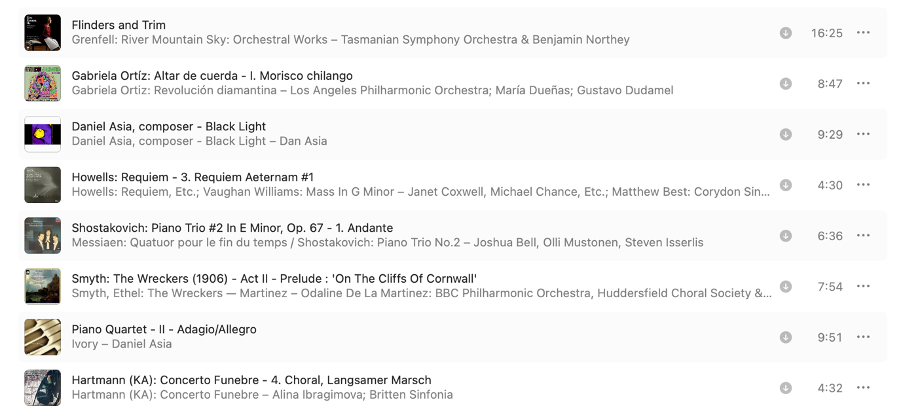
The Words
Hello everyone. Welcome to another episode of the ‘Classical For Everyone’ Podcast… five hundred years of incredible music. My name is Peter Cudlipp and… If you enjoy any music at all then I’m convinced you can enjoy classical music. All you need are ears. No expertise is necessary. If you’ve ever been curious about classical music… or explored it for a while once upon a time… or just quietly wondered what all the fuss was about… then this is the podcast for you.
And because there’s a lot of music out there each episode has something of a theme. And this episode is the second one I am calling ‘recent discoveries’. And that should only be taken in the very personal sense of ‘recent discoveries’ for me. Some of it is indeed ‘recent’ but in addition to music written in the last few years, there are a couple of pieces that date back to the early and mid 20th century so they were well and truly discovered before I encountered them.
Part of the process of finding the music for this episode was the kindness of strangers… and I’ll say some ‘thank yous’ at the end of the show but to start I want to apply a little bit of gentle pressure on behalf of the unfamiliar. I am going to hope that you will be pleasantly surprised by how good music by people whose names might not know can be… Music from Maria Grenfell, Gabriela Ortiz, Daniel Asia, Ethel Smyth, Herbert Howells, and the perhaps more recognisable… Dmitri Shostakovich.
It is a lucky accident that the first piece in an episode called ‘recent discoveries’ was partially inspired by one of the great maritime explorers of the early 19th century… Matthew Flinders. That name will probably be known to listeners from a continent at the bottom of the planet. In fact, Flinders was the first person to push to name the place Australia.
First performed in 2019 Maria Grenfell’s ‘Flinders and Trim’ is a sixteen minute work for orchestra. But who is Trim you might ask? Trim was the ship’s cat and here is an excerpt from Grenfell’s notes about the piece…
“Flinders and Trim is not a narrative musical composition. It does not tell a story, but it attempts to capture the essence of the ocean, friendship, companionship, humour, love and loss. One of the most engaging facts about Matthew Flinders was his affection for his cat. This fabulous feline was named after the butler in novel Tristram Shandy by Laurence Sterne. Trim spent most of his life on ships, climbing ropes, swimming in the sea, and catching mice. He spent some time in England but his temperament did not suit dry land. Trim was Flinders’s constant companion in the period of Flinders’ greatest achievements.
Here is Maria Grenfell’s ‘Flinders and Trim’. Benjamin Northey conducts the Tasmanian Symphony Orchestra.
A
That was Maria Grenfell’s ‘Flinders and Trim’. Benjamin Northey conducted the Tasmanian Symphony Orchestra. I’ll put link to Maria Grenfell’s website in the show notes. Much very good music to be enjoyed.
Incidentally, Trim is actually one of the most celebrated cats in cat history, if that is a thing… even memorialised in a statue on a window ledge of the State Library of New South Wales from which he gazes with that special cat-like passivity at a nearby statue of Matthew Flinders. When Trim died during the six years Flinders was a prisoner of the French on the island of Mauritius (a story for another time) Flinders wrote…
“Thus perished my faithful intelligent Trim! The sporting, affectionate and useful companion of my voyages during four years. Never, my Trim, to take thee all in all, shall I see thy like again.”
Ok. The 2024 album of music by the Mexican composer Gabriela Ortiz, Revolución diamantina, won three Grammy Awards, including Best Contemporary Classical Composition. On that release is a violin concerto Ortiz called Altar de cuerda — or "String Altar". It was commissioned by the conductor Gustavo Dudamel and the Los Angeles Philharmonic and for the violinist Maria Dueñas.
It is the seventh in Ortiz's ongoing series of what she calls musical altars, a project she began in 1995. For Ortiz, the altar is not a religious concept — its meaning tends more toward the symbolic, the spiritual, and the magical. An altar is a place to throw music into relief.
I’m going to play the first section called Morisco chilango, which fuses Gabriela Ortiz's Mexico City background with Maria Dueñas's roots from Andalusia in Southern Spain — "chilango" being the affectionate slang term for residents of Mexico City, and "morisco" evoking the Moorish musical threads that run through Spanish musical culture. It is about nine minutes long and here is the conductor Gustavo Dudamel and the Los Angeles Philharmonic… and the violinist Maria Dueñas.
Morisco Chilango from Altar de cuerda by Gabriela Ortiz.
B
That was the conductor Gustavo Dudamel and the Los Angeles Philharmonic… the violinist Maria Dueñas with Morisco Chilango from Altar de cuerda by Gabriela Ortiz.
Now, if by chance you wanted to buy a copy of that CD, you can’t. Even with three Grammy’s it is only available as a digital download. It is as if the publishers of the Man Booker Prize winning novel decided to only release a version for Kindle.
On a lighter note I listened to a very good interview with Gabriela Ortiz on Emmanual Ax’s new podcast ‘Classical Music Happy Hour’. I’ll put a link to it in the show notes.
Ok. Next up is music from the American composer Daniel Asia who was born in 1953.
Asia belongs to a generation of American composers who found their way back from the austerities of the mid-twentieth century avant-garde toward a music that trusts the ear again — not by abandoning complexity but by insisting that complexity and beauty are not in opposition.
From intimate song cycles drawing on Hebrew poetry and E.E. Cummings to large-scale orchestral works commissioned by major American symphony orchestras, Asia's output spans virtually every genre of concert music — six symphonies, concertos, chamber music, and choral works.
Here is his work for orchestra, ‘Black Light’. This is a recording from the early 2000’s with the New Zealand Symphony Orchestra conducted by James Sedares. It is in two parts, is about 9 minutes long and starts very quietly. Music of Daniel Asia.
C
That was the New Zealand Symphony Orchestra conducted by James Sedares with Daniel Asia’s ‘Black Light’. I’ll put a link to the composer’s website in the show notes. There is an amazing amount of great music to explore.
Ok. Herbert Howells was an English composer who lived from 1892 to 1983. He was best known for his Anglican church music.
How does he fit into a ‘recent discoveries’ episode? Well, sometimes you buy a CD for a particular piece that is on it and then time passes and you pick it up and go… well… might be time to listen to the other music on the disc.
I’m going to go off on a tangent for a moment to say that I am generally a fan of the idea of a ‘canon’… that there are certain works of art that are of such quality that they deserve to be elevated to a certain dominant position… the work you want future generations to have the opportunity to experience… even is that is a process of selection that means there are winners and losers. But the more I actively listen to music as I put these episodes together the more my confidence in this idea of a ‘canon’ is eroded.
I just asked Google for a list of the top 50 choral requiems… music setting the words of various Christian denomination’s services to commemorate the dead. Now, we are already in an area of musical composition that is not going to get onto many Desert Island Disc lists… but the piece I am going to play you a selection from doesn’t even make it onto the top 50 Requiems.
So as you listen to the next 4 and a half minutes of music from Herbert Howells Requiem written in 1932 maybe have a think about the assumptions we make when we put together a list of ‘best of’ or ‘most popular’ or ‘top ten’. Perhaps we can be a little too quick to discard works that for all sorts of reasons were not ‘anointed’. All that said, you could just enjoy the music.
Here are the Croydon Singers conducted by Matthew Best with the third section of Howell’s Requiem where he sets the Latin words meaning… “Eternal rest grant unto them, O Lord, and let perpetual light shine upon them."
D
That was the Croydon Singers conducted by Matthew Best with the third section of Herbert Howell’s Requiem.
The next work is in this show arrives in the recent discoveries category by virtue of a newly acquired re-released recording of a relatively well-known piece… where the three performers are all artists I’ve been lucky enough to see live over the years.
I’ll tell you a little about the work after I’ve played it for you. This is the opening section of Dmitri Shostakovich’s 2nd Piano Trio. The performers are Joshua Bell playing the violin, Steven Isserlis playing the cello and Olli Mustonen playing the piano. It is about 7 minutes long. It starts very, very quietly.
E
That was Joshua Bell playing the violin, Steven Isserlis playing the cello and Olli Mustonen playing the piano with the opening section of Dmitri Shostakovich’s 2nd Piano Trio.
The piano trio was composed in 1944, in the heart of the Second World War, It was written in memory of Shostakovich’s friend Ivan Sollertinsky, a musicologist and champion of his music who had died suddenly in February 1944. But it was also written as the reports of what was happening in the Nazi death camps began to reach the Soviet Union… and the fate of the Jewish people was something Shostakovich referenced later in the work.
And if you recall a little earlier I was discussing things canonical… music that the weight of opinion over time determines, to put it simply, to be in a class of its own. And I earlier questioned the validity of such a selection process but now I want to have my cake and eat it too… and heartily recommend that if you enjoyed that excerpt from Shostakovich’s 2nd Piano Trio that you seek out the work. And if you can hear it live… that’s even better.
Ok. The next piece was composed in 1904. And I’d known of its existence for a long time… but it was only recently that I listened to it… so, for me a recent discovery. This is Ethel Smyth’s opera ‘The Wreckers’. I played little section from it a few months back but at the time I didn’t have the CD. Now I do. I’m going to play the orchestral prelude from the opening of the 2nd which has come to be called… ‘On the Cliffs of Cornwall’.
Cornwall, where the opera is set, is a peninsula that thrusts out into the Celtic sea at the extreme southwest of the United Kingdom and as you’d expect the coast is rugged and storm-tossed. And in past centuries it was the site of all too common shipwrecks. The locals, generally living in grinding poverty would collect whatever washed ashore for themselves and earned the name ‘wreckers’. This predatory and perhaps macabre cottage industry was then embellished by hearsay into the fiction that villagers would move navigation lamps and fires around the clifftops to lure ships to their doom on the rocks below… and then murder any surviving sailors. And this dark subject became the premise for Ethel Smyth’s opera.
Here is Odaline de la Martinez conducting the BBC Philharmonic Orchestra with the prelude to Act II of Ethel Smyth’s opera ‘The Wreckers’. It is about 9 minutes long.
F
That was Odaline de la Martinez conducting the BBC Philharmonic Orchestra with the prelude to Act II of Ethel Smyth’s opera ‘The Wreckers’.
Surprisingly, that music is not available on Spotify, Idagio or Apple Music. So this was one of those times when having invested in old fashioned physical media turns out to be not the worst idea.
My name is Peter Cudlipp and you have been listening to the ‘Classical for Everyone’ Podcast. I have another couple of pieces coming up but before I get to them I want to give you a little information that I hope you find useful…
If you would like to listen to past episodes or get details of the music I’ve played please head to the website classicalforeveryone.net. That address again is classicalforeveryone.net
On the individual episode pages of the website there are links to Spotify playlists with the full versions of most of the music played in each of the episodes. I hope you have enjoyed this ‘recent discoveries’ episode of ‘Classical For Everyone’.
And a quick note. I am taking a couple of weeks off. So the next two or three episodes of the podcast will be repeats. I’m going to choose early ones that some of you may have missed. Maybe the one on Maurice Ravel and perhaps the one on Muses. But if you have any particular favourites then please email me at…info@classicalforeveryone.net.
Alright, next I have some more from the composer Daniel Asia. This is the second section from his Piano Quartet which is featured on the CD ‘Ivory’… available I believe from the good people at Summit Records. There will be a link in the show notes.
The performers are the Bridge Ensemble and the pianist Jonathan Shames. It is about nine minutes long.
G
That was the Bridge Ensemble and the pianist Jonathan Shames with the second section from Daniel Asia’s Piano Quartet.
Thanks for your time…
And I’d like to thank a couple of people who made a big contribution to this episode… Igor Reznik from Momentum Artists in New York who got in touch and introduced me to the music of Daniel Asia… and the composer Maria Grenfell who went to the trouble of mailing me a CD of her music when it proved tricky to track down by more conventional methods.
This podcast is made with Audacity Software for editing, Wikipedia for Research, Claude for Artificial Intelligence and the music played is licensed through AMCOS / APRA. Classical For Everyone is a production of Mending Wall Studios and began life thanks to Mr Jeffrey Sanders.
Ok. The final work for this episode is something more from the composer Gabriela Ortiz… from her ballet ‘Revolucion diamantina’ which takes its name from a women’s protest movement that began in Mexico City in 2019.
The ballet is in six parts and I’m going to play the first which has the subtitle ‘The sounds cats make’ …which I think rather nicely wraps up an episode that began with the story of a cat. Here are the Los Angeles Philharmonic and the Los Angeles Master Chorale conducted by Gustavo Dudamel. It is about nine minutes long.
Thanks again for listening.