


Recent Discoveries


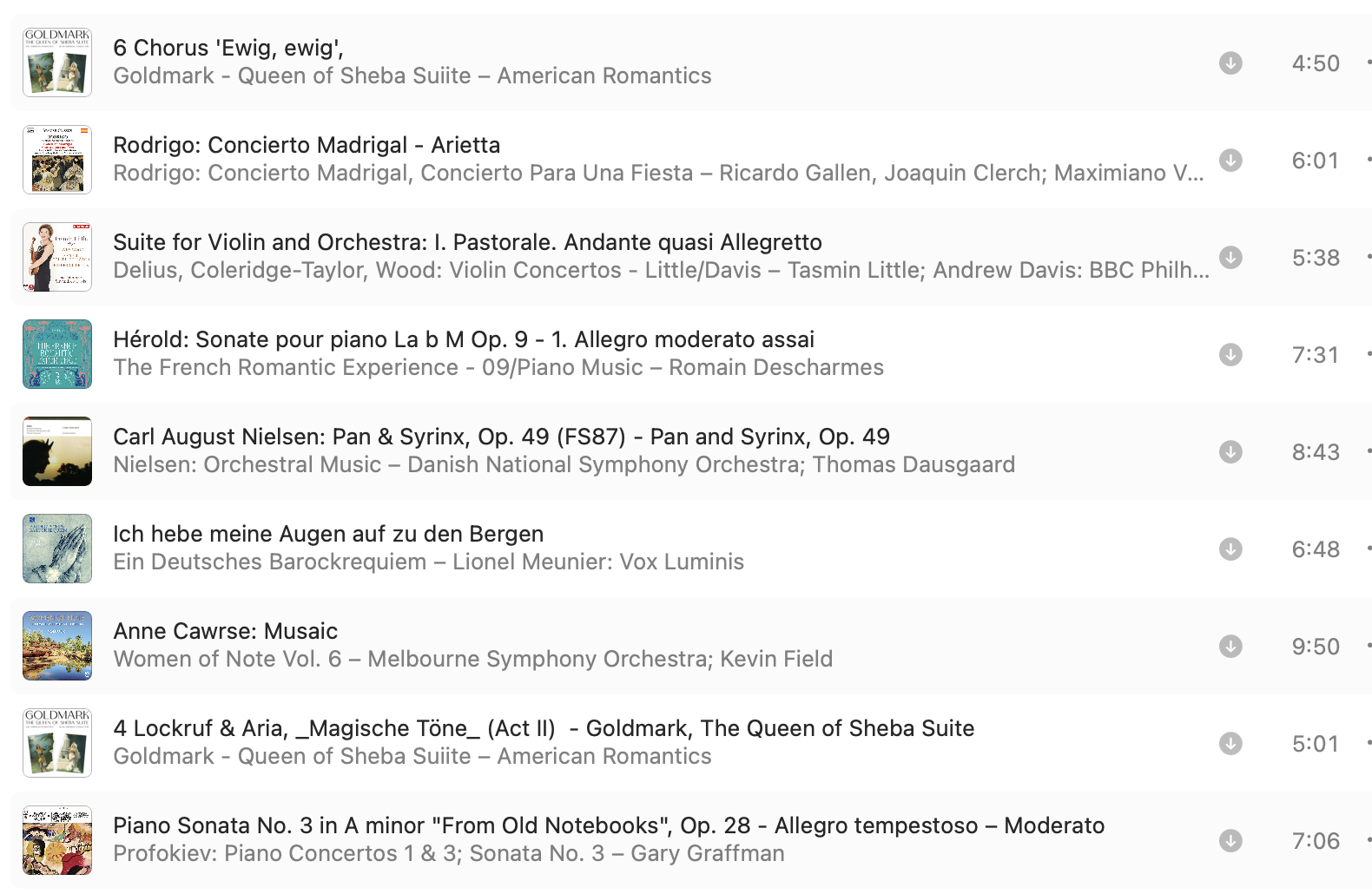
Only be taken in the very personal sense of… recent discoveries by me. Not that I actually discovered anything. In my ongoing mission to keep the production of CDs alive, I came across music I didn’t know and thought that you, my fine listeners, might enjoy. Incidentally, I was chatting with my friend Claude about the episode and his comment was that my title sounded much more dignified than "Music from Last Month’s Credit Card Statement." And I urge you not to be discouraged by the idea of unfamiliar music. I promise there is some very lovely listening in the next 75 minutes from… Karl Goldmark, Joaquin Rodrigo, Frederick Delius, Ferdinand Hérold, Carl Nielsen, Andreas Hammerschmidt and Anne Cawrse.
And here is a link to a playlist on Spotify with some of the music from this episode:
https://open.spotify.com/playlist/6cXTXiNN15bh9GE0iJstzL?si=3af8c3ca56d64611
And this is a link to the documentary featuring Tasmin Little exploring Frederick Delius time in Florida:
The Music
The Words
Hello everyone. Welcome to another episode of the ‘Classical For Everyone’ Podcast… five hundred years of incredible music. My name is Peter Cudlipp and… If you enjoy any music at all then I’m convinced you can enjoy classical music. All you need are ears. No expertise is necessary. If you’ve ever been curious about classical music… or explored it for a while once upon a time… or just quietly wondered what all the fuss was about… then this is the podcast for you.
And because there’s a lot of music out there each episode has something of a theme. And for this one it is… what I am calling ‘recent discoveries’. And that should only be taken in the very personal sense of ‘recent discoveries’ by me. Not that I actually discovered anything. In my ongoing mission to keep the production of CDs alive, I came across music I didn’t know and thought that you, my fine listeners, might enjoy. Incidentally, I was chatting with my friend Claude about the episode and his comment was that my title sounded much more dignified than "Music from Last Month’s Credit Card Statement."
I’d also urge you not to be discouraged by the idea of unfamiliar music. I promise there is some very lovely listening in the next 75 minutes from… Karl Goldmark, Joaquin Rodrigo, Frederick Delius, Ferdinand Hérold, Carl Nielsen, Andreas Hammerschmidt and Anne Cawrse.
Now another reason that prompted this show is that Kevin Sherwin, the conductor of The American Romantics group, which specialises in the performance practices and repertoire of the late 19th and early 20th centuries, sent me an email about a fascinating recording project they have embarked on. And I am going to start with an excerpt from it.
There is a long tradition of taking selections of the music from operas and turning them into a work for the concert hall… often calling it a ‘suite’. And as putting on an opera is not exactly an easy undertaking this is a way for the composer’s music to live on. Or in this instance perhaps to be resurrected.
Karl Goldmarks’ 1885 opera The Queen of Sheba premiered in Vienna in 1875 and was, for the then 45 year-old composer, a huge success. And it remained popular until the 1930s. The libretto was by Saloman Mosenthal and the work was in the grand opera style of Verdi’s ‘Aida’ and Saint-Saen’s ‘Samson and Delilah’. The plot was a fictional love triangle set in the court of the Biblical King Solomon.
Kevin Sherwin has written an orchestral suite featuring Goldmark’s music for ‘The Queen of Sheba’ and it is now available as a CD or for streaming from their website www.americanromantics.org.
Here from the Suite is the piece ‘Ewig, Ewig’ or ‘Forever, forever’. In the opera this music is for a scene in Solomon’s Temple. This is the American Romantics conducted by Kevin Sherwin.
A
That was The American Romantics with ‘Ewig, Ewig’ or ‘Forever, forever’. Arranged and conducted by Kevin Sherwin from Karl Goldmark’s opera ‘The Queen of Sheba’. And that is a brand new recording available at www.americanromantics.org. And I will play another selection at the end of this episode.
Next up in this ‘recent discoveries’ show is a piece by the 20th century Spanish composer Joaquin Rodrigo but it is connected to a composer / performer I featured back in the Brilliant Women episode in November last year… the guitarist Ida Presti. Her brilliance as a performer, along with that of her husband and musical partner Alexandre Lagoya, as a celebrated guitar duo had already inspired Rodrigo to write his Tonadilla for two guitars in 1959.
In 1966 Presti and Lagoya commissioned Rodrigo to compose a concerto for two guitars and orchestra. But tragically, Ida Presti died suddenly in April 1967 at the age of 42 during a concert tour in the United States, before she and Lagoya could perform the new work. The ‘Concierto Madrigal’ as Rodrigo called it would be premiered by Angel and Pepe Romero and the Los Angeles Symphony Orchestra at Hollywood Bowl in 1970.
Based on music from a Renaissance song by Jacques Arcadelt, the concerto takes the form of a suite in ten short sections, each with its own title, representing what Rodrigo himself described as one of his finest achievements in combining variation form with poetic character sketches. I’m going to play the ‘Arietta’ section. It is about 6 minutes long. And by way of explanation ‘arietta’ is Italian for ‘little song’ and the section is a light and reflective interlude, that sits between the sections that are based on the energetic dances of Spain.
Here are the guitarists Ricardo Gallen and Joaquin Clerch; the conductor Maximiano Valdes and the Asturias Symphony Orchestra with the Arietta from the Concierto Madrigal by Joaquin Rodrigo.
B
That was the Guitarists Ricardo Gallen and Joaquin Clerch; the conductor Maximiano Valdes and the Asturias Symphony Orchestra with the Arietta from the Concierto Madrigal by Joaquin Rodrigo.
In the context of an episode called ‘recent discoveries’, Frederick Delius’ ‘Suite for Violin and Orchestra’ from 1888 seems to fit the bill quite well. It would have been hard to discover for the first century of its existence as it was only performed for the first time in 1984.
I think it is fair to say that Delius music does not crop up that often especially outside the UK. And it was only when I discovered that he had a connection with the coast of north-eastern Florida in the USA, an area I know pretty well, that my interest was piqued. The story is that in his early 20s Delius ended up running an orange plantation on the St Johns River near Jacksonville. The British violinist Tasmin Little was featured in a 30 minute documentary about his time there and she argues, persuasively I think, that events there coloured his music in interesting ways. I’ll put a link to the documentary on YouTube on this episode’s page on at classicalforeveryone.net. It’s a fascinating story. It was only a few years after the Florida experience that Delius really started to write mature music and his Suite for Violin and Orchestra is one of his earliest works. Here is the opening section. It is performed, appropriately, by the violinist Tasmin Little and the BBC Philharmonic Orchestra conducted by Andrew Davis.
C
That was the opening section of Frederick Delius ‘Suite for Violin and Orchestra’. It was performed by the violinist Tasmin Little and the BBC Philharmonic Orchestra conducted by Andrew Davis.
If the 19th Century French composer Ferdinand Hérold is known today at all, it is as the composer of one of the several versions of the comic ballet ‘La Fille Mal Gardée’ or ‘The Poorly Guarded Girl’. Along with ballets, Hérold wrote music for 24 operas and one of the articles I was reading referred to him as ‘a creature of the stage’. And I wonder if that is a factor in his relative obscurity today. Only a handful of the composers we still celebrate wrote primarily for the stage and if you were not in that elect few, and I’m thinking of Verdi, Wagner and Puccini, then with the costs and personnel required to keep your work alive, the chances of longevity are dramatically reduced. But in a collection of French music put out by the Bru Zane Foundation I discovered a gorgeous Piano Sonata by Hérold and here is the first section performed by Romain Descharmes.
D
That was the first section of Ferdinand Hérold’s Piano Sonata in A Flat major first published in 1817 performed by Romain Descahrmes.
In the episode I put out for the New Year was the first selection of music from Carl Nielsen I had included in the podcast and that has then led me to discover a little more from him including what I am going to play you now... his symphonic poem 'Pan and Syrinx’ from 1919. The term symphonic poem was, if not invented, the certainly popularised and widely adopted by Franz Liszt, and it means a piece of orchestral music which illustrates or evokes the content of a poem, short story, novel, painting, landscape, or other (non-musical) source.
Pan and Syrinx is a story from the ancient Roman writer Ovid’s collection of transformation myths called Metamorphosis. It goes something like this… Pan, the Greek god of nature (half-man, half-goat), becomes infatuated with the beautiful nymph Syrinx. She wants nothing to do with him and flees through the woods to escape his pursuit. When she reaches a river and can run no further, she calls to the river nymphs for help. Just as Pan reaches out to grab her, she is transformed into hollow water reeds. Frustrated and dejected, Pan sighs, and his breath blows through the reeds, creating a haunting, beautiful sound. Enchanted by this music, he cuts several reeds of different lengths and binds them together, creating the first panpipe—which the Greeks called a "syrinx" in her memory.
Here is the Danish National Symphony Orchestra conducted by Thomas Daussgaard with the symphonic poem ‘Pan and Syrinx’ by Carl Nielsen. It is about nine minutes long.
E
That was the Danish National Symphony Orchestra conducted by Thomas Daussgaard with the symphonic poem ‘Pan and Syrinx’ by Carl Nielsen. I hope you are enjoying this ‘Recent Discoveries’ episode of ‘Classical For Everyone’.
Next up is a bit of choral music performed the Belgian ensemble Vox Luminis. To celebrate their 20th birthday three years ago they released a box set of 20 their recordings and one of them is titled A German Baroque Requiem. Inspired by Johannes Brahms use of early Lutheran texts for his ‘A German Requiem’ the founder and leader of Vox Luminis, Lionel Meunier, took music from different composers of the 1600s to make up his version of a Requiem… hence the title ‘A German Baroque Requiem’. They finish the collection with a work published in 1654 by the composer Andreas Hammerschmidt. It is a setting of Psalm 121. In German it begins ‘Ich hebe meine Augen auf zu den Bergen’ which in English is “I will lift up mine eyes unto the hills”. It is about 7 minutes long and here is Vox Luminis.
F
That was Andreas Hammerschmidt setting of Psalm 121 ‘Ich hebe meine Augen auf zu den Bergen’, “I will lift up mine eyes unto the hills” It was performed by Vox Luminis.
Alright, leaping forward to the 21st century. Back in October I played an excerpt from a trio for piano, violin and cello by the Australian composer Ann Cawrse. (whose surname is spelt C A W R S E) That prompted me to listen to more of her music and I’m going to play you a work she wrote in 2008 she called ‘Musaic’. Here is a note from the ABC record label which released the recording I am going to play.
Structured as a series of six contrasting dances that flow one into the other without a break, Musaic journeys through a landscape of musical emotions: darkly ominous passages, plaintive odes, exultant proclamations and blissfully serene dreamlike phrases. Tuned and, in particular, metal percussion helps the work glisten and sparkle through both sombre and joyous moments. Just as the chequered squares of coloured glass in a mosaic combine together to produce a picture or pattern, so the individual dances of Musaic create a whole bigger than its parts.
This is the Melbourne Symphony Orchestra conducted by Kevin Field with Musaic by Anne Cawrse. It is about 10 minutes long.
G
That was the Melbourne Symphony Orchestra conducted by Kevin Field with ‘Musaic’ by Anne Cawrse.
My name is Peter Cudlipp and you have been listening to the ‘Classical for Everyone’ Podcast. I have another couple of pieces coming up but before I get to them I want to give you a little information that I hope you find useful… If you would like to listen to past episodes, of which there are more than forty, or get details of the music I’ve played please head to the website classicalforeveryone.net. That address again is classicalforeveryone.net And on the individual episode pages of the website there are links to Spotify playlists with the full versions of most of the music played in each of the episodes. And if you want to get in touch then you can email… info@classicalforeveryone.net.
Alright, to finish this episode I have another part of the suite from Karl Goldmark’s music from the opera ‘The Queen of Sheba’ just released by the American Romantcis. In Act II of the opera, Assad, the man who has unwillingly fallen in love with the Queen of Sheba sings of his passion in an aria… ‘Magische Töne, berauschender Duft’ or in English ‘Magical music, intoxicating scent’. Here are The American Romantics with Kevin Sherwin’s arrangement of that song from their recording of ‘The Queen of Sheba’ available at www.americanromantics.org. The flute solo is played by Rafael Mendez, the cello solo is played by Abigail Leidy and The American Romantics are conducted by Kevin Sherwin.
G
That was The American Romantics conducted by Kevin Sherwin with Sherwin’s arrangement of ‘Magische Töne,’ from Karl Goldmark’s opera ‘The Queen of Sheba’.
Thanks for your time and I look forward to playing you some more incredible music on the next ‘Classical For Everyone’. This podcast is made with Audacity Software for editing, Wikipedia for Research, Claude for Artificial Intelligence and Apple, Sennheiser, Sony, Rode and Logitech for hardware… The music played is licensed through AMCOS / APRA. Classical For Everyone is a production of Mending Wall Studios and began life on Radio 2BBB in Bellingen NSW, Australia thanks to the late, great Mr Jeffrey Sanders.
And if you have listened to the credits… here is a little more music for you.
A few weeks back the American pianist and educator Gary Graffman died at the age of 97.
Here he is playing Sergei Prokofiev’s 3rd Piano Sonata from 1917 which has the subtitle ‘From Old Notebooks’ referring to sketches Prokofiev had made as a teenager a decade earlier. Thanks for listening.