

 Apple Podcasts
 Spotify
 Amazon Music
 iHeartRadio
 Overcast
 PocketCasts
  RSS Feed
 Pieter Wispelwey - Cellist


This episode features a living musician, still very much in his prime… the Dutch cellist, Pieter Wispelwey. So, what prompted me to choose him? Well, a few things. I’ve been a fan for a long while and have been lucky enough to hear him play a number of times over the last three decades. And about 18 months ago the record company Channel Classics released a big box of CDs of recordings he made for the company… and they’re terrific. And Wispelwey is equally at home with music from any of the last several centuries. Plus he is still touring… so for many of you listening to this podcast… he will be on a stage near you at some point and I recommend you grab the opportunity to hear him play. And perhaps most importantly I can get to play you some of the best music written for the cello… from Johann Sebastian Bach, Josef Haydn, Pyotr Illich Tchaikovsky, Benjamin Britten, Antonin Dvorak, Antonio Vivaldi, Dmitri Shostakovich and Peter Sculthorpe. [The episode photograph is by Michel Garnier.]
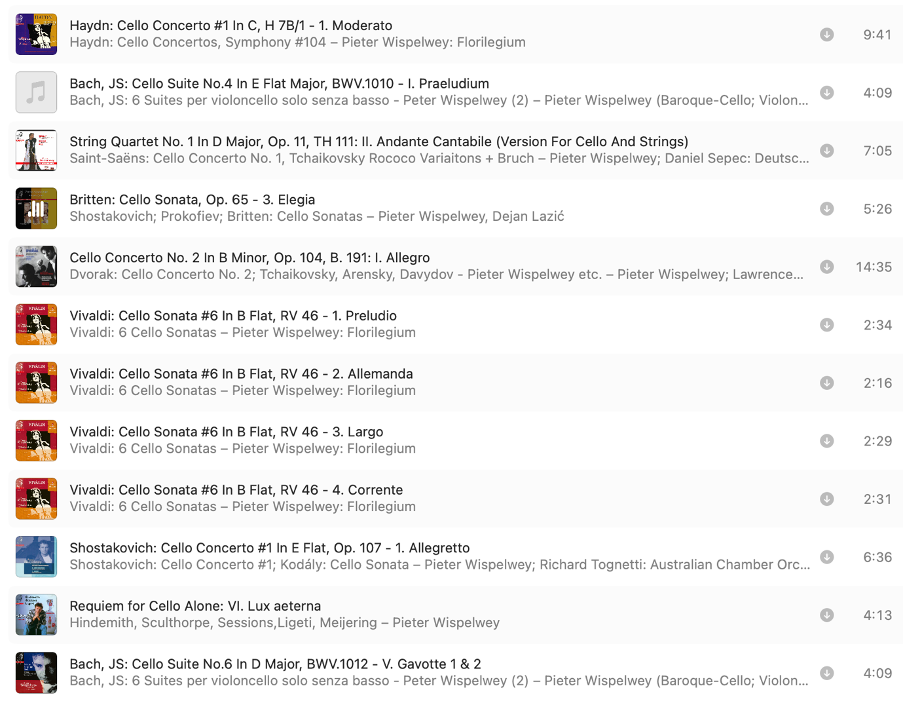
And here is a link to a playlist on Spotify with the music from this episode:
https://open.spotify.com/playlist/7lyEx8rUqvcfxCWsYclLKb?si=e5c132b79c8245d9
Tarisio Interview
https://tarisio.com/digital_exhibition/pieter-wispelwey-guadagnini-1760/
Peter Wispelwey Website
https://www.pieterwispelwey.com
ClassicsToday.com – Shostakovich Review
The Music
The Words
Hello everyone. Welcome to another episode of the ‘Classical For Everyone’ Podcast… five hundred years of incredible music.
My name is Peter Cudlipp and… If you enjoy any music at all then I’m convinced you can enjoy classical music. All you need are ears. No expertise is necessary.
If you’ve ever been curious about classical music… or explored it for a while once upon a time… or just quietly wondered what all the fuss was about… then this is the podcast for you.
And because there’s a lot of music out there each episode has a theme. And for this one it is… well, looking back at the last eighty episodes, this one is a bit of a departure. This is a show devoted to performances by a living musician, still very much in his prime… the Dutch cellist, Pieter Wispelwey who was born in 1962.
So, what prompted me to choose him? Well, a few things. I’ve been a fan for a long while and have been lucky enough to hear him play a number of times over the last three decades. And about 18 months ago the record company Channel Classics released a big box of CDs of recordings he made for the company… and they’re terrific. And Wispelwey is equally at home with music from any of the last several centuries. Plus he is still touring… so for many of you listening to this podcast… he will be on a stage near you at some point and I recommend you grab the opportunity to hear him play. Incidentally, as this episode is released he is about to play two concerts at Carnegie Hall in New York.
But perhaps most importantly I can get to play you some of the best music written for the cello… from Johann Sebastian Bach, Pyotr Illich Tchaikovsky, Benjamin Britten, Antonin Dvorak, Antonio Vivaldi, Dmitri Shostakovich and Peter Sculthorpe.
But I’m going to start with Josef Haydn… the opening section of his 1st concerto for cello and orchestra. If for any reason you have been a little down I’m going to say with some confidence that this is music to make you smile.
It was written in the early 1760’s when Haydn was in his early 30’s. And in one of those stories I love about the serendipity that plays such a role in what we get to hear… this concerto, today one of the most popular cello works ever written, was only discovered in 1961.
An archivist at the National Museum in Prague, Oldrich Pulkert, was digging through old documents collected from a château in Radenín, a tiny village in southern Bohemia. Within the papers, he found a set of orchestral parts signed by Joseph Weigl, the principal cellist in the Esterházy court orchestra from 1761 to 1768, where Haydn was employed — the very musician for whom Haydn almost certainly wrote the concerto. It took some years of academic pondering to establish that this was a missing Haydn work but opinion is now pretty much unanimous.
Here is the group Florilegium and the cello soloist Pieter Wispelwey with the ten minute opening of Josef Haydn’s 1st concerto for cello and orchestra.
A
The next piece is from Johann Sebastain Bach… and it too has a story… In 1889 the Spanish cellist Pablo Casals, already a prodigy at the age of thirteen, was exploring a junk shop in Barcelona and came across some sheet music for unaccompanied cello.
In that period composers used the French term ‘Suite’ to mean a collection of generally short pieces and it wasn’t restricted to any particular grouping of instruments. What many had in common was starting with what the composer called a ‘Prelude’ and then following it with several individual pieces each of which took their name from popular dances, and hence to an extent rhythms, of the day. And with the style having been popularised in France, the names were generally given in French. So Bach uses terms including ‘sarabande’, ‘courante’ and ‘bourrée’. I’ll play one of the dances at the end of the show but for now here is the prelude to the 4th Suite. Performed by Pieter Wispelwey
C
At a concert in London in 1961 two composers… two quite significant composers, one English and one Russian sat side by side listening to a cellist play. After the concert the Russian composer complained that his ribs were sore because every time the other composer got wildly excited by something the cellist did; he would elbow him. The slightly injured Russian was Dmitri Shostakovich. The enthusiastic Englishman was Benjamin Britten. And the cellist was Mstislav Rostropovich. And from the meeting after that concert Rostropovich would commission Britten to write a piece of music for him. It would be the first of five works Britten would go on to write for the cellist.
Here Pieter Wispelwey is joined by the pianist Dejan Lazić (DEH-yan LAH-zitch.) with the ‘Elegy’ section from Benjamin Britten’s Cello Sonata. It is about five minutes long.
D
Pieter Wispelwey and the pianist Dejan Lazić (DEH-yan LAH-zitch.) played the ‘Elegy’ section from Benjamin Britten’s Cello Sonata.
The composer Antonin Dvorak started writing a cello concerto in his 20s but never completed it. Some years later he said the cello was a ‘fine instrument in an orchestra’ and that he was fond of the middle register, but complained about the nasal high notes and the mumbling bass. He could never imagine writing a work with a cello in the solo role.
That changed when in his 50’s he found himself in New York as the First Director of the National Conservatory and heard a cello concerto written by a colleague Victor Herbert. That seemed to have changed Dvorak’s mind and he completed his own concerto for cello and orchestra in February 1895. And it has ended up one of the most popular works featuring the cello ever written.
I’m going to play you the opening section. It is about 15 minutes long. This is one of those works that calls for such emotional and dynamic range that I am tempted to recommend turning your volume up. It really is worth immersing yourself in this music.
Here is Pieter Wispelwey with Lawrence Renes conducting the Netherlands Philharmonic Orchestra. Antonin Dvorak’s Cello Concerto.
E
That was Pieter Wispelwey with Lawrence Renes conducting the Netherlands Philharmonic Orchestra with the opening section of Antonin Dvorak’s Cello Concerto.
Now I haven’t been making too much of a fuss about the term ‘concerto’ in this episode. I think by the context and then by what the music sounds like; the idea of a concerto being a solo instrument in dialogue with a group of instruments is pretty clear. But I am about to play you what is called a ‘sonata’. And in the 1720’s when Antonio Vivaldi wrote the cello sonata I am going to play you; the term was applied very broadly to all sorts of pieces in all sorts of combinations… the only constant being that the music was generally for either a solo instrument or a small group of instruments with one slightly more dominant than the others. So, if this cello sonata sounds to you a little like a cello concerto… I don’t think you are wrong.
Pieter Wispelwey and the group Florilegium playing Vivaldi’s 6th Cello Sonata. It is about ten minutes long and is in four parts.
F
That was Pieter Wispelwey and the group Florilegium playing Antonio Vivaldi’s 6th Cello Sonata.
So a few minutes back I mentioned a concert where Dmitri Shostakovich and Benjamin Britten were listening to the cellist Mstislav Rostropovich play in London in 1961. Well, what they were listening to was one of the first performances outside the Soviet Union of Shostakovich’s First Cello Concerto… which the composer had written for Rostropovich.
Since then the piece has become deservedly central to music for cello and orchestra. I’ve heard it performed live a few times but I think one of the very finest was in a big shed normally used to age wine about four hours west of Sydney, Australia at the Huntington Estate Music Festival. The cellist was Pieter Wispelwey and the Australian Chamber Orchestra was directed by Richard Tognetti. Now, it was a while back, and these is a small chance I am misremembering… plus there was a lot of wine.
But what is certainly true is that Wispelwey, the orchestra and Tognetti made a recording of the work. Which I am about to play you an excerpt from. But before I do, I’m going to quote a bit of the review from the American critic David Hurwitz…
“I have no hesitation in recommending this recording of the Shostakovich First Cello Concerto as the finest since Rostropovich’s pioneering 1959 recording, supervised by the composer himself, with the Philadelphia Orchestra conducted by Eugene Ormandy”.
I’ve never doubted this is a great recording but growing up a long way from what are considered the great cultural centres of the world, praise like that is perhaps a welcome additional validation of antipodean confidence.
Here’s the music. The opening section of Dmitri Shostakovich’s First Cello Concerto. It’s about 6 minutes long.
G
That was the opening section of Dmitri Shostakovich’s First Cello Concerto. Pieter Wispelwey was the soloist and Richard Tognetti directed the Australian Chamber Orchestra.
My name is Peter Cudlipp and you have been listening to the ‘Classical for Everyone’ Podcast. I have another couple of pieces coming up but before I get to them I want to give you a little information that I hope you find useful…
Because I haven’t really given you much biographical information I’ll put a link to Pieter Wispelwey’s website and an enjoyable interview with him from Tarisio the musical instrument dealers.. and a link to the Classics.com Shostakovich review.
And on the individual episode pages of the website there are links to Spotify playlists with the full versions of most of the music played in each of the episodesAlright, next I have a section from Peter Sculthorpe’s ‘Requiem For A Cello Alone’ written in 1979. He used the Latin Mass for the Dead as his inspiration and here is what he wrote about it for a program note. As an aside, I confess I have, as they say, edited it a little for clarity…
As you might expect this music is a little sombre but it has a quiet beauty as well. Here is Pieter Wispelwey with the Lux Aeterna ‘eternal light’ section from Peter Sculthorpe’s ‘Requiem for a cello Alone’. It is about 4 minutes long.
H
That was the Lux Aeterna ‘eternal light’ section from Peter Sculthorpe’s ‘Requiem for a cello Alone’.
Thanks for your time and I look forward to playing you some more incredible music on the next ‘Classical For Everyone’… which I think is going to start an exploration of the music of Franz Schubert.
This podcast is made with Audacity Software for editing, Wikipedia for Research, Claude for Artificial Intelligence and the music played is licensed through AMCOS / APRA. Classical For Everyone is a production of Mending Wall Studios and began life thanks to the enthusiasm and encouragement of Mr Jeffrey Sanders.
I