

 Apple Podcasts
 Spotify
 Amazon Music
 iHeartRadio
 Overcast
 PocketCasts
  RSS Feed
 Not Dead Yet - Two
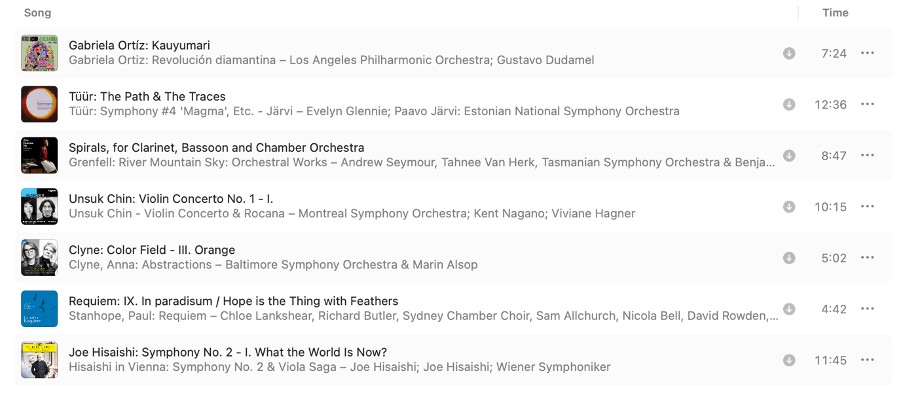
When a podcast is about five hundred years of music, there is going to be a reasonable amount of music from people who are no longer with us. Now if you combine that with the baggage of the term ‘classical’ then you can kind of forget that there is a lot of music being written, performed, recorded and released right now. Music by composers who are still very much amongst the living. And you are going to hear from seven of them in this episode… Gabriela Ortiz, Erkki-Sven Tüür, Maria Grenfell, Unsuk Chin, Anna Clyne, Paul Stanhope and Joe Hisaishi. I hope you enjoy the second ‘Not Dead Yet’ show from the ‘Classical For Everyone’ podcast.
And here is a link to a playlist on Spotify with the complete versions of the music from this episode:
https://open.spotify.com/playlist/4GWeoCjCroM7oadyCEmIc4?si=13b1d116bf6848b7
The Music
The Words
Hello everyone. Welcome to another episode of the ‘Classical For Everyone’ Podcast… five hundred years of incredible music. My name is Peter Cudlipp and If you enjoy any music at all then you can enjoy classical music. All you need are ears. No expertise is necessary.
If you’ve ever been curious about classical music… or explored it for a while once upon a time… or just quietly wondered what all the fuss was about… then this is the podcast for you. And because there’s a lot of music out there each episode has a theme.. and for this one it is ‘Not Dead Yet’.
When your podcast is about five hundred years of music there is going to be a reasonable amount of music from people who are no longer with us. Now if you combine that with the overarching term ‘classical’ then you can kind of forget that there is a lot of music being written, performed, recorded and released right now. Music by composers who are still very much amongst the living. And you are going to hear from seven of them today… Gabriela Ortiz, Erkki-Sven Tüür, Maria Grenfell, Unsuk Chin, Anna Clyne, Paul Stanhope and Joe Hisaishi.
Before I get into the music I want to suggest a couple of things that may overcome the understandable reticence that a few listeners might have when it comes to ‘new music’.
At some point every single artifact of human creativity was new… was being sent out into the world for the very first time. And much of what we now celebrate took a while to find acceptance and appreciation. Now surviving time’s passing is not a foolproof guide to a work of art’s merits. Of the mass of stuff that has been forgotten and is going to be forgotten… some deserves to be and some doesn’t. And just because something is new, doesn’t mean it is necessarily good either… or just waiting for a more enlightened age or audience to stumble upon it. It might just not be very good.
And when art is new, there can be a bit of a challenge to separate the wheat from the chaff. We really have no idea what future generations are going to cherish. To claim some sort of foresight is just wonderfully foolish. And seriously… How can a man who didn’t think texting would catch on (that would be me) be trusted to choose works of contemporary music for you? Well the good news is that with new classical music there is a surprisingly impressive selection system in place that has done most of the work for me. To put it simply: any work that needs more than a handful of musicians to perform it has a lot of hurdles to clear before anyone bothers to record it. And requires an enterprise to take some significant financial risk. So, if it's been recorded, the music has already survived plenty of gatekeepers, dead ends, and false starts. I think that in itself recommends that each of these works might deserve a listen.
Finally, why play any new music at all? Because I think there is something really exciting about what is being expressed in our time by our contemporaries. Now, at last, some music to make that case.
In 2021 when concerts began again after the Covid pandemic the Los Angeles Philharmonic Orchestra commissioned the composer Gabriela Ortiz to write a piece to celebrate the return of live music. She called it ‘Kauyumari’ and wrote this note…
Among the Huichol people of Mexico, Kauyumari means ‘blue deer’. The blue deer represents a spiritual guide that is transformed through an extended pilgrimage. It allows the Huichol to communicate with their ancestors, do their bidding and serve as guardians of the planet.
It is about seven minutes long and here is the LA Philharmonic Orchestra conducted by Gustavo Dudamel. By the way it starts very quietly. ‘Kauyumari’ by Gabriela Ortiz.
A
That was ‘Kauyumari’ by Gabriela Ortiz and the LA Philharmonic Orchestra was conducted by Gustavo Dudamel.
In 2005 the Estonian composer Erkki-Sven Tüür wrote a work for String Orchestra the name of which in English is ‘The Path and the Traces’ and this is what he had to say about the process…
I had spent a few weeks on the island of Crete and took part in a lavish church service in the local cathedral to mark the beginning of Lent. It had a transcendent effect on me. The traditional singing of the ancient Greek church as sung by the fantastic cantors resounded throughout the service. As a result of the experiences I gained I started composing.
In the work the growing intensity on the emotional level reaches its limits at a certain point, and all that follows is a premonition of something that remains on the other side of the border.
On a more personal level, what gives this music an additional dimension is that the period in which it was written coincided with the passing of my father.
As you might imagine there is, if not a sadness, then a contemplative tone to this music in parts. My assistant Claude describes it as… ‘Long, aching lines in the old Estonian elegiac tradition keep catching on something sharper and more modern, then settling back into stillness.’ It is about 12 minutes long and here is Paavo Järvi conducting the Estonian National Symphony Orchestra. Erkki-Sven Tüür’s ‘The Path and the Traces’.
B
That was Paavo Järvi conducting the Estonian National Symphony Orchestra with Erkki-Sven Tüür’s ‘The Path and the Traces’.
Composers draw inspiration from all sorts of places but one commonality seems to be encountering and/or collaborating with gifted musicians. Such was the case for Maria Grenfell when she wrote… ‘Spirals’ in 2017 for Clarinet, Bassoon and Chamber Orchestra.
And here is an edited version of the notes about the work from the composer’s website:
The idea for a work for clarinet and bassoon came from a conversation in 2014 with Tahnee van Herk, principal bassoon of the TSO. Tahnee asked if I would be interested in writing a piece for her to play with Andrew Seymour, principal clarinet in the orchestra, and I jumped at the opportunity. While searching for some musical inspiration to begin writing the work, I came across some early “slave songs” in a book that I had acquired on a visit to a plantation in New Orleans some years earlier. Initially I wanted to combine several of the spiritual tunes but the composition process took another direction and left only residual elements of the tunes: the syncopated rhythms and leaping melodic lines - hence the title Spirals, depicting the swooping and swirling nature of the melodies. In my view, the piece is not really long enough to be called a “concerto”, but it is exciting to think of it as a showpiece for the wonderful players for whom it is written.
Here is the Tasmanian Symphony Orchestra conducted by Benjamin Northey with soloists Andrew Seymour (clarinet) and Tahnee van Herk (bassoon). ‘Spirals’ by Maria Grenfell.
C
That was the Tasmanian Symphony Orchestra conducted by Benjamin Northey with soloists Andrew Seymour (clarinet) and Tahnee van Herk (bassoon). ‘Spirals’ by Maria Grenfell.
I had not heard the Korean composer Unsuk Chin’s Violin Concerto until I started listening for music for this show. It was written in 2001 for the German Symphony Orchestra Berlin, where Chin was composer-in-residence, and went on to win the 2004 Grawemeyer Award — one of the most prestigious prizes in composition in the world.
I’m going to play you the opening section…which grows out of something quite simple — the four open strings of the violin — and spins them into a shimmering, restless structure of great scale.
This is the Montreal Symphony Orchestra conducted by Kent Nagano and the soloist is Viviane Hagner. The first section of Unsuk Chin’s Violin Concerto. It is about ten minutes long.
D
That was the Montreal Symphony Orchestra conducted by Kent Nagano and the soloist was Viviane Hagner. Performing the first section of Unsuk Chin’s Violin Concerto.
I hope you are enjoying this ‘Not Dead Yet’ show. Next in this collection of music written by people still very much in their prime is a piece by Anna Clyne.
We’ve had works inspired by a spirit animal from northern Mexico, a church service on the island of Crete and two remarkably gifted performers. And Anna Clyne started her piece ‘Color Field’ with a painting. In fact one very specific painting of that title by the American mid 20th century artist, Mark Rothko.
I’m going to digress for a second here. I remember decades ago reading the Australian critic and author Robert Hughes exhorting all who would heed him to physically go to art galleries and look at the art… rather than, as was becoming easier and easier, make do with reproductions of it. At the time I kind of got it but didn’t really get it until I was in front of a Mark Rothko painting in I think Chicago. If there was ever an artist who just cannot be reproduced effectively it is Rothko. Maybe about ten years ago I sat in front of another one in San Francisco for quite a long time. And the best way to describe what happened is that the painting came to life. Probably enough about me but maybe think of what can happen when the colours in a Rothko painting start to vibrate, merge, demerge and float from the canvas and when a composer as gifted as Anna Clyne comes along and turns that effect into music. Here is ‘Orange’ the third and final part of her ‘Color Field’ from 2020. Marin Alsop conducts the Baltimore Symphony Orchestra. The piece is five minutes long.
E
That was Marin Alsop conducting the Baltimore Symphony Orchestra with Orange from Anna Clyne’s ‘Color Field’.
In 2020 the composer Paul Stanhope wrote a Requiem. It is a major work for soloists, choir and a small ensemble based on the medieval Latin Mass for the Dead and I will let the composer take it from here…
I have followed Benjamin Britten's lead of incorporating English poetry as he did with his ‘War Requiem’, with the difference that the poetry settings are replacements of some of the Latin Mass movements rather than just additions. And all the English language texts are written by female poets.
I didn't deliberately set out to do this but instinctually was drawn to poetry that seemed a counterweight to the Mass texts, which might represent the paternal tradition of the Catholic Church.
The piece as a whole has a number of themes all beginning with 'C': consolation, connection to country, commemoration and, strangely enough, celebration. Although a Requiem is weighty and sombre in many ways, it also has the capacity to be uplifting and life-affirming.
I’m going to play you the final section. For it Stanhope set both the Latin words from the final section of the Requiem… In Paradisum which begins… Eternal Rest grand them Lord, May angels lead you into Paradise… and Emily Dickinson’s poem ‘Hope is the thing with feathers’.
“Hope” is the thing with feathers -
That perches in the soul -
And sings the tune without the words -
This is I think really special music. I hope you enjoy it. Chloe Lankshear and Richard Butler are the soloists and the composer conducts the Sydney Chamber Choir. It is about five minutes long. The concluding section of Paul Stanhope’s Requiem.
F
That was the singers Chloe Lankshear and Richard Butler and the Sydney Chamber Choir with the concluding section of Paul Stanhope’s ‘Requiem’ titled ‘In Paradisum / Hope is the thing with feathers’ and the composer was the conductor.
I’m going to slightly truncate the end of this show so instead of a few procedural comments then a final piece then some credits and then a little bonus I’m going to get through the less musical stuff quickly and then conclude with one pretty fabulous piece.
My name is Peter Cudlipp and you have been listening to the ‘Classical for Everyone’ Podcast. If you would like to listen to past episodes or get details of the music I’ve played. And if you want to get in touch then you can email… info@classicalforeveryone.net.
Ok. The composer Joe Hisaishi’s relationship with a Tokyo animation studio has given him fame outside the world of classical music.
But in case your enthusiasm for new music is waning at this point in the show and a popular culture connection is enough to make you go back to reading Proust then let me list some other composers who made a few extra dollars writing for film… Dmitri Shostakovich, Aaron Copland, Nino Rota, Malcolm Arnold, Leonard Bernstein, William Walton and Sergei Prokofiev.
Hisaishi’s 2nd symphony was written during the Covid epidemic and he later commented…
I wrote the entire piece in one go between April and May 2020 at my workspace away from Tokyo, and also completed most of the orchestration. However, due to the concert postponements and becoming busy with projects like Hong Kong films, I had left it untouched until 2004.
Because of the times we are living in, I wanted to write something that wasn't heavy. In other words, I aimed for a piece that purely pursues the kinetic movement of sound.
This is the opening section of the symphony to which Hisaishi gave the title… What the world is now?
This is the Vienna Symphony Orchestra and the composer Joe Hisaishi conducts the 12 minute opening section of his 2nd Symphony.
Thanks for listening.