

 Apple Podcasts
 Spotify
 Amazon Music
 iHeartRadio
 Overcast
 PocketCasts
  RSS Feed
 Night and Darkness
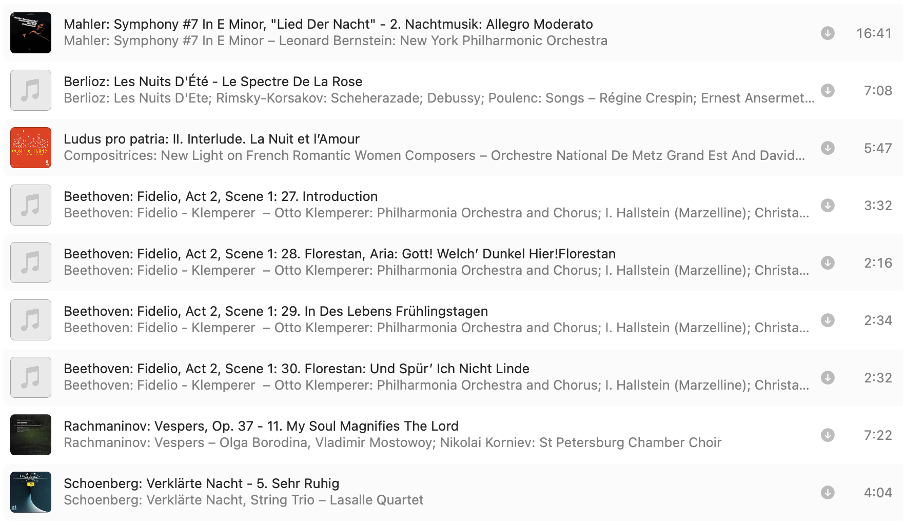
It could be argued that Night and Darkness are sort of the same. The Night is Dark. That’s kind of the point. But there are brightly moonlit nights and there are very dark nights; in more ways than one, and then there is darkness that is as black as night. So it's “Night and Darkness”… including symphonic night music from Gustav Mahler, a song of a rose on a summer night from Hector Berlioz, a night of love from Augusta Holmès, Ludwig van Beethoven’s political prisoner crying out from a pitch black dungeon, Sergei Rachmaninoff’s All Night Vigil and Arnold Schoenberg’s music of two lovers sharing secrets walking through a dark forest at night.
[Episode image: Night Sky. Christian Hoiberg - Digital Photography School.]
And here is a link to a playlist on Spotify with most of the music in the episode:
https://open.spotify.com/playlist/5r7T0AhJvUagJIXPVw8NVG?si=e8ec85e06c7743ea
The Music
The Words
Hello everyone. Welcome to another episode of the ‘Classical For Everyone’ Podcast… five hundred years of incredible music. My name is Peter Cudlipp and… If you enjoy any music at all then I’m convinced you can enjoy classical music. All you need are ears. No expertise is necessary. If you’ve ever been curious about classical music… or explored it for a while once upon a time… or just quietly wondered what all the fuss was about… then this is the podcast for you.
And because there’s a lot of music out there each episode has a theme. And for this one it is… Night and Darkness. Symphonic night music from Gustav Mahler, a song of a rose on a summer night from Hector Berlioz, a night of love from Augusta Holmès, Ludwig van Beethoven’s political prisoner crying out from a pitch black dungeon, Sergei Rachmaninoff’s All Night Vigil and Arnold Schoenberg’s music of two lovers sharing secrets walking through a dark forest on a moonlit night.
Music publishers, concert promoters and probably audiences are fans of a nickname for a piece of music. And in the mysterious way that nicknames are added to music, Gustav Mahler’s 7th symphony, completed in 1906, came to be called ‘Song of the Night’ or in the original German… ‘Lied der Nacht’. Mahler was dead by the time the name really stuck but he would not have been happy. At the time he wrote the symphony he pushed back against any ‘popular’ title. That said, he did name two of the four sections of the symphony ‘night music’ and had discussed with a friend that some of the music was linked to an idea of ‘night wandering’. And today I want to start the show with one of those ‘night music’ sections.
For me, Mahler’s music is really best experienced live OR, and again this is just for me, by familiarising oneself with individual sections from his generally massive symphonies. Anyway, I think there is so much contrast, clever unpredictability, with a mix of snippets of dances and marches that this 15 minutes of night music that it can be richly rewarding.
If you have the chance to turn up the volume of this incredible recording of Leonard Bernstein conducting the New York Philharmonic then I would urge you to do so. From Gustav Mahler’s 7th Symphony, the second section, called by the composer ‘Night Music’.
A
That was Leonard Bernstein conducting the New York Philharmonic with the second section of Gustav Mahler’s 7th Symphony, the section called by the composer ‘Night Music’.
The French composer Hector Berlioz lived next door to the poet Theophile Gautier and in 1841 Berlioz took six of Gautier’s poems and set them for a soprano singer and piano. He called the group of them ‘Les Nuits d’été’ or ‘Summer Nights’. In 1856 he arranged them for singer and orchestra. I’m going to play you the one called ‘The Ghost of the Rose’ … ‘Le spectre de la rose’.
In the poem a girl dreams of the ghost of the rose she wore to a Ball earlier that night. Although the rose has died, it has ascended to paradise; According to the ghost, to have died on the girl's breast was a fate that kings might envy…
Sur ton sein j'ai mon tombeau,
Et sur l'albâtre où je repose
Un poète avec un baiser.
On your breast I have my tomb,
And on the alabaster I repose
A poet with a kiss.
Berlioz’ song has been described as among the most perfect expressions of French Romanticism.
This is Regine Crispin with the orchestra of the Swiss Romande conducted by Ernest Ansermet. ‘The Ghost of the Rose’ by Hector Berlioz from his collection ‘Summer Nights’.
B
That was Regine Crispin with the orchestra of the Swiss Romande conducted by Ernest Ansermet. The Ghost of the Rose by Hector Berlioz from his collection ‘Summer Nights’.
Staying in France for the next ‘Night and Darkness’ music... the composer Augusta Holmès was a student of Cesar Franck, turned down a marriage proposal from Camille Saint-Saens, wrote four operas along with tone poems, cantatas and songs… and in the Metropolitan Museum of New York there is a beautiful painting by Auguste Renior of her three daughters. Even though at times she resorted to the impressive male pseudonym of Hermann Zenta to access publishing opportunities for her music; whilst alive she was widely known, well-regarded and frequently performed. But after her death in 1903 at the age of 55 her music vanished from concert stages. And only in the last couple of decades has any of her music been recorded.
She is currently best known for a six minute piece from 1888 she called ‘La Nuit et l’amour’. ‘Night and Love’. It was part of a larger work called ‘Games for the Homeland’ based on a mural of the same name though both were actually in Latin… Ludus pro patria.
Here is the National Orchestra of Metz conducted by David Reiland with Augusta Holmès ‘La nuit et l’amour’
C
That was the National Orchestra of Metz conducted by David Reiland with Augusta Holmès ‘La nuit et l’amour’… night and love.
It could be argued that calling this episode Night and Darkness is an unnecessary tautology. The Night is Dark. That’s kind of the point. But there are brightly moonlit nights and there are very dark nights, in more ways than one, and then there is darkness that is as black as night.
At the beginning of the second Act of Ludwig van Beethoven’s only opera, ‘Fidelio’ the character of Florestan is finally introduced. He is a political prisoner chained to a wall in the deepest, darkest cell in a prison outside Seville in Spain in the late 1600s. After three minutes of music setting the scene Florestan cries out in words written probably by Stephan von Bruening (though there were a number of contributors to the libretto). He cries out…
Gott! Welch Dunkel hier! O grauenvolle Stille!
Öd' ist es um mich her. Nichts lebet ausser mir.
God! What darkness here! O dreadful silence!
But as his song progresses, he takes solace from an imagined vision of his beloved Leonora; not knowing that she has in fact disguised herself as a young man by the name of Fidelio to infiltrate the prison and rescue him.
Here, as Florestan, is the singer Jon Vickers with the Philharmonia Orchestra conducted by Otto Klemperer. The opening eleven minutes of the second act of Beethoven’s opera ‘Fidelio’.
D
That was Jon Vickers singing with the Philharmonia Orchestra conducted by Otto Klemperer with the opening eleven minutes of the second act of Beethoven’s opera ‘Fidelio’.
My name is Peter Cudlipp and you have been listening to the ‘Classical for Everyone’ Podcast. I have another couple of pieces coming up but before I get to them I want to give you a little information that I hope you find useful… If you would like to listen to past episodes or get details of the music I’ve played please head to the website classicalforeveryone.net. That address again is classicalforeveryone.net
On the individual episode pages of the website there are links to Spotify playlists with the full versions of most of the music played in each of the episodes. I hope you have enjoyed this Night and Darkness focused episode of ‘Classical For Everyone’. And if you want to get in touch then you can email… info@classicalforeveryone.net.
And by the way, if you want some more night music… back in February last year (that is 2025) I released an episode just called ‘Night’… and there is a fair amount of night-themed music in the one called ‘A Different Halloween’ from back in October of last year.
Ok. As a young man Sergei Rachmaninoff studied at the Moscow Conservatory and amongst his teachers was Stepan Smolensky who is credited with introducing Rachmaninoff to the traditions of the Russian Orthodox liturgical chant. Smolensky led a revival of interest in Russian sacred music and whilst Rachmaninoff was not overtly religious he too was influenced by this revival.
And in particular it may have been the death of his old teacher, Smolensky, in 1909 that prompted him to start work on his ‘All Night Vigil’. This is best known in the English speaking world as Rachmaninoff’s ‘Vespers’. Which is kind of a lazy mistranslation. Vespers is the beginning of the Russian Orthodox ‘all-night vigil’ service. There are two more sections, Matins and First Hour; and texts from the Vespers service are only one third of the fifteen texts that Rachmaninoff used.
His ‘All Night Vigil’ was written as a concert piece and the whole thing is about an hour long but the origin of the ‘all-night vigil’ service was an all-night vigil… a series of sermons, chants, and readings that went from sunset to sunrise and which originated in the monasteries around Jerusalem. I don’t think it is hard to get a sense from this music of a centuries long tradition of devotion carrying the faithful through the dark of the night.
The other thing that might perhaps be coincidence or anachronistic is that this moving but sombre music was written in 1915 in the months after the beginning of the First World War. Even with the tight restrictions of any information reaching the populace of the disastrous defeats the Russian Army was suffering at the hands of the Germans; for an international figure like Rachmaninoff this must have been a dark time in a national mood of unspoken catastrophe and anxiety.
A great success at its first performances, presented to raise money for the war effort; the work would effectively disappear after the 1917 Bolshevik Revolution and the banning of all religious worship. By this time Rachmaninoff and his family has managed to escape to the USA but the work would not be performed in the USSR until after the death of Josef Stalin.
Here is the St Petersburg Chamber Choir directed by Nikolai Korniev with the eleventh section, My Soul Magnifies the Lord, from Sergei Rachmaninoff’s ‘All Night Vigil’.
E
That was the St Petersburg Chamber Choir directed by Nikolai Korniev with the eleventh section, My Soul Magnifies the Lord, from Sergei Rachmaninoff’s ‘All Night Vigil’.
Thanks for your time and I look forward to playing you some more incredible music on the next ‘Classical For Everyone’. This podcast is made with Audacity Software for editing, Wikipedia for Research, Claude for Artificial Intelligence, Cleanfeed for remote recording; and the music played is licensed through AMCOS / APRA. Classical For Everyone is a production of Mending Wall Studios. The Producers do not receive any gifts, remuneration or support of any kind from any organisation or individual mentioned in the show.
And if you have listened to the credits… here is some more music for you…
In 1902 the young Austrian composer Arnold Schoenberg premiered his first and what would be his only string sextet… which is a work for two violins, two violas and two cellos.
He called it ‘Verklärte Nacht’ or ‘Transfigured Night’. The title is from a poem by Richard Dehmel which describes a man and a woman at an emotional crossroads walking through a forest at night and Schoenberg follows the action of the poem quite specifically.This was an early success for a composer who would take music down some surprising pathways in years to come… but here, even though he is using some dark and dissonant touches, there is still a Romantic quality of the music he uses to capture the strange quality of the poem…
I’m going to play you the final section by which point in the poem the man and the woman have found a way to move forward into the future together. The final three lines of the poem are…
Er faßt sie um die starken Hüften.
Ihr Atem küßt sich in den Lüften.
Zwei Menschen gehn durch hohe, helle Nacht.
He puts an arm about her strong hips.
Their breath embraces in the air.
Two people walk on, through the high, bright night.
Here is the Lasalle Quartet plus Donald McInnes and Jonathan Pegis with the final section of Arnold Schoenberg’s “Transfigured Night”. It is about four minutes long and begins and ends very quietly.
Thanks again for listening.
F