

 Apple Podcasts
 Spotify
 Amazon Music
 iHeartRadio
 Overcast
 PocketCasts
  RSS Feed
 Neglected Beethoven
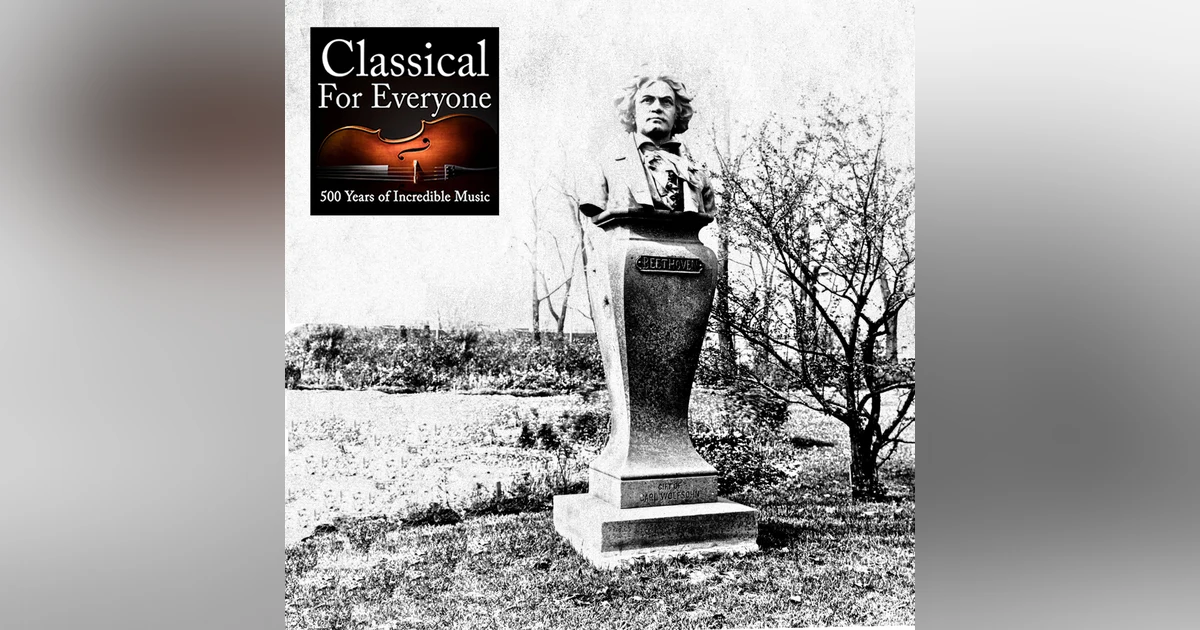

Is Ludwig van Beethoven neglected? No, not at all. But with the well-deserved emphasis on his symphonies, a couple of piano concertos and a handful of piano sonatas and string quartets; there is another roughly eighty hours of music to explore. And in the same way that maybe Picasso, Rembrandt, Shakespeare and Dickens created very little that is not of extraordinary quality… there is a bunch of incredible music that is not going to be encountered by the casual listener and that is what I want to feature in this show. An overture, excerpts from a misnumbered piano concerto, a string quartet, a piano sonata and from the Triple Concerto. [Episode image: Johannes Gelert sculpture of Beethoven photographed in Lincoln Park outside Chicago mid-20th Century by Percy Sloan.]
And here is a link to a playlist on Spotify with the complete versions of the music from this episode:
https://open.spotify.com/playlist/05hoL3JeOqEcSSB53aUfd2?si=4f8d81aeee9f40eb
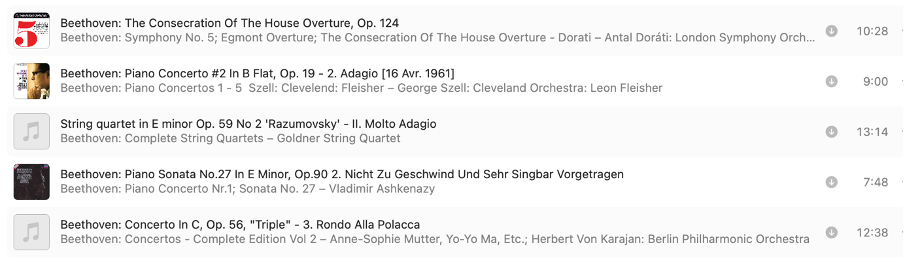
The Music
The Words
Hello everyone. Welcome to another episode of the ‘Classical For Everyone’ Podcast… five hundred years of incredible music. My name is Peter Cudlipp and… If you enjoy any music at all then I’m convinced you can enjoy classical music. All you need are ears. No expertise is necessary. If you’ve ever been curious about classical music… or explored it for a while once upon a time… or just quietly wondered what all the fuss was about… then this is the podcast for you.
And because there’s a lot of music out there each episode has a theme. And for this one it is… Neglected Beethoven. Is Ludwig van Beethoven neglected? No, not at all. But with the well-deserved emphasis on his symphonies, piano concertos and a handful of piano sonatas and string quartets there is another about roughly 80 hours of music to explore. And in the same way that maybe Picasso, Rembrandt, Shakespeare and Dickens created very little that is not of extraordinary quality… there is a bunch of incredible music that is not going to be encountered by the casual listener and that is what I want to feature in this show.
I’m going to start with The Consecration of the House Overture, which was composed for the reopening of Vienna's Theater in der Josefstadt in 1822 after it was rebuilt for bigger audiences. The music is a ceremonial… almost architectural — fitting for its purpose of "consecrating" a building — built on a slow processional theme that then evolves into complicated bright multi-melody sequences that are thought to be inspired by the music of Georg Friedrich Handel who Beethoven was focused on at the time.
It is about 10 minutes long and here is Antal Dorati conducting the London Symphony Orchestra.
A
That was Beethoven’s ‘The Consecration of the House Overture’ from 1822 and Antal Dorati conducting the London Symphony Orchestra.
So, if that overture was from what musicologists call Beethoven’s late period, then now I’m going to leap back to his early period. I’m going to play you the slow section from a piano concerto Beethoven started writing when he was 17 and still living in his birthplace, the town of Bonn on the Rhine River in what is now western Germany. It was probably premiered a few years later in Vienna in 1795 at the first public concert Beethoven gave there. And Beethoven tinkered with it for years to come leading to a complicated publishing history with the quirky, or irritating, depending on how you look at it, result that this piano concerto is called his 2nd. Which it wasn’t. It was his first. You might think that at some conference somewhere that could have been fixed. In the last two centuries.
And maybe this numbering issue has contributed to the relative ‘neglect’ of this concerto but as I was sitting listening to a rare live performance of it a couple of days ago I was especially struck by how very lovely the second section is… especially the final couple of minutes. I hope you enjoy it too.
Here is Leon Fleischer playing the piano and George Szell conducting the Cleveland Orchestra. It is about nine minutes long. The slow section of what is universally known as Ludwig van Beethoven’s 2nd Piano Concerto… which was the very first one he wrote!
B
That was Leon Fleischer playing the piano and George Szell conducting the Cleveland Orchestra with the slow section of Ludwig van Beethoven’s 2nd Piano Concerto.
Next up in this ‘Neglected Beethoven’ episode of the Classical For Everyone podcast I’m going to add some nuance to this term ‘neglected’. In the general public’s conception of ‘classical music’ I’d argue that the string quartet is barely thought about… is very much neglected. The symphony orchestra is the default image. But I think the world at large would be surprised by the amount of music making going on everywhere all the time with two violins, a viola and a cello. This is the ideal music to play at home though it helps if you’re a family of string players.
Now of the sixteen string quartets Beethoven wrote all are still performed but when you think about how exquisite this music is… and that you really need to seek it out… you’re not going to stumble upon it being pumped into an elevator… I think I can support the ‘neglected’ argument.
You can probably tell I rate this music pretty highly. And the example I am going to play you is the slow section of Beethoven’s 8th string quartet published in 1808… so written in his late 30’s.
Beethoven’s student Carl Czerny said that the composer’s inspiration for this remarkable thirteen minutes of music came from staring up at a starry night sky and thinking about the music of the spheres. Here is the Goldner String Quartet with the ‘molto adagio’ or ‘very slow’ section of Beethoven’s 8th String quartet. This is for all the people who look up at the night sky. It starts very quietly.
C
That was Goldner String Quartet with the ‘molto adagio’ or ‘very slow’ section of Beethoven’s 8th String quartet.
I just want to digress for a minute and tell you about the image of a sculpture of Beethoven I’m using for this episode. Oddly enough there is a Wikipedia page devoted to a list of the Sculptures of Beethoven. And in the very long list is one that… at a very big stretch… seemed to be right for an episode called ‘Neglected Beethoven’. After being exhibited at the 1893 World’s Fair in Chicago the sculptor Johannes Gelert's bust of Beethoven was installed in the vast Lincoln Park to the north of the city. And there it stayed until 1970… when it disappeared. It is still missing. I do like to think that the ultimate super-fan has the sculpture in his or her basement though that’s probably not the case. At some point in the middle of the 20th century the photographer Percy Sloan took the image I am using for this show. Sadly, there is a good chance that is all that is left of Gelert’s sculpture.
Ok. Back to the music. When you write 32 challenging complex long virtuosic inspired breathtaking (I could go on) pieces for solo piano there are going to be some that perhaps don’t quite get the attention they deserve.
Here is the second of the two sections that make up Beethoven’s 27th piano sonata written in 1814. It is about 7 minutes long and here is Vladimir Ashkenazy.
D
That was the second of the two sections that make up Ludwig van Beethoven’s 27th piano sonata and it was performed by Vladimir Ashkenazy.
My name is Peter Cudlipp and you have been listening to the ‘Classical for Everyone’ Podcast. I have another piece coming up but before I get to it I want to give you a little information that I hope you find useful… If you would like to listen to past episodes or get details of the music I’ve played please head to the website classicalforeveryone.net. That address again is classicalforeveryone.net. On the individual episode pages of the website there are links to Spotify playlists with the full versions of most of the music played in each of the episodes.
I hope you have enjoyed this Neglected Beethoven focused episode of ‘Classical For Everyone’. And if you want to get in touch then you can email… info@classicalforeveryone.net.
Alright, to finish this episode I have an absolute rarity that I would argue is genuinely neglected as well. In the era of Bach, Telemann and Vivaldi the idea of a small group of solo instruments contrasting with a larger group was popular and there were all sorts of combinations. They were called concertos or concerto grosso and Bach’s Brandenburg Concertos are a good example. But by the time of Beethoven this had been replaced by an orchestra with just one solo instrument out the front and since then we have piano concertos, violin concertos, cello concertos etc. etc. But in 1804 Beethoven wrote what became known as his Triple Concerto… a work where a violin, a cello and a piano are out the front of the orchestra and the three solo instruments have complicated musical dialogue between them as well as with the orchestra.
Now I don’t think this is neglected today because of the music. This is just practicalities. As the programming model for symphony orchestras around the world has become one star soloist per concert… the budget is just not there for another couple. The Triple Concerto does turn up at music festivals and with student orchestras and there is no lack of recordings. But you’re not going to hear it live that often. And interestingly, Beethoven’s Triple Concerto was the only one he wrote and is the only work with that combination that had any afterlife at all… and even the very few attempts made by composers in the 20th and 21st centuries have not really found an audience.
Here is the third and concluding section of Ludwig van Beethoven’s Triple Concerto. Herbert von Karajan conducts the Berlin Philharmonic and the soloists are Mark Zeltser (piano), Yo-Yo Ma (cello) and Anne Sophie Mutter (violin).
Thanks very much for listening to Classical For Everyone.
E