



Music For Young People (and their grown-ups)




Sorcerers, Toys, Wolves, Volcanoes and Fossils. Music for young people… but why them… and why now? In some parts of the world people are having a bit of a holiday as this episode goes out… and you may have your children… or nephews, nieces or grandchildren lying around your home or stuck with you in your car. This is music for them. It can be enjoyed by anyone… but this is a collection of music that can be great early experiences of classical music for young people. Music from Michael Haydn, Paul Dukas, Camille Saint-Saëns, Gareth Farr, Sergei Prokofiev, Benjamin Britten and Wolfgang Amadeus Mozart.
And here is a link to a playlist on Spotify with the music from this episode:
https://open.spotify.com/playlist/039bSqZekpz1DGTwFSZKsH?si=6f6ccc8eca9c46ff
And here is a link to the video of 'The Sorcerer's Apprentice' from the 1940 Disney Film 'Fantasia'
https://video.disney.com/watch/sorcerer-s-apprentice-fantasia-4ea9ebc01a74ea59a5867853
The Music
The Words
Hello everyone. Welcome to another episode of the ‘Classical For Everyone’ Podcast… five hundred years of incredible music. My name is Peter Cudlipp and… If you enjoy any music at all then I’m convinced you can enjoy classical music. All you need are ears. No expertise is necessary. If you’ve ever been curious about classical music… or explored it for a while once upon a time… or just quietly wondered what all the fuss was about… then this is the podcast for you. And because there’s a lot of music out there each episode has something of a theme. And for this one it is… music for young people. So… why them, why now?
In some parts of the world people are having a bit of a holiday as this episode goes out… and you may have your children… or nephews, nieces or grandchildren lying around your home or stuck with you in your car. This is music for them. It can be enjoyed by anyone… but for the next hour and a bit this is a collection of music that can be great early experiences of classical music for young people. I know a lot of them were for me.
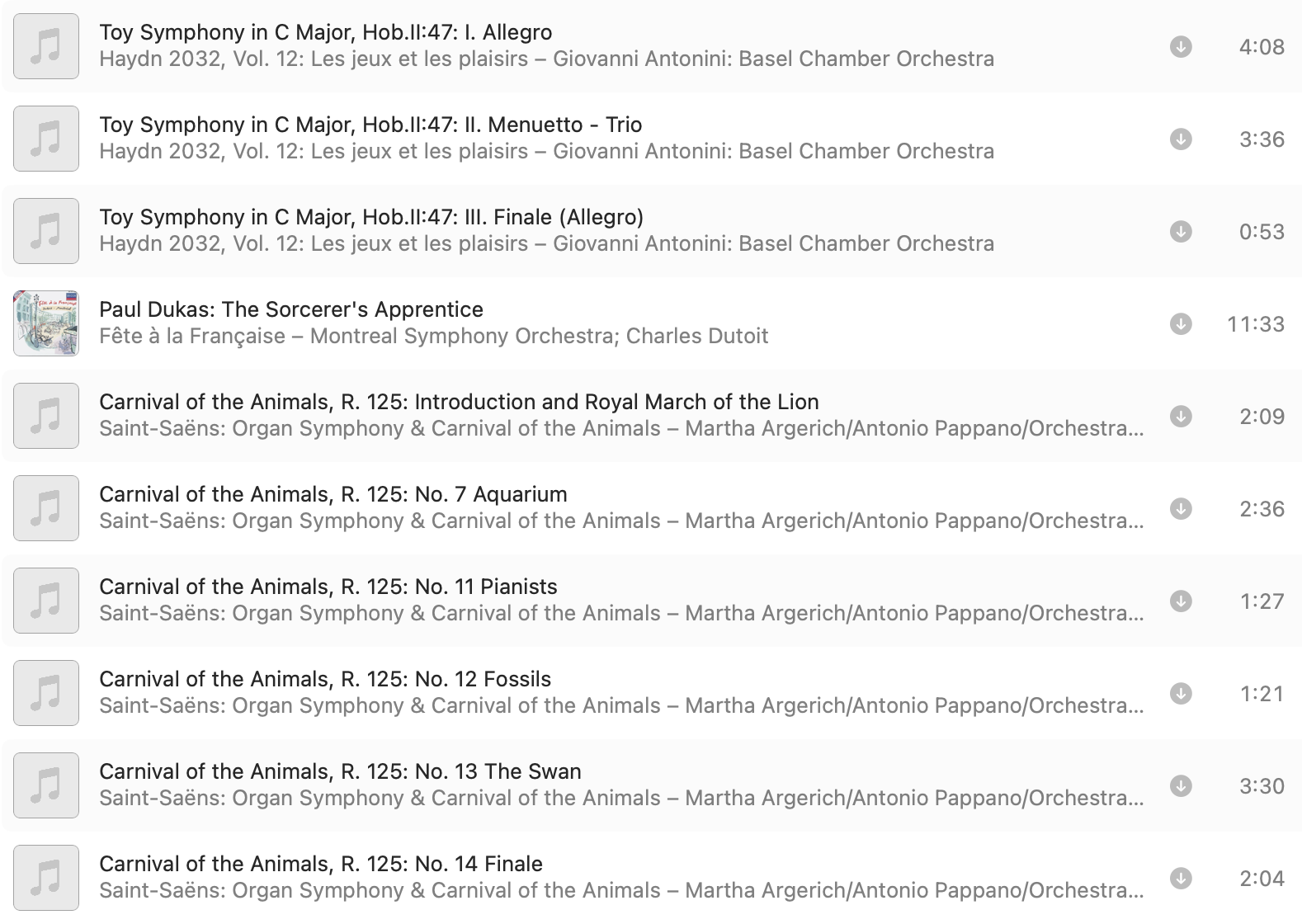
First up is a ten minute three part piece known as The Toy Symphony. For a longtime it was thought to have been written by Joseph Haydn but it is now thought to be the work of his brother, Michael Haydn. And it was written sometime in the 1760s. The name ‘toy symphony’ is a little misleading… I think it really should be called ‘symphony with parts to be played by toy instruments… instruments that mimic birdsong and rattling and clattering sounds. Apparently this was a popular concert attraction in parks… Families sitting around a band rotunda in central Europe on a sunny afternoon. Here is Giovanni Antonini conducting the Basel Chamber Orchestra. Michael Haydn’s ‘Toy Symphony’.
A
That was Giovanni Antonini conducting the Basel Chamber Orchestra with Michael Haydn’s ‘Toy Symphony’. Just a quick note. If you want this episode to be a ‘music only’ experience… then please go to the website for the podcast… classicalforeveryone.net and on the page for this episode there will be a link to a Spotify playlist with all the music… including the complete versions of pieces I am just going to be playing excerpts from.
But next up is a complete piece. It is ‘The Sorcerer’s Apprentice’ written in 1897 by the French composer Paul Dukas. In the work Dukas very deliberately tells a story with music and the structure, dynamics and instrumentation follow the narrative of a poem written a hundred years earlier by Johann Wolfgang von Goethe, best known for his version of the Faust story. Goethe called the poem ‘Der Zauberlehrling’, which could be literally translated as ‘the little magic student’… The poem begins in the voice of the young apprentice magician…
That old sorcerer has vanished
And for once has gone away!
Spirits called by him, now banished,
My commands shall soon obey.
Every step and saying
That he used, I know,
And with sprites obeying
My arts I will show.
Things don’t work out very well for the young apprentice. A broom he enchants to do his cleaning chores… to carry buckets of water for him… cannot be stopped and breaking it into pieces only multiplies the brooms and the flood that the broom’s untiring efforts unleash. In the end the old Sorcerer returns and puts everything back to rights. If this is sounding a little familiar it might be because it was animated by Walt Disney in 1940 as one of the sequences for the film ‘Fantasia’. I’ll put a link to a video of the sequence on the episode page of the website.
Alright here’s the music. It is about 13 minutes long and you can sort of listen for the broom coming to life and then the increasingly relentless march of the broom collecting water and then the waves rushing around the flooded magician’s study. And the final quiet ending after the Magician has returned and the now-sheepish apprentice returns to his chores.
Here is Charles Dutoit conducting the Montreal Symphony Orchestra with ‘The Sorcerer’s Apprentice’ by Paul Dukas. And it starts quietly.
B
That was Charles Dutoit conducting the Montreal Symphony Orchestra with ‘The Sorcerer’s Apprentice’ by Paul Dukas.
Ok, next up is another piece from France but with a bit of an odd performance history. It was written in 1886… about ten years before Dukas’ The Sorcerer’s Apprentice’. But it was not publicly performed until more than thirty years later. The odd part of the story is that this was the instruction of the composer, Camille Saint-Saëns… who insisted that the light-hearted and accessible collection of pieces he had written not be published until after his death… for fear the work would be so popular that it would eclipse his ‘serious’ work. Which might sound like a slightly out of control ‘gallic’ ego… but Saint-Saëns was absolutely right. ‘The Carnival of the Animals’ is by far and away his best known piece.
It is in fourteen brief sections each one is named after an animal or a group of animals. I’m just going to play you a selection of them and as knowing the titles of each section makes the intent of the music clearer and hopefully more entertaining I’ll announce the titles between the sections.
Here are Martha Argerich and Antonio Pappano playing the pianos along with the Orchestra dell'Accademia Nazionale di Santa Cecilia. The Carnival of the Animals by Camille Saint-Saëns. It begins with the ‘Introduction and Royal March of the Lion’.
C
That was Martha Argerich and Antonio Pappano playing the pianos along with the Orchestra dell'Accademia Nazionale di Santa Cecilia. With a few sections from ‘The Carnival of the Animals’ by Camille Saint-Saëns.
Alright I hope you are enjoying this ‘music for young people’ episode of the Classical For Everyone podcast. And I especially hope that if you have managed to keep actual young people listening… that they are enjoying it too.
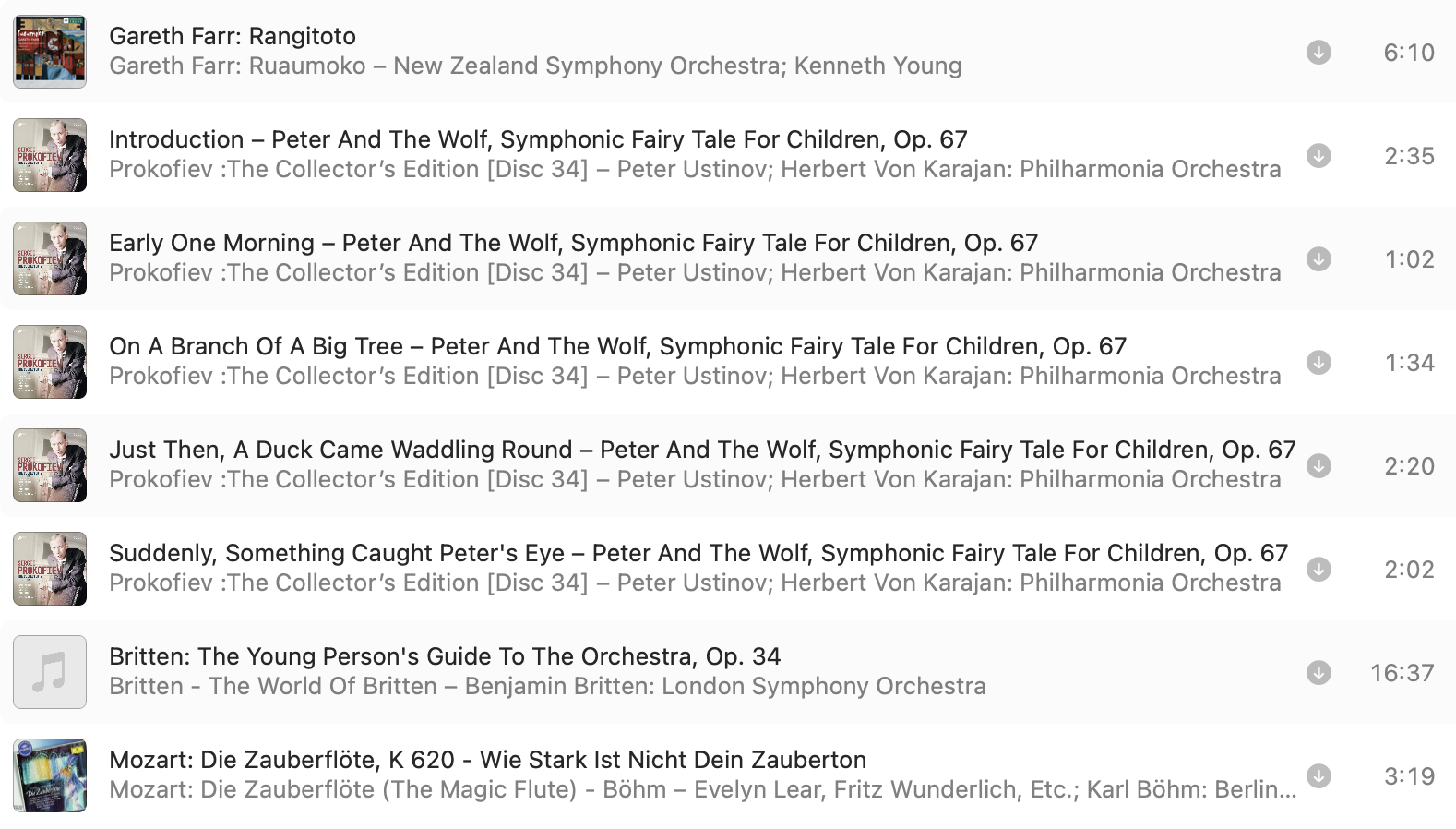
This next piece is for people who like very loud noises, lava flows, earthquakes and general geological mayhem. Over 600 years ago, about 20 miles from what is now downtown Auckland in Aotearoa New Zealand, a volcano erupted. And the extraordinarily beautiful island that remained was given the name ‘Rangitoto’… which means ‘Blood-Red Sky’ in the Maori language. In 1999 the New Zealand composer Gareth Farr was commissioned to write a piece for the millennium celebrations describing the eruption of Rangitoto. It is about six minutes long and here is the New Zealand Symphony Orchestra conducted by Kenneth Young. Gareth Farr’s ‘Rangitoto’.
D
That was the New Zealand Symphony Orchestra conducted by Kenneth Young with Gareth Farr’s ‘Rangitoto’. Incidentally New Zealand has 12 volcanoes considered ‘active’ and the city of Auckland sits on what is called a ‘volcanic field’ consisting of 53 separate volcanic cones. It is a country where, to put it mildly, unexpected things can and do happen.
Ok. Next up I am going to play you the opening ten minutes of the piece that is probably top of the heap of music to play young people to introduce them to classical music… It is ‘Peter and the Wolf’ by Sergei Prokofiev.
Commissioned in 1936 for a Children’s Theatre in Moscow, a narrator tells a Russian folk tale, which an orchestra illustrates by using different instruments to play themes that represent each character in the story. It is a wonderfully charming and simple approach that has been imitated frequently but I don’t think ever bettered.
In researching this episode I stumbled upon a little bit of detail in the origin of the work… which makes sense if you think about the constraints on artists in the Soviet Union under Joseph Stalin… but that I had not been aware of.
Prokofiev wrote the story and the narrator’s script with a quite formal Soviet agenda. Peter, a young boy, who is intended to represent a member of the youth section of the Communist Party… the Young Pioneers… and his animal friends capture a wolf. As well as promoting desired Young Pioneer virtues such as vigilance, bravery, and resourcefulness, the plot illustrates Soviet themes such as the stubbornness of the reactionary older generation (the grandfather) and the triumph of Man (Peter) taming Nature (the wolf). Now the afterlife of ‘Peter and the Wolf’ has left this sort of propaganda sub-plot way back in the mists of time. The most controversial issue about this incredibly well-loved piece now is probably choosing a recording. There are at least fifty available. I’ve chosen one from 1989. The actor, writer, director and raconteur Peter Ustinov is perhaps not as famous as he once was but I think he is an ideal narrator and here he is joined by Herbert von Karajan conducting the Philharmonia Orchestra. I hope you like the opening nine minutes of Sergei Prokofiev’s ‘Peter and the Wolf’.
E
That was the opening of Peter & the Wolf by Sergei Prokofiev from 1936 , Peter Ustinov was the narrator and Herbert von Karajan conducted the Philharmonia Orchestra. You can hear the rest of it by going to the website for the podcast… classicalforeveryone.net and on the page for this episode there will be a link to a Spotify playlist with all the music from the episode… including the complete versions of pieces I am playing excerpts from.
By the way, A bit of a spoiler… For lovers of wolves the ending is not too bleak… the wolf gets a nice spot in a zoo where he was probably able to put some weight on and have a decent night’s sleep.
My name is Peter Cudlipp and you have been listening to the ‘Classical for Everyone’ Podcast. The final piece for this Music for Young People episode is great. But it may just be responsible for turning thousands if not tens of thousands of people off classical music. Which is the exact opposite of what Benjamin Britten, the composer, intended. In 1945 Britten took a musical theme from a piece by Henry Purcell from the 1600s and broke it up into a series of variations each showcasing a separate part of the orchestra. And then at the end… after about fifteen minutes of brilliant invention he put the orchestra back together again to restate Purcell's theme.
The problem was perhaps that the work was called, as per the commission from the British Ministry of Education… ‘The Young Person’s Guide to the Orchestra’. Not exactly as catchy as ‘Peter and the Wolf’ or ‘Carnival of the Animals’… or anywhere near as cool as ‘Rangitoto’. And in many recordings it had a terribly dry narration delivered with all the characteristic warmth and charm of post WWII British educators. Basically, none at all. And then pretty much every young child in the British Commonwealth’s introduction to classical music was being forced to listen to this whilst maintaining absolute silence in a classroom. Which is a terrible shame for a whole bunch of reasons… not least of which is the simply joyous and engaging music Britten wrote.
So here is Benjamin Britten’s ‘The Young Person’s Guide to the Orchestra’ without the narration. It is about 16 minutes long. This is the London Symphony Orchestra conducted by the composer.
F
That was Benjamin Britten’s ‘The Young Person’s Guide to the Orchestra’ and The London Symphony Orchestra was conducted by the composer.
Thanks for your time and I look forward to playing you some more incredible music on the next ‘Classical For Everyone’. This podcast is made with Audacity Software for editing, Wikipedia for Research, Claude for Artificial Intelligence and Apple, Sennheiser, Sony, Rode and Logitech for hardware… The music played is licensed through AMCOS / APRA. Classical For Everyone is a production of Mending Wall Studios and began life on Radio 2BBB in Bellingen NSW, Australia thanks to the late, great Mr Jeffrey Sanders. The producers do not receive any gifts or support of any kind from any organisation or individual mentioned in the show. But, never say never.
And if you have listened to the credits… here is a little final observation about music for young people and one more short piece of music…
So some years ago there was a thing floating around called ‘the Mozart effect’… the idea that playing recordings of classical music (especially music by Wolfgang Amadeus Mozart) to babies made them smarter. The most polite I can be is to say that this was just not true. It’s still not true and it will never be true. It was based on a tiny study of university students (not babies) from 1993 that has never been able to be repeated. And if you can’t repeat an experiment and get the same result… then the data has no merit. And because he was the composer hijacked by the dark side of the industrial/educational/classical music complex and deserves better; here is some Mozart…
One short song from his and Emmanuel Schikaneder’s opera ‘Die Zauberflöte’… or, in English, ‘The Magic Flute’. Near the end of the first half the character Prince Tamino finds himself in a dark wood filled with menacing animals and he uses the magic flute he has been given to calm them and sings about it. Please trust me when I say that in a good production this is just a gorgeous moment. And incidentally if you ever had the crazy idea of introducing a young person to opera... then The Magic Flute is a pretty good place to start. In this three minute song Tamino begins by singing ‘Wie Stark ist nicht dein Zauberton’… ‘Isn’t your magic sound powerful’.
Fritz Wunderlich is the singer. The orchestra is the Berlin Philharmonic and the conductor is Karl Böhm. Schikaneder and Mozart’s ‘The Magic Flute’.
Thanks again for listening.