


Music for Shakespeare… Dreams, Lovers and Ghosts


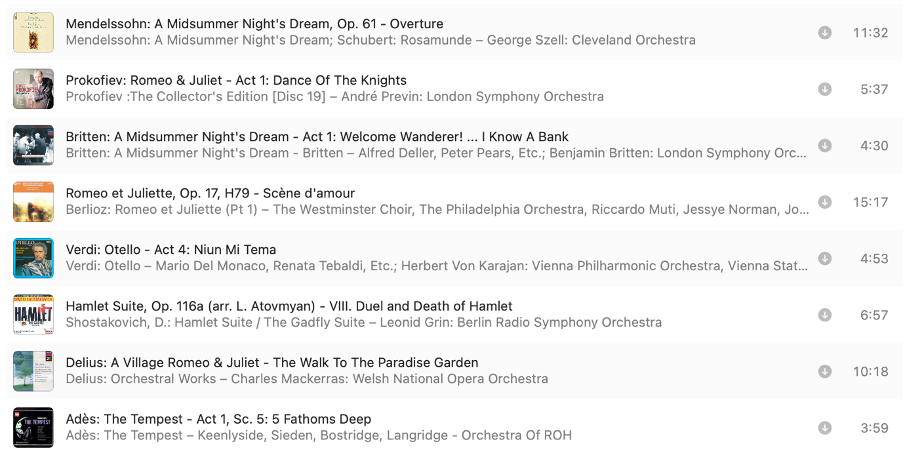
The relationship between classical music and William Shakespeare’s writing is one of the longest and most productive partnerships in the history of either art form. Composers have been drawn to Shakespeare's plays for four centuries and there is a vast amount of music to choose from. For this episode I have nine pieces, but only from four plays which suggests that some of the plays are perhaps more beloved by composers than others… Music from composers responding to ‘A Midsummer Night’s Dream’, ‘Romeo and Juliet’, ‘Hamlet’ and ‘Othello’. And those composers… ranging from the 19th century to the 21st are… Felix Mendelssohn, Sergei Prokofiev, Benjamin Britten, Hector Berlioz, Giuseppe Verdi, Dmitri Shostakovich, Frederick Delius and Thomas Adès.
And here is a link to a playlist on Spotify with the music from this episode:
https://open.spotify.com/playlist/2Xk8FzkVYFqDTFkHauFQDx?si=362f3dc9c79f454a
The Music
The Words
Hello everyone. Welcome to another episode of the ‘Classical For Everyone’ Podcast… five hundred years of incredible music. My name is Peter Cudlipp and… If you enjoy any music at all then I’m convinced you can enjoy classical music. All you need are ears. No expertise is necessary. If you’ve ever been curious about classical music… or explored it for a while once upon a time… or just quietly wondered what all the fuss was about… then this is the podcast for you.
And because there's a lot of music out there each episode has something of a theme. And for this one it is… classical music inspired by the plays of William Shakespeare.
The relationship between classical music and the plays of William Shakespeare is one of the longest and most productive partnerships in the history of either art form. Composers have been drawn to Shakespeare's plays for four centuries and there is a vast amount of music to choose from. Today I’ve got nine pieces, but only from four plays which suggests that some of the plays are perhaps more beloved by composers than others… And those composers… ranging from the 19th century to the 21st are… Felix Mendelssohn, Sergei Prokofiev, Benjamin Britten, Hector Berlioz, Giuseppe Verdi, Dmitri Shostakovich, Frederick Delius and Thomas Adès.
First up is Felix Mendelssohn. And specifically the overture he wrote to Shakespeare's 'A Midsummer Night's Dream'. Mendelssohn was seventeen years old when he wrote this music. Seventeen. According to my AI pal Claude… that is one of those facts that you either find inspiring or deeply discouraging depending on your temperament and your current relationship with your own creative output.
'A Midsummer Night's Dream' is a comedy about love, magic, mistaken identity and the chaos that results when a powerful fairy king and queen fall out in an enchanted forest outside Athens. There are mortals wandering lost among the trees, the king of the fairies playing tricks on his own queen, and a group of bumbling amateur actors who have wandered in to rehearse a play. It is, to put it plainly, a wonderful mess.
Mendelssohn had read the play in a German translation by August Schlegel, which was remarkable in itself — Schlegel's translations were so good that Germans sometimes claimed Shakespeare was actually better in German. Whether or not that is true, something about the play caught fire in the imagination of this teenage prodigy in Berlin in the summer of 1826. Of all the pieces I’m playing in this episode this is perhaps the best known which makes sense as it has had 200 years to get a following. But for a bunch of people the sound world Mendelssohn created is almost instantly conjured up when they hear the words ‘A Midsummer Night’s Dream’.
The overture is about eleven and a half minutes long. George Szell conducts the Cleveland Orchestra. Felix Mendelssohn's overture to 'A Midsummer Night's Dream'.
A
That was Felix Mendelssohn's overture to 'A Midsummer Night's Dream'. George Szell conducted the Cleveland Orchestra.
The next piece moves from an enchanted forest to the streets of Verona. And from the delicate, mercurial world of Mendelssohn to something altogether more dangerous and earthbound.
Sergei Prokofiev wrote his ballet based on Shakespeare’s tragedy 'Romeo and Juliet' in 1935 and 1936. The section I'm going to play is called 'Dance of the Knights' — and it is worth knowing a little about where it appears in the story. The Montagues and the Capulets are the two feuding, wealthy, Veronese families at the heart of the play, and this music accompanies a grand, formal ball at the Capulet house. Romeo, who is a Montague and has no business being there at all, has gate-crashed. And it is here that he first sees Juliet who is a Capulet.
The music could not be further from gate-crashing. It is massive, formal, deliberately imposing. Prokofiev gives the Capulets — the hosts, the powerful family on their own ground — music of almost crushing authority. This is about six minutes long. André Previn conducts the London Symphony Orchestra. Prokofiev's 'Dance of the Knights' from 'Romeo and Juliet'.
B
That was the 'Dance of the Knights' from Sergei Prokofiev's ballet 'Romeo and Juliet'. André Previn conducted the London Symphony Orchestra.
Back now to the enchanted forest outside Athens… because this episode includes two pieces drawn from 'A Midsummer Night's Dream' — the Mendelssohn overture I played at the beginning of the show, and now music from Benjamin Britten's opera based on the same play, written in 1960. One hundred and thirty-four years after Mendelssohn.
When Britten wrote his opera, he and his partner the singer Peter Pears adapted the play into an opera libretto themselves. To do this they cut more than half the play. And yet I would argue you really don’t miss what was lost. It is a totally masterful adaptation and they only added one line of their own invention… a little bit of plot clarification that really replaced a fifth of the play. Anyway, the section I'm going to play comes from the opening of the opera. It is night. The forest. And Oberon, the king of the fairies, is singing. In Britten's opera, Oberon is written not for a male voice of the kind you might expect — a baritone or a tenor — but for a countertenor. A countertenor is a male singer who uses a technique that produces a voice in a much higher register. The effect is otherworldly, which is precisely the point.
The countertenor singing Oberon here is Alfred Deller, one of the great countertenors of the twentieth century, and in fact one of the singers most responsible for bringing the countertenor voice back into serious musical life. If you compare what you are about to hear with the Mendelssohn overture— both pieces about the same play, both trying to conjure the same enchanted forest — the difference is fascinating. Mendelssohn's forest shimmers and sparkles. Britten's forest is stranger, darker, more genuinely unsettling.. They just happen to be extraordinary in completely different ways.
This section, 'Welcome Wanderer' and then 'I Know a Bank', is about four minutes long. It includes a setting of some very lovely poetry… the sweetness of which undercuts Oberon’s malevolent intent to make life very complicated for his lover Tytania…
“I know a bank where the wild thyme blows,
Where oxlips and the nodding violet grows
Quite over-canopied with luscious woodbine,
With sweet musk-roses and with Eglantine;
There sleeps Tytania, sometime of the night,
Lull’d in these flowers, with dances and delight:
And there the snake throws her enamel’d skin,
Weed wide enough to wrap a fairy in.
And with the juice of this flower I’ll streak her eyes
And make her full of hateful fantasies.”
Benjamin Britten conducts the London Symphony Orchestra and Alfred Deller sings the role of Oberon.
C
That was Alfred Deller as Oberon, with the London Symphony Orchestra conducted by Benjamin Britten, in a section from Britten's opera 'A Midsummer Night's Dream'… ‘Welcome wanderer’.
Now — back to Romeo and Juliet. The French composer Hector Berlioz wrote what he called a 'dramatic symphony' based on 'Romeo and Juliet' in 1839. It is a large-scale work for orchestra, chorus and soloists, and it is one of his most ambitious undertakings.
And within it there is a section called the 'Scène d'amour' — the love scene — that is, I think, a quite ravishingly beautiful piece of music.
Considering there are singers elsewhere in the work, Berlioz made an interesting choice. In this love scene, there are no singers. No soprano as Juliet, no tenor as Romeo. The scene is played entirely by the orchestra. And Berlioz was quite explicit about why. He felt that the moment in the play when Romeo and Juliet first declare their love to each other — the famous balcony scene — was simply too great, too overwhelming in its emotion, to be expressed by mere human voices singing words. He needed something else. He needed the orchestra to do it.
The result is fifteen minutes of music that does something very few pieces can manage. I think it makes you feel like you are actually witnessing something private and tender and fragile. And I say that as someone who has never quite connected with the music of Berlioz. Maybe that is about to change.
Riccardo Muti conducts the Philadelphia Orchestra. Berlioz's 'Scène d'amour' from 'Roméo et Juliette' by Hector Berlioz.
D
That was the 'Scène d'amour' from Hector Berlioz's dramatic symphony 'Roméo et Juliette'. Riccardo Muti conducted the Philadelphia Orchestra.
Giuseppe Verdi's opera 'Otello' is considered by opera people as one of the supreme achievements of the operatic form. Verdi wrote it in 1887, when he was seventy-three years old… working with the librettist Arrigo Boito and very closely following Shakespeare’s play ‘Othello’.
The section I'm going to play comes at the very end of the opera. Otello a general for the republic of Venice has, through the poisonous scheming of his subordinate Iago, been convinced that his wife Desdemona has been unfaithful to him. He has killed her. And now at the very end of the opera he has discovered the truth — that she was innocent, that he has been manipulated, that he has destroyed the thing he loved most in the world.
What Verdi does musically in these final minutes is pretty extraordinary. The voice has to carry everything — the ruin of a great man, the memory of love, and the taking of his own life. The piece is called 'Niun mi tema', which translates roughly as 'Let no one fear me now'.
The tenor singing Otello here is Mario Del Monaco. Herbert von Karajan conducts the Vienna Philharmonic. It is about five minutes long.
E
That was Mario Del Monaco as Otello, with the Vienna Philharmonic conducted by Herbert von Karajan, in the final scene from Verdi's opera 'Otello'.
My name is Peter Cudlipp and you have been listening to the 'Classical for Everyone' Podcast. I have a couple more pieces coming up but before I get to them I want to give you a little information that I hope you find useful… If you would like to listen to past episodes or get details of the music I've played please head to the website classicalforeveryone.net. That address again is classicalforeveryone.net. On the individual episode pages of the website there are links to Spotify playlists with the full versions of most of the music played in each of the episodes. I hope you are enjoying this Shakespeare-inspired episode of 'Classical For Everyone'. And if you want to get in touch then you can email… info@classicalforeveryone.net.
Next — Shakespeare’s ‘Hamlet’. It’s worth just taking a moment to state the premise of the play… A Ghost is seen stalking the battlements of the Danish royal castle, Elsinore. Hamlet, the Prince of Denmark believes it is his recently deceased father, the King. The Ghost claims that his brother poisoned him to win the crown and calls upon Hamlet to avenge his murder. The play follows Hamlet's agonised, circling struggle to act on what he knows or what he believes he knows, in a court where he can trust almost no one.
In 1964 the Soviet director Grigori Kozintsev made what many people believe is the greatest film version of Hamlet ever committed to screen. And the composer Dmitri Shostakovich wrote the music for it.
Staging Shakespeare in the Soviet Union in the 1960s was not a straightforward artistic decision. Kozintsev had been working on a version of Hamlet for years, and the themes of the play — a man of conscience trapped in a corrupt and murderous court, surrounded by surveillance, forced to pretend madness to navigate to the truth — these themes were not, I think it is fair to say, without contemporary resonance in Soviet Russia. Whether the authorities recognised the parallel or chose not to, the film was made. And it is remarkable.
The section I'm going to play from Shostakovich's suite drawn from the film score is called 'Duel and Death of Hamlet'. Which tells you where in the story it sits. This is the end. Shostakovich gives it music of controlled anguish — not melodrama, but something more spare and devastating than that.
The section is about seven minutes long. Leonid Grin conducts the Berlin Radio Symphony Orchestra.
F
That was 'Duel and Death of Hamlet' from Dmitri Shostakovich's Hamlet Suite. Leonid Grin conducted the Berlin Radio Symphony Orchestra.
The next piece is the one in this programme that has the most tenuous connection with Shakespeare. And I want to be upfront about that. But I think the music is well worth playing.
Frederick Delius was a British composer, born in Bradford in 1862, and he wrote an opera called 'A Village Romeo and Juliet'. The title borrows from Shakespeare — but the story is not Shakespeare's. The opera is based on a novella by the Swiss author Gottfried Keller, written in 1856, which itself drew on a real news story Keller had read about two young Swiss villagers whose families were locked in a bitter land dispute, and who chose to die together rather than live apart. The connection to Shakespeare's Romeo and Juliet is real — Keller was clearly thinking of the play — but Delius's opera is its own story… a long way from Verona.
The title is worth pausing on for a moment… 'The Walk to the Paradise Garden'. In 1946, the American photojournalist W. Eugene Smith — who had been severely wounded covering the fighting in the Pacific and spent two years unable to hold a camera — took his first photograph since his injury. He walked into the woods behind his house with his two young children, Patrick and Juanita, and photographed them from behind as they walked hand in hand toward a sunlit clearing in the trees. He called the photograph 'The Walk to the Paradise Garden'. It became one of the great photographic images of the twentieth century — Edward Steichen chose it as the final print in his landmark 'Family of Man' exhibition at the Museum of Modern Art in 1955.
The connection between Smith's photograph and Delius's music is, as far as anyone knows, entirely coincidental. Same title, same feeling — two figures moving toward the light, knowing or not knowing what lies ahead.
This is about ten minutes long. Sir Charles Mackerras conducts the Welsh National Opera Orchestra.
G
That was 'The Walk to the Paradise Garden' from Frederick Delius's opera 'A Village Romeo and Juliet'. Sir Charles Mackerras conducted the Welsh National Opera Orchestra.
The final piece in today's programme is the most recent. The British composer Thomas Adès wrote his opera 'The Tempest' in 2004, and it has since become one of the most performed new operas of the twenty-first century — a remarkable achievement for a contemporary classical work.
'The Tempest' is Shakespeare's last play — or at least the last he wrote entirely alone — and in some ways the strangest and most mysterious of them all. It takes place on an island ruled by the magician Prospero, who was the rightful Duke of Milan before being overthrown and exiled. With him on the island are his daughter Miranda, and two extraordinary figures. One is Caliban, a creature of the island, half human and deeply resentful of Prospero's dominion over him. The other is Ariel — a spirit of the air, genderless, magical, neither fully of this world nor entirely free of it. Ariel serves Prospero under a promise of eventual freedom.
The section I'm going to play — 'Five Fathoms Deep' — is Ariel's first song in the opera. The words Adès sets are taken directly from Shakespeare — the song that Ariel sings in the play, which begins 'Full fathom five thy father lies'. It is a song about transformation — the body of a drowned king becoming something beautiful and strange, his eyes turned to pearls, his bones to coral. Shakespeare's way of saying that grief, and loss, and even death, can be transformed into something else entirely.
Adès writes the role of Ariel for a very high soprano voice — almost at the extreme of what the human voice can do — and the effect is exactly right. This is not a human creature singing. This is something between the elements.
The soprano singing Ariel is Cyndia Sieden. Thomas Adès conducts the Orchestra of the Royal Opera House, Covent Garden. This is about five minutes long.
H
That was Thomas Adès conducting the Orchestra of the Royal Opera House, Covent Garden in a performance of his own opera ‘The Tempest’ based on the play by William Shakespeare. You heard the character Ariel’s song ‘Five Fathoms Deep’ and Cyndia Sieden was the singer.
Thanks for your time and I look forward to playing you some more incredible music on the next 'Classical For Everyone'.
This podcast is made with Audacity Software for editing, Wikipedia for Research, Claude for Artificial Intelligence and the music played is licensed through AMCOS / APRA. Classical For Everyone is a production of Mending Wall Studios and began life thanks to the enthusiasm and encouragement of Mr Jeffrey Sanders.
And if you have listened to the credits… here is one more piece of music for you. Just a couple of minutes.
I think this sort of combines a couple of the styles of music in this episode. At the end of Benjamin Britten’s opera ‘A Midsummer Night’s Dream’ a play is performed for the Athenian court’s marriage celebrations. In the play, an ancient tragedy called ‘Pyramus & Thisbe’ the actors are local tradesmen. They are not very good. And that, in the play, is the source of the comedy. In the opera there is an additional layer of humour in what Britten does with the music to either support or subvert the efforts of the not very dramatically gifted tradesmen.
At the end of the play within a play within an opera the character Thisbe discovers that her lover Pyramus is dead. Operatic drama ensues. And Britten writes in the style of a grand swansong death from a nineteenth century opera… not a million miles from Verdi’s end of ‘Otello’ I played a while back. I hope you enjoy a couple of minutes of operatic satirical comedy.
Benjamin Britten conducts the London Symphony Orchestra and Kenneth Macdonald is singing Thisbe.
Thanks again for listening.
I