

 Apple Podcasts
 Spotify
 Amazon Music
 iHeartRadio
 Overcast
 PocketCasts
  RSS Feed
 Music For Pets
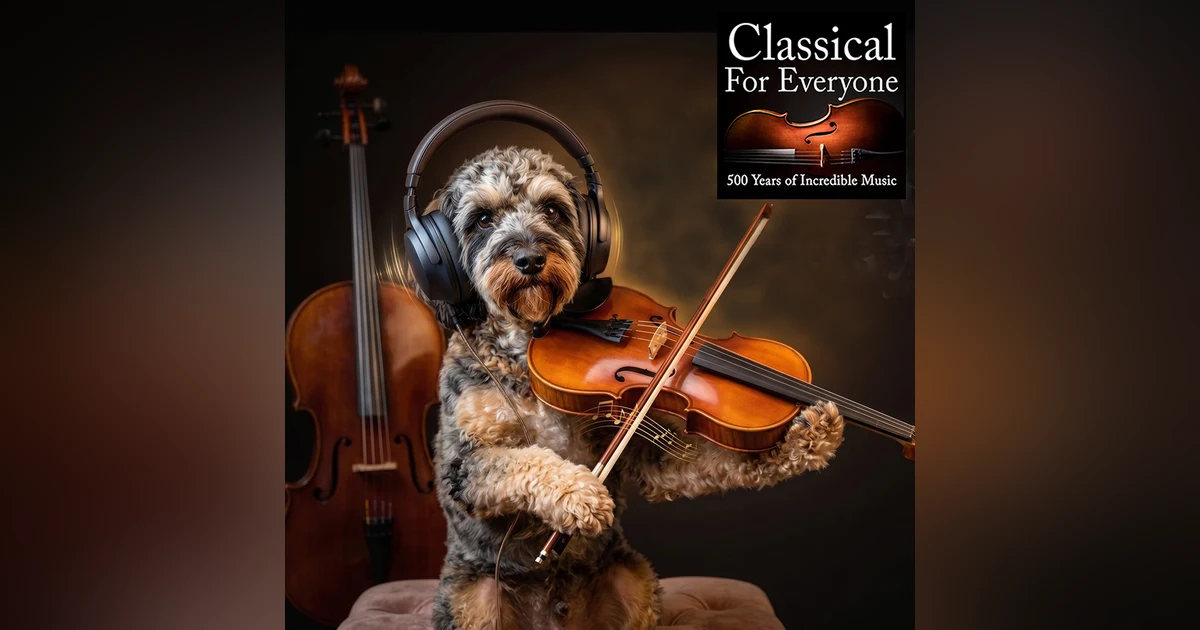
There may have been wine involved when the decision to put together a show of music for pets was first discussed. But when I was presented with art for the episode featuring the surprisingly gifted cavoodle, Bob; it was too late to go back. So, music for pets it is. But I don’t imagine you lining up your Spots, Tiggers, Fidos, Nuggets and Bobs for them to listen appreciatively to your audio device. No, the music is really more about a selection of the animals that we happen to enjoy as pets. And like all the themes for Classical for Everyone it is an excuse to find some wonderful music… And in this episode it is going to come from… Aaron Copland, Bernd Deutsh, Antonio Vivaldi, Jessica Wells, Domenico Scarlatti, Camille Saint-Saens, Bright Sheng, Sergei Prokofiev, Bohuslav Martinu, Nigel Westlake and Maurice Ravel. [Episode Image: Bob.]
And here is a link to a playlist on Spotify with the music from this episode:
https://open.spotify.com/playlist/21cnqIT7AgGPh4W06vdKB6?si=87f0df00aedc41b2
The Music
The Words
Hello everyone. Welcome to another episode of the ‘Classical For Everyone’ Podcast… five hundred years of incredible music. My name is Peter Cudlipp and… If you enjoy any music at all then I’m convinced you can enjoy classical music. All you need are ears. No expertise is necessary. If you’ve ever been curious about classical music… or explored it for a while once upon a time… or just quietly wondered what all the fuss was about… then this is the podcast for you.
And because there’s a lot of music out there each episode has a theme. And for this one it is… Music for Pets.
Now, though it will I believe still live up to the ‘incredible music’ promise the show makes; this episode has a deliberately light-hearted intent.. It is pretty easy to accuse the world of classical music of taking itself too seriously so something maybe a little frivolous is not a bad idea. But first, a little origin story…
My good friend Nicole is the parent of, apart from two spectacular young men, a caboodle called Bob. Now when I started the podcast Nicole kindly had a listen but could not help but be a little mean about my let’s be fair, slightly pretentious Germanic pronunciation of the name ‘Bach’. Puns involving the composer’s name and the sound a dog makes ensued. And Bob became a friend of the show and has been name-checked a couple of times.
So there may have been wine involved when the decision to put together a show of music for pets was first discussed with Nicole but when I was presented with art for the episode featuring the surprisingly gifted Bob, it was too late to go back. So, music for pets it is. But I don’t imagine you lining up your Spots, Tiggers, Fidos, Nuggets and Bobs and seeing if they can listen appreciatively to your device.
No, the music is really more about the animals that we enjoy as pets. And like all the themes for Classical for Everyone it is an excuse to find some wonderful music… And in this episode it is going to come from… Aaron Copland, Bernd Deutsh, Antonio Vivaldi, Jessica Wells, Domenico Scarlatti, Camille Saint-Saens, Bright Sheng, Sergei Prokofiev, Bohuslav Martinu, Nigel Westlake and Maurice Ravel.
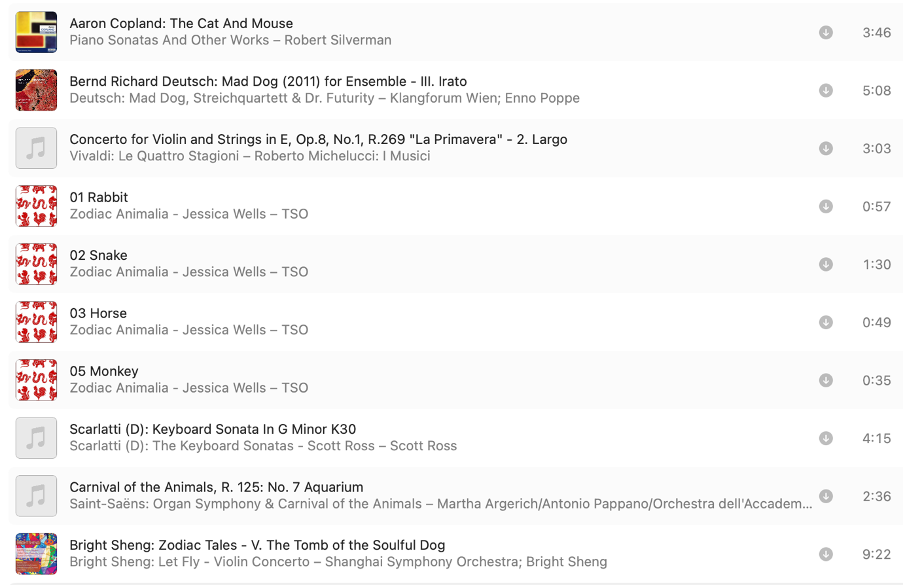
Ok. When the American composer Aaron Copland was Paris for the first time in 1921 he performed a short piece for solo piano at a recital and was approached by a music publisher for the work. It was called ‘The Cat and The Mouse’ and it became Copland’s first published music. Here it is played by Robert Silverman. It is a bit under four minutes long.
A
That was Robert Silverman playing Aaron Copland’s ‘The Cat and the Mouse’ which incidentally was based on a fable by Jean De La Fontaine. More about him a little later.
Ok. Surprisingly when searching for music about dogs or inspired by dogs not a great deal turned up. But that became an excuse to look a bit further afield and find some great music a little off the beaten track.
Back in 2011 the contemporary Austrian composer Bernd Richard Deutsch put together a three part work for small ensemble he called ‘Mad Dog’. I’m going to play you the third section he called ‘Irato’… a depiction, in part, of a rambunctious canine in the morning. Here is the group ‘Klangforum’ from Vienna led by Enno Poppe. It is about five minutes long. ‘Mad Dog’ by Bernd Richard Deutsch.
B
That was the third and final section of ‘Mad Dog’ by Bernd Richard Deutsch and it was performed by the group Klangforum led by Enno Poppe.
So, what does the most overused and abused piece of classical music in the history of the art form have to do with pets? Well in the slow section of the first part of Antonio Vivaldi’s ‘The Four Seasons’, you can hear a dog barking. Literally, the cellos repeatedly go ‘woof woof’ or ‘arf arf’ depending on your preference. So Vivaldi either found or wrote (no one is quite sure) poems to go with each of the sections of ‘The Four Seasons’ and further broke them down into verses that are specific to each of the three parts of each section. So, for the slow part of ‘Spring’ the lines are…
"E quindi sul fiorito ameno prato
Al caro mormorio di fronde e piante
Dorme 'l Caprar col fido can' à lato."
Which roughly translates as…
On the flower-strewn meadow,
with leafy branches rustling overhead,
the goat-herd sleeps, his faithful dog beside him.
The goat-herd must have been a very good sleeper because his dog barks the whole time. Here is the group iMusici with the slow section of Antonio Vivaldi’s ‘Spring’ from The Four Seasons. About three minutes of pet music.
C
That was the group iMusici with the slow section of Antonio Vivaldi’s ‘Spring’ from The Four Seasons.
Ok. In 2017 the composer Jessica Wells wrote a collection of 12 quite short pieces taking as her inspiration the Chinese zodiac. And she called it ‘Zodiac Animalia’. Of the twelve I have chosen the ones most likely to be pets… or pet adjacent. In the order you will hear four of them they are… Rabbit, Snake, Horse and Monkey. Here is the Tasmanian Symphony Orchestra conducted by the composer, Jessica Wells, with about five minutes from her piece ‘Zodiac Animalia’.
D
That was the Tasmanian Symphony Orchestra conducted by the composer, Jessica Wells, with Rabbit, Snake, Horse and Monkey from her Zodiac Animalia.
The Neapolitan born composer Domenico Scarlatti who spent most of his working life in Spain and Portugal dying in Madrid at the age of 71 in 1757 is best known for his collection of 555 keyboard sonatas.
As with much classical music, especially if the composer has written a number of works in the one genre, a nickname can help with the popularity and longevity of an individual piece. If you think of the 32 piano sonatas by Beethoven, the ones with nicknames… Moonlight, Appassionata, Waldstein etc. are better known. And it is a bit of a chicken and egg situation. But it does make a difference. So, back to Scarlatti’s 555 keyboard sonatas.
There are about twelve that have nicknames and for the purposes of this episode of ‘Music For Pets’ it is the one called the ‘Cat’s Fugue’ that matters. But let’s get the term ‘fugue’ out of the way first… very simply a fugue is an organized musical puzzle where a main melody is introduced and is then imitated by other voices at staggered intervals. And for keyboard music of course, those other voices are all sounded on the same instrument and wonderful complexity can evolve… not to mention extreme challenges for the performer.
But back to pets. So, the story goes that Scarlatti had a pet cat called Pulcinella who would from time to time, whilst Scarlatti was working away at his harpsichord, decide to wander across the keys… the musical cat’s standard method of saying ‘I’m hungry’. One time the notes Pulcinella stepped on formed a melodic sequence Scarlatti was taken with and turned them into the beginning of a sonata which ended up being called ‘Fuga del Gatto’… or the ‘Cat’s Fugue’. Now as this nickname was first used a hundred or so years after Scarlatti’s death… it’s hard to really authenticate this story. But have a listen to the four minute sonata, here performed by Scott Ross, and I think you really can hear a cat walking across a harpsichord for the first couple of phrases.
E
That was Domenico Scarlatti’s ‘Fuga Del Gatto’; the Cat’s Fugue performed by Scott Ross.
Ok. Another batch of pets. Once upon a time I was under the wild misapprehension that an outdoor fishpond was a good idea. What, as they say, could possibly go wrong. Well, the white-faced heron is what went horribly wrong. I had created a beautiful smorgasbord for this particularly hungry descendent of dinosaurs. But I suppose the heron was doing what a heron does. I was the problem… laying out a feast of fish. Which brings me back to music… And the delightful two and a half minute ‘Aquarium’ section from Camille Saint-Saens 1886 ‘Carnival of the Animals. Martha Argerich and Antonio Pappano play the two pianos and are accompanied by the Orchestra dell'Accademia Nazionale di Santa Cecilia.
F
That was the Aquarium’ section from Camille Saint-Saens ‘Carnival of the Animals. Martha Argerich and Antonio Pappano played the two pianos and were accompanied by the Orchestra dell'Accademia Nazionale di Santa Cecilia.
Ok. Bright Sheng is a Chinese American composer perhaps best known for his connection to the Silk Road Project. In 2005 he wrote a concerto for orchestra he called ‘Zodiac Tales’. And yes, this is the 2nd time the animals used in the Chinese zodiac makes an appearance in this episode. The fifth section is titled ‘The Tomb of the Soulful Dog’ and here is what Bright Sheng wrote about it…
The notion that ‘the dog is Man’s best friend’ has also been part of Chinese culture for a long time. The most well-known fable is about the dog of Emperor Liu Bang, the founder of the Han Dynasty (206 B.C.-220 A.D.). In the legend, the Emperor’s dog sacrificed himself to save his master’s army by putting out a fire set by the enemy as they besieged and surrounded the Emperor’s troops. Emperor Liu later buried the dog in a serene ceremony and built a large tombstone inscribed with ‘The Tomb of the Soulful Dog’.
The section is about nine minutes long and here is the Shanghai Symphony Orchestra conducted by the Composer, Bright Sheng, with his ‘The Tomb of the Soulful Dog’.
G
That was Shanghai Symphony Orchestra conducted by the Composer, Bright Sheng, with his ‘The Tomb of the Soulful Dog’.
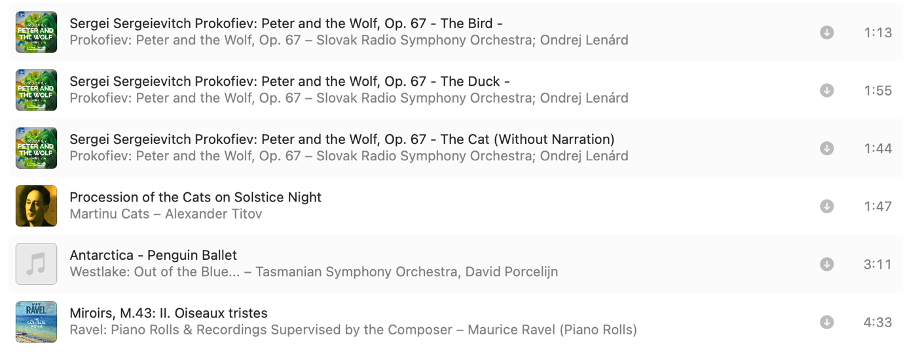
Ok. I played the complete ‘Peter and the Wolf’ written by Sergei Prokofiev in 1936 a while back. But if you are looking for music about animals that just radiates charm and fun then it is frankly impossible to go past this. It is best known in versions with a narration that explains that particular instruments represent particular animals but today thanks to the good people of Naxos Records I have found a version with just the music and I would have really liked to play you the wolf’s music. But according to the robot masters of the internet… “Owning a wolf as a pet is highly discouraged and largely illegal.”. Not really going to work for an episode called ‘Music For Pets’. So… I am going to play you the Bird, the Duck and the Cat. Here is Slovak Radio Symphony Orchestra conducted by Ondrej Lenard. Five minutes from Sergei Prokofiev’s ‘Peter and the Wolf’.
H
That was the Bird, the Duck and the Cat from Sergei Prokofiev’s ‘Peter and the Wolf’ performed by the Slovak Radio Symphony Orchestra conducted by Ondrej Lenard.
Ok. Continuing with cats…
If you recall I mentioned the French writer Jean De La Fontaine earlier and one of his Tales from the mid 1600s is called ‘Quand la Chat ronronne’… When the cat purrs. And it is just so sweet I want to read you a couple of lines…
Sometimes she hides under the sheets
Just waiting for me to play with her.
Or she’s behind a thin curtain,
Puzzling over the world;
She wants me to watch her and then to catch her.
But the Bohemian composer Bohislav Martinǔ had a slightly darker view of cats in mind when in 1919 he wrote a short piano piece her called… "The Cats' Procession in the Solstice Night" . Now I’ve been unable to find out which solstice Martinu was referring but it can be assumed it was to do with folk tales about cats gathering to lead a collection of witches to bonfires where much dark magic would take place at midnight.
But the music is actually slightly lighter than that makes it sounds. Especially in this version orchestrated by Alexander Titov and performed by the Saint Petersburg Orchestra of the State Hermitage Museum Camerata. I think you can imagine that the cats in the procession are quite puzzled as to why women with brooms are following them. It is about 2 minutes long.
I
That was Bohislav Martinǔ’s "The Cats' Procession in the Solstice Night" orchestrated by Alexander Titov who conducted the Saint Petersburg Orchestra of the State Hermitage Museum Camerata.
My name is Peter Cudlipp and you have been listening to the ‘Classical for Everyone’ Podcast. I have another couple of pieces coming up but before I get to them I want to give you a little information that I hope you find useful… If you would like to listen to past episodes or get details of the music I’ve played please head to the website classicalforeveryone.net. That address again is classicalforeveryone.net. On the individual episode pages of the website there are links to Spotify playlists with the full versions of much of the music played in each of the episodes. I hope you have enjoyed this ‘Pets’ focused episode of ‘Classical For Everyone’. And if you want to get in touch then you can email… info@classicalforeveryone.net.
Alright, to finish this episode I have some music about some animals that I think would make great pets. Apart from the smell, the large pool you’d need to build, the aquatic food you’d need to supply. And a very powerful cooling system. But I just think they’d be great pets. Here is ‘Penguin Ballet’ by Nigel Westlake from his score for the film ‘Antarctica’. The Tasmanian Symphony Orchestra is conducted by David Porcelijn and Timothy Kain plays the solo guitar.
J
That was ‘Penguin Ballet’ by Nigel Westlake from his score for the film ‘Antarctica’. The Tasmanian Symphony Orchestra was conducted by David Porcelijn and Timothy Kain played the solo guitar.
Thanks for your time and I look forward to playing you some more incredible music on the next ‘Classical For Everyone’. This podcast is made with Audacity Software for editing, Wikipedia for Research, Claude for Artificial Intelligence and the music played is licensed through AMCOS / APRA. Classical For Everyone is a production of Mending Wall Studios and began life thanks to the enthusiasm and encouragement of Mr Jeffrey Sanders.
And if you have listened to the credits… here is a bit more music for you…
Between 1904 and 1905 the French composer Maurice Ravel wrote a five part work for solo piano he called Mirrors and the second part is called ‘Oiseaux tristes’ or ‘Sad Birds’. I don’t know if Ravel was referring to birds in cages, or the slightly sorrowful tunes some birds sing, Or my white faced heron nemesis after I put netting over the fishpond.
But what I do know is that this is a recording of Maurice Ravel playing the piece himself. Or to be totally accurate… this is a performance of the player piano roll he recorded in London in 1922. Ravel plays Ravel. ‘Sad Birds’.
Thanks again for listening.
K