

 Apple Podcasts
 Spotify
 Amazon Music
 iHeartRadio
 Overcast
 PocketCasts
  RSS Feed
 Mozart Opera Overtures
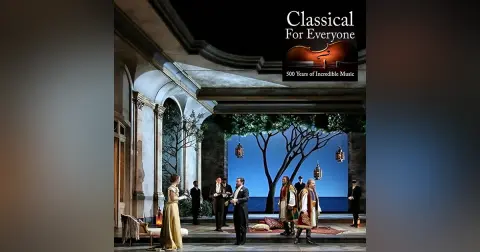
Why Mozart Opera Overtures? Well, whilst they were not really intended to be stand-alone pieces they have in many instances become favourites of concert programmers and broadcasters, not to mention the public. And with most of them being about five minutes long you can fit eleven of them into a podcast episode! They are also in a way an interesting lens into the development of a composer… since Mozart wrote his first opera very early and completed two in the final year of his life. And in between he wrote another 15 to 20 operas depending on how you define them. So I’m going to play them in chronological order. And as a parallel they chart the changes in the make-up of a theatre orchestra in this time of intense development… the late 1760s to the early 1790s. What we think of as the modern orchestra was starting to settle at this time and the difference in the resources, in terms of instruments, Mozart had from the beginning of his career to the end is striking. And music is pretty damn sensational.
[Episode image: ‘Cosi Fan Tutte’ – Opera Australia.]
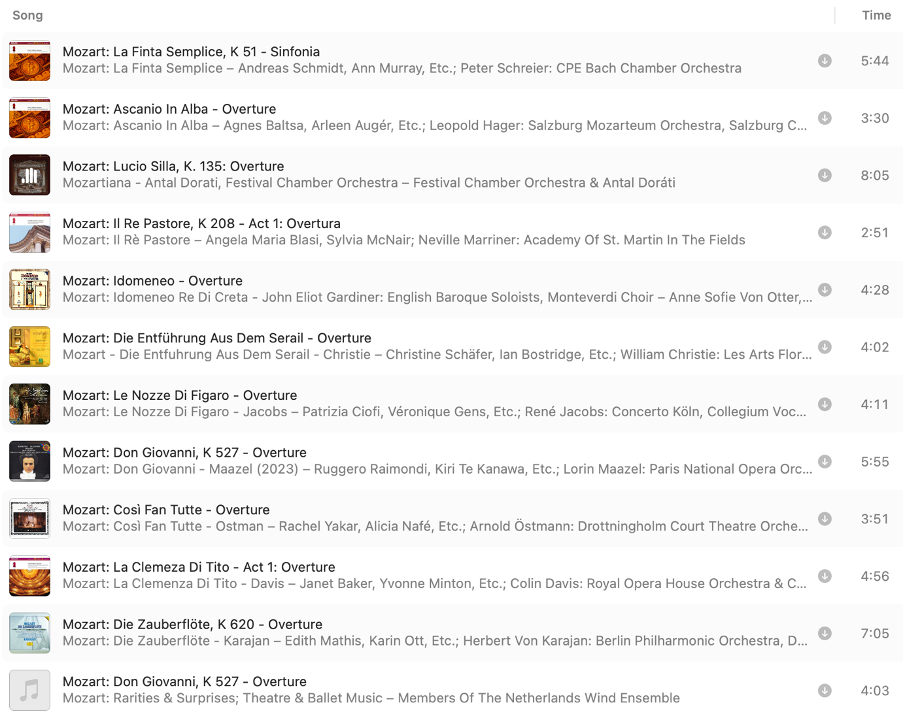
Here is a link to a playlist on Spotify with the music in the episode:
https://open.spotify.com/playlist/2Mh92scMlKeF81OLhe6KZ7?si=836504cc9b764b1b
The Music
The Words
Hello everyone. Welcome to another episode of the ‘Classical For Everyone’ Podcast… five hundred years of incredible music. My name is Peter Cudlipp and… If you enjoy any music at all then I’m convinced you can enjoy classical music. All you need are ears. No expertise is necessary. If you’ve ever been curious about classical music… or explored it for a while once upon a time… or just quietly wondered what all the fuss was about… then this is the podcast for you.
And because there’s a lot of music out there each episode has a theme. And for this one it is… overtures to operas written by Wolfgang Amadeus Mozart.
And just quickly…An overture was a short orchestral piece to settle a chattering audience and signal that the action was about to begin. In Mozart’s early years it was usually a generic piece that could have been swapped between operas. But as his career went on, he increasingly used the overture to set the mood of the work and to foreshadow music the audience would hear later in the performance.
So why all Mozart opera Overtures?
Well, whilst in most cases they were not really intended to be stand-alone pieces they have in many instances become favourites of concert programmers and broadcasters, not to mention the public. . And with most of them being about five minutes long you can fit eleven of them into a podcast episode.
They are also in a way an interesting lens into the development of a composer… since Mozart wrote his first opera very early and completed two in the final year of his life. And in between he wrote another 15 to 20 operas depending on how you define them. So I’m going to play them in chronological order.
And as a parallel they chart the changes in the make-up of a theatre orchestra in this time of intense development… the late 1760s to the early 1790s. What we think of as the modern orchestra was starting to settle at this time and the difference in the resources, in terms of instruments, Mozart had from the beginning of his career to the end is striking.
Then there is the, what can I call it, unadulterated sentimentality of the record collector. This is an opportunity to play to you some terrific recordings. I’ve made a choice to use a different orchestra and conductor for each overture. Not that I have too many CDs.
If you are in my corner of finding this sort of comparison in and of itself interesting then you really are in the right place today.
For those of you who have far better things to do than compare the merits of a Herbert von Karajan versus a John Eliot Gardiner… I hope over an hour of Mozart’s incredible music will be more than enough reward for your time.
Ok. Some music. I’ve used the semi-rhetorical question of ‘hey, what were you doing when you were x years of age' a few times in the podcast so it would be repetitious to use it here.
I’ll just play you the four minute Overture from Mozart’s 1768 full length opera La Finta Semplice (‘The Feigned Simpleton’ is the common (and kind of awkward) translation into English… but I think ‘Playing The Innocent’ is better). This is the CPE Bach Chamber Orchestra conducted by Peter Schreier.
And I am afraid I can’t resist. Mozart was 12 years old when he wrote this.
A
That was the Overture from Mozart’s 1768 opera La Finta Semplice (which is known in English as ‘The Feigned Simpleton’ but perhaps more accurately given as ‘Playing The Innocent’. And it was performed by the CPE Bach Chamber Orchestra conducted by Peter Schreier.
The opera was based on a libretto by Carlo Goldoni the Italian playwright but it went through a few extra hands before being chosen by the young Emperor Joseph II in Vienna as the right project for the very young Mozart.
It concerns a smart young woman who poses as somewhat less bright than she really is to outwit two disappointingly unworthy suitors. Which sounds like it would have been a fun night out for the court. But it was not ever performed in Vienna. Rumours, possibly circulated by jealous composers, circulated suggesting that there was no way a 12 year old could compose an opera... It must have been being written by Mozart’s pushy and one suspects somewhat abrasive father Leopold and passed off as the work of his son.
I have to say that I have some sympathy for the suspicions. Child prodigies, particularly in the world of classical music, are actually in pretty good supply. But of even the handful of other child genius composers… Mendelssohn, Prokofiev etc. … no one has ever written anything on the scale of La Finta Semplice. But it was Mozart who wrote it. You can go to University Library of Krakow in Poland and ask to see it. I’m not sure if they’ll let you but that is where the 588 handwritten manuscript pages of the opera have ended up.
Ok. I’d say there is very little chance anyone is going to be seeing Mozart’s 1771 opera ‘Ascanio in Alba’ any time soon. The fifteen year-old Mozart was commissioned to write it for a royal wedding in Milan and it is filled with allegorical representations of deities and figures from ancient history there on stage to celebrate the happy couple.
But here is the three minute Overture. It is I think typically delightful early Mozart. This is Leopold Hager conducting the Salzburg Mozarteum Orchestra.
B
That was Leopold Hager conducting the Salzburg Mozarteum Orchestra with the Overture from Mozart’s opera ‘Ascanio in Alba’.
Now when I say ‘opera’ it is more typically described in German as a ‘Festspiel’ or in Italian as a ‘festa teatrale’. There’s no exact English term but the idea is something a bit like an opera for a festival or celebration. And it was generally derived from the traditions of ‘opera seria’.
And since I’ve thrown that term in; I am going to quickly digress into the different types of operas in Mozart’s time. First. Opera seria. It was the prestige form of the court theatre: serious drama, usually on heroes and rulers from ancient history or myth,. Its music was built around the singers, especially castrati and star sopranos, in a fixed alternation of recitative that advanced the plot and arias in which each character reflected on a single emotion. Ensembles and choruses were rare, the plot typically ended with a magnanimous ruler restoring order, and the whole genre carried an aristocratic, moralising tone.
Then there was Opera buffa. Comic opera. Opera seria’s lively, socially broader cousin: comic stories about servants, merchants, peasants and the occasional foolish nobleman, in contemporary settings and full of wordplay. Its music favoured brisk tempos, and character types drawn from commedia dell'arte traditions. Above all, it developed the ensemble where many characters sing at once and the music changes pace as the plot twists.
And not quite as widespread as opera seria and opera buffa was the dramma giocoso: In English roughly ‘playful drama’. It was the Italian playwright Goldoni's term for an opera mixing buffa characters with one or two "serious" roles sung in a more elevated style. It ended up working both ways… a drama with some comedy in it… or a comedy with some drama in it. It will come to be at the centre of Mozart’s later operas. But just to add some context, the first overture I played was from an ‘opera buffa’ , ‘La Finta Semplice’, the second one was loosely an opera seria, ‘Ascanio in Alba’. And next up is the overture to Mozart’s first opera seria… Lucio Silla.
By the way, you might find it helpful to think of opera as the eighteenth century’s movies. And in the same way we divide movies broadly into comedies and dramas with subdivisions of black comedies, satires, and the truly awful term ‘dramedy’.
But back to Lucio Silla. Very definitely an opera seria. Written for Milan when Mozart was 16 and taking an old libretto based on some ancient Roman history that had been used for four earlier operas. And because we are only talking about overtures I do not need to go on about the plot at all. But I think in the music you can hear a more serious tone… one that befits the ‘weightier’ mood and mission of ‘opera seria’. And its longer than Mozart’s ‘opera buffa’ overtures… coming in at about eight minutes. Here is Antal Dorati conducting the Festival Chamber Orchestra. Mozart’s ‘Lucio Silla’.
C
That was Antal Dorati conducting the Festival Chamber Orchestra with the overture to Mozart’s ‘Lucio Silla’.
Now, if I didn’t put you to sleep when I was discussing it, you may recall descriptions of the different types of operas in Mozart’s day. But just to add some more complication; sometimes a composer would take an opera seria libretto and cut it down for a less weighty result. And that is what Mozart did with ‘Il re pastore’, ‘The Shepherd King’. He cut the three and a half hour libretto down to two hours and made it much more… pastoral. There's no villain, no real danger and no political crisis, just shepherds and gentle misunderstandings. And this ended up with another term… a ‘serenata’.
Here is Neville Marriner conducting the Academy of St Martin in the Fields with the overture to Mozart’s 'Il re pastore’, ‘The Shepherd King’. It is about three minutes long.
D
That was Neville Marriner conducting the Academy of St Martin in the Fields with the overture to Mozart’s 'Il re pastore’, ‘The Shepherd King’
After a few years with some unfinished operas and some opera-adjacent works Mozart was in 1780 commissioned to write an opera for the Bavarian court based in Munich. And it is most likely that Karl Theodore the Elector of Bavaria chose the subject and libretto. It was an opera seria called ‘Idomeneo, King of Crete’.
I’ve been a little flippant about the plots of the earlier operas but Idomeneo is I think the first Mozart opera that needs no qualifications: no ‘amazing for a teenager’, no ‘worth hearing for its promise’. Audiences might struggle with the whole ‘heroes of the ancient world acting heroically and a sea monster’ opera seria genre traits of the libretto; but with the music Mozart is moving into the blend of drama, passion, wit and elegance that would define his maturity… and his continuing appeal.
Here is the overture. It is about four minutes long and this is John Eliot Gardiner conducting the English Baroque Soloists. Mozart’s Idomeneo.
E
That was John Eliot Gardiner conducting the English Baroque Soloists with the overture from Mozart’s opera Idomeneo, King of Crete.
Ok. Guess what? Time for another sub-genre in the world of opera. But this one is easy. Whilst most of the European courts believed for most of the 1700s that if the singers weren’t singing in Italian it wasn’t an opera; there was some push back developing and one champion of the idea of opera-like productions written and sung in German was Emperor Joseph II. He took the term for ‘a play with songs’ ‘singspiel’ and in 1788 established the National Singspiel for the express purpose of creating operas that were in German plus ditching the Italian recitative… that is sung dialogue with very simple and frequently improvised harpsichord accompaniment… with spoken dialogue. Thus… the opera form now known as ‘singspiel’.
When Mozart moved to Vienna permanently in 1781 one of the first things he did was lobby Gottfried Stephanie who ran the National Singspiel for an opportunity to write an opera. Without too much prompting he was given the opportunity and as was the practice the libretto was provided by and indeed in this instance adapted by Gottfried Stephanie himself from another work.
This was ‘The Abduction From The Seraglio’ or in the original German ‘Die Entführung aus dem Serail’. The opera was inspired by contemporary interest in the exotic culture of the Ottoman Empire which had only recently ceased to be a military threat to Austria-Hungary. It also fed a frankly disturbing fascination with the idea of a harem which is what a seraglio actually is. And all this is actually wrapped up in some surprisingly good comedy and a happy ending. It was and remains a tremendous success for Mozart.
Here is William Christie directing the group Les Arts Florissants with the overture to Mozart’s ‘The Abduction from the Seraglio’.
F
That was William Christie directing the group Les Arts Florissants with the overture to Mozart’s ‘The Abduction from the Seraglio’.
I could say a great deal about the next opera. But I think wild, gushing praise can have a dulling effect… particularly for someone who is unfamiliar with whatever the subject of that praise might be… book, play, painting, film… or opera. And I genuinely hope that for some of the listeners to this episode… this is going to be something new.
But I have said on this podcast before that if you want to find a way into opera then Wolfgang Amadeus Mozart’s ‘Le Nozze di Figaro’ , ‘The Marriage of Figaro’ with words by Lorenzo Da Ponte based on a play by Pierre de Beaumarchais… is I think the ideal place to start. It is hard not to be charmed by the comedy, the romance, the complexity, the depth… but mostly the music.
Here is Rene Jacobs directing the Concerto Cologne with the Overture to ‘The Marriage Of Figaro’.
G
That was Rene Jacobs directing the Concerto Cologne with the Overture to ‘The Marriage Of Figaro’.
I will give you a little more detail about Figaro before we move on. It was composed in 1786. And this is a very rare instance of Mozart finding the dramatic material for an opera himself. He brought the Beaumarchais play to the poet Lorenzo da Ponte and asked him to adapt it as an opera libretto. And it was da Ponte who then persuaded the Emperor Joseph II who had banned the play because of its anti-nobility politics to allow it to be staged as an opera assuring him that he and Mozart had removed the more confronting elements.
It was a success and it would lead to two more collaborations between Mozart and da Ponte over the next four years. Figaro was very definitely an ‘opera buffa’, if you recall the term meaning ‘comic opera’. Their next opera would be a ‘dramma giocoso’… a ‘playful drama’… a blend of lightness and darkness. And it would be titled ‘Il dissoluto punito, ossia il Don Giovanni’, ‘The Libertine Punished, or Don Giovanni’. Today it is just known as ‘Don Giovanni’ but the shortening of the name removes the very clear message… that this is a morality tale. A bad man in punished.
It came about because The Marriage of Figaro had been such a success when it was staged in Prague that the impresario Pasquale Bondini, who ran the theatre there, commissioned Mozart directly for another opera and Don Giovanni would premiere there in October 1787.
The recording of the Overture from Don Giovanni I am going to play you comes from the soundtrack of a movie version of the opera made by the director Joseph Losey in 1979. It is the Paris National Opera Orchestra conducted by Lorin Maazel. It is about 6 minutes long.
H
That was the Paris National Opera Orchestra conducted by Lorin Maazel with the Overture from Mozart’s ‘Don Giovanni’. Mozart and da Ponte’s final collaboration was ‘Così fan tutte, ossia La scuola degli amanti’ or ‘Women are all like that, or the School for Lovers’.
You can probably tell from the title that there are some challenging issues about the portrayal of women in this opera… in which two sisters’ affections for their fiancées are shown to be less than absolute. It is possible to enjoy the story just as a light-hearted exploration of the cracks in the facade of young love. And perhaps in an era of arranged marriages at very young ages using comedy to question the true depth of feeling amongst the inexperienced couples is not quite as troubling as the title makes it sound.
But then perhaps I am now sounding like the character Don Alfonso who comes up with the whole device of testing the fidelity of the two sisters. Maybe old men should keep their mouths shut and just play the music.
This is the Drottingholm Court Orchestra conducted by Arnold Ostmann with the overture to Mozart’s ‘Cosi Fan Tutte’.
I
That was the Drottingholm Court Orchestra conducted by Arnold Ostmann with the overture to Mozart’s ‘Cosi Fan Tutte’.
So after the dramma giocoso of ‘Don Giovanni’ and the opera buffa of ‘Cosi Fan Tutte’ it is perhaps surprising that he returned to the opera seria form for his next opera. It seems to our modern ears that this a backward step. We’ve come to think of the Mozart da Ponte operas as containing deeper characters of more complexity than works about Roman emperors. And I think that is true but when you are then people running an opera company in Prague and you want to celebrate the coronation of a new Emperor when he visits town… then a libretto about a forgiving autocrat, which has already been set by forty other composers over the five decades since it was written, is probably what you need. And that is what ‘La Clemenza di Tito’ ‘The Clemency of Titus’ is all about… a celebrated and wise all-powerful ruler. And what you also need is a composer who can work fast. Who has already had some hits in Prague. And so Mozart, who was already at work on another opera, had two months from the signing of the contract until the opening night in September 1791.
Here is the overture to ‘La Clemenza di Tito’. Colin Davis conducts the Royal Covent Garden Opera Orchestra. It is about five minutes long.
J
That was the overture to ‘La Clemenza di Tito’. Colin Davis conducted the Royal Covent Garden Opera Orchestra.
My name is Peter Cudlipp and you have been listening to the ‘Classical for Everyone’ Podcast. I have another couple of pieces coming up but before I get to them I want to give you a little information that I hope you find useful… If you would like to listen to past episodes or get details of the music I’ve played please head to the website classicalforeveryone.net. That address again is classicalforeveryone.net On the individual episode pages of the website there are links to Spotify playlists with the full versions of most of the music played in each of the episodes. I hope you have enjoyed this ‘Mozart opera overtures’ focused episode of ‘Classical For Everyone’. And if you want to get in touch then you can email… info@classicalforeveryone.net.
Alright, to finish this episode I have the overture to what would be Mozart’s final opera ‘Die Zauberflöte’… The Magic Flute. Whilst it has come to be put into the category of ‘singspiel’ Mozart just called it ‘an opera in German’… which it certainly is… with words written by the actor and producer Emmanuel Schickenader.
The opera is difficult to describe briefly. One way to think of it is as a journey from darkness to light… a musical and dramatic representation of the values of the Enlightenment. But it is also a fairytale with elements of the supernatural and moments of delight perfect for children.. or anyone’s inner child. And it is a love story or two love stories really with some of Mozart’s most beautiful music. Which is saying something.
It seems a fitting way to end this episode. I hope you have enjoyed it. Here is the Berlin Philharmonic Orchestra conducted by Herbert von Karajan with Wolfgang Amadeus Mozart’s overture to ‘Die Zauberflöte’… The Magic Flute.
K
That was the Berlin Philharmonic Orchestra conducted by Herbert von Karajan with Wolfgang Amadeus Mozart’s overture to ‘Die Zauberflöte’… The Magic Flute.
Thanks for your time and I look forward to playing you some more incredible music on the next ‘Classical For Everyone’. This podcast is made with Audacity Software for editing, Wikipedia for Research, Claude for Artificial Intelligence, Cleanfeed for remote recording; and the music played is licensed through AMCOS / APRA. Classical For Everyone is a production of Mending Wall Studios. The Producers do not receive any gifts, remuneration or support of any kind from any organisation or individual mentioned in the show.
And if you have listened to the credits… here is some more music for you…
This is something I stumbled across while researching this show. Josef Triebensee was an oboist who was actually in the orchestra for the premiere of Mozart’s Magic Flute. He later wrote his own music and also made arrangements of other people’s music for groups of wind instruments. And he did one for Mozart’s overture to Don Giovanni. So here is that brilliant music a second time. Performed by the Netherlands Wind Ensemble.
Thanks again for listening.
L