



Mozart… Farewell Salzburg, Hello Vienna




Here is the third Classical For Everyone podcast featuring the music of Wolfgang Amadeus Mozart. I’ve done an episode on the music Mozart wrote in the last year of his life, 1791, back in June and one focused on 1786 last October. This one is still going to use the ‘year in the musical life’ theme but it will be a little looser… covering the year or so on each side of the pivotal moment in Mozart’s life and career where he left Salzburg and moved to Vienna in 1781. It gives me a chance to play you music from a variety of genres, orchestral, opera, string quartet, choral and keyboard. The afterlife of Mozart’s music is probably the most successful, or perhaps most fortunate, of all classical composers. So much of his music is still played, broadcast and recorded. But there is a pretty massive amount of amazing music that is not often heard and I think some of it will come up in this episode.
And here is a link to a playlist on Spotify with the music from this episode:
https://open.spotify.com/playlist/6iqieGrtMs0inb1b9KhgFH?si=875dae4170ca4e9b
The Music
The Words
Mozart… Farewell Salzburg, Hello Vienna
Hello everyone. Welcome to another episode of the ‘Classical For Everyone’ Podcast… five hundred years of incredible music. My name is Peter Cudlipp and… If you enjoy any music at all then I’m convinced you can enjoy classical music. All you need are ears. No expertise is necessary. If you’ve ever been curious about classical music… or explored it for a while once upon a time… or just quietly wondered what all the fuss was about… then this is the podcast for you.
It’s funny how some episodes come together. I’ve got a running list of ideas. I have a few episodes in various states of partial completion. Then something just pops into my head and a whole new plan is hatched. A few friends of the show have suggested I announce upcoming episodes. It’s a good idea but then little random changes of plan like this might not happen.
So, I was thinking about Mozart and had been listening to his opera “Idomeneo, King of Crete”… which I didn’t really know at all. And then I wondered when I’d last done a Mozart show and then one thing led to another. So here is the third Classical For Everyone podcast featuring the work of Wolfgang Amadeus Mozart.
I did an episode on the music Mozart wrote in the final year of his life, 1791, back in June and one focused on 1786 last October. This one is still going to use the ‘year in the musical life’ theme but it will be a little looser… covering the year or so on either side of the pivotal moment in Mozart’s life and career where he left Salzburg and moved to Vienna in 1781.
And as in the other Mozart episodes it gives me a chance to play you music from a variety of genres, orchestral, opera, string quartet, choral and keyboard. I’m hoping some of this will be new to you. The afterlife of Mozart’s music is probably the most successful, or perhaps most fortunate, of all classical composers. So much of his music is still played, broadcast and recorded. But there is still a pretty massive amount of music that is not often heard and I think some of it will come up in the next hour and a bit.
I’m going to start with the Sinfonia Concertante for violin, viola and orchestra, written in Salzburg in 1779, when Mozart was twenty-three years old. The term 'sinfonia concertante' describes a hybrid form that was enormously fashionable in the 1770s and 1780s — somewhere between a symphony and a concerto, it features two or more solo instruments in conversation with the orchestra, with none of the soloists quite dominating in the way a concerto soloist would.
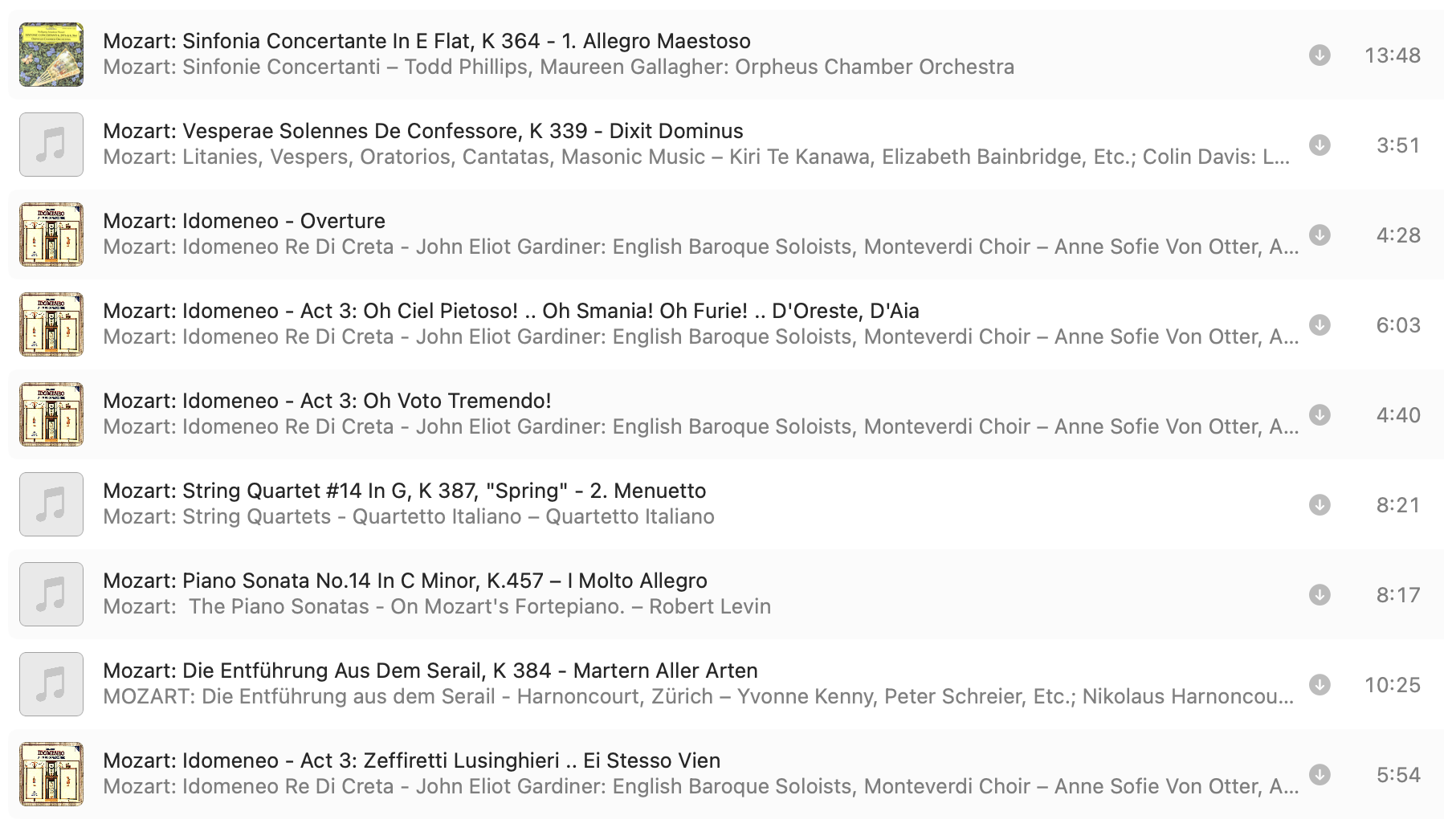
This work is widely regarded as the finest example of the form ever written, and in fact one of the peaks of Mozart's entire output. Here is the first section. It is about 14 minutes long. This is the Orpheus Chamber Orchestra and the soloists are Todd Phillips (violin) and Maureen Gallagher (Viola).
A
That was the Orpheus Chamber Orchestra and the soloists were Todd Phillips (violin) and Maureen Gallagher (Viola) with the first section of Mozart’s ‘Sinfonia Concertante’ from 1779.
Mozart was born in Salzburg and had been in the service of the Salzburg court essentially since childhood — his father Leopold had held a position there, and Wolfgang had been formally employed since 1773 when he was seventeen, making it the only professional home he had ever known.
Salzburg was an independent ecclesiastical state and the ruler was Archbishop Hieronymus von Colloredo had been appointed in 1772, the year before Mozart joined the court, and from the beginning the relationship was uncomfortable. Colloredo was in many ways a man of the Enlightenment — efficient, reforming, impatient with excess and ceremony — and he ran his court with brisk administrative authority. He had little time for what he regarded as Mozart's restlessness and inflated sense of his own importance, and he was not wrong that Mozart was difficult to manage.
As a child prodigy Mozart was the closest thing the 18th century had to a superstar. He had performed for the crowned heads of Europe.. most memorably Empress Maria Theresa in Vienna, King Louis XV at Versailles and a young Marie Antionette. But that was years earlier and now… he was literally a court servant.
Since he was in the employ of an archbishop a certain amount of the music he was instructed to write was for religious ceremonies. And here is four minutes from one.
The Vesperae solennes de Confessore or ‘Solemn Vespers For A Confessor’, was composed in 1780, almost certainly for a formal liturgical occasion at the Salzburg Cathedral,. The work sets six psalm texts, and it opens with the ‘Dixit Dominus’ — Psalm 110 which roughly translates as… ‘The LORD says 'Sit at my right hand until I make your enemies a footstool for your feet” — From the very first moments the orchestra launches into music of tremendous confidence and grandeur, and when the chorus enters it feels genuinely ceremonial.
Here is Colin Davis with the London Symphony Orchestra and Chorus. Dixit Dominus from Mozart’s ‘Solemn Vespers For A Confessor’.
B
That was Colin Davis with the London Symphony Orchestra and Chorus performing Dixit Dominus from Mozart’s ‘Solemn Vespers For A Confessor’.
One of the sources of tension between Mozart and the archbishop was Mozart’s long absences from the Court and his duties. They were tolerated and I assume that there was an upside for Colloredo having his ‘servant’ out in other courts impressing the other rulers… the competition. And Mozart’s father Leopold was always looking for both creative and financial opportunities for his extraordinarily gifted son.
And harking back to the religious music I just played, there was a very real sense amongst the powerful people in Mozart’s world, that his gifts were from God and that there was a duty for his voice to be heard.
Of all the musical genres that the courts of Europe invested time and money and attention into, opera was the most important. And by the late 1770s opera came in a variety of different styles. The style that was the most highly regarded was called ‘opera seria’… literally 'serious opera' — It drew its subjects from ancient history and mythology, favoured noble characters facing impossible moral dilemmas, and placed the utmost demands on its singers, particularly its tenors and sopranos. And it was pretty much always sung in Italian. At the time German was not considered a noble enough language.. even in the city states where German was the language everyone spoke.
In his teenage years Mozart had written the music for two operas in the ‘opera seria’ style but he was aching to write another and bring to it his fully developed compositional strengths. The opportunity finally came in 1780 from Munich, from the Elector of the state of Bavaria, Karl Theodor. I’ll tell you more about the opera in a few minutes but first I want to play you the overture from it… Mozart and librettist Giambattista Varesco’s opera Idomeneo, King of Crete. The overture is about four minutes long and this is the English Baroque Soloists conducted by John Eliot Gardiner.
C
That was the overture from W A Mozart and librettist Giambattista Varesco’s opera seria ‘Idomeneo, King of Crete’. The English Baroque Soloists was conducted by John Eliot Gardiner.
I’ve got two short songs, or arias, from the opera coming up nut first I’ll give you a bit of background about the plot.
The premise is as stark as anything in a Greek tragedy: Idomeneo, King of Crete, is caught in a terrible storm on his way home from the Trojan War, and in desperation vows to the god Neptune that if he survives, he will sacrifice the first living creature he meets on shore. He survives. And the first living creature he meets is his own son, Idamante. What follows is an opera about a man trapped between a sacred vow and a father's love.
I think it is a little tempting to scoff at the frankly preposterous nature of the plot. And there is no way to insert ourselves into the mentality of an aristocratic audience in Munich in 1781. But I think there are actually some interesting ideas being explored by the opera…
Are we just playthings of the gods? Or by inference, the Christian God.
Subject to forces beyond his understanding or control —Idomeneo makes a vow and must pay the price; the universe is indifferent to human suffering. But Mozart was a product of the Enlightenment, and there's a strong case that the opera quietly subverts that older framework.
The resolution — in which the god Neptune ultimately relents and human love is allowed to prevail — suggests that the gods can be moved by human dignity and feeling. The supernatural yields to the humane. Sorry for that diversion. Back to the music.
Late in the opera the character Electra sings of her rage at her treatment by Idamante… an opportunity for Mozart to showcase the gifts of the soprano who he wrote the part for, Elizabeth Wendling, who was known for her fiery dramatic performances. Here now is the singer Hillevi Martinpelto. Again John Eliot Gardiner conducts the English Baroque Soloists. It is about four minutes long… the aria, or song. ‘Oh Furies’.
D
That was ‘Oh Furies’. From Mozart’s ‘Idomeneo’. The singer was Hillevi Martinpelto. and John Eliot Gardiner conducted the English Baroque Soloists.
One more piece from the opera. It’s the chorus ‘Oh terrible sacrifice’. The people of Crete sing of Idomeneo’s impending sacrifice of his son. Four minutes of drama. The Monteverdi Singers join the English Baroque Soloists and John Eliot Gardiner conducts.
E
That was the chorus ‘Oh terrible sacrifice’ from Mozart and Varesco’s opera ‘Idomeneo, King of Crete’. The Monteverdi Singers joined the English Baroque Soloists and John Eliot Gardiner conducts.
Idomeneo was a huge success for Mozart. But shortly after its premiere, Archbishop Colloredo summoned Mozart to Vienna, where Colloredo was visiting with his retinue, Mozart came — but he came fresh from the applause of Munich, where hie opera had been received with something close to adulation.
A confrontation took place. Colloredo berated Mozart for his absences and his attitude, and Mozart — for once — gave as good as he got. In a letter to his father he described the Archbishop calling him a scoundrel, a rascal, and a slovenly fellow. Mozart resigned. Colloredo refused to accept the resignation. Mozart insisted. And then, on the 9th of June 1781, the Archbishop's chief steward Count Arco delivered the final dismissal in the most literal way possible — he kicked Mozart out of the door. Physically. Mozart was twenty-five years old, and he was free. For the rest of his life he would, and this was incredibly rare for the time… be a freelance performer / composer.
Vienna in 1781 was the cultural capital of the German-speaking world — a city of theatres, concert halls, aristocratic salons, and an audience hungry for new music and new talent. For an ambitious young composer it was the only place to be, and Mozart knew it. He was giving lessons, performing at private concerts, being received in the best houses. He told his father that he was certain he could make a living, that Vienna was his city, that everything he had endured in Salzburg had been worth it to arrive at this moment.
One of the first things he completed in Vienna was a set of string quartets. And he dedicated them to the older composer who had really turned the idea of two violins, a viola and a cello playing together into a genre still extraordinarily popular today, Josef Haydn.
I’m going to play you a section from the one that has come to be known as the 'Spring' quartet — a nickname that came later, as these things usually do, but one that feels right. There is a freshness and lightness to this music, a sense of new beginnings, especially in the third section… the Minuet. It is about 8 minutes long and here is the Quartetto Italiano.
F
That was the Minuet section from Mozart’s Spring String Quartet played by the Quartetto Italiano. The years that followed Mozart’s move to Vienna in 1781 led to symphonies, concertos, operas, oratorios and masses. But he also continued to write for the keyboard… the instrument he was most identified with by the public.
Here is the opening section of his 14th keyboard sonata. It’s about 8 minutes long. The performance I've chosen is by the American pianist and Mozart scholar Robert Levin — and by the way, he is playing it on Mozart's own keyboard, actually a fortepiano, the immediate predecessor of the modern piano. That this instrument survives to this day, now perhaps ironically, in Salzburg. Is amazing.
Almost as amazing as the continued survival of Academy Records and CDs on 18th St in New York City where I found this recording a couple of weeks ago. That Levin is playing Mozart’s keyboard gives the music a quality that is difficult to describe. My AI pal Claude suggested it is worth closing your eyes as you listen to this.
G
That was Robert Levin playing the opening section of Mozart’s 14th keyboard sonata.
I’m going to assume that if you are still listening to this episode you are okay with some more opera. I mentioned earlier that the language of opera in German speaking Europe was Italian. But with his very first opera in Vienna, Mozart would join the Emperor Joseph II’s short-lived experiment in making German opera. It was run by the court official Gottlieb Stephanie who actually commissioned Mozart and also provided him with the libretto.
Die Entführung aus dem Serail — The Abduction from the Seraglio — was completed in 1782, less than a year after Mozart settled in Vienna, The opera tells the story of a young Spanish nobleman, Belmonte, trying to rescue his beloved Konstanze from the palace of a Turkish Pasha.
The aria I am going to play you is Konstanze singing 'Martern aller Arten' — which translates roughly as 'Tortures of every kind' — Konstanze is making the very strong point that she’d rather die horribly than submit to the desires of the Pasha.
Here is Yvonne Kenny with the Orchestra of the Zurich Opera House conducted by Nikolaus Harnoncourt. There is about a two minute orchestral introduction and then some fabulous vocal fireworks. The whole thing is about ten minutes long.
H
That was 'Martern aller Arten' — or 'Tortures of every kind' from Wolfgang Amadeus Mozart and Gottlieb Stephainie’s opera ‘Die Entführung aus dem Serail — The Abduction from the Seraglio —
It was performed by Yvonne Kenny with the Orchestra of the Zurich Opera House conducted by Nikolaus Harnoncourt.
My name is Peter Cudlipp and you have been listening to the ‘Classical for Everyone’ Podcast. If you would like to listen to past episodes, of which there are now about 60, or get details of the music I’ve played please head to the website classicalforeveryone.net. That address again is classicalforeveryone.net. And on the individual episode pages of the website there are links to Spotify playlists with the full versions of most of the music played in each of the episodes. And if you want to get in touch then you can email… info@classicalforeveryone.net. Thanks for your time and I look forward to playing you some more incredible music on the next ‘Classical For Everyone’.
This podcast is made with Audacity Software for editing, Wikipedia for Research, Claude for Artificial Intelligence and Apple, Sennheiser, Sony, Rode and Logitech for hardware… The music played is licensed through AMCOS / APRA. Classical For Everyone is a production of Mending Wall Studios and began life on Radio 2BBB in Bellingen NSW, Australia thanks to Mr Jeffrey Sanders. The producers do not receive any gifts or support of any kind from any organisation or individual mentioned in the show. But, never say never.
And if you have listened to the credits… here is a little more music for you…
This is the song "Zeffiretti lusinghieri" or ‘Flattering Little Breezes’ from Act III of the opera ‘Idomeneo’, where the character Ilia asks the gentle breezes to carry her message of love to Prince Idamante. She sings…
Zeffiretti lusinghieri,
Deh volate al mio tesoro...
In English…
"Flattering little breezes, fly to my beloved: and tell him that I adore him, that he should keep his heart faithful to me.
And you plants, and honest flowers, that my bitter tears now water, tell him that you never saw a rarer love beneath the sky."
It's worth remembering that Ilia is a Trojan princess, a captive in Crete, secretly in love with Idamante — the son of the man who conquered her people. Her love is therefore both a personal vulnerability and a kind of transgression. A love that should not exist.
Here is Sylvia McNair singing Illia. John Eliot Gardiner conducts the English Baroque Soloists.
Thanks again for listening.