
 Apple Podcasts
 Spotify
 Amazon Music
 iHeartRadio
 Overcast
 PocketCasts
  RSS Feed
 More Brilliant Women.


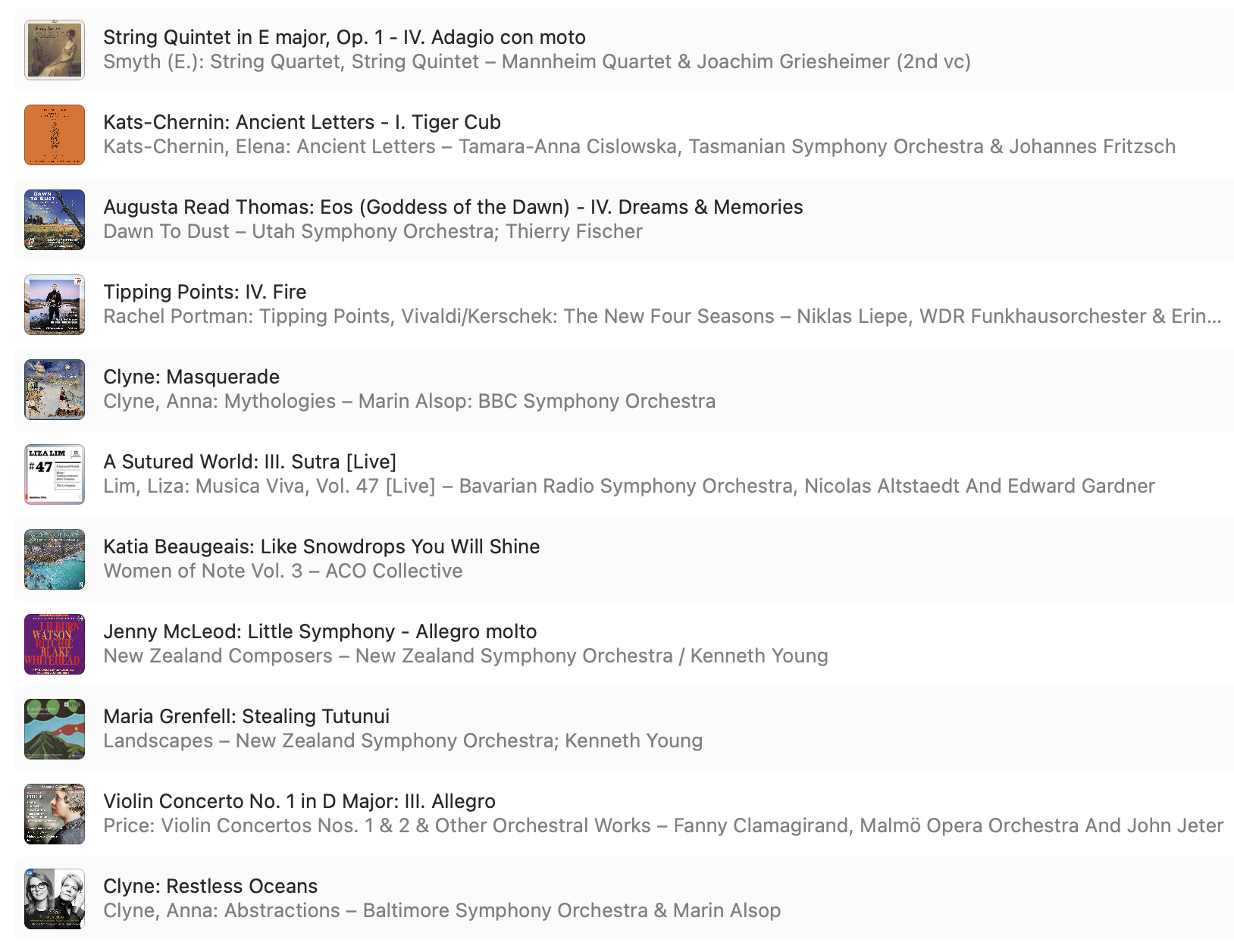
I did an episode of music by women composers back in November based around a CD Box release by the record label ‘Brilliant Classics’ and called it ‘Brilliant Women’. No prizes for imagination but it was clear and accurate. So, I am going to keep things simple and call this show ‘More Brilliant Women’. I could also call it ‘music I am genuinely extremely excited to play for you that just happens to be written by women’. But that would be a little cumbersome. What I can say is this is just fabulous music which I think there is a very good chance you will enjoy. In the next hour and a bit I am going to play music by Ethel Smyth, Augusta Read Thomas, Rachel Portman, Anna Clyne, Liza Lim, Katia Beaugeais, Jenny McLeod, Maria Grenfell, Elena Kats-Chernin and Florence Price.
Liza Lim interview with Naxos Music’s Raymond Bisha:
https://podcasts.apple.com/au/podcast/naxos-classical-spotlight/id1432126168?i=1000718447358
https://www.abc.net.au/listen/classic/shop/river-mountain-sky/104313990
https://www.newyorker.com/magazine/2018/02/05/the-rediscovery-of-florence-price
https://open.spotify.com/playlist/5IvjQsBwOYTjLz0029SLNA?si=b4ba95339f184e88
The Music
The Words
Hello everyone. Welcome to another episode of the ‘Classical For Everyone’ Podcast… five hundred years of incredible music. My name is Peter Cudlipp and… If you enjoy any music at all then I’m convinced you can enjoy classical music. All you need are ears. No expertise is necessary. If you’ve ever been curious about classical music… or explored it for a while once upon a time… or just quietly wondered what all the fuss was about… then this is the podcast for you.
And because there’s a lot of music out there each episode has something of a theme. And for this one it another sampling of incredible music written by women. I did an episode back in November based around a release by the record label ‘Brilliant Classics’ and called it ‘Brilliant Women’. No prizes for imagination but it was clear and accurate. So, I am going to keep things simple and call this show ‘More Brilliant Women’.
I could also call it ‘music I am genuinely extremely excited to play for you that just happens to be written by women’. But that would be a little cumbersome. What I can say is this is just fabulous music which I think there is a very good chance you will enjoy.
In the next hour and a bit I am going to play music by Augusta Read Thomas, Rachel Portman, Anna Clyne, Liza Lim, Katia Beaugeais, Jenny McLeod, Maria Grenfell, Elena Kats-Chernin and Florence Price.
Most of these composers are still alive and still writing music But I am going to begin with the English composer Ethel Smyth who was born in 1858 and died in 1944. In her 20’s she studied in Leipzig in Germany, where she met the composers Brahms, Grieg and Dvořák and began to forge her own distinctive voice.
She returned to England to build a career of extraordinary range and determination, producing operas, orchestral works, music for small ensembles and songs across six decades. But she is perhaps best known today for her connection to the women’s suffrage movement and her arrest and imprisonment for two months rather than for her music. Which is I think a real shame. This is a section from one of the earliest pieces she wrote… a string quintet… music for two violins, a viola and two cellos… from 1881. This is the section she called ‘Adagio con moto’ which can sort of be translated as ‘slowly but with purpose or momentum’.
This is the Mannheim Quartet with the addition of the cellist Joachim Griesheimer. It is a little over three minutes… the fourth section from Ethel Smyth’s String Quintet. And just keep in mind this was her first published composition.
A
That was the Mannheim Quartet with the addition of the cellist Joachim Griesheimer performing the slow section of Ethel Smyth’s String Quintet.
In the 1970s as a teenager the composer Elena Kats-Chernin migrated from Tashkent in what is now Uzbekistan to Australia. In 2017 she wrote a concerto for keyboard and orchestra she called ‘Ancient Letters’ and with it she explored her connection to the geography and culture of her birthplace. Here is a note Kats-Chernin wrote for the 2025 CD release of the recording I am going to play you a section from.
“The Ancient Letters are the first known documents of the Sogdian people who lived across what is today Uzbekhistan, the place where I was born. The letters dated from the 4th century were discovered ca 16 centuries after being written, in an abandoned watchtower, far to the east of the main city Samarkand along the Silk Road to China.”
“Two of the five letters concern a woman called Tiger Cub or Mewnai. Tiger Cub has not seen or heard of her husband for three years. He has disappeared somewhere along the Silk Road. She despairs for the years ahead. We will never know what did happen to Tiger Cub. I have written a portrait of this feisty, desperate, beautiful, deserted woman the way I see her.”
Here is the opening seven minute long section of Elena Kats-Chernin’s ‘Ancient Letters’, the section called ‘Tiger Cub’. It begins with a solo piano played by Tamara Anna-Cislowska and she is then joined by the Tasmanian Symphony Orchestra. Johannes Fritzsch is the conductor.
B
That was the opening section of Elena Kats-Chernin’s ‘Ancient Letters’, The pianist was Tamara Anna-Cislowska and the Tasmanian Symphony Orchestra was conducted by Johannes Fritzsch.
Augusta Read Thomas was born in New York in 1964 and has become one of the most performed and celebrated American composers of her generation… for nearly a decade the Composer-in-Residence with the Chicago Symphony Orchestra.
Her ballet EOS, subtitled Goddess of the Dawn, was premiered by the Utah Symphony Orchestra in 2015 The work moves through the mythology of the Greek dawn goddess, Eos. Thomas writes that the fourth section called, Dreams and Memories, is the still heart of the work: Eos summons Sleep, and Memory, to release those who are dreaming so that they can wake.
It is three minutes long and here is Thierry Fischer conducting the Utah Symphony Orchestra. Eos by Augusta Read Thomas.
C
That was the section ‘Dreams and Memories’ from Augusta Read Thomas ballet ‘Eos, goddess of the dawn’. Thierry Fischer conducted the Utah Symphony Orchestra.
Ok. Back across the Atlantic to the UK. Rachel Portman studied music at Oxford University and amongst other achievements was the first woman to win an Academy Award for Best Original Score, for her music for the film ‘Emma’.
Her suite for solo violin and orchestra called Tipping Points, premiered at the Beethoven Festival in Bonn, Germany in 2023, and was written in response to the climate crisis, with each of the four central sections dedicated to one of the elements… earth, air, fire and water. Fire, the fourth section, is described by Portman as the darkest in the suite — and whilst that rings true there is I think a real brilliance to the music… a slow build to a climax and then a retreat to a certain feeling of desolation.
Here is the WDR Radiohouse Orchestra of Cologne. Erina Yashima is the conductor and Niklas Liepe is the violinist. The Fire section from Rachel Portman’s ‘Tipping Points’. It is about 5 minutes long.
D
That was the WDR Radiohouse Orchestra of Cologne. Erina Yashima conducted and Niklas Liepe played the violin. ‘Fire’ from Rachel Portman’s ‘Tipping Points’.
The English composer Anna Clyne, now resident in the United States, has become one of the most performed living composers in the world — ranked a couple of years ago as the most performed living female British composer internationally. It was her piece ‘Masquerade’ commissioned by the BBC in 2013 and premiered by the conductor Marin Alsop that really made audiences, commissioners and broadcasters take notice.
‘Masquerade’ draws on the mid-1700s pleasure gardens of London where people of all backgrounds mingled to hear music, watch acrobats, see fireworks and lose themselves behind masks. Clyne weaves together two musical ideas: a grand welcoming theme, and an old English country dance called Juice of Barley.
It is about 5 minutes long and here is Marin Alsop conducting the BBC Symphony Orchestra.
E
That was ‘Masquerade’ by Anna Clyne performed by the BBC Symphony Orchestra conducted by Marin Alsop.
The Grawemeyer Award for Musical Composition was started forty years ago and in that time it has been won by six women. The sixth, last year’s winner, is the Australian composer Liza Lim. The award is distinguished by a few things… it is for an individual composition, not a body of work… and it is set up such that part of the judging process includes members of the concert-going public.. and recordings of the pieces are played to them without revealing the identities of the composers.
Liza Lim’s work which won the prize… is her concerto for cello and orchestra from 2024 called ‘A Sutured World’. The concerto draws on two ideas that turn out to share the same linguistic ancestors: the word suture, meaning to stitch a wound, and the Sanskrit word sutra, meaning a thread.
On her website Lim writes…This work asks ‘how does light arrive in the world?’ Like all the famous poets say (Rumi, Ursula le Guin, Leonard Cohen, Paul McCartney, Emily Dickenson and others): through a crack, a laceration, a broken wing, a homeless person; through falling, through pleasure, through a flutter in the throat…
I’m going to play you the third section called ‘Sutra’. It is about 7 minutes long and starts with just the solo cello. Edward Gardiner conducts the Bavarian Radio Symphony Orchestra and Nicolas Alsteadt is the cellist.
I’ve wanted to play this a few times over the last months but I have hesitated because this is I think dense, textured music; and at times has a deliberate abrasiveness, especially in the cello part. I think the conclusion of the section I’m going to play is hauntingly beautiful and that is perhaps the reward for the challenging and less than inviting music that precedes it. For what it’s worth, the more I listen to it the more moving and engrossing I find it.
F
That was… Liza Lim’s concerto for cello and orchestra from 2024 called ‘A Sutured World’. I played the section called ‘Sutra’ and Edward Gardiner conducted the Bavarian Radio Symphony Orchestra and Nicolas Alsteadt was the cellist.
On the page for this episode on the podcasts website I’m going to put a link to an interview Liza Lim did with Naxos Music’s Raymond Bisha. I found it a real insight into the music and personality of this remarkable composer.
https://podcasts.apple.com/au/podcast/naxos-classical-spotlight/id1432126168?i=1000718447358
Ok. Staying in Australia.
Katia Beaugeais is an Australian-French composer and saxophonist based in Sydney. Her work ’Like Snowdrops You Will Shine’ came from a residency at the Sydney Children's Hospital in Randwick, where Beaugeais spent time with patients, families and the staff who care for them.
The piece was written for the Hush Music Foundation, whose mission is to bring music into hospital environments to ease stress and anxiety, and it was premiered in 2018.
Here is a note about the piece from the composer’s website…
“Like Snowdrops You Will Shine for string orchestra refers to the delicate white snowdrop flower that symbolises hope, optimism, courage, resilience and new beginnings. It features Australian nature sounds to create a soothing, peaceful and uplifting sound world.
My aim was to create a piece that would have a calming effect and serve as a distraction to reduce stress and anxiety. Through my music I hope to provide comfort for anyone who is facing a challenging time in their lives.”
This is the Australian Chamber Orchestra Collective directed by Helena Rathbone. The piece is about six minutes long. Katia Beaugeais ’Like Snowdrops You Will Shine’.
G
That was the Australian Chamber Orchestra Collective directed by Helena Rathbone. with Katia Beaugeais ’Like Snowdrops You Will Shine’.
Jenny McLeod was born in Wellington, New Zealand in 1941, studied at Victoria University and then went to Paris to study with Olivier Messiaen. She studied with Pierre Boulez in Basel and then Karlheinz Stockhausen in Cologne, before returning to New Zealand where at twenty-nine she became the youngest professor of music in the country's history.
As an aside, those three composers McLeod studied with would not like to be grouped together but in their ways I think they each took classical music down pathways audiences did not willingly want to go.
But the work I am going to play is from before she went to Europe.
The Little Symphony was written in 1963 when McLeod was still a third-year undergraduate, inspired by Igor Stravinsky's Symphony in C… which was a set work that year. Her response was direct: she simply thought, I can do one of these — and did.
Here is the first section subtitled ‘To Distant Friends’. It is about six minutes long and here is the NZSO conducted by Kenneth Young. Jenny McLeod’s ‘Little Symphony’.
H
That was the first section of Jenny McLeod’s ‘Little Symphony’ subtitled ‘To Distant Friends’. The NZSO was conducted by Kenneth Young.
Ok. Continuing with another New Zealand connection. Though Maria Grenfell was born in Malaysia and is now based in Tasmania she grew up in New Zealand and in 2000 she took a Maori legend about the theft of a whale by a treacherous priest and wrote a nine minute piece for orchestra inspired by the story called ‘Stealing Tutunui’.
Here again is the NZSO conducted by Kenneth Young.
I
That was the NZSO was conducted by Kenneth Young with Maria Grenfell’s ‘Stealing Tutunui’.
By the way I have just discovered that a new CD several of her works has just been released by ABC records and the Tasmanian Symphony Orchestra. I’ll put a link on this episode’s web page. And I’d say there is a good chance that once I have it my possession you’ll hear some more of Maria Grenfell’s music.
https://www.abc.net.au/listen/classic/shop/river-mountain-sky/104313990
My name is Peter Cudlipp and you have been listening to the ‘Classical for Everyone’ Podcast. I have another couple of pieces coming up but before I get to them I want to give you a little information that I hope you find useful…
If you would like to listen to past episodes or get details of the music I’ve played please head to the website classicalforeveryone.net. That address again is classicalforeveryone.net
On the individual episode pages of the website there are links to Spotify playlists with the full versions of most of the music played in each of the episodes. I hope you have enjoyed this women composers focused episode of ‘Classical For Everyone’. And if you want to get in touch then you can email… info@classicalforeveryone.net.
Alright, to finish this episode, the majority of which has been made up of amazing music by living successful composers who just happen to be women, I have a work that is a reminder that this level of access and opportunity for women is, in terms of the history of classical music, a very recent shift.
Florence Price was the first African American woman to have a symphony performed by a major American orchestra — the Chicago Symphony, in 1933. She was a composer of extraordinary range and productivity, writing four symphonies, concertos, choral music and piano works… much of it drawing on the African American spiritual tradition she had grown up with. And then, after her death in 1952, she was largely forgotten. Her first Concerto for Violin and Orchestra written in 1939, was apparently never performed in her lifetime — and was not even discovered until 2009, when a couple renovating her former summer home near Chicago found a cache of manuscripts in the abandoned house.
I’m going to play you the third and final section of the concerto. The violinist is Fanny Clamagirand, and the Malmö Opera Orchestra is conducted by John Jeter.
J
That was the final section of Florence Price’s 1st concerto for Violin and Orchestra. Fanny Clamagirand, played the solo violin and the Malmö Opera Orchestra was conducted by John Jeter.
If you want to know more of Florence Price’s story I’m going to put a link on this episode’s page at classcialforeveryone.net to an article by the New Yorker magazine’s Alex Ross. Just a fascinating article.
https://www.newyorker.com/magazine/2018/02/05/the-rediscovery-of-florence-price
Thanks for your time and I look forward to playing you some more incredible music on the next ‘Classical For Everyone’.
This podcast is made with Audacity Software for editing, Wikipedia for Research, Claude for Artificial Intelligence and the music played is licensed through AMCOS / APRA. Classical For Everyone is a production of Mending Wall Studios and began life thanks to the enthusiasm and encouragement of Mr Jeffrey Sanders.
And if you have listened to the credits… here is some more music for you… I was tossing up which of Anna Clyne’s pieces to include in the show and really found it hard to decide. So, I can solve the dilemma by playing you the other contender. Here is her four minute piece for Chamber Orchestra ‘Restless Oceans’. This is the Baltimore Symphony Orchestra conducted by Marin Alsop. Thanks again for listening.
K