


Lullabies and Reveries


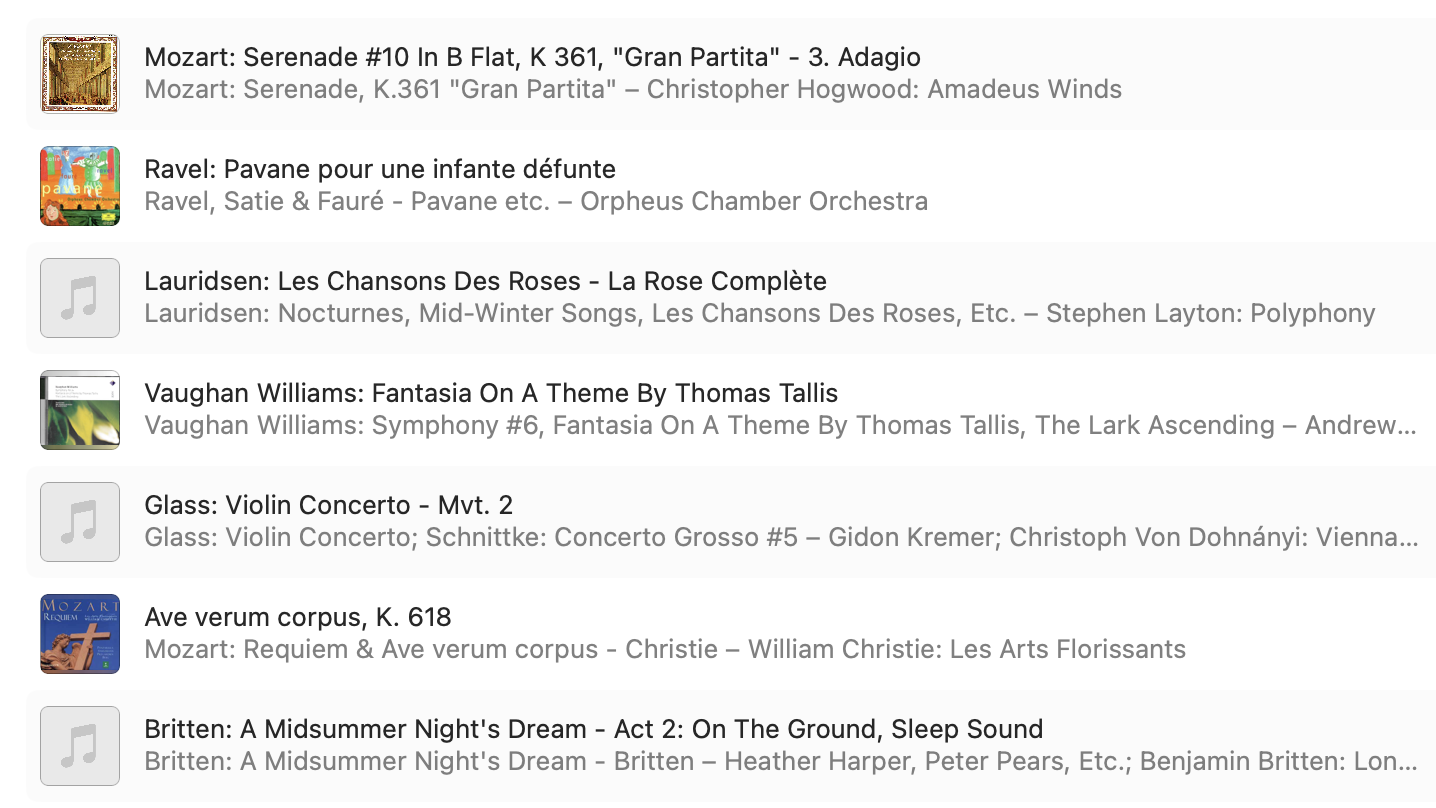
Music from Wolfgang Amadeus Mozart, Maurice Ravel, Morten Lauridsen, Ralph Vaughan-Williams, Philip Glass and Benjamin Britten… chosen pretty deliberately for its calming qualities. I’m guessing that quite a few of you are balancing the joys and challenges of the holiday season. So if you just want to put your feet up… or you’ve come to the end of a day with too much red and green in your world and are unwinding… or perhaps heading toward sleep, then I hope you’ll enjoy this episode called ‘Lullabies and Reveries’. And I’m perhaps using the word ‘lullaby’ in a broad sense… who says toddlers are the only ones who deserve evocative music to carry them to a dreamy state.
And here is a link to a playlist on Spotify with the music from this episode:
https://open.spotify.com/playlist/5ylN9oSsICcgmJmnOD2lsY?si=840bcb327f5643c4
The Music
The Words
Hello everyone. Welcome to another episode of the ‘Classical For Everyone’ Podcast… five hundred years of incredible music. My name is Peter Cudlipp and… If you enjoy any music at all then I’m convinced you can enjoy classical music. All you need are ears. No expertise is necessary. If you’ve ever been curious about classical music… or explored it for a while once upon a time… or just quietly wondered what all the fuss was about… then this is the podcast for you.
And because there’s a lot of music out there each episode has something of a theme. And for this episode I’ve chosen music pretty deliberately for its calming qualities. I’m guessing that quite a few of you are balancing the joys and challenges of the holiday season. And there can be some stress that comes with that. So if you just want to put your feet up… or you’ve come to the end of a day with too much red and green in your world and are unwinding… or perhaps heading toward sleep, then I hope you’ll enjoy this episode which I’ve called ‘Lullabies and Reveries’. And I’m perhaps using the word ‘lullaby’ in a broad sense… who says toddlers are the only ones who deserve evocative music to carry them to a dreamy state.
I’ve included a few pieces I’ve played in past episodes. But I think they bear repeating. I have music by Wolfgang Amadeus Mozart, Maurice Ravel, Morton Lauridsen, Ralph Vaughan-Williams, Philip Glass and Benjamin Britten.
I’m going to start with something that I think is pretty hard to resist in its ability to elevate one’s mood. Here are the Amadeus Winds conducted by Christopher Hogwood with the third section of Mozart’s Serenade for Wind Instruments with the nickname ‘Gran Partita’. It is about five minutes long.
A
That was the Amadeus Winds conducted by Christopher Hogwood with the third section of Mozart’s Serenade for Wind Instruments with the nickname ‘Gran Partita’.
A ‘Pavane’ is a slow dance that was popular in the 1500’s in the courts of Spain. In the late 1800s it became popular in France. Lots of people were writing Pavanes. Including Maurice Ravel. In 1899 he wrote a piece for piano he called ‘Pavane for a dead princess’… ‘Pavane pour une infante défante’ describing a slow dance by a princess in the court during Spain’s golden age. I don’t know if Ravel intended that the double meaning of his title be echoed in the music… Is it simply a dance that would have been performed by a princess in an earlier time or is it music in tribute upon the death of a princess? I think it works both ways. In 1910 he took the piano piece and arranged it for small orchestra. It is about 7 minutes long and here is the Orpheus Chamber Orchestra.
B
That was the Orpheus Chamber Orchestra with ‘Pavane for a dead princess’ by Maurice Ravel.
In the 1920s the writer Rainer Maria Rilke wrote a series of poems in French ostensibly about roses. But the rose was really a starting point for exploring love, beauty and mortality. In 1993 the American composer Morten Lauridsen took several of the poems and turned them into group of quite beautiful choral works. And next up in this ‘Lullabies and Reveries’ show is his five minute setting of Rilke’s poem ‘The Perfect Rose’… ‘La Rose Complète’. It is performed here by the vocal group Polyphony conducted by Stephen Layton.
But I think first it is worth giving you a sense of the words… in particular the 2nd verse which in French is…
Je te respire comme si tu étais
Rose. Toute la vie.
Et je me sense l’ami parfait
D’une telle amie.
And in English that is something like…
I breathe you in as if you were,
Rose, all life itself,
And I feel myself the perfect lover
Of such a beloved.
C
That was the vocal group Polyphony conducted by Stephen Layton with Morten Lauridsen’s setting of Rainer Maria Rilke’s poem ‘The Complete Rose’.
Next up is the ‘Fantasia on a theme by Thomas Tallis’ written by Ralph Vaughan-Williams in 1910. It is based on a tune by the 16th-century English composer Thomas Tallis, which Vaughan Williams had come across while editing the English Hymnal, published in 1906. And with it he composed what his biographer James Day calls "unquestionably the first work by Vaughan Williams that is recognisably and unmistakably his and no one else's".
And the review in the London Times after the premiere had this to say… “Throughout its course one is never quite sure whether one is listening to something very old or very new. … But that is just what makes this Fantasia so delightful to listen to; it cannot be assigned to a time or a school.”
Here is Andrew Davis conducting the BBC Symphony Orchestra with Vaughan Williams ‘Fantasia on a Theme of Thomas Tallis’. It is about fifteen minutes long.
D
That was Andrew Davis conducting the BBC Symphony Orchestra with Vaughan Williams ‘Fantasia on a Theme of Thomas Tallis’.
Now leaping ahead almost eighty years I have the slow section of Philip Glass first violin concerto but before I play it, to keep with this episode’s theme, I want to read you a short anonymous Italian lullaby I found when I was researching this episode. It takes its title from the first line ‘May the slow-turning stars that surround you.’ which in Italian is…
"Possano le stelle che lentamente girano”
In English the seven lines are…
“May the slow-turning stars that surround you,
The watchful night-sighted creatures that stand guard,
The airs and melodies of wind rustling through leaves;
All watch over you as you slip away from time,
Leaving cares and daylight’s necessary gravity.
Rest in the soft silken weave of love and
Know no harm will come. Sleep now.”
Here is Gidon Kremer playing the solo violin with the Vienna Philharmonic Orchestra conducted by Christoph von Dohnányi with the slow section of Philip Glass 1st concerto for violin and orchestra from 1987. It is about nine minutes long.
E
That was Gidon Kremer playing the solo violin with the Vienna Philharmonic Orchestra conducted by Christoph von Dohnányi with the slow section of Philip Glass 1st concerto for violin and orchestra
I hope you’re not tired of Herr Wolfgang Amadeus Mozart because next up is a three and a half minute little gem from him. The Latin words ‘Ave verum corpus’ mean ‘Hail, True Body’ and are the beginning of a short Catholic prayer associated with the feast of Corpus Christi… meaning ‘the body of Christ’. Mozart’s friend Anton Stoll was the musical director for the parish of St Stephan in Baden and Mozart set the words to music for him and his congregation… It is written for a choir, string instruments and an organ. Here is the group Les Arts Florissant directed by William Christie. Mozart’s ‘Ave verum corpus’.
F
That was the group Les Arts Florissant directed by William Christie. With Mozart’s ‘Ave verum corpus’.
My name is Peter Cudlipp and you have been listening to the ‘Classical for Everyone’ Podcast. You can find more information at the website classical for everyone . net. That address again classicalforeveryone.net. And on the individual episode pages of the website there are links to Spotify playlists with most of the music played in each of the episodes.
I’m going to finish this ‘Lullabies and Reveries’ show with music that is actually… well, a Lullaby. In 1963 the composer Benjamin Britten and his partner the singer Peter Pears adapted William Shakespeare’s play ‘A Midsummer Night’s Dream’ into an opera. In the play after much midsummer night’s confusion and comedy the magical spirit Puck puts the four confused lovers at the heart of the play to sleep and he says…
On the ground, sleep sound:
I’ll apply to your eye,
Gentle lover, remedy.
When thou wakest, thou takest
True delight in the sight
Of thy former lady’s eye:
And the country proverb known,
In your waking shall be shown
Jack shall have Jill;
Nought shall go ill;
The man shall have his mare again,
And all shall be well.
In the opera Britten and Pears gave the words to the chorus of Fairies.
Here is Benjamin Britten conducting the London Symphony Orchestra and the choirs of Wandsworth and Downside Schools. ‘On the ground, sleep sound’.
Thanks for listening.
G