

 Apple Podcasts

 Spotify

 Amazon Music

 iHeartRadio

 Overcast

 PocketCasts
 RSS Feed
Longing
We bring meanings to music that the composers often didn't intend. And this episode is going to be an example of that. There is something in some music that for me triggers a sort of longing. The writer and composer Jan Swafford describes some of Mozart's music as having a 'deep yearning' and I think that is in the same general area. And you can't be too prescriptive about this. It is a bit different if there are lyrics but music on its own is generally suggestive rather than specific. And when I describe the music I'm going to play as inspiring feelings of 'longing'… that in itself is a broad and perhaps vague concept… the music might bring up feelings of someone you have lost… or of a place you can't return to… maybe a golden time you can't recapture… or an ache for someone you can't be with.
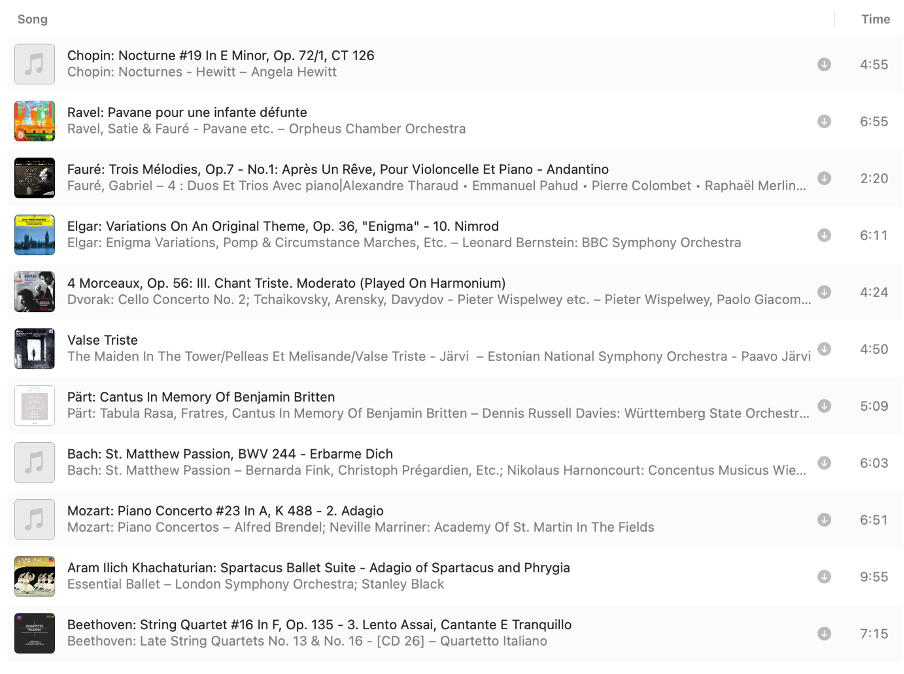
And of course it may do none of those things for you but for the next hour and a bit there will be music with maybe a hint of melancholy or wistfulness or searching or longing… from Frederic Chopin, Maurice Ravel, Gabriel Fauré, Edward Elgar, Anton Arensky, Jean Sibelius, Arvo Pärt, Johann Sebastain Bach, Wolfgang Amadeus Mozart, Aram Khachaturian and Ludwig van Beethoven.
[Episode image: 'A distant star' Chania, Crete.]
Here is a link to a playlist on Spotify with the music in the episode:
https://open.spotify.com/playlist/0MDL9CeJPB5evJJRceI2xp?si=47230f5e80b9489e
The Music
The Words
Hello everyone. Welcome to another episode of the ‘Classical For Everyone’ Podcast… five hundred years of incredible music. My name is Peter Cudlipp and… If you enjoy any music at all then I’m convinced you can enjoy classical music. All you need are ears. No expertise is necessary. If you’ve ever been curious about classical music… or explored it for a while once upon a time… or just quietly wondered what all the fuss was about… then this is the podcast for you.
And because there’s a lot of music out there each episode has a theme. And for this one it is… well, the title of the episode sort of gives it away but let me set it up for a moment.
We bring meanings to music that the composers often didn’t intend. And this episode is going to be an example of that. There is something in some music that for me triggers a sort of longing. The writer and composer Jan Swafford describes some of Mozart’s writing (and I’m going to play a piece in this show) as having a ‘deep yearning’ and I think that is in the same general area.
And you can’t be too prescriptive about this. It is a bit different if there are lyrics but music on its own is generally suggestive rather than specific. And when I describe the music I’m going to play as inspiring feelings of longing… that in itself is a broad and perhaps vague concept… the music might bring up feelings of someone you have lost… or of a place you can’t return to… maybe a golden time you can’t recapture… or an ache for someone you can’t be with.
And of course it may do none of those things but for the next hour and a bit there will be music with maybe a hint of melancholy or wistfulness or searching or longing… from Frederic Chopin, Maurice Ravel, Gabriel Fauré, Edward Elgar, Anton Arensky, Jean Sibelius, Arvo Pärt, Johann Sebastain Bach, Wolfgang Amadeus Mozart, Aram Khachaturian and Ludwig van Beethoven.
Chopin used the term ‘nocturne’ perhaps more as indicative of mood than of time of day and there is no information about what his thoughts were behind what was published as Nocturne No. 19 a few years after his death… even though he wrote it in Warsaw at the age of 17. So, let your imaginations go wild. Here is Angela Hewitt with the five minute Nocturne No. 19 by Frederic Chopin.
A
That was Angela Hewitt playing the Nocturne No. 19 by Frederic Chopin.
Next up is the 1910 orchestral version of Maurice Ravel’s ‘Pavane for a dead princess’… ‘Pavane pour une infante défante’ which describes a slow dance by a princess during Spain’s golden age of the 1500s.
I don’t know if Ravel intended that the double meaning of his title be echoed in the music… Is it simply a dance that would have been performed by a princess in an earlier time or is it music in tribute upon the death of a princess? I think it works both ways.
Here is the Orpheus Chamber Orchestra. It is about 7 minutes long. Maurice Ravel’s ‘Pavane for a dead princess’.
B
That was the Orpheus Chamber Orchestra performing Maurice Ravel’s ‘Pavane for a dead Princess’.
Ok. Staying in France. Here is an early work by Gabriel Fauré from 1877. ‘Après un rêve’ ‘After a dream’. It was originally written as a song for baritone and piano but later it was arranged by Pablo Casals for cello and piano and this is the version I am going to play. Eric Le Sage and François Salque play the piano and the cello. Fauré’s two minute ‘After a Dream’.
C
That was Eric Le Sage and François Salque playing the piano and the cello with Gabriel Fauré’s ‘After a Dream’.
If there is one piece of music that prompted this episode it is ‘Nimrod’ from Edward Elgar’s ‘Enigma Variations’. There is for me an ‘ache’ or a ‘yearning’ to this music. As I said at the beginning of the show “We bring meanings to music that the composers often didn’t intend”.
In the ‘Enigma Variations’ Elgar was writing a group of short pieces each linked to a particular person in his life but not explicitly naming them; instead generally using their initials. The Enigma of the title comes from Elgar’s announcement that the main theme of the work was a counterpart to another theme… and that he would not reveal what it was. To this day what that theme is, remains an enigma.
Who ‘Nimrod’ was though, was quite quickly established. Nimrod is the name of an Old Testament hunter, and this is connected to Elgar’s friend and colleague August Jaeger… ‘jaeger’ meaning ‘hunter’ in German… hence Nimrod.
At the time Elgar wrote The Enigma Variations, 1899, Jaeger was 39 years old, recently married and professionally successful. So, why is there this deep yearning in the music and remember Elgar is not ‘describing’ the people he names the variations for.
Elgar later reported that Jaeger had, in a conversation when Elgar was deeply depressed during a long evening walk together, used the example of Beethoven overcoming the tremendous challenges of his life to continue composing. And that Elgar should take solace from that example and resume composing himself.
So perhaps Elgar was trying to capture an idea of the effort required to overcome almost insurmountable obstacles.. or to celebrate the grandeur of a deep and caring friendship. Or to recognise consolation brought at a time of despair. But then, nine years after the premiere, Jaeger died from tuberculosis and since then ‘his’ variation has carried a certain sadness to it as well.
And whilst the music is frequently used in the context of memorials what I hear is what I have called this episode… longing.
Here is Leonard Bernstein conducting the BBC Symphony Orchestra. The six minute ‘Nimrod’ from Edward Elgar’s ‘Enigma Variations’.
D
That was Leonard Bernstein conducting the BBC Symphony Orchestra with‘ Nimrod’ from Edward Elgar’s ‘Enigma Variations’.
The Russian composer Anton Arensky is not much heard of today. He was strongly influenced by Tchaikovsky and is maybe best known now as a teachers of both Rachmaninoff and Scriabin.
Here is one of what he called ‘four fragments’ written in 1902. This is called ‘sad song’ and was written for cello and piano but here the piano is replaced by that slightly more sombre instrument, the harmonium… played by Paolo Giocometti and the cello is played by Pieter Wispelwey. It is about 4 and a half minutes long.
E
That was Anton Arensky’s ‘Sad Song’ from his 1902 collection ‘Four Fragments’. Paolo Giocometti played the harmonium and the cello was played by Pieter Wispelwey.
A year after Arensky wrote that piece, a Finnish playwright by the name of Arne Järnefelt wrote a play called ‘Death’. Which you’d have to think was not a great marketing ploy for a good night out in Helsinki; and which might explain why it is pretty much forgotten today.
But he did ask his brother-in-law to write the incidental music… including music for a scene where a man sitting beside the bed of his dying mother falls asleep and dreams that ghostly dancers surround the woman and she rises from her bed to waltz with them. The playwright’s brother-in-law was Jean Sibelius and he later took the waltz as a piece on its own and called it ‘Valse Triste’… sad waltz.
Here is the Estonian National Symphony Orchestra conducted by Paavo Järvi wth Jean Sibelius 1904 ‘Valse Triste’. It is about 5 minutes long.
F
Ok that was the Estonian National Symphony Orchestra conducted by Paavo Järvi wth Jean Sibelius’ ‘Valse Triste’. Sad Waltz.
Since we have made our way to Estonia here is a work from that nation’s best known composer Arvo Pärt.
This is his ‘Cantus in memory of Benjamin Britten’. A cantus in Latin means a melody or song. Pärt wrote the work in 1977 shortly after Britten died and he said this about it…
Why did the date of Benjamin Britten's death – 4 December 1976 – touch such a chord in me? During this time I was obviously at the point where I could recognise the magnitude of such a lossI had just discovered Britten for myself. Just before his death I began to appreciate the unusual purity of his music. And for a long time I had wanted to meet Britten – and now it would not come to that.
It is about five minutes long and starts very quietly. Dennis Russell Davies conducts the Wurttemberg State Orchestra. Arvo Pärt’s ‘Cantus in memory of Benjamin Britten’.
G
That was Dennis Russell Davies conducting the Wurttemberg State Orchestra. Arvo Pärt’s ‘Cantus in memory of Benjamin Britten’.
The next piece I am going to play is by Johann Sebastain Bach and is perhaps a bit of a square peg in the round holes of an episode called ‘Longing’. It is the song ‘Erbarme Dich’ or ‘Have Mercy’ from the St Matthew’s Passion. It is a very personal appeal from a devout Lutheran to his God. But like much music inspired by genuine faith there is something in this composition which captures what I think can be described as an almost universal longing for something that is greater than ourselves.
All that aside… at the heart of it though is six minutes of dazzlingly beautiful music. The singer is Bernarda Fink and Nikolaus Harnoncourt conducts the Concentus Musicus Vienna. ‘Erbarme Dich’ or ‘Have Mercy’ from the St Matthew’s Passion by Johann Sebastian Bach.
H
That was the singer Bernarda Fink and Nikolaus Harnoncourt conducted the Concentus Musicus Vienna with ‘Erbarme Dich’ or ‘Have Mercy’ from the St Matthew’s Passion by Johann Sebastian Bach.
The picture of the composer Wolfgang Amadeus Mozart that I think many people have is of a brilliant and effervescent and wildly optimistic prodigy / genius. And I think that has considerable factual basis and is supported by the joy in much of his music. But every so often he would write music that carries this extraordinary ache… this deep yearning for… for well who really knows what.
Here is the slow section of Mozart’s Piano Concerto No. 23 from 1786… completed two months before the premiere of his opera ‘The Marriage of Figaro’. This is the pianist Alfred Brendel and Neville Marriner conducts the Academy of St Martin in the Fields. It is about seven minutes long.
I
That was the slow section of Wolfgang Amadeus Mozart’s Piano Concerto No. 23. The pianist was Alfred Brendel and Neville Marriner conducted the Academy of St Martin in the Fields.
My name is Peter Cudlipp and you have been listening to the ‘Classical for Everyone’ Podcast. I have another couple of pieces coming up but before I get to them I want to give you a little information that I hope you find useful…
If you would like to listen to past episodes or get details of the music I’ve played please head to the website classicalforeveryone.net. That address again is classicalforeveryone.net On the individual episode pages of the website there are links to Spotify playlists with the full versions of most of the music played in each of the episodes. I hope you have enjoyed this ‘Longing’ focused episode of ‘Classical For Everyone’. And if you want to get in touch then you can email… info@classicalforeveryone.net.
To finish this episode I have some music from the Soviet Armenian composer Aram Khachaturian. This is the ten minute Adagio from his ballet ‘Spartacus’ written in 1954. If there was ever music that just absolutely evokes a certain type of longing… then I think this is it. Stanley Black conducts the London Symphony Orchestra.
J
That was Stanley Black conducting the London Symphony Orchestra with the Adagio from Aram Khachaturian’s ballet ‘Spartacus’.
Thanks for your time and I look forward to playing you some more incredible music on the next ‘Classical For Everyone’. This podcast is made with Audacity Software for editing, Wikipedia for Research, Claude for Artificial Intelligence, Cleanfeed for remote recording; and the music played is licensed through AMCOS / APRA. Classical For Everyone is a production of Mending Wall Studios. The Producers do not receive any gifts, remuneration or support of any kind from any organisation or individual mentioned in the show.
And if you have listened to the credits… here is two minutes more music for you… but before that a little poetry.
I’ve been trying to find the right spot in this episode for a poem by Johann Wolfgang von Goethe. When I was researching the show the internet kept pushing me to different musical settings of his poem called ‘Sehnsucht’ in German which can be literally translated as ‘yearning sickness’ or more simply as ‘longing’.
It’s just two verses written in 1795 beginning with the lines…
Nur wer die Sehnsucht kennt
Weiß, was ich leide!
Only one who knows longing
Knows how I ache!
Alone and separated
From all joy,
I look up to the Firmament,
Toward that farthest side.
Is so far away.
My head swims; I am burning
Deep within.
Only one who knows longing
Knows how I ache!
And now here is one of the four different settings Ludwig van Beethoven made of the poem between 1807 and 1810. In a note to his publisher Beethoven wrote… “I didn’t have time to produce a good one, so here are several attempts.”. This is Beethoven’s fourth setting of Goethe’s “Nur wer die Sehnsucht kennt.” Or just simply ‘Longing’. Ann Murray is the singer and Iain Burnside is the pianist. Thanks again for listening.
K