


Joseph Haydn: The Early Years.


Haydn’s music is in no way neglected or forgotten but I wonder if, because he lived a long life, during which he achieved significant success and seemed free of personality disorders, he is a little taken for granted. The creative artist dying at the height of his or her powers, or never recognised in their lifetime, or plagued by psychosis all seem to have an extra attraction for us. And Haydn was born a couple of generations before the ‘artist as hero’ cult began to emerge. For most of his working life he was ‘artist as employee’ or ‘artist as courtier’. This episode includes sections from his early efforts with the string quartet, the symphony, opera and sacred music. Early but in no way juvenile. In fact surprisingly developed, mature and confident.
And here is a link to a playlist on Spotify with the music from this episode:
https://open.spotify.com/playlist/4TcqEh6jgL9bSF8LmdrUcR?si=949a45e646f6429b
The Music
The Words
Hello everyone. Welcome to another episode of the ‘Classical For Everyone’ Podcast… five hundred years of incredible music. My name is Peter Cudlipp and… If you enjoy any music at all then I’m convinced you can enjoy classical music. All you need are ears. No expertise is necessary. If you’ve ever been curious about classical music… or explored it for a while once upon a time… or just quietly wondered what all the fuss was about… then this is the podcast for you. And because there’s a lot of music out there each episode has something of a theme. And for this one it is… the early music of the composer Josef Haydn. Haydn’s music is in no way neglected or forgotten but I wonder if, because he lived a long life, during which he achieved significant success and seemed free of personality disorders, he is a little taken for granted.
The creative artist taken at the height of his or her powers, or never recognised in their lifetime, or plagued by psychosis all seem to have an extra attraction for us. And Haydn was born a couple of generations before the ‘artist as hero’ cult began to emerge. For most of his working life he was ‘artist as employee’ or ‘artist as courtier’.
Through the episode I’ll give you some biography but I want to start with an early example of the form that Haydn popularised with such effectiveness that it is still at the heart of classical music today… the string quartet… music written for two violins, a viola and a cello.
The string quartet has accumulated so much reputational baggage over the centuries that it is easy to imagine an origin story steeped in mystery and significance. The truth is better and reassuringly simple.
When Haydn was about 24 or 25 a Baron Fürnberg who lived about 50 miles outside Vienna, asked him to compose a piece for the group of amateur musicians the Baron had to hand… his priest, his estate manager, a local cellist and Haydn himself. The combination just happened to be two violins, a viola and a cello. Haydn played one of the violins.
This was, if not the first, then amongst the earliest music Haydn wrote for a string quartet. He would go on to write for that group of instruments for the next fifty years completing almost seventy of them. I like the idea that rise of this form of intimate music making capable of so many different expressions began with an informal gathering of amateurs who needed something to play.
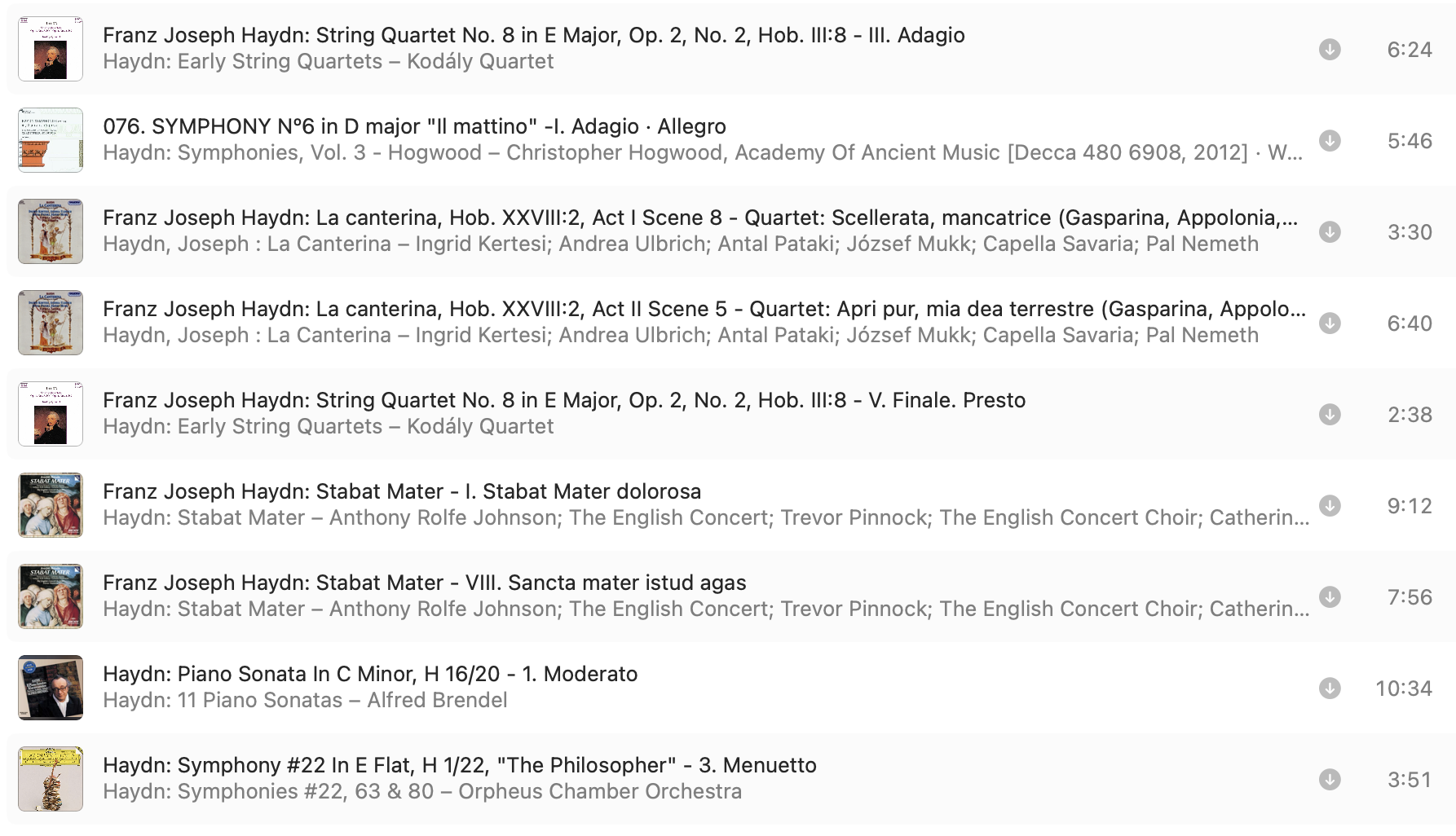
The dating of the composition of Haydn’s early string quartets involves a certain amount of guesswork but from probably the late 1750s here is the third section from his 8th string quartet. It is about six minutes long and here is the Kodaly Quartet.
A
That was the third section from Josef Haydn’s 8th string quartet performed by the Kodaly Quartet.
So… a bit of biography. Joseph Haydn was born in 1732 in Rohrau, a small village in Lower Austria near the Hungarian border. His surprising musical talent was noticed early, and at around age six he was sent to live with a distant relative, Johann Matthias Frankh, a schoolmaster and choirmaster in the nearby town of Hainburg, where he received his first formal musical instruction.
As an old man dictating reminiscences Haydn discussed this first teacher… "I thank this man, [Herr Frankh] even in his grave, for making me work so hard, though I used to get more blows than food."
In 1740, the director of music at St Stephen's Cathedral in Vienna, Georg Reutter, heard the eight-year-old sing and was sufficiently impressed to take him on as a chorister. Haydn spent the next nine years at the cathedral choir school, receiving a solid grounding in music but little in the way of formal composition teaching.
When his voice broke around 1749 he was summarily dismissed —and found himself at seventeen, virtually penniless, on the streets of Vienna.
The decade that followed was one of genuine hardship but also of relentless self-education. Haydn lodged in a cold attic room, gave music lessons to earn money, and taught himself composition largely through study of C.P.E. Bach's keyboard sonatas, which he later said were of immense importance to his development.
He also had the good fortune to become acquainted with the poet and librettist Pietro Metastasio, who lived in the same building and introduced him to the composer and teacher Nicola Porpora. Haydn worked for Porpora as an accompanist and valet — he was essentially a servant — but in return received invaluable instruction in the Italian vocal style and important connections to Viennese musical society.
Through this period he also composed prolifically, producing early keyboard works, string quartets, and his first works for orchestra. By his late twenties he was beginning to attract serious attention, and in 1759 he was appointed music director to Count Karl von Morzin in Bohemia — his first significant court appointment.
In the same way that Haydn’s name is inextricably connected to the development of the string quartet… Haydn is also key to the development of the symphony.
I’ll talk about that a little more after some music. This is the opening of his sixth symphony with the subtitle ‘The Morning’. It was written in 1761 when Haydn was 29. This opening section which starts very quietly and builds as if the sun is rising, hence the subtitle, is about six minutes long and Christopher Hogwood conducts the Academy of Ancient Music.
B
That was the opening of Joseph Haydn’s sixth symphony with the subtitle ‘The Morning’. Christopher Hogwood conducted the Academy of Ancient Music.
I mentioned that Haydn’s name is quite tightly connected to the development of the symphony. Musicologists and historians have for now settled on the number 106 for the number of symphonies Haydn wrote over the course of his long lifetime. I’ll get into what Haydn did with the symphony in later episodes but for now I want to just mention a couple of other factors that pushed the form of ‘the symphony’ to become the essentially the defining form of classical music to this day. Competitive aristocratic families in German speaking Europe from the 1740s onwards seemed to have aspired to surpass each other in the number of musical ‘servants’ they had and the scale of musical entertainments they could stage. There might have been 300 families with musicians on the payroll and of that number maybe 50 had a small orchestra. And back at that time ‘new music’ was what mattered so composers were needed as well.
Another element in the rise of the symphony was the rise of brass and woodwind instruments… horns, flutes, oboes and others. Their designs were starting to stabilise and their musical reliability… being able to play the right note… was increasing. Patrons, composers and audiences were able to hear more complex sounds. An old small strings only group started to sound like the orchestras we know today.
Ok. I left the biographical bit at the year 1759 when Haydn was appointed music director to Count Karl von Morzin in Bohemia — his first significant court appointment. That position was short-lived when von Morzin ran into some cashflow problems and let all the musicians go, but it led directly to the opportunity that would define his career. In 1761, at the age of 29, Haydn was appointed Vice-Kapellmeister to the enormously wealthy Esterházy family, one of the most powerful noble houses in the Habsburg Empire. And the symphony I just played a section from was one of his first compositions for the family.
Haydn served initially under the elderly Kapellmeister or ‘orchestra director’ Gregor Joseph Werner, but after Werner's death in 1766 Haydn assumed full control of all musical life at the court. He would remain in the employ of the Esterhazy’s for another 25 years. But that is for another episode.
If you recall that Haydn was a chorister and studied with a master of the Italian opera styles of the day, it will not surprise you that he was a quite successful opera composer. It helped that the Esterhazys had their own theatre in their palace and rented companies of singers for when they were in residence. Haydn’s operas are very rarely performed now but they show something of the same lightness, delicacy and wit of his orchestral music. Of his earliest operas, perhaps the most charming is called ‘La Canterina’ or ‘The Songstress’. It is a short comedy about a beautiful young soprano, her very financially-focused mother, a jealous music teacher / composer and a wealthy young suitor.
I’m going to play you two short sections… about three minutes and six minutes… each of which showcases the singing of all four characters. In the first one the two male characters express the suspicion they are being financially and romantically exploited by the singer and her mother. In the second, which is the conclusion of the opera the now-apologetic and remorse-filled men use jewellery and cash like smelling salts to revive the singer who has feigned a collapse. From the edge of the scene her mother sings… ‘Don’t let those two get away’. The singers are Ingrid Kertesi; Andrea Ulbrich; Antal Pataki; József Mukk; and the Capella Savaria is conducted by Pal Nemeth
C
D
That was two sections from the short opera ‘The Songstress’ ‘La Canterina’ by Joseph Haydn One of his very first. Written in about 1766 when Haydn was 34 and had just been appointed head of all music for the Esterhazy family. The singers were Ingrid Kertesi; Andrea Ulbrich; Antal Pataki; József Mukk; and Capella Savaria was conducted by Pal Nemeth. I’ve got some more singing coming up, but I want to break the show up with little more from Haydn’s eighth string quartet. Here is the final section. About three minutes of music. And again it is performed by the Kodaly Quartet.
E
That was the final section of Joseph Haydn’s eighth string quartet performed by the Kodaly Quartet. Near the end of his life when asked to list the compositions Haydn thought would define his legacy… central was his religious work from 1767… his Stabat Mater. The Stabat mater is a 13th century Christian hymn to the Virgin Mary in Latin that portrays her suffering as a mother because of the crucifixion of her son. The full first line of the hymnn is actually "Stabat Mater dolorosa", which means… Stood the Mother, grief-stricken.
This would be Haydn’s first major sacred composition… in fourteen parts, for four soloists a choir and an orchestra. A total of about an hour’s amazing music.
Here are the opening nine minutes. The Latin text of this section is…
Stabat mater dolorosa
Juxta crucem lacrimosa
In English it is the harrowing…
Stood the Mother, grief-stricken, Weeping at the cross's side, While her Son hung there.
The soloists are Patricia Rozario, Catherine Robbin, Anthony Rolfe Johnson & Cornelius Hauptmann. The English Concert and The English Concert Choir are all conducted by Trevor Pinnock.
F
That was the opening of Haydn’s Stabat Mater. I want to play you another section. It really is a bit hard to choose which one. But this is the Sancta Mater. The sung Latin is
Sancta Mater, istud agas,
Crucifixi fige plagas
Cordi meo valide.
Which translates as “Holy Mother, do this I pray, Fix the wounds of the Crucified Deep within my heart”. As you would imagine from the text this is an opportunity for some quite profound and moving music. And I think this is what Haydn supplies.
Again this is The English Concert conducted by Trevor Pinnock and the two soloists are the soprano Patrizio Rozario and the tenor Anthony Rolfe Johnson. It is about eight minutes long.
G
That was the Sancta Mater section from Joseph Haydn’s ‘Stabat Mater’. The English Concert was conducted by Trevor Pinnock and the two soloists were the soprano Patrizio Rozario and the tenor Anthony Rolfe Johnson.
My name is Peter Cudlipp and you have been listening to the ‘Classical for Everyone’ Podcast. I have another couple of pieces coming up but before I get to them I want to give you a little information that I hope you find useful… If you would like to listen to past episodes or get details of the music I’ve played please head to the website classicalforeveryone.net. That address again is classicalforeveryone.net. On the individual episode pages of the website there are links to Spotify playlists with the full versions of most of the music played in each of the episodes. I hope you have enjoyed this ‘Music of the young Joseph Haydn’ focused episode of ‘Classical For Everyone’. And if you want to get in touch then you can email… info@classicalforeveryone.net.
Alright, to finish this episode I have something that can’t quite be called the music of a young man. But Haydn was a prolific writer of music for the solo keyboard and he was 39 when he wrote what I am going to play. There are recordings of earlier pieces but this is a favourite. And… the music critic Stephen Plaistow, writing in Gramophone magazine suggested that this piece is "one of Haydn’s best and perhaps also the first great sonata for the piano by anybody". It is Haydn’s keyboard sonata from 1771 known variously as No. 33 or No. 16/20 depending on which catalogue you prefer.
Here is the opening section performed on a modern piano by Alfred Brendel. It is a bit over ten minutes long.
G
That was the opening of Joseph Haydn’s keyboard sonata no. 33 from 1771 played by Alfred Brendel.
Thanks for your time and I look forward to playing you some more incredible music on the next ‘Classical For Everyone’. And I’ll be putting together some more Haydn episodes over the next months. This podcast is made with Audacity Software for editing, Wikipedia for Research, Claude for Artificial Intelligence and the music played is licensed through AMCOS / APRA. Classical For Everyone is a production of Mending Wall Studios and began life thanks to the enthusiasm and encouragement of Mr Jeffrey Sanders. And if you have listened to the credits… here is a more music for you…
A year or so before Haydn was elevated to the position of Kapellmeister for the Esterhazy family he wrote a symphony that ended up with the nickname of ‘The Philosopher’. This is the third section, the Minuet. It is about four minutes long and there is something about this that I think sort of sums up the elegance and brightness and surprising calm and maturity of all of this early music from Joseph Haydn. Here is the Orpheus Chamber Orchestra.
Thanks again for listening.
H