


Holiday Music (You Can Actually Listen To)


In this episode there will be an amount of Christmas music from the western tradition… which I think you might have to expect from a podcast with the word ‘classical’ in the title but this is not really a celebration of mangers, shepherds, wise men or difficult to explain conceptions… though I have to confess, some shepherds snuck their way in. Some of the music is just there for the sheer joy of it. Music that has a festive feel and in some instances has a certain holiday exuberance. Works by Corelli, Bach, Mendelssohn, Saint-Saëns, Liszt, Rimsky-Korsakov, Tchaikovsky, Schoenberg, Mozart, Lilburn and Kats-Chernin.
And here is a link to a playlist on Spotify with the music from this episode:
https://open.spotify.com/playlist/1fRLtc8jEdEzi7dTea90Qm?si=cfc10f7f67644d3b
The Music
The Words
Hello everyone. Welcome to the first ‘Holidays’ episode from the ‘Classical For Everyone’ Podcast… a bit over an hour of music that will not include any reference to men in red suits or sexy elves. My name is Peter Cudlipp and… If, like me you think the little drummer boy is not a very good drummer, that Jingle Bells shouldn’t rock and that Frosty the Snowman should go on a date with a microwave… you can enjoy classical music. All you need are ears. No expertise is necessary. If you’ve ever wanted to run screaming from a department store in December as Good King Wenceslas wrestles with you for your credit card then this is the podcast for you.
So in this episode there will be a certain amount of Christmas music from the western tradition… which I think you might have to expect from a podcast with the word ‘classical’ in the title but this is not really a celebration of mangers, shepherds, wise men or difficult to explain conceptions… though I have to confess, some shepherds snuck their way in. A certain amount of the music is just there for the sheer joy of it. Music that has a festive feel and in some instances has a certain holiday exuberance. And then there are a couple of more reflective pieces for quieter moments. And speaking of quiet, there will be a bit less of me talking in this episode. It’s a holiday after all.
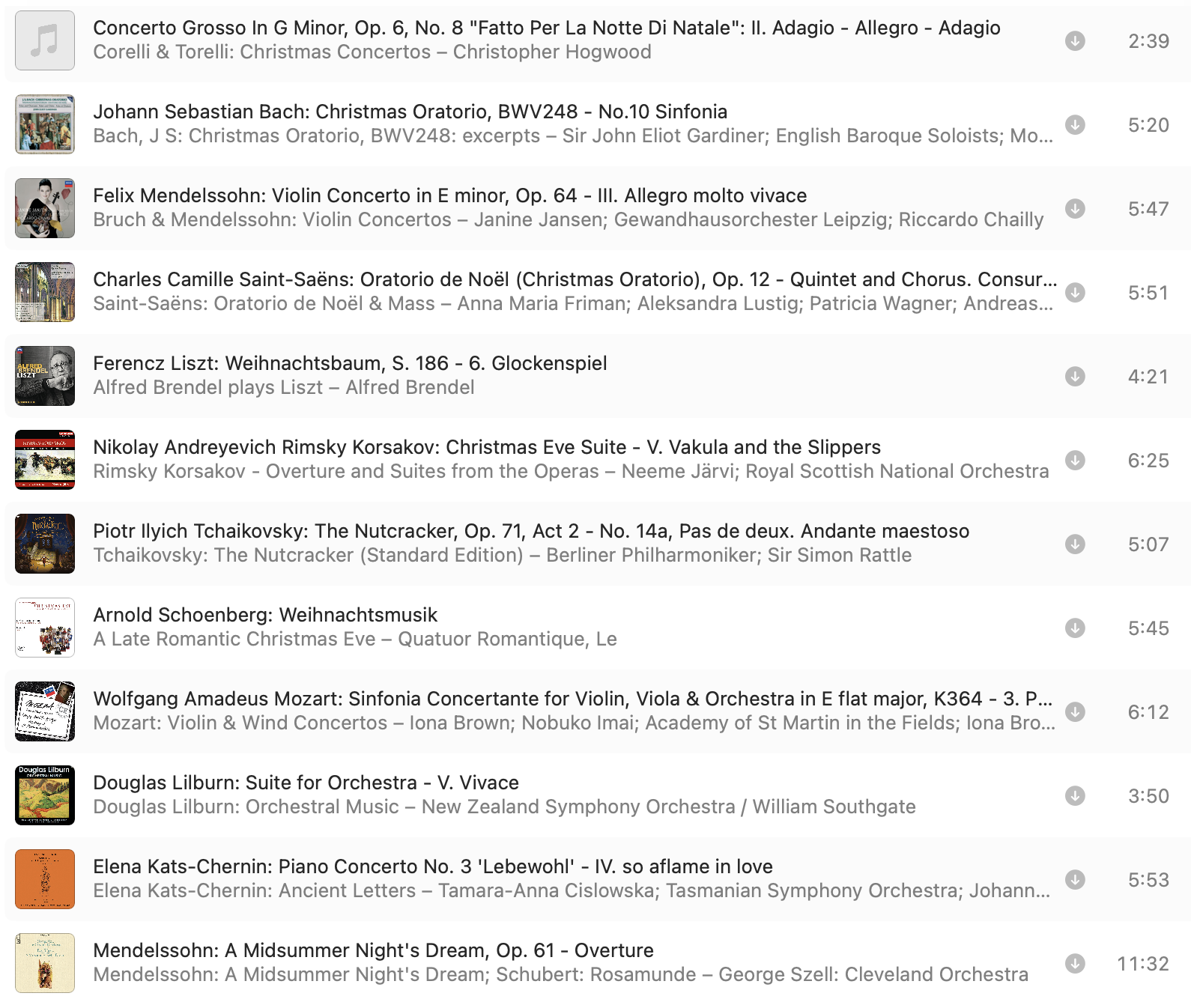
There is a good amount of pretty wonderful music from… Corelli, Bach, Mendelssohn, Saint-Saëns, Liszt, Rimsky-Korsakov, Tchaikovsky, Schoenberg, Mozart, Lilburn and Kats-Chernin.
Perhaps around 1690 the Italian composer Archangelo Corelli wrote a concerto in five parts and he gave it the nickname of ‘Fatto Per La Notte Di Natale’ which means ‘made for Christmas night’. And since then it has been known as Corelli’s Christmas Concerto. Here is the three minute second section performed by The Academy of Ancient Music directed by Christopher Hogwood.
A
That was Archangelo Corelli’s Christmas Concerto ‘Fatto Per La Notte Di Natale’ performed by The Academy of Ancient Music directed by Christopher Hogwood.
Ok. When you search for classical music for Christmas about the first thing that comes up is Johann Sebastian Bach’s ‘Christmas Oratorio’ from 1734. The oratorio is actually six connected but distinct works each composed for a different day’s religious service at Christmas… each one focusing on a particular part of the Christmas story. In total there is somewhere near three hours of music. The second of the six works which is concerned with some shepherds who accidentally got caught up in the story. This is the five minute introduction written for small orchestra alone… and it is there to set up a sweet bucolic scene before the singers tell the story. Here are the English Baroque Soloists conducted by John Eliot Gardiner.
B
That was the English Baroque Soloists conducted by John Eliot Gardiner with the opening to the second part of Johann Sebastian Bach’s ‘Christmas Oratorio’. So a few of the pieces I’ve included in this ‘Holiday Music’ episode are just plain and simple ‘happy music’.
Here is the final section of Felix Mendelssohn’s Concerto for Violin and Orchestra premiered in 1845. Here is Ricardo Chailly conducting the Leipzig Gewandhaus Orchestra and Janine Jansen is the soloist. It is about six minutes long.
C
That was the final section of Felix Mendelssohn’s Concerto for Violin and Orchestra. Ricardo Chailly conducted the Leipzig Gewandhaus Orchestra and Janine Jansen was the soloist
So, next up is selection from another oratorio. And it makes sense I should probably give you a very quick definition of what an oratorio is. It is a dramatic composition for soloists, chorus, and orchestra, typically based on a religious narrative, presented as a concert piece rather than a staged performance; while originally performed in churches, some oratorios are intended for theatres and concert halls. But this one was written for a church… the La Madelaine church in Paris and it was written in two weeks in 1858 by the church’s organist… the 23 year old Camille Saint-Saens.
This is the section using the text ‘Arise, Daughter of Zion’. It is about six minutes long and here it is performed by (Anna Maria Friman; Aleksandra Lustig; Patricia Wagner; Andreas Wagner; Tobias Schabel; Peter Kranefoed;) Stuttgart Bach Choir; Stuttgart Bach Orchestra; conducted by Jörg-Hannes Hahn. Camille Saint-Saëns ‘Christmas Oratorio’.
D
That was ‘Arise, Daughter of Zion’ from Camille Saint-Saëns Christmas Oratorio.
It was performed by (Anna Maria Friman; Aleksandra Lustig; Patricia Wagner; Andreas Wagner; Tobias Schabel; Peter Kranefoed;) Stuttgart Bach Choir; Stuttgart Bach Orchestra; Jörg-Hannes Hahn.
Next up is some music for solo piano. Of all places, the Houston Symphony Orchestra website had a fascinating list of music for Christmas and that is where I found out that Franz Liszt had written a collection of music in 1875 he called ‘The Christmas Tree’. This is the 6th piece which he named ‘Glockenspiel’. It is about 4 minutes long and here is the pianist Alfred Brendel to play it.
E
That was ’Glockenspiel’ from Franz Liszt’s collection ‘The Christmas Tree’ and the pianist was Alfred Brendel.
Alright, we’re going to head to Russia for the next couple of pieces. In 1832 the writer Nikolai Gogol published a collection of short stories that included a sort of fantasy folk tale called ‘The Night Before Christmas’. It was such popular material that it was turned into an opera by four different composers in Russia in the nineteenth century… including Rimsky Korsakov in 1895. Ten years later he adapted it to an orchestral work for the concert hall and here is the section called ‘Vakula and the slippers’ based on the part of the opera where the lead character, the peasant Vakula, has persuaded the Empress of all the Russia’s to give him her slippers to help him win his love back in the village. That’s probably enough of that for now. Here is Neeme Järvi conducting the Royal Scottish National Orchestra with ‘Vakula and the Slippers’ from Rimsky-Korsakov’s ‘Christmas Eve’. It is a bit over 6 minutes long.
F
That was Neeme Järvi conducting the Royal Scottish National Orchestra with ‘Vakula and the Slippers’ from Rimsky-Korsakov’s ‘Christmas Eve’.
Staying in Russia, there is a ballet that has, at least in the northern hemisphere, become synonymous with the holiday season and that is ‘The Nutcracker’ written by Pyotr Illich Tchaikovsky in 1892. The emotional highlight of the ballet is ...a slow romantic dance for two – often given the French term… a 'pas de deux' meaning ‘step for two’ - in the second act. Originally intended for two supporting characters, many productions now give the dance to the lead characters of Clara and The Nutcracker, who by now is a Prince. I think this is the most emotionally fulfilling and dramatically logical choice. For me it should be the once wooden prince and the young ballerina.
Here is Simon Rattle conducting the Berlin Philharmonic Orchestra with the five minute ‘Pas de Deux’ from Tchaikovsky’s ballet, The Nutcracker.
G
That was Simon Rattle conducting the Berlin Philharmonic Orchestra with the ‘Pas de Deux’ from Tchaikovsky’s ballet, The Nutcracker.
I’m not sure many people who know his work would associate the Austrian composer Arnold Schoenberg with ‘holiday music’ but again thanks to the clever author of a page on the Houston Symphony website I discovered that in 1921 he wrote a sweet piece for a handful of instruments… a string trio, a piano and a harmonium… that he called simply Christmas music. Even whilst he spent his career tearing up traditional western musical harmony in search of a ‘new’ language he would frequently say ‘there is still much good music to be written in the key of C major’. Which, without getting too technical, is thought of as an ‘easy’ set of notes… think of playing just eight white keys on a piano.
Here is Schoenberg’s ‘Christmas Music’ written in the key of C major… performed by a German group called the Romantic Quartet. It is about six minutes long.
H
That was Arnold Schoenberg’s ‘Christmas Music’ performed by the Romantic Quartet.
Ok, that is probably enough ‘Christmas’. The final four pieces of this ‘holiday music’ episode are just here for the sake of pure pleasure. Music that I hope does the job of just making people feel good. Here is the concluding section of Wolfgang Amadeus Mozart’s concerto for violin and viola and orchestra… known as the Sinfonia Concertante… and celebrated for the interplay of the solo lines of the two string instruments.. here performed by Iona Brown and Nobuku Imai with the Academy of St Martin in the Fields.
I
That was the conclusion of Mozart’s Sinfonia Concertante… performed by Iona Brown (violin) and Nobuku Imai (viola) with the Academy of St Martin in the Fields.
If the North Pole gets an unreasonable amount of attention at this time of year here is some music from closer to the South Pole. Starting with New Zealand… also known these days as Aotearoa. A place that many of you know is close to my heart. In 1955 the composer Douglas Lilburn, by then teaching at Victoria University in Wellington, wrote a work he called ‘Suite for Orchestra’. It is in five parts and here is the final one. Four pretty exuberant minutes of music. This is the New Zealand Symphony Orchestra conducted by William Southgate.
J
That was the final section of Douglas Lilburn’s ‘Suite For Orchestra’. The New Zealand Symphony Orchestra was conducted by William Southgate.
Ok. Something a little more reflective now. In 2018 Elena Kats-Chernin wrote her third piano concerto inspired by the lives of Johann Sebastian Bach and his first wife Maria. Each section of the concerto has a title taken from a particular piece of German poetry set to music by Bach. The section I am going to play you has the title of ‘so aflame in love’. It is about six minutes long and here is the pianist Tamara-Anna Cislowska with the orchestra that incidentally performs closest to the South Pole… the remarkable Tasmanian Symphony Orchestra and they are conducted by Johannes Fritzsch. ‘So aflame in love’ from Elena Kats-Chernin’s third piano concerto.
K
That was the pianist Tamara-Anna Cislowska with the Tasmanian Symphony Orchestra conducted by Johannes Fritzsch performing the ‘So aflame in love’ section from Elena Kats-Chernin’s third piano concerto.
My name is Peter Cudlipp and you have been listening to the ‘Classical for Everyone’ Podcast. I have a bit more music coming up but first I want to give you a little information that I hope you find useful… If you would like to listen to past episodes or get details of the music I’ve played please head to the website classicalforeveryone.net. That address again is classicalforeveryone.net. And on the individual episode pages of the website there are links to Spotify playlists with the full versions of most of the music played in each of the episodes.
And if you want to get in touch then you can email… info@classicalforeveryone.net.
This podcast is made with Audacity Software for editing, Wikipedia for Research, Claude for Artificial Intelligence… The music played is licensed through AMCOS / APRA. Classical For Everyone is a production of Mending Wall Studios and began life on Radio 2BBB in Bellingen NSW, Australia thanks to the late, great Mr Jeffrey Sanders.
Alright, whilst the holiday season is traditionally wrapped in the imagery of winter for half the planet it is the complete opposite. In the Southern hemisphere it is midsummer. Very hot dramatic weather But the midsummer nights can make up for the scorching days. And that to be fair slightly strained connection to the ‘holidays’ gives me all the reason I need to finish this episode with the sheer delight of Felix Mendelssohn’s Overture to his incidental music for ‘A Midsummer Night’s Dream’. Here is George Szell conducting the Cleveland Orchestra.
And if you are fortunate enough to be celebrating holidays may they be filled with love, joy and laughter. Thanks for listening.
L