

 Apple Podcasts
 Spotify
 Amazon Music
 iHeartRadio
 Overcast
 PocketCasts
  RSS Feed
 Germans In Italy
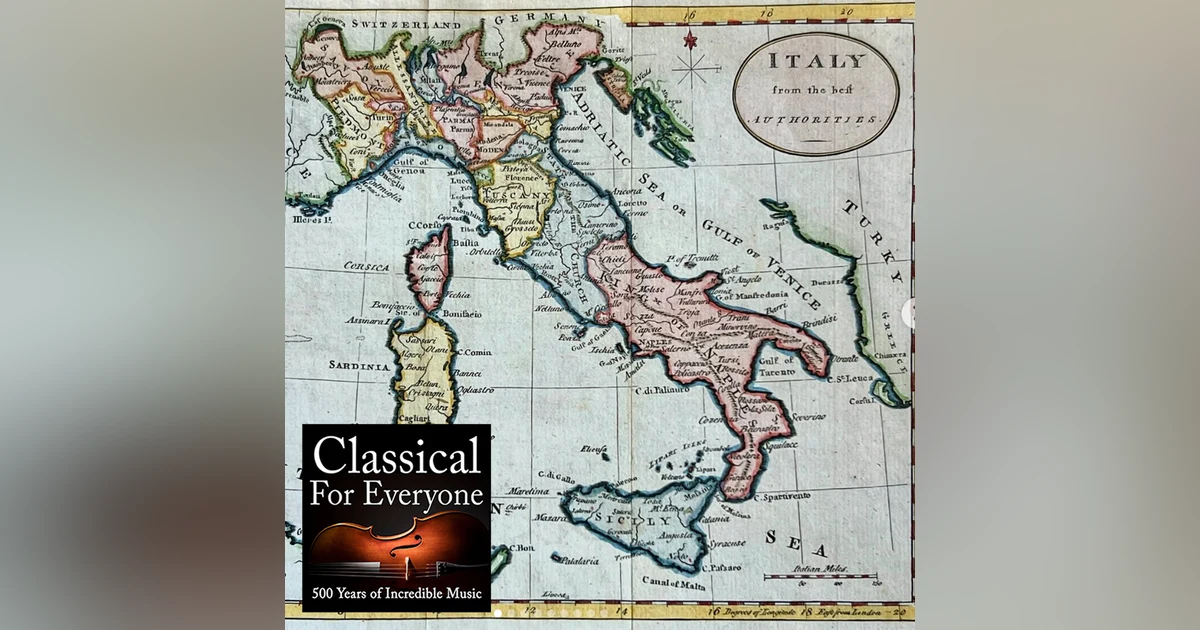
Let’s be fair, this is a deeply flawed title. Why? Well the idea is to play music written by German composers when they were living in or visiting Italy. But in the 18th century… which is when most of the music comes from… Germany and Italy as we know them today did not exist. And to make things worse… the whole episode is really an excuse to play some music by a man now well and truly owned by modern Austria… which also didn’t exist. What became Italy, Germany and Austria were a wonderfully confusing collection of kingdoms, republics, city states, free imperial trading centres, ecclesiastical principalities, and electorates. And you can imagine how catchy that sort of accuracy would have made the title. So please forgive ‘Germans in Italy’. My clickbaity title will not diminish the pleasure I hope you are going to get from music by Heinrich Schutz, Johann Rosenmüller, Georg Friederich Handel, Johann Adolf Hasse, Johann Christian Bach, Christoph Willibald Gluck and the composer I alluded to earlier as the emblem of contemporary Austrian tourism… who was in fact from the sovereign ecclesiastical state of Salzburg… Wolfgang Amadeus Mozart. [Episode image: Map of Italy. English, Circa 1788. “ITALY from the best AUTHORITIES” printed in London.]
Jane Glover’s book ‘Mozart in Italy’:
https://www.panmacmillan.com/authors/jane-glover/mozart-in-italy/9781529059908
And here is a link to a playlist on Spotify with most of the music in the episode:
https://open.spotify.com/playlist/62rkAKy2K8PWQRkU7TSaLu?si=cd8f7f03dd5b4d9f
The Music
The Words
Hello everyone. Welcome to another episode of the ‘Classical For Everyone’ Podcast… five hundred years of incredible music. My name is Peter Cudlipp and… If you enjoy any music at all then I’m convinced you can enjoy classical music. All you need are ears. No expertise is necessary. If you’ve ever been curious about classical music… or explored it for a while once upon a time… or just quietly wondered what all the fuss was about… then this is the podcast for you. And because there’s a lot of music out there each episode has a theme. And for this one it is… Germans In Italy.
Which is, let’s be fair, a deeply flawed title. Why? Well the idea is to play you music written by German composers when they were living in or visiting Italy. But in the 18th century… which is when most of the music comes from… Germany and Italy as we know them today did not exist. And to make things worse… the whole episode is really an excuse to play some music by a man now well and truly owned by modern Austria… which also didn’t exist. What became Italy, Germany and Austria were a wonderfully confusing collection of kingdoms, republics, city states, free imperial trading centres, ecclesiastical principalities, and electorates. And you can imagine how catchy that sort of accuracy would have made the title. So please forgive ‘Germans in Italy’. My clickbaity title will not diminish the pleasure I hope you are going to get from music by Heinrich Schutz, Johann Rosenmüller, Georg Friederich Handel, Johann Adolf Hasse, Johann Christian Bach, Christoph Willibald Gluck and the composer I alluded to earlier as the emblem of Austrian tourism… who was in fact from the sovereign ecclesiastical state of Salzburg… Wolfgang Amadeus Mozart.
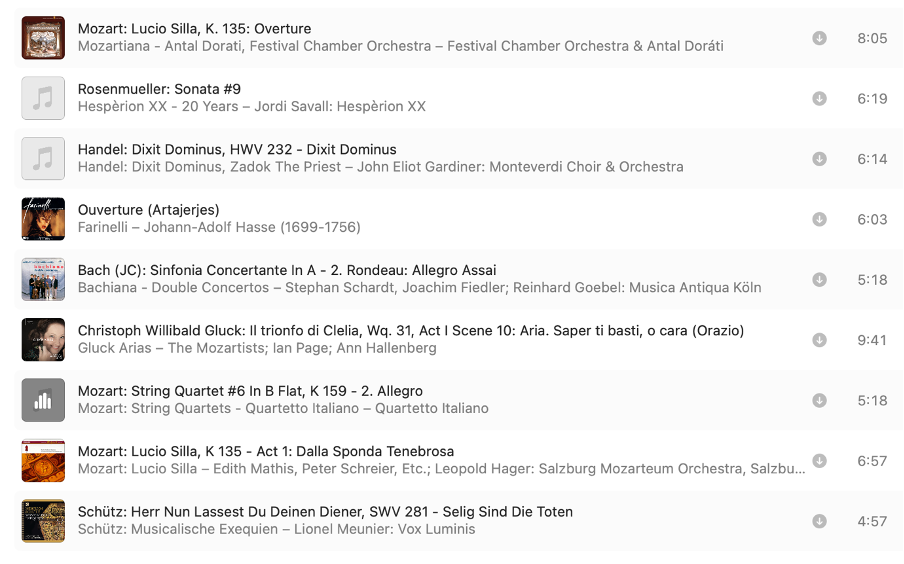
And I am going to start with him. I’ll tell you a little more about Mozart’s time in Italy a little later in the show but now here is the Overture to his opera ‘Lucio Silla’ written in 1772 when he was 16 and it was first performed in Milan. It is about eight minutes long and this is Antal Dorati conducting the Festival Chamber Orchestra… a group the Mercury label pulled together for the recording made in 1965 in the, I guess affordable, Watford Town Hall in Hertfordshire in the UK… maybe just a little less glamorous than the Teatro Regio Ducale at the Royal Palace of Milan where it was first performed.
A
That was the Overture to Mozart’s opera ‘Lucio Silla’. Antal Dorati conducted the Festival Chamber Orchestra.
The orphanage in Venice, the Ospedale della Pieta, is where Antonio Vivaldi taught and wrote much of the work he is remembered for. Consequently he is the only composer generally connected to the institution but Wikipedia lists close to fifty another musicians who taught… and in some instances, composed there. One of them, two generations before Vivaldi, was Johann Rosenmüller born near Dresden in 1610. He spent 25 years in Venice and most of that time he was head of choral teaching at the Ospedale but he is best remembered for a set of pieces he wrote for small groups of instruments in 1681 which were published under the name ‘Sonatas for 2, 3, 4, and 5 string and other instruments’. And at this time ‘sonata’ was a term for pretty much any music where the instruments had individual lines of melody. This is the 9th sonata. It is about six minutes long and here is Jordi Savall leading the group Hesperion XX.
B
That was Jordi Savall leading the group Hesperion XX with Johann Rosenmüller’s 9th ‘Sonata for string and other instruments’.
Georg Friedrich Handel is so associated with his time in London where he lived and worked for more than half his life that it is easy to forget that after early successes in Hamburg he spent four years in Italy on and off from 1706 t0 1710. He worked in Florence, Rome, Naples and Venice. His major work was writing operas but in Rome at the time opera was banned and had been for 30 years. Something about opera houses being magnets for all sorts of lascivious behaviour and wasteful expenditure. So, whilst in the Papal States he wrote one of his earliest major religious choral works. Probably commissioned by Cardinal Carlo Colonna, he took the words of the Psalm 109 in the Latin bible which begins ‘Dixit Dominus, Domino Meo’. ‘The Lord said unto my Lord’.
Here is the opening section.. the setting of that first verse. This is John Eliot Gardiner with the Monteverdi Choir and Orchestra. It is about six minutes long. The opening of Georg Friedrich Handel’s ‘Dixit Dominus’ from 1707.
C
That was John Eliot Gardiner with the Monteverdi Choir and Orchestra performing the opening of Georg Friedrich Handel’s ‘Dixit Dominus’ .
You might at this point be wondering why were all these composers heading to Italy? Partly, opportunity — a crowded map of competing wealthy courts, churches and opera houses meant more commissions than the German lands could offer. Partly education — Bologna and Naples had teachers and conservatories nobody north of the Alps could match. And partly, I suspect the simple pull of the south — sunlight, ruins, and the ghosts of ancient Rome.
But underneath all of that was something bigger: for most of the 1600s and 1700s, Italian wasn't just the language you sang in — it was essentially the language of music itself. If you wanted to be taken seriously anywhere in Europe as a composer, you had, at some point, to go and prove yourself in Italy. And there is certainly an episode for another time on the migration in the opposite direction… of Italians into the courts and cities of other parts of Europe. But for now back to the Germans.
It’s hard to comprehend the appetite for operas in the 18th century in Europe from our vantage point… but a little fact about the next composer might help. Johann Adolf Hasse wrote somewhere between 60 and 70 operas between the 1720s and his death in 1783. And that was maybe just a quarter of his compositional output.
Born near Hamburg he moved to Naples in his 20s and for the rest of his life seems to have moved between different Italian centres plus stints in Dresden and Vienna. And he was probably the most successful opera composer of his day. And his style was widely influential. And then he essentially vanished. A couple of his choral works kept his name alive but that was it. The Belgian musicologist François-Joseph Fétis, who in the 1840s wrote and published the first multi-volume collection of biographies of musicians, said of Hasse ‘that few composers had been as famous and yet as quickly forgotten’. And interest in his music has only very recently revived.
One of the very first instances of the revival was the use of the overture to his opera ‘Artaserse’ from 1730 in the soundtrack for the film ‘Farinelli’ in 1994. Here is Christophe Rousset and Les Talens Lyriques. It is about six minutes long. The music of Johann Adolf Hasse.
D
That was the overture to Johann Adolf Hasse’s opera ‘Artaserse’ Christophe Rousset led Les Talens Lyriques.
Ok. If any of you recall the episode a couple of months back about the extended Bach family you perhaps won’t be surprised to know that one of his four composing sons ended up spending a bunch of time working in Italy. Johann Christian Bach lived in Bologna and then Milan from 1754 for about ten years. Amongst his achievements was popularising the ‘sinfonia concertante’ form. Not getting too bogged down this describes ‘an orchestral work, normally in several sections, in which one or more solo instruments contrast with the full orchestra’ which sounds exactly like a modern concerto but the orchestras were smaller and the solo instrument was slightly more integrated into the fabric of the orchestral sections. Sorry, I did get bogged down. And actually what I am going to play you was probably written later in London but I do think you can hear a certain Italianate character to it.
Here is Musica Antiqua Cologne led by Reinhardt Goebel with the 2nd section of Johann Christian Bach’s ‘Sinfonia concertante in A’. It is about 5 minutes long.
E
That was Musica Antiqua Cologne led by Reinhardt Goebel with the 2nd section of Johann Christian Bach’s ‘Sinfonia concertante in A’.
So a while back I mentioned the precipitous decline in the performance of the music of the opera composer Johann Adolf Hasse. One of the reasons for that is the success of the next German whose music I am going to play… Christoph Willibald Gluck who was born in Eastern Bavaria in 1715.
It can be hard for most listeners (and I certainly include myself in this) to discern the differences between the operas of Hasse and Gluck but there was a generational shift in tastes, expectations and composition. I’m going to quote the English composer and music historian… and friend of Joseph Haydn, Charles Burney writing in 1773…
“Feelings run as high among poets, musicians and their adherents, at Vienna as elsewhere. Hasse, may be said, to be at the head of one of the principal sects; and Gluck of another. The first, regarding all innovations as quackery, adhere to the ancient form of the musical drama, in which the poet and musician claim equal attention from an audience; The second party depend more on theatrical effects, propriety of character, simplicity of diction, and of musical execution, than on, what they style flowery description, superfluous similes, sententious and cold morality.”
As the eighteenth century wore on the style of Gluck and his followers would come to dominate and Hasse’s works would fade from memory.
To modern ears I think all the operas under discussion here, and Gluck would write fifty of his own, seem surprisingly similar; and this is perhaps because the subjects for both groups are drawn almost exclusively from mythology and ancient history. It would really be Mozart who would finally bring a contemporary sensibility to opera. But back to Gluck.
From the age of 23 he spent five years studying composition in Milan, where four years later his first opera would be performed. And he would write one a year for Milan for the next four years… as well as operas for Venice and Turin. As his career and reputation advanced he would spend time in Vienna and then most significantly Paris… his position there organised by his former student, a Habsburg princess who became Queen Marie Antionette.
But for the purposes of this episode I want to bring the story back to the Italian peninsula, specifically to Bologna where in 1763 on a brief return trip Gluck wrote ‘Il trionfo di Clelia’… ‘the Triumph of Clelia’. Now if you might be wondering why something with such a catchy title is not performed that often any more… here is Wikipedia’s description of the premise...
The opera's story revolves around four main characters: Porsenna, an Etruscan king who laid siege to Rome in 509 BC to restore the monarchy; Tarquinio, a deposed King of Rome; Clelia, a woman of the Roman Republic held hostage by Porsenna; and Orazio, ambassador of the Roman Republic and Clelia's intended husband.
But as with so many of the works of this period what is to modern sensibilities almost completely unengaging can also be the source of some exquisitely beautiful music. In the first act Orazio sings of his devotion to Clelia. The opening verse in Italian is…
Saper ti basti o cara
che sei, che fosti ognor
e che il mio solo amor
sempre sarai.
Which in English is… Let it be enough for you to know, my dearest,
that you are, and have always been,
and that you will always remain
my only love.
Here is the mezzo soprano Ann Hallenberg and the Mozartists conducted by Ian Page with ‘Saper ti basti’… ‘Let it be enough’ from Gluck’s The ‘Triumph of Clelia’. It is about ten minutes long. F
That was the mezzo soprano Ann Hallenberg and the Mozartists conducted by Ian Page with ‘Saper ti basti’ from Christoph Willibrant Gluck’s The ‘Triumph of Clelia’. In 1769, six years after that music was written, the 13-year-old Wolfgang Amadeus Mozart and his father Leopold made the first of three trips to Italy. And stayed for 18 months… moving from city to city and court to court. On the episode page of the podcast’s website, classicalforeveryone.net, I’ll put a link to Jane Glover’s book ‘Mozart in Italy’. And it might have been reading that recently that was the genesis for this ‘Germans in Italy’ episode.
The book paints a fantastic picture of the young Mozart’s awkward transition from child superstar to precocious teen composer; and the extraordinary efforts of his father to exploit every financial and musical opportunity that came their way or that he could engineer or orchestrate.
Suffice to say Mozart was also composing now all the time… symphonies, operas… and… string quartets. On their third trip Mozart had some down time in Milan and wrote his first group of six String Quartets. There is no direct evidence of a commission nor of an offer to write them for a publisher, so some argue that it was just an exuberance of inspiration channeled into a genre Mozart had not explored. But there is also a vague reference in a later letter from his father of Mozart composing ‘six quartets for an Italian gentleman’. For me that is enough to make the case that these were written to order. Not that it really matters at all. But you know I do like these little mysteries. Here is the Quartetto Italiano with the 2nd section of Mozart’s 6th String Quartet. It is about five minutes long.
G
That was the Quartetto Italiano with the 2nd section of Wolfgang Amadeus Mozart’s 6th String Quartet.
My name is Peter Cudlipp and you have been listening to the ‘Classical for Everyone’ Podcast. I have another couple of pieces coming up but before I get to them I want to give you a little information that I hope you find useful…
If you would like to listen to past episodes or get details of the music I’ve played please head to the website classicalforeveryone.net. That address again is classicalforeveryone.net On the individual episode pages of the website there are links to Spotify playlists with the full versions of most of the music played in each of the episodes. I hope you have enjoyed this ‘Germans In Italy’ focused episode of ‘Classical For Everyone’. And if you want to get in touch then you can email… info@classicalforeveryone.net.
Alright, to finish this episode I have an aria or song from Mozart’s 2nd full opera, Lucio Silla. I played you the overture at the opening of the show and I mentioned he wrote his six string quartets during downtime in Milan. The downtime was whilst he was waiting for ‘Lucio Silla’ to be staged. The year was 1772 and Mozart was 16.
Now even though Gluck was by now in Paris and leading the charge to remove the rigidity and undermine the formulaic strictures of the operas Hasse and his followers had dominated Europe with; the young Mozart was writing for a court where traditions remained strong and ‘Lucio Silla’ is a very conventional exercise. I think it is also fair to say that at the age of 16 Mozart was probably not going to be rocking the boat the way he would with later operas. Like every other opera mentioned in this episode the story of Lucio Silla is a slice of obscure ancient history… The Roman dictator Lucio Silla lusts after Giunia, the daughter of his enemy Gaius Marius. Giunia, on the other hand, loves the exiled senator Cecilio. I shouldn’t really be so glib. The plots of most operas, plays and movies don’t really stand close scrutiny. But the important thing with this early exercise of Mozart’s is the music he put to a libretto that frankly fades by comparison with anything Lorenzo da Ponte wrote.
Here is the aria ‘Dalla sponda tenebrosa’ or ‘From the dark shore’. In it Giunia defiantly rejects the romantic advances of Lucio Silla, expressing her eternal loyalty to her murdered father and her exiled husband. The singer is Arleen Auger and Leopold Hager is conducting the Salzburg Mozarteum. ‘Dalla sponda tenebrosa’ from Mozart’s ‘Lucio Silla’. It is about seven minutes long.
H
That was Arleen Auger singing and Leopold Hager conducted the Salzburg Mozarteum with ‘Dalla sponda tenebrosa’ ‘From the dark shore’ from Mozart’s opera ‘Lucio Silla’. Written in Milan in 1772.
Thanks for your time and I look forward to playing you some more incredible music on the next ‘Classical For Everyone’. This podcast is made with Audacity Software for editing, Wikipedia for Research, Claude for Artificial Intelligence, Cleanfeed for remote recording; and the music played is licensed through AMCOS / APRA. Classical For Everyone is a production of Mending Wall Studios. The Producers do not receive any gifts, remuneration or support of any kind from any organisation or individual mentioned in the show.
And if you have listened to the credits… here is something more for you…
This is a beautiful five minute piece of choral music by Heinrich Schütz, who was one of the very first German composers in Italy. He was there about 150 years before Mozart… with his earliest Italian works being written in Venice in 1611. This is his setting of the ‘Nunc dimittis’ or the Canticle of Simeon from the Latin bible. Here is the group Vox Luminos led by Lionel Meunier.
Thanks again for listening.
I