

 Apple Podcasts
 Spotify
 Amazon Music
 iHeartRadio
 Overcast
 PocketCasts
  RSS Feed
 Frederic Chopin
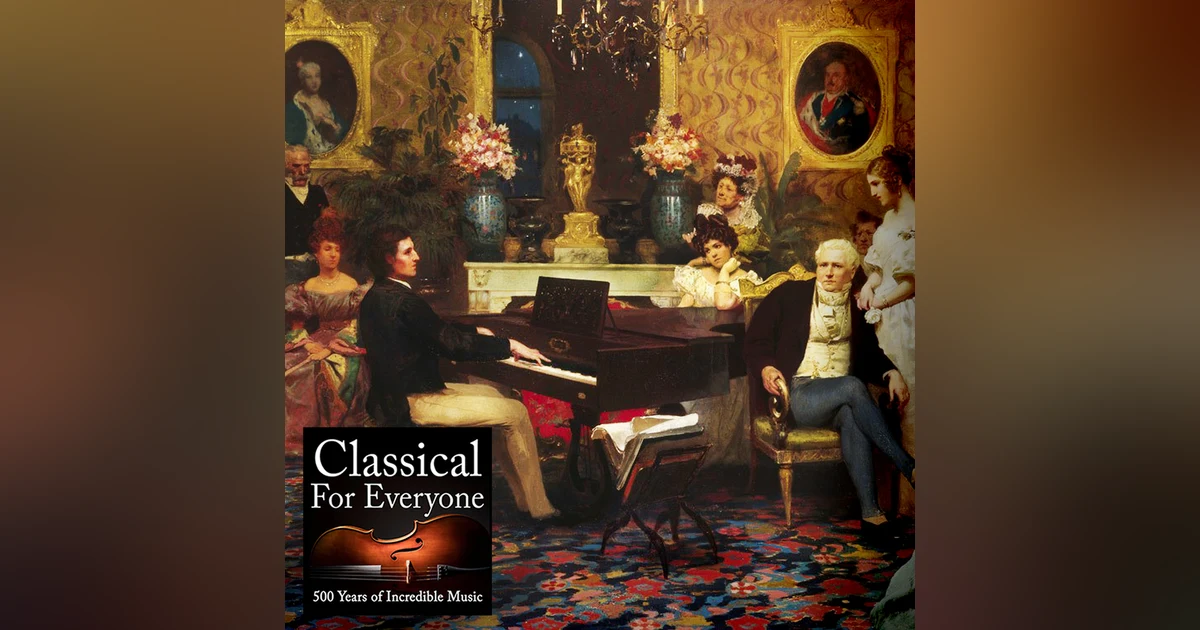

I have been asking myself why it has taken close to a hundred episodes before I got around to one devoted to Chopin. When I was chatting with Claude about doing the episode he described my neglect of the composer as, and I quote, ‘an alarming gap… genuinely startling given Chopin’s centrality to the repertoire and his obvious appeal to audiences’. So, if even my AI buddy is scratching his virtual head (and frankly being a little pretentious and unsupportive); then there may be listeners to the show who feel the same. So, with the help of eight pianists, a couple of cellists, a conductor and an orchestra let me make it up to you with an hour and a bit of the music of Frédéric Chopin.[Episode image: Detail from ‘Chopin Playing the Piano in Prince Radziwill's Salon’ by Henryk Siemiradzki 1887.]
And here is a link to a playlist on Spotify with most of the music in the episode:
https://open.spotify.com/playlist/0oFavfDuE6HrGGYsaXAN4r?si=1b557e17e36f448c
The Music
The Words
Hello everyone. Welcome to another episode of the ‘Classical For Everyone’ Podcast… five hundred years of incredible music. My name is Peter Cudlipp and… If you enjoy any music at all then I’m convinced you can enjoy classical music. All you need are ears. No expertise is necessary. If you’ve ever been curious about classical music… or explored it for a while once upon a time… or just quietly wondered what all the fuss was about… then this is the podcast for you. And because there’s a lot of music out there each episode has a theme. And for this one it is… the music of Frédéric Chopin.
And I have been asking myself why it has taken close to a hundred episodes before I got around to one devoted to Chopin. When I was chatting with Claude about doing the episode he described my neglect of the composer as, and I quote, ‘an alarming gap… genuinely startling given Chopin’s centrality to the repertoire and his obvious appeal to audiences’. So, if even my AI buddy is scratching his virtual head and frankly being a little unsupportive; then there may be listeners to the show who feel the same. So, with the help of eight pianists, a couple of cellists, a conductor and an orchestra let me make it up to you with an hour and a bit of the music of Frédéric Chopin.
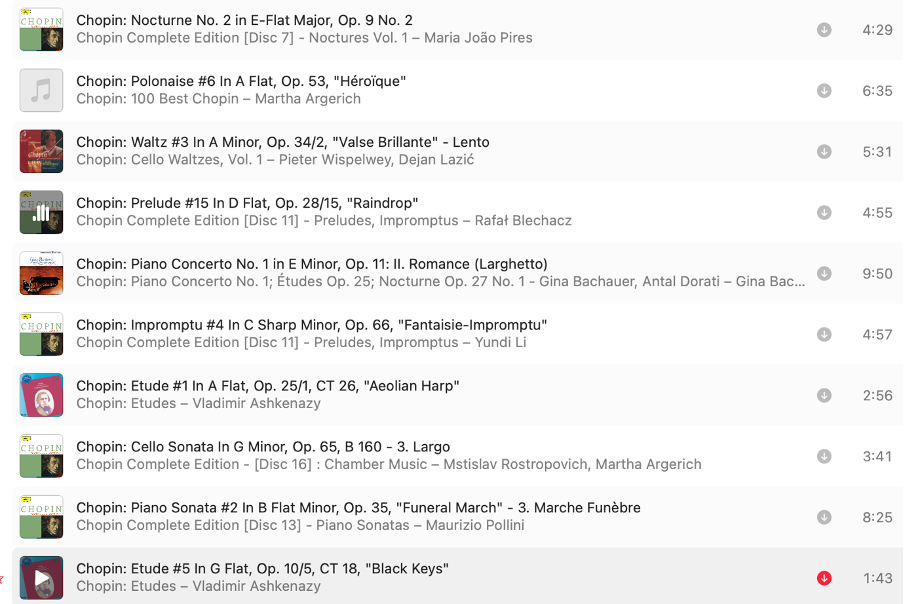
The French term ‘nocturne’ translates as ‘of the night’ and was first applied to delicate and romantic music for a solo piano by the Irish composer John Fleld; but it was Chopin who popularised the nocturne with the 21 he wrote between 1827 and 1846. And to get the music started today, here is the Portuguese pianist Maria João Pires playing his 2nd Nocturne written in 1832 when Chopin was 22. It is about 4 minutes long.
A
That was Maria João Pires playing Frederic Chopin’s 2nd Nocturne.
Let me give you some very quick biographical brushstrokes. Chopin was born in 1810 in a village 30 miles west of Warsaw and was quickly recognised as a child prodigy giving public concerts from the age of seven and starting to compose at about the same time. He later studied at the Warsaw Conservatory and then at the age of twenty moved to Paris after some months in Vienna. This coincided with a failed uprising back in Poland after which Russia removed what limited self-government Poland had enjoyed. For Chopin to return he would have had to apply for travel documentation that recognised the Russian Czar as the head of the Polish state… something Chopin refused to do and he would spend the rest of his life primarily in France never returning to his homeland. In Paris he would befriend Liszt and Schumann and support himself by publishing music and giving piano lessons. He rarely appeared in public preferring to play in the salons of aristocrats.
His most significant relationship was with Amantine Aurore Dupin better known to the world as the writer and activist George Sand… an utterly fascinating figure who was, in terms of her views about the place of women in society, at least a century ahead of her time. When they met in 1836 Chopin was already showing signs of the tuberculosis that would have an increasing impact on the rest of his life and would lead to his death at the age of 38 in 1849.
Ok, next I am going to play you what Chopin called a Polonaise. He wrote 23 of them and the term has quite a specific meaning. It doesn’t mean ‘broadly pertaining to Poland’; it was originally the name of a folk dance that emerged in the 1500s but which had by Chopin’s time been formalised to describe a dance in waltz time, that is 3/4, but at a slow almost walking pace… slow and stately processional music connected to the entrance of nobility into a ballroom. Here is the pianist Martha Argerich with Frederic Chopin’s Polonaise No. 6 which carries the nickname ‘Heroic’. This is a bit over six minutes of utterly spectacular writing and playing.
B
That was Martha Argerich with Frederic Chopin’s Polonaise No. 6 which has the nickname ‘Heroic’.
That nickname, which incidentally Chopin did not choose, prompts me to digress a little into the nineteenth century travails of what we now know as Poland. In a series of partitions the territory which had once been the Polish Lithuanian Commonwealth had by 1795 been divided between Russia, Austria and Prussia.
In 1807 Napoleon Buonaparte, after his victories over those three states, annexed the area around Warsaw and then following his defeat the Congress of Vienna in 1815 created a semi-independent state that has come to be called Congress Poland. But it was effectively given to Russia. Then as I mentioned a while back there was an uprising that was brutally suppressed in 1830. And another in the 1860s with a similar outcome. It would not be until 1918 that an independent state of Poland would be created.
In a way, in the popular imagination the struggles of the Polish people have been fused with the short life of their brilliant exile, Frederic Chopin, and it is a little hard to untangle Chopin’s post-mortem adoption as a symbol for the nation from the facts of his life. The piece I just played you, the ‘Heroic’ Polonaise has come to be seen as a statement of the revolutionary spirit of a people suffering under a foreign autocracy.
It’s not unusual to imbue the work of a great artist with qualities and aspirations that are way beyond the intentions of that individual. But I think in the case of Chopin I’m surprised that his deeply personal and frankly small-scale works have become a nation’s music. But perhaps it was Chopin’s reluctance to explain meanings and inspirations that left this body of work as something of a blank canvas waiting for history to co-opt it.
Ok more music. Whilst the focus of Chopin’s composition was the piano he was not averse to working with other musicians to arrange his works for additional instruments. And it might be safe to assume he had a thing for cellos.
Here are the cellist Pieter Wispelwey and the pianist Dejan Lajic with an arrangement for those instruments of Chopin’s Waltz No. 3. It is about 5 minutes long.
C
That was the cellist Pieter Wispelwey and the pianist Dejan Lajic with an arrangement Chopin’s Waltz No. 3.
Ok. There is no shortage of stories of artists creating amazing works under wildly less than ideal circumstances. But Chopin and George Sand’s trip to Mallorca, along with her children, in 1838 was an extreme misadventure plagued by dreadful accommodation, foul winter weather, local antipathy and chronic ill-health. But under these trying circumstances Chopin was still able to write some of his best loved pieces. He had been working on a group he called Preludes for a couple of years and, as an indication to how well regarded his music was, he had sold the publication rights to the Preludes to three separate territories.
Many of these have had names appended to them and the one I am going to play you is known as the ‘Raindrops’ prelude… a name given to it a couple of decades after Chopin’s death. The idea is that one repeated note sounds like the constant drip of water. But it’s worth quoting George Sand from her reminiscences of the trip to Mallorca… Chopin played her a prelude (and we don’t know which one) and she commented on the sound of nature she heard in the piece… She wrote…
“He was even angry that I should interpret this in terms of imitative sounds. He protested with all his might—and he was right to—against the childishness of such aural imitations. His genius was filled with the mysterious sounds of nature, but transformed into sublime equivalents in musical thought, and not through slavish imitation of the actual external sounds.”
Time to let you be the judge. Here is Rafal Blechacz playing Frederic Chopin’s 15th Prelude.
D
That was Rafal Blechacz playing Frederic Chopin’s 15th Prelude.
Pondering what artists didn’t create is an odd and kind of pointless thing to do. But as I’ve been pulling this episode together I keep coming back to a certain sadness that Chopin wrote so little music for orchestra and in particular for piano and orchestra. He wrote two piano concertos when he was 20 years old. Both were premiered in Warsaw and he never went back to the form.
Chopin titled the nine minute second section of the 1st concerto a ‘Romance’ and he described it in a letter to a friend…
"It is not meant to create a powerful effect; it is rather a Romance, calm and melancholy, giving the impression of someone looking gently towards a spot that calls to mind a thousand happy memories. It is a kind of reverie in the moonlight on a beautiful spring evening"
It was a bit of a hunt through different recordings to find one to play that captures this mood best but Gina Bachauer, playing the piano with the London Symphony Orchestra conducted by Antal Dorati, does I think have a healthy amount of the lovers’ reverie Chopin puts into music.
E
That was Gina Bachauer playing the piano with the London Symphony Orchestra conducted by Antal Dorati performing the second section of Frederic Chopin’s 1st Piano Concerto.
Here is the pianist Yundi Li. It is about five minutes long. Chopin’s Fantasie-Impromptu
F
That was Yundi Li with Chopin’s Fantasie-Impromptu.
If you have ever learnt a musical instrument you will perhaps have encountered the term ‘study’… the name given to a work written to assist the student to practice a particular skill. And there might be parallels with drills in sports. A very repetitive form of practice. And as can be imagined many musical studies are just terrible pieces of music. ‘You will practice increasing reach of your fifth finger away from your fourth by playing these three notes at different speeds for the next five minutes’.
Now Chopin wrote his own collection of studies… which are known by the French term for a study… an Etude. He wrote 27 etudes during the 1830s… starting when he was preparing to perform his own piano concertos and wanted a way to train himself for the trickier passages. Which does suggest a peculiar internal monologue… ‘I’ve written something so hard to play that I have to write something else really hard to play to practice with’.
He also heard the Italian composer and virtuoso violinist Nicolo Paganini perform in Warsaw in 1829 and was struck by how his 24 Caprices for solo violin were both technical exercises and works of art.
And so over the next decade Chopin would write his Etudes primarily for himself. But at the same time he decided that a piece could be focused on technical challenges and at the same time poetic, engaging, moving and even beautiful.
The one I am going to play you was written to coach the ability of the weaker fingers to carry a melody whilst the rest of the fingers are playing rapid supporting notes carrying the harmony… or to put it even more technically… “voicing the melody through the top notes of continuous sextuplet arpeggios, with the weaker fingers doing the singing while everything else stays soft and even.”
The composer and critic Robert Schumann after hearing this etude said it reminded him of the sound of an Aeolian Harp… which is a stringed instrument designed to be installed outside and which makes quite otherworldly sounds when a strong wind vibrates the strings… hence the piece’s nickname.
Here is Vladimir Ashkenazy playing Chopin’s 1st Etude from his second collection of Etudes published in 1836, the ‘Aeolian Harp’. It is about 3 minutes long.
G
That was Vladimir Ashkenazy playing Chopin’s ‘Aeolian Harp’ Etude.
At Chopin’s final public concert in 1857, the year before he died, he performed with his friend the French cellist Auguste Franchomme. The sonata for cello and piano he had written for Franchomme was close to the last work Chopin would write.
Here are the pianist Martha Argerich and the cellist Mstislav Rostropovich with the slow third section of the sonata. It is about four minutes long.
H
That was pianist Martha Argerich and the cellist Mstislav Rostropovich with the slow third section of Chopin’s sonata for cello and piano.
My name is Peter Cudlipp and you have been listening to the ‘Classical for Everyone’ Podcast. I have another couple of pieces coming up but before I get to them I want to give you a little information that I hope you find useful…If you would like to listen to past episodes or get details of the music I’ve played please head to the website classicalforeveryone.net. That address again is classicalforeveryone.net On the individual episode pages of the website there are links to Spotify playlists with the full versions of most of the music played in each of the episodes.I hope you have enjoyed this Chopin focused episode of ‘Classical For Everyone’. And if you want to get in touch then you can email… info@classicalforeveryone.net.
Alright, before I finish this episode I want to make a couple of observations about Chopin.
Of all the composers who are thought of as great… as sort of belonging to something of a pantheon.. Chopin is one of a handful who worked in very few genres. There are no Chopin operas. There are no Chopin symphonies, string quartets or religious works. Virtually all of the music Chopin wrote was for the piano. And most of that was for the piano on its own.
And to an extent his ongoing fame paralleled the rise of the piano as an increasingly important fixture in middle class homes from the early nineteenth century. With the arrival of the phonograph and then the radio; piano sales peaked in the 1920s and began a slow decline but by then Chopin’s place as a composer who everyone who played the piano knew was well established. And it may be true of other composers but amongst the sheer volume of music Chopin wrote there was a certain amount that was playable by an early to intermediate piano student… cementing Chopin’s place in the hearts of professionals and amateurs alike.
But that doesn’t factor in the sheer beauty of so much of Chopin’s music. Which is perhaps subjective… but then I think it is an opinion shared by many. And if you are new to the music of Frederic Chopin I hope that some of what I have played has illustrated that point.
I want to finish with the third section of his Piano Sonata No. 2 from 1838. Chopin give it the name ‘Funeral March’. When I was a kid this piece was wildly overused… even to satirical effect in cartoons… so I maybe didn’t take it too seriously. But listening again, it really is pretty extraordinary.
The opening very much carries the impressions of slowly and sadly accompanying a coffin to a graveside but it is followed by, what for me, is actually tremendously uplifting music. There is consolation in this part of the piece. But what it can mean is best left up to each individual listener. Certainly Chopin did not, to our knowledge, have any specific funeral in mind. He called it a ‘funeral march’ in the same way he used the term ‘waltz’ or ‘polonaise’… it was about a musical form. A slow musical procession which, more by implication than specific intent, captures a certain universal grief.
Here now is Maurizio Pollini playing the eight and a half minute Funeral March from Frederic Chopin’s Piano Sonata No. 2.
I
That was Maurizio Pollini playing the Funeral March from Frederic Chopin’s Piano Sonata No. 2
Thanks for your time and I look forward to playing you some more incredible music on the next ‘Classical For Everyone’. This podcast is made with Audacity Software for editing, Wikipedia for Research, Claude for Artificial Intelligence, Cleanfeed for remote recording; and the music played is licensed through AMCOS / APRA. Classical For Everyone is a production of Mending Wall Studios. The Producers do not receive any gifts, remuneration or support of any kind from any organisation or individual mentioned in the show.
And if you have listened to the credits… here is some more music for you…
This is Vladimir Ashkenazy playing another of Frederic Chopin’s Etudes. It is the fifth in the first group which were published in 1833. A bit under two minutes of music with the nickname ‘Black Keys’. Thanks again for listening.
J