

 Apple Podcasts
 Spotify
 Amazon Music
 iHeartRadio
 Overcast
 PocketCasts
  RSS Feed
 Franz Schubert 1
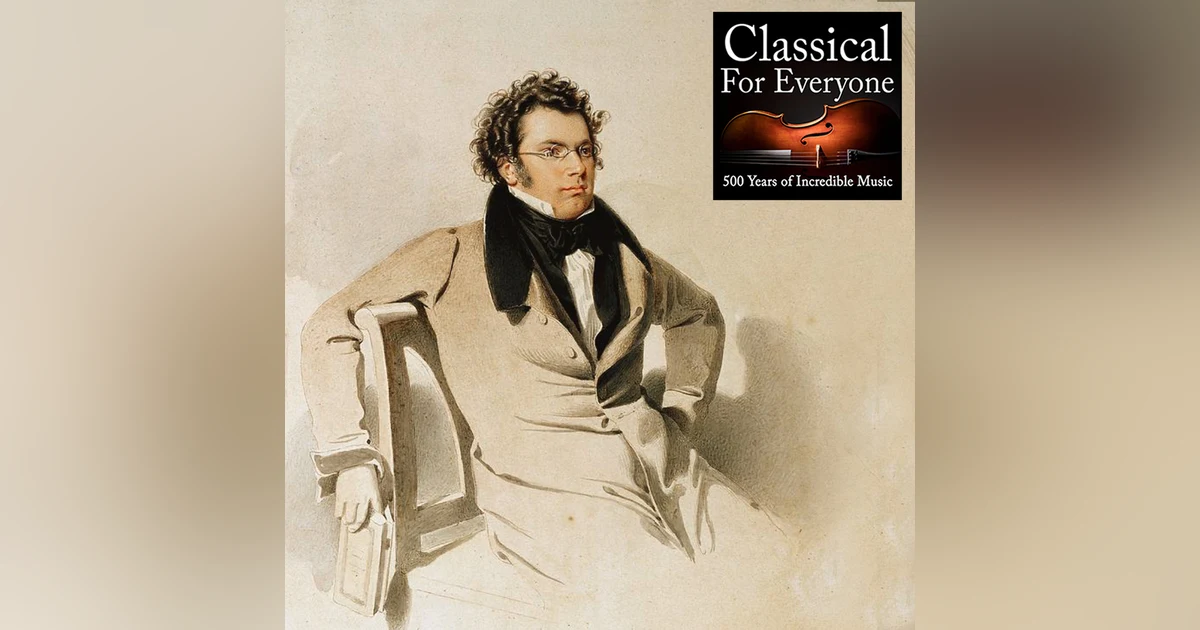

He was taught by Antonio Salieri and his music was admired by Ludwig van Beethoven… but he enjoyed very little success in his short lifetime. It would take decades after his death for his music to make its way onto concert stages… and for him to become one of the best loved composers who ever lived. If you are new to his music I hope that over the next hour and a bit I’ll give you a sense of why that is the case. I’m going to concentrate on music Schubert wrote between 1814 and 1822, that is between the ages of 17 and 25, including sections from two symphonies, two piano sonatas and a piano quintet; and three songs. [The image for this episode is a watercolour of Schubert by his friend Wilhelm August Rieder from 1825.]
Text to Schubert’s ‘The Wanderer’ in German & English
https://oxfordsong.org/song/der-wanderer
Text to Schubert’s ‘Erlkönig’ in German & English
https://oxfordsong.org/song/erlkönig-2
And here is a link to a playlist on Spotify with the music from this episode:
https://open.spotify.com/playlist/0BxsgpEHm4f12gYXZQFCEs?si=93ac12eab9a84c8f
The Music
The Words
Hello everyone. Welcome to another episode of the ‘Classical For Everyone’ Podcast… five hundred years of incredible music. My name is Peter Cudlipp and… If you enjoy any music at all then I’m convinced you can enjoy classical music. All you need are ears. No expertise is necessary. If you’ve ever been curious about classical music… or explored it for a while once upon a time… or just quietly wondered what all the fuss was about… then this is the podcast for you.
And because there’s a lot of music out there each episode has a theme. And for this one it is the music of Franz Peter Schubert. And because he wrote so much incredible music there will be a second Schubert episode not too far down the track.
Here’s a little bit of biography. He was born in a suburb of Vienna in 1797 and died in 1828 at the age of 31, most probably from typhoid fever. He lived on the edge of poverty most of his life. Only in his final few years did he and his music gain any recognition at all. Through most of his adult life he was fortunate to have a circle of close friends who supported him with loans, gifts and accommodation. He was certainly never in a financially secure position.
He completed over 1400 works, almost half of them settings of poetry to be sung accompanied by a piano. His most significant teacher was Antonio Salieri and his music was admired by Ludwig van Beethoven. It would take decades after his death for his full compositional output to make its way onto concert stages… and… for him to become one of the best loved composers who ever lived. And if you are new to his music I hope that over the next hour and a bit I’ll give you a sense of why that is the case. I’m going to concentrate on music Schubert wrote between 1814 and 1822 and play you music from his final years in the next show. This episode will include sections from two symphonies, two piano sonatas and a piano quintet; and three songs.
I want to start with the opening to Schubert’s 5th symphony which was written in 1816 when he was 19. As I guess you’ll understand from the brief introduction it is a little hard to talk about Schubert without focusing on sadness and disappointment… with good reason. And much of his music especially from his final years, does reflect the struggles of his short life. But he also wrote some of the most unashamedly happy music ever written. And I think this is a great example.
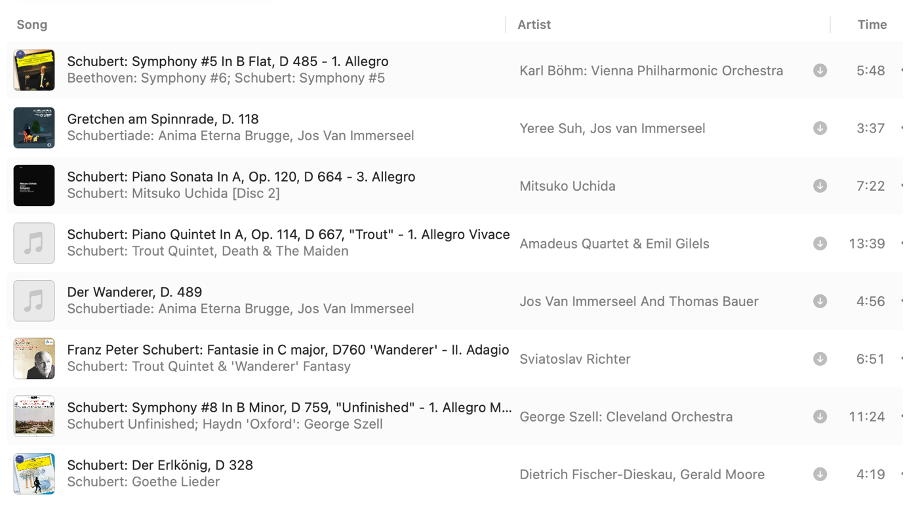
Here is Karl Böhm conducting the Vienna Philharmonic with the opening six minutes of Franz Schubert’s 5thsymphony.
A
That was Karl Böhm conducting the Vienna Philharmonic with the opening of Franz Schubert’s 5thsymphony…. Written when Schubert was 19. He’d written his first symphony when he was 16 for the small orchestra of the school he was attending. And of the nine symphonies that Schubert would complete… exactly none of them were publicly performed in his lifetime.
I mentioned at the beginning of the show that Shubert wrote a lot of songs… about 600 of them. The German word for song is ‘Lied’ and the plural is ‘Lieder’ and that is a term that is pretty much impossible to avoid once you step into Schubert’s world. But I’ll generally refer to them as Songs.
Schubert wrote his first song when he was fourteen and kept writing them throughout his entire life. And it was the one area where he was in a modest way something of a success. There was an appetite for music to be performed in the home by family members and the printing of sheet music for that market was a proper business. For example by the 1820s dozens of songs were being published each month across German speaking countries. During his lifetime it is estimated that about 150 of Schubert’s songs were published.
But even this success has to be qualified. For the amateurs wanting to display modest gifts playing the family piano or singing along with it, Schubert’s music was actually too demanding, both technically and emotionally for most singers and players.
Finding a way into Schubert’s songs can for some, like me if I’m being totally honest, be a little challenging BUT they are such a critical part of his legacy… and can genuinely reward the small effort it takes to engage with them… that it would be a disservice not to include a couple of them in this episode. I’m going to start with one written when Schubert was 17, called ‘Gretchen at the Spinning Wheel’… in German ‘Gretchen am Spinnrade’.
The text is from Johann Wolfgang von Goethe’s play in rhyming verse ‘Faust’ which is quite a different story to Christopher Marlowe’s ‘Dr Faustus’ though based on the same medieval story of a learned man selling his soul to the devil, called Mephistopheles, for rewards in this lifetime.
The Gretchen of the song is a young devout woman in Faust’s town and her seduction is one of the first things Faust asks Mephistopheles to make happen. In the famous scene that follows this Gretchen sits at a spinning wheel on her own and her speech is a remarkable picture of deep conflict between passion and a sense that she knows a terrible price is going to be paid. She begins with…
Meine Ruh’ ist hin,
Mein Herz ist schwer,
Ich finde sie nimmer
Und nimmermehr.
My peace is gone
My heart is heavy;
I shall never
Ever find peace again.
Here is the singer Yeree Suh and the pianist Jos Van Immerseel with Franz Schubert’s four minute song… ‘Gretchen am Spinnrade’ ‘Gretchen at the Spinning Wheel’.
B
That was the singer Yeree Suh and the pianist Jos Van Immerseel with Franz Schubert’s song ‘Gretchen am Spinnrade’ ‘Gretchen at the Spinning Wheel’.
Ok this next introduction will be a bit shorter than the last. Schubert wrote a massive amount of music for solo piano. Structurally the largest of these undertakings were his piano sonatas of which he completed eleven.
This is the third and final section from the one known as the ‘Little’ A Major sonata written in the summer of 1819 when Schubert was 22 and there is I think something about being a 20 something in the brightness and energy of this music. It is about 7 minutes long and here is the pianist Mitsuko Uchida.
C
That was the third and final section from Schubert’s piano sonata known as the ‘Little’ A Major played by the pianist Mitsuko Uchida.
As well as his solo piano music, his symphonies and his songs Schubert’s music for small groups of instruments… chamber music… is today incredibly popular and it might be fair to say the one composition genre where he in some ways eclipses Mozart and Beethoven. I’ll have some of his amazing late string quartets in the next show but for now I want to play you the opening section of his piano quintet, that is a work for a piano and a string quartet, from 1819, the same year as the piano sonata I just played you.
In one of the sections Schubert quotes from one of his songs called ‘Die Forelle’ and so the quintet is known as the ‘Forellenquintett’. Perhaps a little unfortunately in English ‘die Forelle’ is ‘the trout’. So, for better or worse this 40 minutes of extraordinary music has been and probably always will be known in the English speaking world as ‘The Trout Quintet’.
Here is the opening section. It is about 14 minutes long and in this recording from 1976 the Amadeus Quartet is joined by the pianist Emil Gilels.
D
That was the opening section of Franz Schubert’s ‘Trout’ piano quintet. The Amadeus Quartet was joined by the pianist Emil Gilels.
Ok. Another song. This one is called ‘The Wanderer’. It was written in 1816. Which I think you have to say is remarkable. Schubert was nineteen and he creates such a mature mood of what I’ll call questioning darkness to echo the words of the poet Georg Lübeck’s first person narrative of a man who is lost and seeking a homeland he once knew. On the page for this episode on the show’s website I’ll put a link to the full text and an English translation but I’ll give you the opening…
Ich komme vom Gebirge her,
Es dampft das Tal, es braust das Meer.
Ich wandle still, bin wenig froh,
Und immer fragt der Seufzer: wo?
I come from the mountains;
the valley steams, the ocean roars.
I wander, silent and joyless,
and my sighs for ever ask: Where?
Here is the singer Thomas Bauer and the pianist Jos Van Immerseel. Franz Schubert’s ‘The Wanderer’. It is about 5 minutes long.
E
That was the singer Thomas Bauer and the pianist Jos Van Immerseel with Franz Schubert’s ‘The Wanderer’.
So, of Schubert’s 600 songs, why did I choose that one? Well, apart from the fact that it is quite an amazing piece of dramatic songwriting, three years later Schubert took some of that music and used it in an incredible work for solo piano he called ‘The Wanderer Fantasy’.
The slow second section begins with a direct quote from the opening of the song and then goes off on a pretty remarkable musical adventure for the next seven minutes. Here is Sviatoslav Richter.
F
That was Sviatoslav Richter with the slow section of Schubert’s ‘The Wanderer Fantasy’.
My name is Peter Cudlipp and you have been listening to the ‘Classical for Everyone’ Podcast. I have another couple of pieces coming up but before I get to them I want to give you a little information that I hope you find useful…
If you would like to listen to past episodes or get details of the music I’ve played please head to the website classicalforeveryone.net. That address again is classicalforeveryone.net
On the individual episode pages of the website there are links to Spotify playlists with the full versions of most of the music played in each of the episodes.
I hope you have enjoyed this first Franz Schubert episode of ‘Classical For Everyone’. And if you want to get in touch then you can email… info@classicalforeveryone.net.
Alright, what I am going to play next is a piece of music that I think many people have heard. Even people not explicitly looking for Classical Music have probably encountered this orchestral music. Or maybe I am lost in a little nostalgia. It just seems to have been around for as long as I can recall.
I’m not quite sure why I am being a little coy about naming this piece but it is perhaps to scrape away some of the accumulated baggage stuck to what could disparagingly… and unfairly be called… a ‘warhorse’. I’m getting to the music but first… yet another one of those stories of the random accidents of history that fill the annals of classical music…
In 1865 old age and perhaps the approach of death seem to have influenced the Viennese composer Anselm Hüttenbrenner to dig up an old manuscript he’d been hanging onto and give it to a visiting friend, the conductor Johann Ritter von Herbeck. It was the first two sections of an unperformed symphony.
It had been sent to Hüttenbrenner years earlier when he was a leading member of the Graz Music Society. The society had given an honorary diploma to a young composer and in response the composer sent the music to Hüttenbrenner. With whom it stayed. Undiscovered and perhaps more sadly, unperformed. For forty-two years.
If you’re of a certain age, ask yourself for a moment how much stuff you still have that was given to you forty two years ago. I think the odds of these pages of handwritten music surviving spring cleans, house moves, silverfish infestation… being used to start a fire on a cold night… whatever… are miniscule.
But miraculously, and I don’t use that word lightly, they did survive. That music? … Franz Schubert’s ‘Unfinished Symphony’. Most symphonies of the day had four sections. Schubert only completed two of what is now also called his 8th Symphony but it is almost universally known as the Unfinished Symphony.
If you know this music well, I want to ask you, as you listen.. to consider this was written by a 25 year old. And if this is new music to you, I really hope you love it. The first section of Franz Schubert’s Unfinished Symphony… performed by the Cleveland Orchestra conducted by George Szell
G
That was the first section of Franz Schubert’s Unfinished Symphony performed by the Cleveland Orchestra conducted by George Szell.
Thanks for your time and I look forward to playing you some more incredible music on the next ‘Classical For Everyone’.
This podcast is made with Audacity Software for editing, Wikipedia for Research, Claude for Artificial Intelligence and the music played is licensed through AMCOS / APRA. Classical For Everyone is a production of Mending Wall Studios and began life thanks to the enthusiasm and encouragement of Mr Jeffrey Sanders.
One final piece. One more song. Which might benefit from a little backstory. And a link to the text in German and in English is on this episode’s web page.
In Germanic folklore there is a sinister elf who lurks in deep, dark forests at night who can kill a child with a single touch. He is the Erlkönig or ,in English, the ‘Erlking’ spelt E R L K I N G.
In 1782 the writer Johann Wolfgang von Goethe, already encountered an hour back with ‘Gretchen at the Spinning Wheel’ from his dramatic poem ‘Faust’; wrote a simple but deeply disturbing poem about a father carrying his son on horseback through a wood. The son believes that the Erlking is following him and that he can hear the Erlking’s promises of a better life if he will go with him. The father reassures the son he is hearing the wind, seeing whisps of fog and moonlight on old willow trees. But when they arrive at their farmhouse the child is dead.
In 1815 the eighteen year old Schubert set Goethe’s poem to music for piano and voice. Even without understanding the German text I think you’ll be able to get an idea of the incredible job Schubert does in giving the singer four quite distinct ‘voices’ to create… the Narrator, the Father, the Son… and the Erlking. And all the time whilst colouring these voices the piano keeps slowly building the tension. And it all takes just four and a half minutes.
Here is the pianist Gerald Moore and the singer Dietrich Fisher-Dieskau. Franz Schubert’s ‘The Erlking’.
Thanks again for listening.
H