

 Apple Podcasts
 Spotify
 Amazon Music
 iHeartRadio
 Overcast
 PocketCasts
  RSS Feed
 Film Music
Who knew that Camille Saint-Saens of ‘Carnival of the Animals’ fame wrote the world’s first film score? Or that the Pulitzer Prize for music has been given to only one work for the screen. Or that five composers, including the American music theatre legend Richard Rodgers, were approached for ‘Lawrence of Arabia’ before the job fell to an unknown Frenchman who was given six weeks to get the job done. Or that one of the great 20th century symphonies started out as music for a movie. Well I certainly didn’t… until I started working on the ‘Film Music’ episode of ‘Classical For Everyone’.
[Episode image: The Embassy Cinema; Wellington, New Zealand.]
Here is a link to a playlist on Spotify with the music in the episode:
https://open.spotify.com/playlist/2ir3jegPH3QGgxtp2A1CHk?si=0932e292bb074eab
And here is a link to the Trailer for ‘Things To Come’:
https://www.youtube.com/watch?v=wemRBFFbhKI
The Music
The Words
Hello everyone. Welcome to another episode of the ‘Classical For Everyone’ Podcast… five hundred years of incredible music. My name is Peter Cudlipp and… If you enjoy any music at all then I’m convinced you can enjoy classical music. All you need are ears. No expertise is necessary. If you’ve ever been curious about classical music… or explored it for a while once upon a time… or just quietly wondered what all the fuss was about… then this is the podcast for you. And because there’s a lot of music out there each episode has a theme. And for this one it is… film music.
I think for many people their first exposure to classical music came when they were watching a movie… the first time they heard a full orchestra used to stir emotions and create an atmosphere. Like all the episodes of Classical for Everyone there are going to be a smattering of my personal favourites. But there are a number of pieces I’d never heard before and some from composers unfairly neglected and odd sub themes have appeared as well… some science fiction has crept in as well as a slightly surprising amount of Shakespeare and one particular filmmaker gets three slots. If you think that all seems a bit random… there is a chance you are right. One thing I will say though is the music is very good. In the next hour and a bit… you are going to hear works by Arthur Bliss, William Walton, Arnold Bax, Virgil Thomson, Ralph Vaughan-Willams, Malcolm Arnold, Maurice Jarre, Toru Takemitsu, Michael Nyman and John Corigliano.
But I am going to start with a composer whose name you might not associate with film music.. Camille Saint-Saens.
In the early 1900s, some stage productions were starting to blend live performers with magic lantern slides and projected film, all accompanied by live music. Ordinary films, too, usually had a pianist playing along, though with music borrowed from somewhere else.
The first time music was written specifically for a stand-alone film was in 1908, for a fifteen-minute French production, The Assassination of the Duc de Guise. It was made by a new company called Film d'Art, set up to bring the prestige of the theatre to cinema, and directed by Charles Le Bargy and André Calmettes of the Comédie-Française. And, not surprisingly for a venture, determined to bring some class to the fledgling medium, they sought the assistance of France's most celebrated living composer… Camille Saint-Saëns.
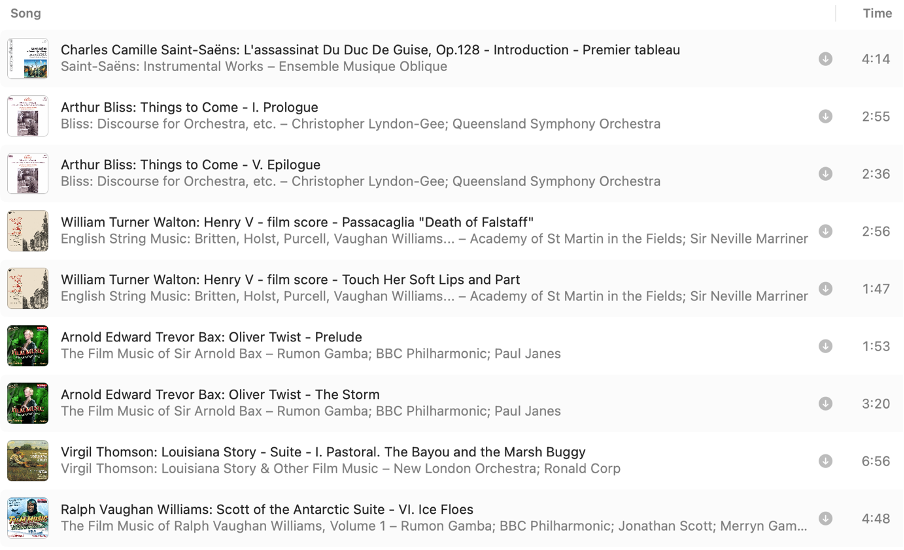
Here are the opening four minutes of the score. And considering the subject matter of the film is a grizzly episode of French history when King Henry III murdered his rival the Duc de Guise in 1588… about a third of the way in, the music becomes a little jaunty which I think might be the entrance of the unsuspecting Duke.The Assassination of the Duc de Guise by Camille Saint-Saens. Performed by Ensemble Musique Oblique.
A
That was the opening section of the first film score ever written… composed for the 1908 film ‘The Assassination of the Duc de Guise’ composed by Camille Saint-Saens. It was performed by Ensemble Musique Oblique.
Alright. A quick bit of background about how what you are listening to in this show evolved. Some listeners may recall an episode back in May of 2025 that was about classical music the director Stanley Kubrick used in his movies. When some fans of the podcast wrote suggesting some more movie music I thought about doing a show based this time around the English director David Lean. Lean, maybe best known for Lawrence of Arabia and Doctor Zhivago; commissioned scores from some of the greatest composers of the twentieth century as opposed to Kubrick who tended to pick from existing works.
But the Lean scores opened up a hopefully bigger idea of film scores by composers who were actually better known in the concert hall. Hence starting with that unexpected little gem from Camille Saint-Saens. But the genesis of the show has led to a certain ‘English Movie Making Bias’. And if there is an upside to that then it will be the opportunity to explore film music from the non-English speaking world in future episodes… though I have in the past played you works that Dmitri Shostakovich and Sergei Prokofiev wrote for the screen.
Ok. More music. In 1934 the Hungarian born, London based Producer/Director Alexander Korda approached the writer H. G. Wells and asked him to adapt his book ‘The Shape of Things To Come’ into a film script. I won’t try to outline the plot suffice to say that Wells was a significant voice following World War One using his speculative fiction to urge people to think deeply about the power of emerging technologies. But I will put a link in the show notes to the trailer for the movie. It is worth a look
It was also Wells who started the process of luring the composer Arthur Bliss to write the music for the film. Here are the opening and closing sections from the score performed by the Queensland Symphony Orchestra conducted by Christopher Lyndon-Gee. It is about six minutes of music. From the film ‘Things To Come’… music by Arthur Bliss.
B
That was the Queensland Symphony Orchestra conducted by Christopher Lyndon-Gee with the opening and closing sections the score to the film ‘Things To Come’… by Arthur Bliss.
I mentioned that H G Wells played a part in persuading the composer Arthur Bliss to write the music for the film but there was another figure involved who would go on to shape much of the great British screen music of the mid 20th century. His name was Muir Mathieson and after studying conducting and piano; at the age of 23 he joined Alexander Korda’s London Films. Over his lifetime he would be credited as Music Supervisor in over a thousand productions. But his most significant skill, for this podcast episode anyway, was to be the interface between the complexities of film production and a generation of great composers.
He understood the practical demands of film, timings, cues, the dubbing, but he spoke the language of the concert hall, and composers trusted him to protect their music. He conducted most of the scores himself, often with the London Symphony Orchestra, and frequently encouraged composers to fashion concert versions from their film work, which is why much of this music survives in performance today. And during the years of World War Two he was responsible for commissioning one of the greatest introductions to music ever written… Benjamin Britten’s ‘Young Persons Guide To The Orchestra’. But back to film scores. At almost exactly the same time as he was working with Britten he was working on his fifth film with the composer William Walton… Shakespeare’s ‘Henry V’ directed by and starring Laurence Olivier in 1944. I’m going to play two short sections from the score. The first is ‘The Death of Falstaff’ and the second is ‘Touch her soft lips and part’ for the scene where Henry’s old gang say farewell to Mistress Quickly as they head for the war in France. About five minutes of music, and this is Neville Marriner conducting The Academy of St Martin in the Fields.
C
That was Neville Marriner conducting The Academy of St Martin in the Fields with ‘The Death of Falstaff’ and ‘Touch her soft lips and part’ from William Walton’s score for the 1944 film of Henry V.
The director David Lean’s early films included two memorable adaptations from the works of Charles Dickens; Great Expectations and Oliver Twist. For the 1948 ‘Oliver Twist’, Muir Mathieson, yes, him again, put Lean together with the composer Arnold Bax. Now Bax is one of a number of British composers in this episode for whom the passing of time and the ascendancy of following generations has not been kind. It’s not rigorous data but to give you an idea… in about 100 episodes of this podcast this is the first time I’m playing music by Bax, Arthur Bliss and Malcolm Arnold. They may deserve future explorations. But now here is the opening Prologue and the Storm scene that follows it from the Arnold Bax score for David Lean’s film ‘Oliver Twist’. A bit over 5 minutes of music. Rumon Gamba conducts the BBC Philharmonic Orchestra.
D
That was the opening prologue and the storm scene that follows it from the Arnold Bax score for David Lean’s film ‘Oliver Twist’. Rumon Gamba conducted the BBC Philharmonic Orchestra. In the same year that Oliver Twist came out, 1948, across the Atlantic the Standard Oil Company decided to make a documentary to celebrate the positive impact of oil exploration in the rural south of the USA.
‘The Louisiana Story’ tells of an impoverished Cajun family in the bayous of the Mississippi who are at first wary of the oil company men but whose lives are changed for the better by the money they receive.
The director Robert Flaherty had worked with the American composer Virgil Thomson on an earlier documentary and commissioned him to do the score for ‘The Louisiana Story’. Thomson is yet another composer in this show whose reputation has waned but his was perhaps eclipsed by his notoriety as a rather cantankerous New York music critic. In his writing he was a passionate supporter of much challenging new music but his own music used hymns and folk-tunes as starting points. And I think you can hear that in this seven minute opening section called ‘Pastoral’. This is Ronald Corp conducting the New London Orchestra. Virgil Thomson’s ‘The Louisiana Story’… brought to you by the good people of Standard Oil.
E
That was the opening section called ‘Pastoral’ from Virgil Thomson’s ‘The Louisiana Story’. Ronald Corp conducted the New London Orchestra. Interestingly, Thomson’s score, his oil-company music, was and remains the only film score to win the Pulitzer Prize for Music.
It is not unusual for composers to take their film scores and adapt them into suites for concert performances… suites in this use meaning an assembly of separate sections into a whole… which means a composer can sort of pick out the eyes of all the separate small pieces of music a film often requires. But it is unusual for a film score to lead to a symphony. But this is what happened when Ralph Vaughan-Williams took the music he wrote for the film ‘Scott of the Antarctic’, yet again in the musically busy year of 1948, and in 1953 used the themes from the score for his 7th symphony which he called ‘Sinfonia antartica’… Which is an incredible work.
But because this is a show of film music I am going to play you the section of the suite from ‘Scott of the Antarctic’ called ‘Ice Floes’. It is about 5 minutes long and here is again Rumon Gamba conducting the BBC Philharmonic Orchestra. Music of Ralph Vaughan-Williams.
F
That was Rumon Gamba conducting the BBC Philharmonic Orchestra with film music by Ralph Vaughan-Williams. ‘Ice Floes’ from ‘Scott of the Antarctic’.
Back to the movies of David Lean. I was going to include Malcolm Arnold’s score for ‘Bridge Over The River Kwai’ but then I meandered across a recording of what is known as ‘The Sound Barrier: A Rhapsody for Orchestra’ from 1952. ‘The Sound Barrier’ is a David Lean film that seems to have vanished into the mists of time though it was a critical and commercial success in its day. Interestingly, even though quite fictional, the portrayal of experimental jet engine technology and the brave pilots who tested it, persuaded many that the British did in fact first break the sound barrier. Which they did not. It had been done by the US Air Force pilot Chuck Yaeger some years earlier.
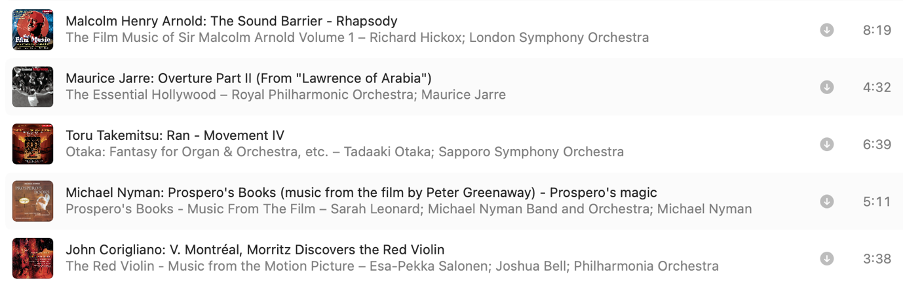
But now the music. Here is Malcolm Arnold’s ‘The Sound Barrier: A Rhapsody for Orchestra’. It is about 8 minutes long and Richard Hickox conducts the London Symphony Orchestra.
G
That was Malcolm Arnold’s ‘The Sound Barrier: A Rhapsody for Orchestra’. Richard Hickox conducted the London Symphony Orchestra.
Of the fifteen films David Lean directed I think the one that will stand the test of time is ‘Lawrence of Arabia’ from 1962 written by Robert Bolt concerning the exploits of Thomas Edward Lawrence (an archaeologist, British army officer, diplomat and writer) in the Arab Revolt and the Sinai and Palestine campaigns against the Ottoman Empire during World War One. One of the things that for me at least makes this such a powerful film, even after six decades… is the music. And it is one of the wonderful accidents of circumstance that the music was not entirely different… as the composer, a young Frenchman by the name of Maurice Jarre, was about the fifth choice.
One early plan was to use two different composers… Aram Khachaturian for the exotic ‘Arabian’ music and Benjamin Britten for the ‘British’ music. But there was no way to get Khachaturian out of the Soviet Union and Britten couldn’t start for six months. Then the film’s Producer, Sam Spiegel came back from Hollywood to the UK where post-production was well underway with the great news that he had secured Richard Rodgers, yes the Richard Rodgers of Oklahoma and later Sound Of Music fame, to do the score… And that he had brought some samples. Apparently Lean was wildly unimpressed and asked if the young Maurice Jarre, who seems to have been on staff as a sort of composer of interludes on demand that the big name composers wouldn’t be able to turn around in a hurry, if he had anything worth listening to. Jarre played what became the film’s best known theme and Lean said to Spiegel… let’s give it to him. Jarre had six weeks until the opening of the film.
Here is the four minute Overture to ‘Lawrence of Arabia’ and it was an Overture in the classical sense. Sometimes when the film is revived in a cinema it will still start with just this music before there are any pictures at all. The composer, Maurice Jarre, conducts the Royal Philharmonic Orchestra.
H
That was the Overture to ‘Lawrence of Arabia’. The composer, Maurice Jarre, conducted the Royal Philharmonic Orchestra. Jarre would write the music for all the movies David Lean would make after Lawrence and become one of the most in demand film composers in the world for the rest of his life.. and working pretty much exclusively in film music.
If that last piece has conjured up images of Peter O’Toole as Lawrence rampaging through the desert and they have put you in an ‘epic’ mood, then here is one more.
In 1985 the Japanese director Akira Korosawa adapted elements of William Shakespeare’s play ‘King Lear’ along with historical figures of Japan’s feudal era of the 1400s and made the film ‘Ran’… a Japanese word which in English and in this context means ‘the chaos of war’. He approached the composer Toru Takemitsu to write the music. By this time in his career Takemitsu, who was in his mid 50s, was an international figure in classical music… to an extent embraced by European and American orchestras and critics more than any non-western composer had been at the time.
Here is the final section of the suite Takemitsu created from the score. It is about seven minutes long and in this recording Tadaaki Otaka conducts the Sapporo Symphony Orchestra. Music from Toru Takemitsu’s score for the film ‘Ran’.
I
That was the final section of the suite Takemitsu created from the score for the film ‘Ran’. Tadaaki Otaka conducted the Sapporo Symphony Orchestra.
My name is Peter Cudlipp and you have been listening to the ‘Classical for Everyone’ Podcast. I have another couple of pieces coming up but before I get to them I want to give you a little information that I hope you find useful…If you would like to listen to past episodes or get details of the music I’ve played please head to the website classicalforeveryone.net. That address again is classicalforeveryone.net. On the individual episode pages of the website there are links to Spotify playlists with the full versions of most of the music played in each of the episodes. I hope you have enjoyed this Film Music focused episode of ‘Classical For Everyone’. And if you want to get in touch then you can email… info@classicalforeveryone.net. And I want to thank the people who got in touch suggesting film music… especially Alison and Kristen.
Alright, to finish this episode I’m going back to the United Kingdom but sticking with Shakespeare. In 1991 the director Peter Greenaway adapted the play ‘The Tempest’ and made a movie called ‘Prospero’s Books’. On many levels this should have been a terrific film… well maybe for a smallish art-house cinema meets Englist-Literature degree demographic. But still… The key ingredient was Sir John Gielgud playing Prospero. Undeniably one of the top two Shakespearean actors of the entire 20th century, along with Laurence Olivier, now in his mid-80s performing Shakespeare’s alter-ego, the magician Prospero, farewelling his art. Well, the film no doubt had and has its fans. I was in London when it was first released staying with my friend Rick and I remember cajoling him to join me at the cinema for what I was expecting to be a truly memorable experience… and it was… but not in the way I was hoping. It was not a good experience. Fortunately Rick started speaking to me again some years later.
But, for all that, the music for the film was and remains wonderful. Michael Nyman, who worked with Greenaway on most of his movies and is also a composer of operas, chamber music and symphonic works; used some material from the English renaissance composer John Dowland for ‘Prospero’s Books’ but, if you know his music, I think you will agree it is very much Michael Nyman’s distinctive voice. Here is the section called ‘Prospero’s Magic’ and Michael Nyman leads the Michael Nyman Band. It is about five minutes long.
J
That was the section called ‘Prospero’s Magic’ from Michael Nyman’s score for the film ‘Prospero’s Books’ and that was the Michael Nyman Band.
Thanks for your time and I look forward to playing you some more incredible music on the next ‘Classical For Everyone’. This podcast is made with Audacity Software for editing, Wikipedia for Research, Claude for Artificial Intelligence, Cleanfeed for remote recording; and the music played is licensed through AMCOS / APRA. Classical For Everyone is a production of Mending Wall Studios. The Producers do not receive any gifts, remuneration or support of any kind from any organisation or individual mentioned in the show. And if you have listened to the credits… here is some more music for you…
The American composer John Corigliano is now in his late 80’s and has amassed an incredible range of operatic, chamber and symphonic music. Bit every so often he has been lured to the world of film scoring and perhaps his best known work in this genre is for the film ‘The Red Violin’ from 1998 directed by Francois Girard. The film uses the device of the episodic journey of a celebrated violin made in Cremona in the 1600s to the Americas in the 20th century. Corigliano’s music required a virtuoso violin part and in the film this is supplied by the musician Joshua Bell. Here he is with Esa Pekka Salonen conducting the Philharmonia Orchestra with the section ‘Morritz Discovers The Red Violin’ from John Corigliano’s music for the film ‘The Red Violin’.
Thanks again for listening.