

 Apple Podcasts
 Spotify
 Amazon Music
 iHeartRadio
 Overcast
 PocketCasts
  RSS Feed
 Felix Mendelssohn
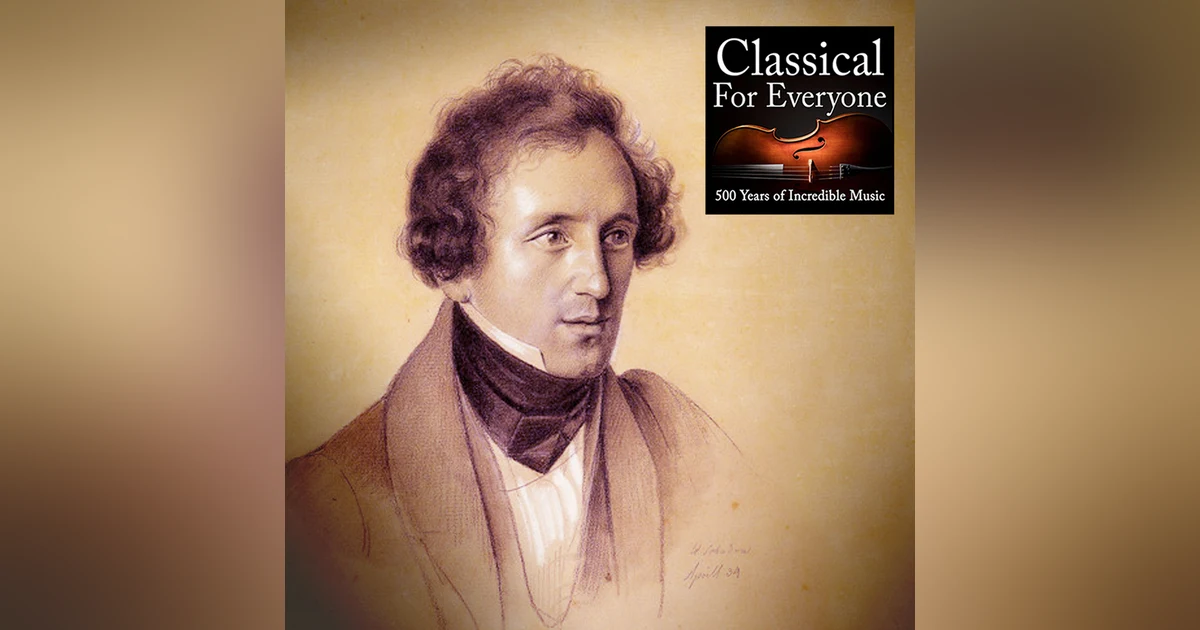
In the latest episode of the ‘Classical For Everyone’ podcast… Scottish caves and rescuing Bach, becalmed boats and banking intrigue, Shakespearean fairies and a garment sellers’ orchestra, a prophet in the wilderness… and a stolen statue. And… if that wasn’t enough… eleven pieces of music from Felix Mendelssohn... perhaps the most gifted and quietly underrated composer of the nineteenth century.[Episode image: Portrait of Mendelssohn by Wilhelm Friedrich von Schadow, 1834.]
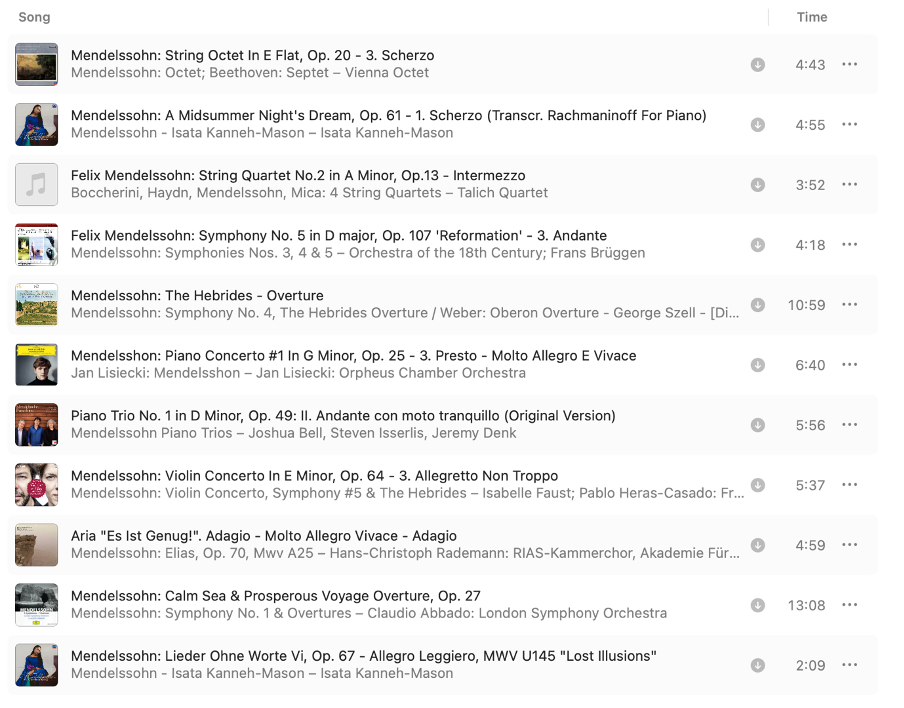
And here is a link to a playlist on Spotify with the music from this episode:
https://open.spotify.com/playlist/2kZcTrEygH5uQU9kYtA3zi?si=d6926e9170874c40
The Music
The Words
Hello everyone. Welcome to another episode of the ‘Classical For Everyone’ Podcast… five hundred years of incredible music. My name is Peter Cudlipp and… If you enjoy any music at all then I’m convinced you can enjoy classical music. All you need are ears. No expertise is necessary. If you’ve ever been curious about classical music… or explored it for a while once upon a time… or just quietly wondered what all the fuss was about… then this is the podcast for you. And because there’s a lot of music out there each episode has a theme. And for this one it is… the music of the composer Felix Mendelssohn.
I’ll give you some more biography a little later in the show but here’s a very brief overview… He was born in Hamburg in 1809 and died in Leipzig after a series of strokes in 1847 at the age of 38. Apart from his compositions he was celebrated as a conductor and performer and he also pretty much single-handedly revived the music of Johann Sebastain Bach. He was also something of a child prodigy… composing from at least the age of 12.
And when he was 16 he wanted to give his violin teacher, Eduard Rietz, a present… so he took a barely established new genre of music making… the string octet, that’s four violins, two violas and two cellos… and composed a work that remains arguably still the greatest octet written to date. Mendelssohn said that he wanted the work to be ‘like a symphony’ meaning he wrote at times for the instruments to play in unison or in groups but balanced that with passages where eight distinct voices could be heard.
Here is the Vienna Octet with the 3rd section of Felix Mendelssohn’s Octet. It is about 5 minutes long.
A
That was the Vienna Octet with the 3rd section of Felix Mendelssohn’s Octet.
A year after he wrote the Octet, Mendelssohn wrote an Overture for the William Shakespeare play, ‘A Midsummer Night’s Dream’. Now I played the original version of this, written for orchestra, back in March in the Shakespeare’s Music episode so today I’m going with something I suspect not often heard. In 1933 the composer Sergei Rachmaninoff took some of Mendelssohn’s music for A Midsummer Night’s Dream and transcribed it for solo piano. He was at the time supporting himself and his family as a touring virtuoso pianist and in this particular instance created something extremely demanding for himself as he condensed music for an orchestra into something for just two hands.
Here is the pianist Isata Kanneh-Mason with Sergei Rachmaninoff’s transcription of the Scherzo from Felix Mendelssohn’s music for ‘A Midsummer Night’s Dream’. It is about 5 minutes long.
B
That was Isata Kanneh Mason with Sergei Rachmaninoff’s transcription of the Scherzo from Felix Mendelssohn’s music for ‘A Midsummer Night’s Dream’.
I wonder if sometimes because of a cliched idea of a great artist.. starving, neglected, tinged with some sort of tragedy etc. etc… we are sometimes just a little less captivated by artists whose lives were largely pretty ok. And Mendelssohn’s was better than most. He was born into a wealthy banking family… of such influence that when Felix was two years old they had to relocate from Hamburg to Berlin in a hurry after being targeted by the French for using their power and money to undermine Napoleon Bonaparte’s economic blockade of Europe.
Once in Berlin the family became a central part of the intellectual and cultural life of the city. Guests of the household who would record their impressions of the young Felix and go on to play roles in supporting his music included the scientist Alexander von Humboldt and the writer Johann Wolfgang von Goethe.
At first sceptical of his dedication to music his parents were eventually convinced by his early performances and compositional efforts and from a very young age he received nothing but their support.
This was not though the case for his older sister Fanny. Arguably an equally gifted performer and composer, conventions and prejudices of the time meant that her music would remain at best a hobby and it would be two centuries before she received any serious recognition.
Ok. Some more music. In 1827 when he was 18 or 19 Mendelssohn wrote what is referred to as his first ‘mature’ string quartet… that is music for two violins, a viola and a cello. Here is the third section from His 2ndString Quartet. It is about four minutes long. This is the Talich Quartet.
C
That was the Intermezzo section from Mendelssohn’s 2nd String Quartet. It was played by the Talich Quartet.
Ok. Getting to some of Mendelssohn’s music for orchestra. Now, he had as a child written thirteen what are called ‘string symphonies’ to distinguish them from his later symphonies for a full orchestra. And as you’d expect from someone who was already writing them at the age of 12, the older he got, the more remarkable were the works he wrote in the genre.
The most popular mature symphonies are the third, called the Scottish, and the fourth, called the Italian but my favourite is actually the 5th known as the ‘Reformation’ symphony because he wrote it for a 300 year anniversary celebration of a key event in the founding of the Lutheran Church.
But the symphony’s fate was at first an unlucky one. The 20 year-old Mendelssohn missed the deadline for the event, and after a later premiere in Berlin he decided that he didn’t like it much after all and put it away in a drawer. And when it was published after his death it was numbered his 5th. Which it wasn’t. If you put the early string symphonies to one side it was his 2nd. Confused? I don’t blame you.
I’ve played this on the show before but I think it certainly can stand another outing. This is the third section, the Andante, from Felix Mendelssohn’s 5th Symphony. Frans Brüggen conducts the Orchestra of the 18th Century. It is about four minutes long and most of it is very quiet.
D
That was the third section, the Andante, from Felix Mendelssohn’s 5th Symphony. Frans Brüggen conducted the Orchestra of the 18th Century.
In the last break I mentioned that one of Mendelssohn’s symphonies was nicknamed ‘Scottish’. This was not the only work inspired by a trip he made to Scotland after a series of concerts in London in 1829. The following year he wrote a ten minute piece for orchestra, basing it on a theme he had written whilst exploring the island of Staffa off the coast of Scotland by boat. It was originally called ‘The Hebrides’ but a couple of years after the first performance Mendelssohn added, or at least, accepted another title for the work… ‘Fingal’s Cave’ after a geological feature of the island.
Looking at the playlist for this episode I’ve frequently opted for recordings of smaller orchestras somewhat similar to the size of the groups Mendelssohn would probably have written the pieces for. But there are also recordings with full size orchestras. And this is one of them. And for this work, those expanded forces seem very well-suited.
This is George Szell conducting the Cleveland Orchestra. Mendelssohn’s ‘The Hebrides’ or ‘Fingal’s Cave’.
E
That was George Szell conducting the Cleveland Orchestra with Felix Mendelssohn’s ‘The Hebrides’ also known as ‘Fingal’s Cave’.
About a year after Mendelssohn wrote that piece he completed his first piano concerto. It was premiered in Munich in 1831 and soon became incredibly popular thanks especially to later performances of it by Clara Schumann and Franz Liszt.
Reportedly Mendelssohn was a little dismissive of the work, commenting that he had written it quickly and somewhat carelessly. Now this and other comments support a sense of his light touch and easy facility which combined with his precocity and an undeniable sunniness in much of his music has created a picture of Mendelssohn’s life being, whilst short, to a certain extent… rosy. Add to this his local and international success and the good fortune of his family circumstances and there has been a tendency to not see the driven, at times aloof and distant, combative workaholic.
But back to the music. This is the final section of the first piano concerto. The pianist is Jan Liesiecki and he is playing with the Orpheus Chamber Orchestra. It is about seven minutes long.
F
That was the final section of Mendelssohn’s first piano concerto. The pianist was Jan Liesiecki and he was playing with the Orpheus Chamber Orchestra.
The musicians Jeremy Denk, Joshua Bell and Stephen Isserlis got together a couple of years back and recorded Mendelssohn’s two piano trios… that is music for piano, violin and cello.
Mendelssohn completed his first piano trio in 1839. He later substantially revised it, increasing the romantic intensity but I am going to play you the original version of the 2nd section. In the notes for the CD Stephen Isserlis makes the point that this version has ‘a delightful freshness that is worth hearing’. I hope you agree.
Here are the pianist Jeremy Denk, the violinist Joshua Bell and the cellist Stephen Isserlis with the six minute slow section from the original version of Felix Mendelssohn’s 1st Piano Trio.
G
That was Jeremy Denk, Joshua Bell and Stephen Isserlis with the slow section from the original version of Mendelssohn’s 1st Piano Trio.
Ok. Before I get to the next piece I want to talk a little about the Leipzig Gewandhaus Orchestra. Founded in 1780 and still playing today it is amongst the oldest orchestras still in existence and claims to be the oldest not originating in a royal court. The name comes from the building where the orchestra first performed… Gewand Haus in English is Garment House and it was the trading floor and the guildhall of Leipzig’s cloth merchants.
And if you step back for a minute it is worth asking the question… in Europe in the years before the French Revolution how did some cloth merchants end up with enough wealth and power to have… call it a ‘head office’… big enough to house their own orchestra?
Well, Leipzig was never a royal residence or a bishop's seat; and was always known by its bourgeois character — its whole civic identity, from the medieval period onward, was as a trading city built and run by merchants, not a court town. It sat at the crossroads of trade routes that ran from the Baltic to Rome and from Poland to France. One small example, relevant to the ‘gewand’ people… in the 18th century 75% of the English cloth that came into central Europe was traded at the fairs in Leipzig.
And from 1835 at the age of 26 Felix Mendelssohn was the Music Director of the Gewandhaus orchestra. He would keep the position until his death twelve years later. And he conducted, and frequently performed, in about 20 concerts a year. Now this was on top of composing. But wait… there’s more. In this same period he made eight concert trips to London. And just the commuting part of that would be exhausting and complex. Don’t imagine an airport lounge… think of a small ship crossing the English Channel in all sorts of weather. Plus, from 1840 to 1845 he was frequently in Berlin at the request of the Prussian Emperor Friedrich Wilhelm IV who had grandiose schemes for the cultural life of the city… though many of them came to nothing. And he had married Cecile Jeanrenaud in 1837 and the couple would have five children. And… and he established the Leipzig Conservatory in 1843.
So is there going to be any music any time soon you might be thinking… And will it have anything to do with Leipzig? Yes and yes. Mendelssohn’s violin concerto was written for and in consultation with his friend and colleague from the Gewandhaus Orchestra, Ferdinand David. It took Mendelssohn a few years to complete it and the premiere was in 1845. Today it still remains amongst the most performed and recorded of all violin concertos. I’m going to play just the five minute conclusion. Here is the soloist Isabelle Faust with the Freiburg Baroque Orchestra conducted by Pablo Heras-Casado.
H
That was the conclusion of Felix Mendelsohn’s Violin Concerto. Isabelle Faust played the violin with the Freiburg Baroque Orchestra conducted by Pablo Heras-Casado.
When Mendelssohn was only 20 in 1829 he conducted a performance of Johann Sebastain Bach’s work for solo singers, choir and orchestra, the ‘St Matthews Passion’ in Berlin. Mendelssohn’s grandmother Bella Salomon had given him a copy of the score five years earlier just a month before she died. She and her sister had been close to Bach’s children and done quite a bit to preserve Johann Sebastian’s legacy.
But, by 1829, Bach was very largely forgotten. Until the concert that Mendelssohn put on. Without that performance maybe Bach would have eventually reached the central position he holds in the world of music… but maybe not. If you enjoy any J. S. Bach then you owe a little something to Felix Mendelssohn.
And Mendelssohn would go on to write two major choral / orchestral works inspired by Bach’s oratorios. The second, written near the end of his life, is called Elijah or Elias in the original German. It tells the story of the old testament prophet Elijah, best known as the nemesis of the worshippers of the god Baal and of King Ahab and Queen Jezebel.
About two thirds of the way through the work Elijah is alone despairing in the wilderness feeling that he has failed and calls out to God ‘Es ist genug’… ‘It is enough’. Here is the baritone Thomas Oliemans singing Elias conducted by Hans-Christoph Rademann and the Akademie für Alte Musik Berlin is conducted by Hans-Christoph Rademann. It is about 5 minutes long.
I
That was ‘Es ist genug’… ‘It is enough’. From Felix Melkdelssohn’s oratorio ‘Elijah’ or ‘Elias’. It was sung by Thomas Oliemans and the Akademie für Alte Musik Berlin was conducted by Hans-Christoph Rademann.
This seems as good a place as any in the show to tell you the story of a statue. In 1892 the good people of Leipzig erected a large bronze statue of Mendelssohn outside the Gewandhaus Orchestra building, honouring his music, his tenure as Director of the orchestra and his role in founding Germany’s first serious music school… the Leipzig Conservatory.
In November 1936 the English conductor Thomas Beecham and his orchestra the London Philharmonic were touring Germany and on the evening of 9th November Beecham laid a wreath at the base of Mendelssohn’s statue. Sometime later that exact same night at the instigation of the rabidly antisemitic deputy Mayor, Rudolf Haake, the statue was torn down from its plinth and was never seen again… presumed melted down or broken up. Even though the Mendelssohn family had converted to Protestantism before Felix’s birth and he had composed many major works on Christian themes, like the oratorio I played just played you a piece from; Mendelssohn’s Jewish ancestry meant he was unacceptable, in words attributed to Haake… ‘as a representative of a German city of music’.
In the catalogue of Nazi atrocities this vandalism barely rates as a footnote but it can be a little too easy to bask in the joy that is at the centre of all this great music and neglect to note in passing that music too is a field where human failings can make themselves felt.
Near the end of the war the home of the Gewandhaus orchestra was destroyed by allied bombing. But in 1947 a bust of Mendelssohn was placed near the ruins. It was only in 2008 that a replica of the original was installed. Roughly coinciding with the opening of a new concert hall for the orchestra.
My name is Peter Cudlipp and you have been listening to the ‘Classical for Everyone’ Podcast. I have another couple of pieces coming up but before I get to them I want to give you a little information that I hope you find useful… If you would like to listen to past episodes or get details of the music I’ve played please head to the website classicalforeveryone.net. That address again is classicalforeveryone.net. On the individual episode pages of the website there are links to Spotify playlists with the full versions of most of the music played in each of the episodes. I hope you have enjoyed this Felix Mendelssohn focused episode of ‘Classical For Everyone’. And if you want to get in touch then you can email… info@classicalforeveryone.net.
Alright, to almost finish this episode I have Mendelssohn’s 10 minute concert overture for orchestra ‘Calm Seas and a Prosperous Voyage’. This was based on a pair of poems by Goethe… the first describing the dread of a too calm sea and the second the relief when the breeze comes to carry the travellers to port. When Mendelssohn wrote this he had seen the sea exactly one time and yet he I think almost perfectly captures the sense of a becalmed vessel slowly being found by the wind and then carried happily on its way. And it is almost a musical prophecy… in his later life Mendelssohn would cross the English Channel more than twenty times.
Here is Claudio Abbado conducting the London Symphony Orchestra with ‘Calm Seas and Prosperous Voyage’. The first four minutes are very quiet.
G
That was Claudio Abbado conducting the London Symphony Orchestra with Felix Mendelssohn’s ‘Calm Seas and Prosperous Voyage’.
Thanks for your time and I look forward to playing you some more incredible music on the next ‘Classical For Everyone’. This podcast is made with Audacity Software for editing, Wikipedia for Research, Claude for Artificial Intelligence and the music played is licensed through AMCOS / APRA. Classical For Everyone is a production of Mending Wall Studios. And if you have listened to these credits… here is two more minutes of music for you…
Mendelssohn called what are his best known works for solo piano ‘Songs without Words’. He kept coming back to this form of short character-filled pieces through his life and there are eight books of them. Many of them were given wincingly awful titles by publishers in the years after Mendelssohn’s death… a practice he prevented whilst he was still alive so I am going to just give you this piece’s less poetic description… Here is Isata Kanneh-Mason playing Felix Mendelssohn’s Song Without Words… Number Two from Book Six.
Thanks again for listening.
H