

 Apple Podcasts

 Spotify

 Amazon Music

 iHeartRadio

 Overcast

 PocketCasts
 RSS Feed
Diving For Pearls – Part Two

[Please feel free to leap straight into this second part of the ‘Diving for Pearls’ episode but there’s background information in the first half you might enjoy if by chance you have missed it.]
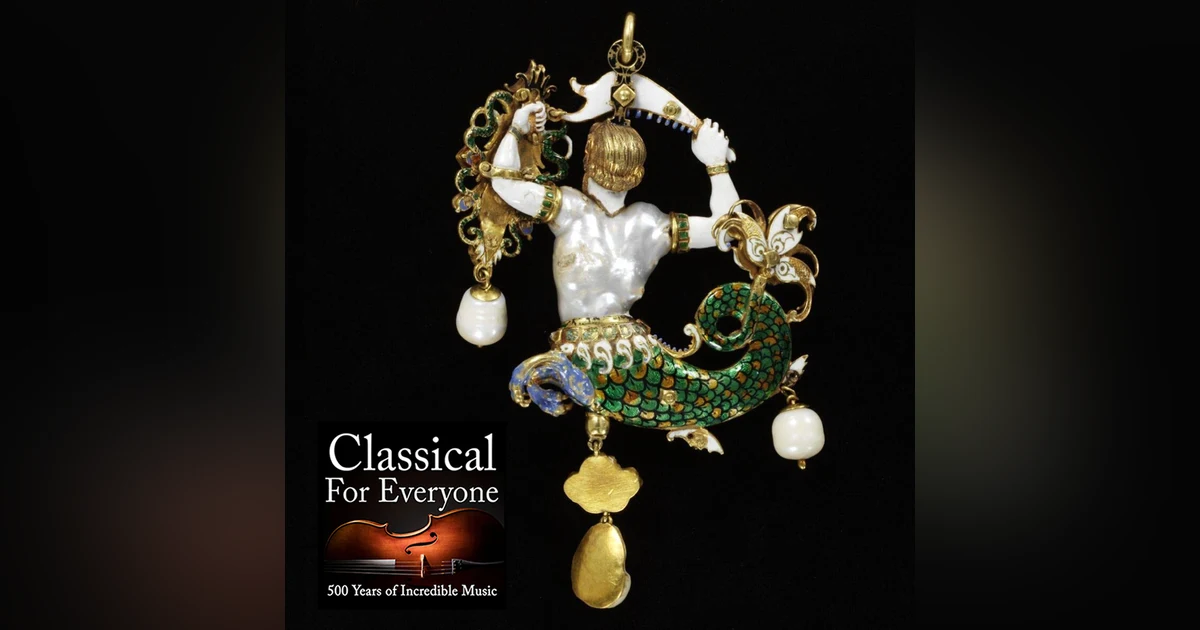
How did the term ‘baroque’, the French version of a very old Portuguese word for a misshapen pearl… which became an insult applied to complicated music… and was then rehabilitated as a description of an ornate style of art and architecture… become the term now almost universally used to describe music written between 1600 and 1750? And what has ‘diving’ got to do with anything? The answers are in this two part episode of Classical For Everyone exploring lesser known Baroque composers. And there’s a merman. But way more importantly… there is amazing music by Rameau, Rebel, Caldara, von Biber, Marais, Keiser, Leonarda, Strozzi, Stradella, Scarlatti, Locatelli and Valentini.
[Episode image: The Canning Jewel (reverse) – Collection, Victoria & Albert Museum.]
And here is a link to a playlist on Spotify with most of the music in the episode:
https://open.spotify.com/playlist/5r7T0AhJvUagJIXPVw8NVG?si=e8ec85e06c7743ea
The Music
The Words
Hello Everyone. Welcome to the second part of Classical For Everyone’s ‘Diving For Pearls’ episode… featuring some amazing, but less well-known, music from the baroque period… which is very roughly from 1600 to 1750. If by chance you missed part one of the episode then you may want to listen to that first for some useful background information and some more incredible music… but it really is not essential. Ok, let’s continue with ‘Diving For Pearls’.
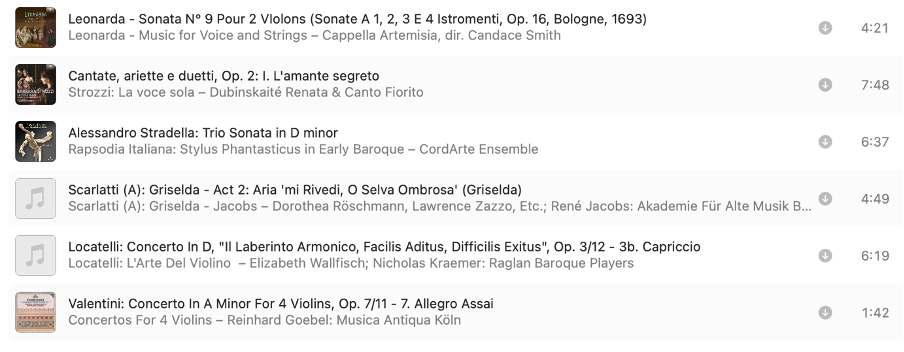
Isabella Leonarda spent essentially her entire life inside a convent in Novara, in northern Italy — she entered as a teenager and became mother superior decades later. And yet across roughly sixty years she published over 200 works, making her one of the most prolific composers, male or female, of the entire century.
Almost everything she wrote was sacred vocal music, for use within her own convent. But in 1693 she published a single collection of purely instrumental sonatas, Opus 16 — and it's a landmark for a reason that has nothing to do with her being a nun: it's among the very first published instrumental sonatas by any composer at all, let alone a woman. The genre itself was still being invented, and Leonarda was there at the start of it.
This is the Ninth Sonata from that collection, for two violins, performed by Cappella Artemisia under Candace Smith. It is about four and a half minutes long.
G
That was Isabella Leonarda's Sonata No. 9, performed by Cappella Artemisia, directed by Candace Smith.
Barbara Strozzi was the adopted daughter of the well-placed Venetian poet and librettist Giulio Strozzi, and was trained in composition by Francesco Cavalli. She put out eight collections of vocal music in her lifetime working entirely outside the usual channels — no court appointment, no church post. She most likely performed much of it herself, as a singer, at her father's private Venetian academy.
This is "L'amante segreto" — "The Secret Lover" — from her Opus 2, a cantata for solo voice. The text is written entirely from a man's perspective — he's pining after "la bella donna mia", "my beautiful lady" — but Strozzi composed it for soprano. That wasn't unusual for the time; a female voice singing a male lover's words was actually standard practice in this repertoire. But given that Strozzi likely sang much of her own music, there's a good chance the composer herself performed this piece — a woman, voicing a suffering man, for an audience gathered in her father's own house… singing…
The more my eyes gaze on her lovely face,
the more my mouth keeps my desire buried;
one with no cure should stay silent about his pain.
Here is Renata Dubinskaité with the ensemble Canto Fiorito. It's about eight minutes long. Barbara Strozzi’s ‘L’amante segreto’.
H
That was Barbara Strozzi's "L'amante segreto", performed by Renata Dubinskaité and Canto Fiorito.
According to my AI pal Claude, the composer Alessandro Stradella deserves a podcast episode of his own and not just for the music. Apart from being one of the most naturally gifted composers of the seventeenth century… he was one of the most reckless people in it. His life reads like an opera plot: embezzlement scandals, a string of love affairs with other men's wives and mistresses, an escape from a hired assassin in Turin after eloping with the mistress of a Venetian nobleman. His luck ran out in Genoa in 1682, where he was stabbed to death in the street, almost certainly over yet another romantic entanglement.
So, maybe Claude will get his, her or its wish. For someone I had not ever heard of he sounds kind of fascinating. But for now here is his six minute Trio Sonata in D minor from probably the 1670’s… a good example of what is sometimes called "stylus phantasticus" — the "fantastic style" — free, improvisatory, unpredictable, full of sudden turns.
This is the CordArte Ensemble. It is about six and a half minutes. Alessandro Stradella’s Trio Sonata in D minor.
I
That was Alessandro Stradella's Trio Sonata in D minor, performed by the CordArte Ensemble.
Alessandro Scarlatti is very often confused with his own son, Domenico — understandably, since Domenico's harpsichord sonatas are much better known today. But in his own time, Alessandro was the dominant figure, essentially the founder of the Neapolitan opera style.
"Griselda" is a late opera of his, from 1721, based on the old story — via Boccaccio and Chaucer — of a wife tested past all reasonable endurance by her husband to prove her loyalty. This aria, "Mi rivedi, o selva ombrosa" — roughly, "You see me again, o shady grove" — is Griselda addressing the wilderness she's been exiled to.
It is about five minutes long and here again is Dorothea Röschmann with René Jacobs directing the Akademie für Alte Musik Berlin.
J
That was an aria from Alessandro Scarlatti’s opera "Griselda". Mi rivedi, o selva ombrosa" — roughly, "You see me again, o shady grove". sung by Dorothea Röschmann with René Jacobs directing the Akademie für Alte Musik Berlin.
My name is Peter Cudlipp and you have been listening to the ‘Classical for Everyone’ Podcast. I have another couple of pieces coming up but before I get to them I want to give you a little information that I hope you find useful…
Alright, to finish this episode I have about six minutes from one of Pietro Locatelli’s 1733 group of violin concertos he called ‘The Art Of The Violin’. In each of the 12 concertos Locatelli included sections for solo violin of fearsome technical difficulty just to show off the absolute virtuosic mastery of the player. This is from the final one which had its own title… the Harmonic Labyrinth… "Il Labirinto Armonico".
The music behaves like a maze, wandering off into increasingly remote harmonic territory before finding its way home. Here is the violinist Elizabeth Wallfisch with Nicholas Kraemer directing the Raglan Baroque Players.
K
That was the conclusion of Pietro Locatelli's concerto "Il Labirinto Armonico", performed by Elizabeth Wallfisch and the Raglan Baroque Players.
Thanks for your time and I look forward to playing you some more incredible music on the next ‘Classical For Everyone’. And if there is a little voice in your head going… ‘where else have I heard the term ‘diving for pearls’ you might be thinking of Elvis Costello’s wonderful song about the Falklands War… ‘Shipbuilding’.
This podcast is made with Audacity Software for editing, Wikipedia for Research, Claude for Artificial Intelligence, Cleanfeed for remote recording; and the music played is licensed through AMCOS / APRA. Classical For Everyone is a production of Mending Wall Studios. The Producers do not receive any gifts, remuneration or support of any kind from any organisation or individual mentioned in the show.
And if you have listened to the credits… here is some more music for you… by Giuseppe Valentini. This is the final movement of his Concerto in A minor for four violins from 1710. And it is performed by Reinhard Goebel and Musica Antiqua Köln. Thanks again for listening.
L