

 Apple Podcasts

 Spotify

 Amazon Music

 iHeartRadio

 Overcast

 PocketCasts
 RSS Feed
Diving For Pearls – Part One

How did ‘baroque’, the French version of a very old Portuguese term for a misshapen pearl… which became an insult applied to complicated music… and was then rehabilitated as a description of an ornate style of art and architecture… become the term now almost universally used to describe music written between 1600 and 1750? And what has ‘diving’ got to do with anything? The answers are in this two part episode of Classical For Everyone exploring lesser known Baroque composers. And there’s a merman. But way more importantly… there is amazing music by Rameau, Rebel, Caldara, von Biber, Marais, Keiser, Leonarda, Strozzi, Stradella, Scarlatti, Locatelli and Valentini.
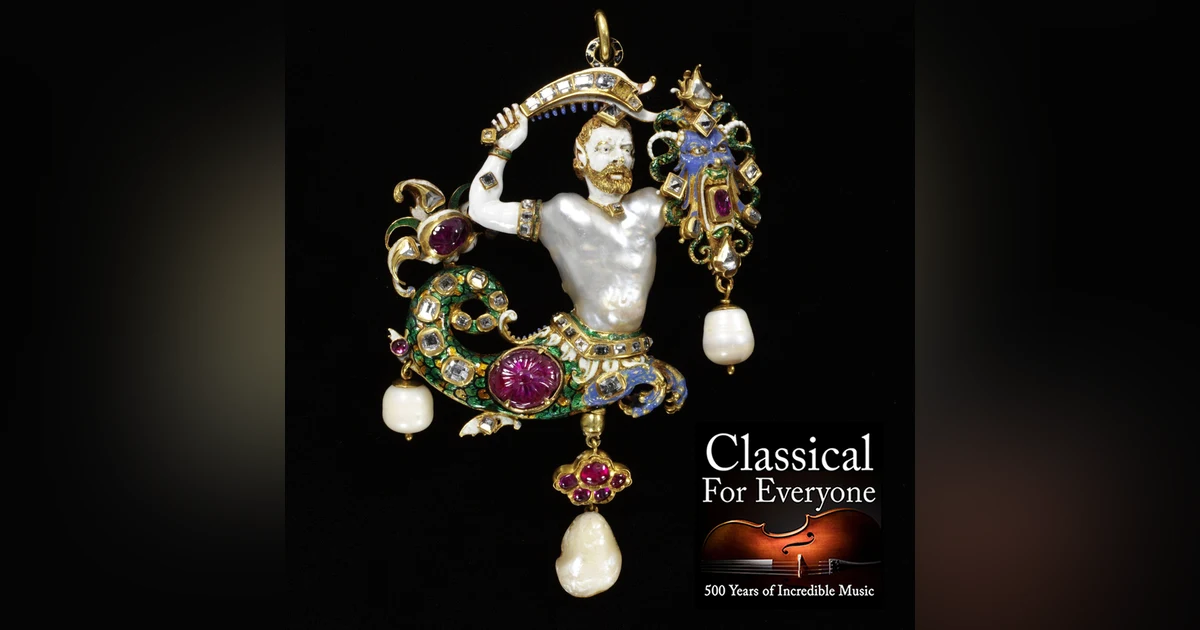
[Episode image: The Canning Jewel – Collection, Victoria & Albert Museum.]
And here is a link to a playlist on Spotify with most of the music in the episode:
https://open.spotify.com/playlist/5r7T0AhJvUagJIXPVw8NVG?si=e8ec85e06c7743ea
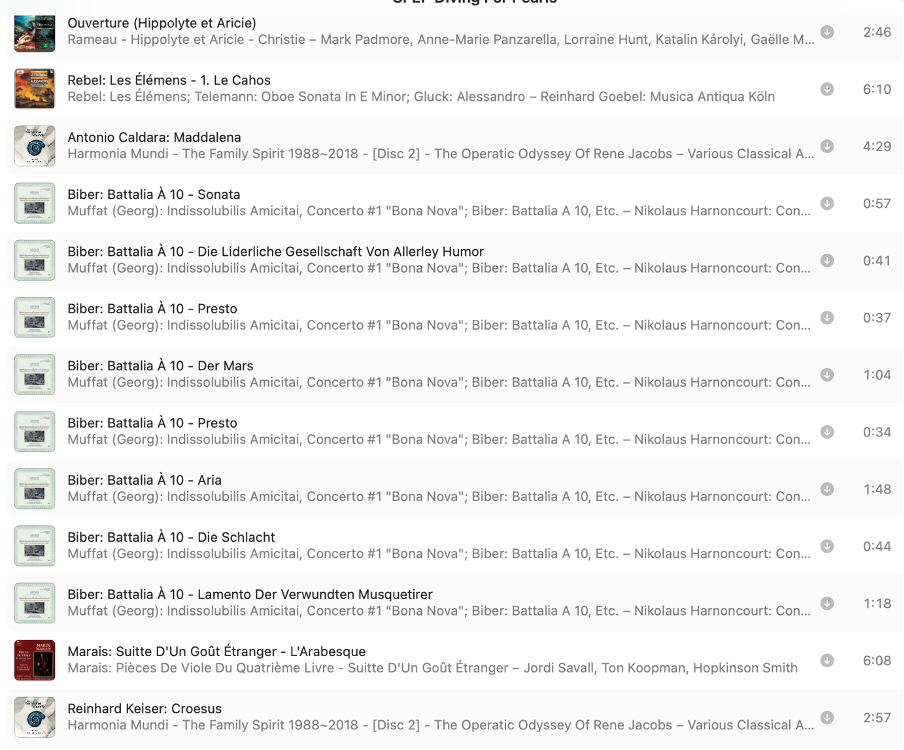
The Music
The Words
Hello everyone. Welcome to another episode of the ‘Classical For Everyone’ Podcast… five hundred years of incredible music. My name is Peter Cudlipp and… If you enjoy any music at all then I’m convinced you can enjoy classical music. All you need are ears. No expertise is necessary. If you’ve ever been curious about classical music… or explored it for a while once upon a time… or just quietly wondered what all the fuss was about… then this is the podcast for you.
And because there’s a lot of music out there each episode has a theme. And for this one it is some of the less well-known music of the Baroque period which is roughly from 1600 to 1750. And I’ll get to why the episode is called ‘Diving For Pearls’ in a moment… but for a second contemplate the one term being used to capture 150 years of music. Now maybe the world moved at a different pace but it is akin to lumping everything from 1876 to today together in one category. Jazz, swing, blues, pop, rock, rap… and don’t forget show tunes. So, what am I saying… perhaps surprisingly you can expect in this episode a pretty incredible variety of music. And that is also why this episode is coming out in two parts.
What is the connection with pearls? In the 1600s the Portuguese word ‘barroco’ was used to describe irregularly and / or imperfectly shaped pearl. The French adopted the term as ‘baroque’ and in a strange twist started to use it figuratively to mean something bizarre, convoluted or overly ornate. And in May 1734 an anonymous review of Jean Phillipe Rameau’s opera ‘Hippolyte et Aricie’ was published in the Mercure de France and it described the opera as ‘du baroque’ writing… ‘that the music lacked coherent melody, was filled with unremitting dissonant pearls.’ I’ll get to how the term came to be applied to so much music later. But for now here is the overture to ‘Hippolyte et Aricie’ just so you know where all the name calling started. It is about three minutes long and this is William Christie directing Les Arts Florissants.
A
That was the overture to Jean Philippe Rameau’s ‘Hippolyte et Aricie’ and William Christie directed Les Arts Florissants.
Ok. I promised I’d explain the Diving For Pearls title in a little more detail. I’ve covered that the term ‘Baroque’ which has come to be applied to about 150 years of music came from the name of imperfectly shaped pearls. But what about ‘diving’? Well, if you’re new to the term, you’ll perhaps know more composers of Baroque music than you realise… Bach, Handel, Vivaldi, Purcell and Telemann all fall into the baroque period.
But there are many, many others. And this two part episode is going to go a little bit deeper, a bit further under the surface if you will. Thus… ‘diving for pearls’. It is tempting to list the composers by name but that would be me practising my mediocre French, German and Italian pronunciation and frequent listeners to Classical For Everyone get too much of that any way. So, suffice to say, in the next hour and a quarter there will be music from another eleven Baroque composers… many of whom are new to me. So, maybe new to most of us. Starting with… Jean-Fery Rebel.
Rebel was a famous violinist in his day, a student of Jean-Baptiste Lully and a composer in the court of King Louis XIV. In 1738 he premiered a ballet called ‘The Elements’. It begins with a 7 minute introduction for the orchestra and is not intended to be danced. Rebel called this section ‘The Chaos’ and wanted it to depict the universe in the moments before divine creation began its work. To show this musically… at the very beginning of the piece Rebel deliberately uses a group of notes that when played together are incredibly jarring. Technically it came to be called a ‘tone cluster’. It is an amazing effect and it would be the twentieth century before composers would use this sort of massive dissonance again with any frequency. After that first 30 seconds the music returns to a more expected language for the time. Here is Jean-Fery Rebel’s ‘The Chaos’ from ‘The Elements’ performed by Reinhard Goebel leading his group Musica Antiqua Cologne.
B
That was Jean-Fery Rebel’s ‘The Chaos’ from his ballet ‘The Elements’ performed by Reinhard Goebel and his group Musica Antiqua Cologne.
If there are four broad sub-categories of music in the baroque era… they could be called chamber music… music for individual instruments or small groups of them which included songs; court music… the modest sized orchestras kept by royalty and aristocrats; opera and oratorio… dramatic performances increasingly supported by ticket sales to the emerging middle classes; and religious music for performance during services in churches and cathedrals.
Like all attempts at putting things in boxes my efforts just then already run into difficulties with the sort of hybrid form, the oratorio which whilst overtly religious in subject matter… in drama and emotion and intended location sits I think more in the opera category. In some senses oratorios were a way for composers to perhaps have their cake and eat it too…. Maybe think of them as ‘opera in ecclesiastical dress’. At certain times of the year operas was not allowed to be performed. And in certain cities, notably Rome, operas were not allowed at all for many decades.
Oratorios developed largely as the sanctioned substitute — sacred subject matter, no staging, no costumes, no scenery, so it fell outside any ban even while giving audiences (and composers) something structurally almost identical to opera: arias, recitative, named characters, dramatic conflict, and a plot.
In Venice in about 1697 the composer Antonio Caldara’s oratorio ‘Maddalena ai piedi di Cristo’… ‘Mary Magdalene at the feet of Christ’ was first performed. Near the conclusion of the oratorio Maddalena sings "Per il mar del pianto mio"… "Through the sea of my tears"… singing about crossing an ocean of her own tears as the pathway to salvation.
Here is the singer Maria Cristina Kiehr with the Schola Cantorum Basel led by Rene Jacobs. It is about 5 minutes long.
C
That was Maria Cristina Kiehr and the Schola Cantorum Basel led by Rene Jacobs performing the song "Through the sea of my tears" from Antonio Caldara’s ‘Maddalena ai piedi di Cristo’… ‘Mary Magdalene at the feet of Christ’.
‘Battalia à 10’ or "Battle for Ten" is a piece of chamber music written by the Bohemian-Austrian composer Heinrich Ignaz von Biber. The ‘ten’ comes from the number of instruments… 3 violins, 4 violas, 2 violones (a sort of distant cousin of the cello) and one harpsichord.
It would be great if there was more information about the circumstances of the creation of this work which was probably written in 1673. It is quite seriously a very odd bit of music. It is made up of eight very short sections with the whole work being just a little over eight minutes long.
I think unusually for that era, each section is given its own title… Of particular strangeness is the second section called, in English, ‘The Profligate Society of Common Humour’ which incorporates eight melodies, but in different key and time signatures… all in just 40 seconds. And the final section of the work is called ‘The Lament of the Wounded Musketeers’.
Von Biber in his day was a revered virtuoso violinist and his compositions were widely performed including his operas. In recent years his work has been rediscovered and it was probably this recording of ‘Battalia a 10’ by Nikolaus Harnoncourt directing Concentus Musicus Vienna that kick-started Von Biber’s renaissance.
D
That was ‘Battalia a 10 ’ by Heinrich Ignaz von Biber performed by Nikolaus Harnoncourt directing Concentus Musicus Vienna.
Ok, so I am going to quickly finish up how a Portuguese term for a misshapen pearl that became an insult applied to complicated music and was then rehabilitated as a retroactively applied description of an ornate style of art and architecture became a term now almost universally used to describe the music written between 1600 and 1750. Apparently it all comes down to one German musicologist writing in English in America in 1947 by the name of Manfred Bukofzer. His influential book ‘Music in the Baroque Era’ did most of the work needed to make ‘baroque’ the label of choice. And the fact that it was already a well-established term in art circles and that it was virtually the same word in Spanish, French, German and Italian certainly helped its rapid adoption.
Marin Marais was a virtuoso player of the viola da gamba — best thought of as an early version of the cello — and studied composition under Jean-Baptiste Lully at the court of Louis XIV. He eventually became the leading viola da gamba player in France, and wrote more music for the instrument than almost anyone in history.
This piece comes from a 1717 suite he called "Suite d'un Goût Étranger"… "Suite in a Foreign Style". Exoticism was fashionable at the French court at the time — a taste for the "foreign" and the "oriental", however loosely and inaccurately imagined by French audiences. Marais exploited that fashion with movement titles evoking far-off places, and this one is called simply "L'Arabesque". And just worth noting in passing that a suite was at this time generally a collection of short pieces each based on a particular dance. But here ‘arabesque’ borrows from art and refers to a curving, linear design in the melody that feels unbound by strict rigid symmetry.
Here is Jordi Savall on viola da gamba, joined by Ton Koopman on harpsichord and Hopkinson Smith on the lute —It's a little over six minutes.
E
That was "L'Arabesque" from Marin Marais's "Suite in a Foreign Style", performed by Jordi Savall, Ton Koopman and Hopkinson Smith.
Reinhard Keiser was, in his own lifetime, arguably the most important opera composer in Germany — he wrote something like a hundred operas for the Hamburg Opera House… and dominated that stage for decades. A teenage Georg Frideric Handel played violin and harpsichord in Keiser's opera orchestra before he'd written an opera of his own, and it's fair to say Handel learned a great deal of his craft looking over Keiser's shoulder.
Keiser’s opera "Croesus" first appeared in Hamburg in 1711 and it is based on the old story of the fabulously wealthy Lydian king, proverbial even in his own time for his riches.
Nearly all of Keiser's vast output has vanished from the stage, and for a long time "Croesus" had too — until 1999, when René Jacobs conducted its first full modern performance, at the Berlin State Opera, effectively rediscovering the piece. Here's a song from the character Elmira, an exiled Princess in love with Croessus’ son.
The stage direction calls for a palace courtyard with a fishpond; Elmira, lost in thought about her beloved, sits by the pond fishing with a line while she sings…
Ihr stummen Fische seyd
Dem gleich den ich muß lieben
You silent fish are
like the one I must love —
he too has remained silent;
but the difference:
you live in cold water,
he, always in burning fire.
Here is the singer Dorothea Röschmann, with Rene Jacobs directing the Akademie für Alte Musik Berlin. About three minutes.
F
That was “You silent fish are like the one I must love” from Reinhard Keiser’s opera "Croesus" It was sung by Dorothea Röschmann with Rene Jacobs directing the Akademie für Alte Musik Berlin.
Just as a quick aside, if you have been slightly puzzled by the artwork I’m using for this episode; it is picture of a famous pendant called the Canning Jewel. And it makes use of a baroque pearl, that is an imperfectly shaped one, as the torso of a ‘merman’… the male version of a ‘mermaid’. It is thought it originated in Italy in the 1500s… or it was made in the 1860s to look like it was made in the 1500s. The name comes from one of the more recent owners of the piece. It is now in the collection of the Victoria and Albert Museum in London.
And as a footnote, I did think the idea of a ‘merman’ was invented by the American actor, writer and director Ben Stiller for his 2001 documentary about male models, ‘Zoolander’. But I was quite wrong.
And if fifty minutes of baroque music is about your fill, then you are in luck. That was the end of part one of ‘Diving For Pearls’. If your podcast platform has a mind of its own there is every chance Part Two will start in just a moment. If not, then I am sure you will know how to find it… if and when you like. Thanks for listening.