



Conductors 1 – Antal Dorati




Why a conductor? The outcomes of the complicated relationships conductors have with orchestras and ensembles, with record companies and the public; and with composers living and dead, are in themselves interesting… but for the purposes of this show it is the recorded legacy that matters and Antal Dorati’s ranks amongst the finest of his generation. Dorati (1906 - 1988) was a Hungarian Jew who was able to escape Europe as World War Two commenced and he made the USA his home for much of the rest of his life. Choosing Dorati is also an excellent way to play some of the music that has been missing from the last few episodes of the podcast… what you might call ‘classic’ classical music… music written for the colours, range and expressive opportunities of a full modern orchestra. Music by Stravinsky, Haydn, Copland, Bartok, Szymanowski, Strauss and Ravel.
https://open.spotify.com/playlist/10BL9Vg7woQyvOZSvgog0r?si=c5f0afcdf5de4304
The Music
The Words
Hello everyone. Welcome to another episode of the ‘Classical For Everyone’ Podcast… five hundred years of incredible music. My name is Peter Cudlipp and… If you enjoy any music at all then I’m convinced you can enjoy classical music. All you need are ears. No expertise is necessary. If you’ve ever been curious about classical music… or explored it for a while once upon a time… or just quietly wondered what all the fuss was about… then this is the podcast for you.
And because there’s a lot of music out there each episode has something of a theme. And for this one it is recordings made by a particular musician… the Hungarian conductor Antal Dorati who lived from 1906 to 1988… who escaped Europe as World War Two commenced and who made the USA his home for much of the rest of his life.
So why focus on a conductor? Well, the outcomes of the complicated relationships conductors have with orchestras and ensembles, with record companies and the public; and with composers living and dead, are in themselves interesting but for the purposes of this show it is the recorded legacy that matters.
And… for the last ten or so episodes there hasn’t been much in the way of what you might call ‘classic’ classical music… music written for the colours, range and expressive opportunities of a full modern orchestra. And choosing this particular conductor, Antal Dorati, is a convenient way to play some of that music… music by Stravinsky, Haydn, Copland, Bartok, Szymanowski, Strauss and Ravel.
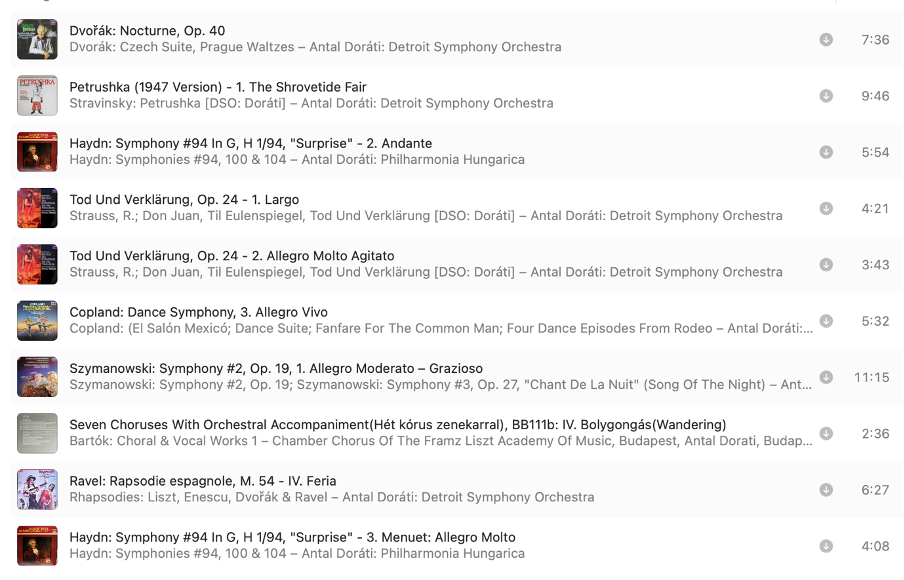
And starting with… Antonin Dvorak’s ‘Nocturne’ for string orchestra from 1883 when Dvorak was 41 and had begun building an international reputation. Since composers use the term ‘nocturne’ to evoke a sense of the night… the piece is, as you might expect, pretty quiet throughout. It is about 8 minutes long and here is Antal Dorati conducting the Detroit Symphony Orchestra with ‘Nocturne’ by Antonin Dvorak.
A
That was the Detroit Symphony Orchestra with the ‘Nocturne’ by Antonin Dvorak conducted by Antal Dorati.
Since the focus of this episode is music made by that particular conductor, I’m going to very briefly digress into what a conductor does and why it matters. From the late 1700’s as orchestras grew larger and amongst composers the idea evolved that not all the music they were writing would be used to wrap food scraps the day after the first performance; composers began to include more and more quite specific instructions in the music notation for how their work was ideally to be performed.
At its heart a conductor’s job is to follow those instructions and communicate them clearly to the musicians… which could number anywhere from twenty to two hundred... and through them to the audience. And to state what might be pretty obvious, the musicians are not all playing the same notes. Sometimes composers will break up even the groups of instruments who it is safe to ordinarily assume might play the same music… for example taking eight cellists and writing four different lines of music for them… each part played by only two instruments. Now the most visibly obvious part of the job of conducting is… beating out the time. The musicians know that when the conductor’s right hand, and usually the baton he or she is holding, firmly descends that they should be about to play the first note of the next bar or measure of music.
And I am going to go out on a limb and suggest that every music lover who has watched a conductor or two doing that has had the thought… ‘how hard can it be?’
The Russian composer Igor Stravinsky had a penchant for making the keeping time part of the job of conducting as hard as it possibly could be. In his three ballet scores from early in the 20th century… The Firebird, Petrushka and The Rite of Spring he took rhythmic complexity to new levels. One of the reasons that these three works are considered to have ushered in ‘modern’ orchestral music is the wildly unpredictable energies the music unleashes with unexpected rhythmic surprises.
I’m going to play you the opening of ‘Petrushka’ which is the story of a fairground puppet’s unrequited love for a ballerina. To reflect the chaotic, jerky movements of the puppet Stravinsky refuses to use a regular rhythm at all and frequently has different parts of the orchestra play at the same time in different time signatures… for example one group playing three beats to a bar and another group playing five beats to the bar... One answer to the question I posed earlier about conducting… ‘how hard can it be?’ might be ‘really, really hard’. Here is Antal Dorati with the Detroit Symphony Orchestra with the first section of Igor Stravinsky’s 1947 reworking of the music from his 1911 ballet Petrushka. It is about 10 minutes long.
B
That was Antal Dorati with the Detroit Symphony Orchestra with the first section of Igor Stravinsky’s 1947 reworking of the music from his 1911 ballet Petrushka.
There is no doubt that Dorati was a great conductor deserving of the respect with which he is held but you might like to know why I’ve chosen him for this first conductor focused episode of the Classical For Everyone podcast.
I confess there is very little science to it. A very long time ago I was in the classical music section of Tower Records in New York City and held in my hands the CD set of the complete symphonies of Josef Haydn (about 104 of them) recorded by the Philharmonia Hungarica (Hoon-GAR-ik-ah) conducted by Antal Dorati on the Decca label. I wanted it very badly. I already had one or two of the CDs and knew how good the set was… But it was too expensive and frankly way too heavy to lug all the way back to the bottom of the planet. So I left it sitting on the shelf.
As the years went by I never quite forgot about those recordings and then a bit over a month ago the good people at the Universal Music Group, the parent company that now owns the Decca record label re-released them. And listeners to this podcast will not be that surprised to know a set is now sitting on my desk. And that is how I came up with a show featuring recordings of music conducted by Antal Dorati.
And from that Josef Haydn complete symphonies project here is the second section of the 94th symphony with the nickname ‘Surprise’… and the reason for the name happens about 30 seconds in.
C
That was the second section of Josef Haydn’s 94th symphony with the nickname ‘Surprise’. It was performed by the Philharmonia Hungarica conducted by Antal Dorati.
I want to tell you just a little more about the circumstances of that recording.
Amongst the many, many refugees who fled Hungary in 1956 after the Soviet Union viciously suppressed a popular uprising were a large number of musicians. They formed an orchestra called Philharmonia Hungarica and in the years that followed with the support of the West German government settled in the north-western German town of Marl.
Now, although he was born in Austria, Josef Haydn spent almost three decades of his working life in what is now Western Hungary in the employ of the Esterhazy family… who were essentially Hungarian royalty. So it is perhaps not a surprise that a Hungarian conductor and an orchestra of expat Hungarian musicians would take on what was at the time one of the largest recording projects ever conceived. Originally released on LP between 1969 and 1972 they were an almost instant critical success and ended up being a commercial success as well.
A few years after Dorati made those Haydn recordings he was appointed the chief conductor of the Detroit Symphony Orchestra. It was his final full-time conducting position and he capitalised on what was already a very fine group of musicians and some very good engineers to make a series of what remain today extraordinarily well-regarded recordings.
Here are the opening two sections of ‘Death and Transfiguration’ by Richard Strauss written in 1889 when Strauss was 25. In German it sounds even more foreboding I think… ‘Tod Und Verklärung’. The first section is slow and quiet and the next one is titled by Strauss as ‘faster and more agitated’. A total of about 8 minutes music. On his death bed sixty years after composing the work, Strauss said to his daughter-in-law… “It's a funny thing, Alice, dying is just the way I composed it in Tod und Verklärung”. ‘Death and Transfiguration’ by Richard Strauss. Antal Dorati conducts the Detroit Symphony Orchestra.
D
That was the opening two sections of ‘Death and Transfiguration’ by Richard Strauss. Antal Dorati conducted the Detroit Symphony Orchestra.
I think you can say that Dorati is not quite considered in the same echelon as the conductors who were able to remain in Europe through the 2nd world war and ended up leading orchestras in Berlin or Vienna… people like Herbert von Karajan and Karl Böhm. But with much of the 2nd half of his life based in the US, Dorati was able to work with major American composers… especially Aaron Copland… and he thrived with the music of his adopted nation… Dorati was made a US citizen in 1943. In 1921 Copland was studying in Paris and he came up with the idea of a ballet inspired by the German expressionist vampire film ‘Nosferatu’ which he called ‘Grohg’. That’s G R O H G. It was about a magician who revives corpses and makes them dance. Maybe not surprisingly but perhaps sadly, it was never performed. In 1929 Copland took some of the music and turned it into what he called his ‘Dance Symphony’.
And in 1981 Dorati recorded it in Detroit. Here is the third and final section. It is about five minutes long.
E
That was the third section of Aaron Copland’s ‘Dance Symphony’. Antal Dorati conducted the Detroit Symphony Orchestra.
I mentioned earlier that Dorati was fortunate with the players and the recording engineers for his time in Detroit. There was also another factor that gives these recordings a special quality. The physical space in which a recording is made is a surprisingly important element in the recipe for any great recording. And sometimes the space where an orchestra is based, where it primarily performs, is not considered the right place for the best recorded results.
Such was the case with Detroit. But in 1928 the United Artists Theatre was opened in downtown Detroit and it was one of the grand movie palaces of the day. And when Dorati and the Detroit Symphony Orchestra were looking for the perfect recording acoustic this was the space they hit upon.
Now unfortunately the United Artists Theatre had lost some of its lustre in the intervening decades. For several years starting in the early 1970s it was one of Detroit’s several pornographic cinemas screening titles such as “The Notorious Concubines” and “The Secret Sex Lives of Romeo and Juliet.”
By 1979 when Dorati and the orchestra started recording in the space it had been closed for the business of entertaining lonely men for a while but after four years not even the orchestra could cope with the lack of heating and the rain coming in through the roof. The building was demolished in 2022.
But for a handful of years some incredible music was recorded in that storied space.
Including the Polish composer Karol Szymanowski’s 2nd symphony from 1909. Here is the opening section and it is about 11 minutes long. Incidentally, this recording is still widely regarded as the best available of this wonderful music.
F
That was the opening section of Karol Szymanowski’s 2nd symphony. Antal Dorati conducted the Detroit Symphony Orchestra. Dorati had a very close working relationship with the composer, and fellow Hungarian, Bela Bartok. I’ve chosen just one small piece to illustrate this. It is the song ‘Wandering’ from Bartok’s Seven Choruses with Orchestral Accompaniment from the mid 1930s.
The words of the song in English begin “I'm wandering in the wild forest at night. The pain of my heart is driving me here. I will go into the dark forest alone, not even God will have mercy upon me.” Sung by children’s voices this text does not come across as that bleak and I’m going to guess that Bartok heard a little irony in the original folk song he sourced the words from.
This is Antal Dorati conducting the singers of the Franz Liszt Academy and the Budapest Symphony Orchestra. It is about three minutes long.
G
That was Antal Dorati conducting the singers of the Franz Liszt Academy and the Budapest Symphony Orchestra with the song ‘Wandering’ from Bela Bartok’s “Seven Choruses with Orchestral Accompaniment”
My name is Peter Cudlipp and you have been listening to the ‘Classical for Everyone’ Podcast. I have another couple of pieces coming up but before I get to them I want to give you a little information that I hope you find useful… If you would like to listen to past episodes or get details of the music I’ve played please head to the website classicalforeveryone.net. That address again is classicalforeveryone.net. On the individual episode pages of the website there are links to Spotify playlists with the full versions of most of the music played in each of the episodes.
I hope you have enjoyed this episode of ‘Classical For Everyone’ focused on recordings by the conductor Antal Dorati… which has also been a way to play to the musical tastes of a couple of friends of the show… Andrew and Darren who I hope will be home from their adventures quite soon. If you want to get in touch then you can email me… info@classicalforeveryone.net.
Alright, to finish this episode I have some music from the French composer Maurice Ravel… who was sort of a bit Spanish as well… his mother was from the Basque region of France within miles of the Spanish border. And this is the conclusion of his Spanish Rhapsody the section called ‘Festival’. It is about seven minutes long. Again Antal Dorati conducts the Detroit Symphony Orchestra.
H
That was the conclusion of Maurice Ravel’s ‘Spanish Rhapsody’… the section called ‘Festival’. Antal Dorati conducted the Detroit Symphony Orchestra.
Thanks for your time and I look forward to playing you some more incredible music on the next ‘Classical For Everyone’. This podcast is made with Audacity Software for editing, Wikipedia for Research, Claude for Artificial Intelligence and the music played is licensed through AMCOS / APRA. Classical For Everyone is a production of Mending Wall Studios and began life thanks to the enthusiasm and encouragement of Mr Jeffrey Sanders.
And if you have listened to the credits… here is a little more music for you…
Oddly, I haven’t given you too much biography of Antal Dorati but when putting the show together I stumbled on one sweet detail that you might like. When he was conceiving the idea of recording all the Haydn symphonies with the Philharmonia Hungarica one of the influences he described in an interview was his recollection of playing Haydn’s String quartets as a child with his family in Budapest… his father playing 1stviolin, his mother playing viola, his uncle playing 2nd violin and Dorati playing the cello. Here’s the third section of Josef Haydn’s Symphony No. 94. Antal Dorati and the Philharmonia Hungarica.
Thanks again for listening.
I