

 Apple Podcasts

 Spotify

 Amazon Music

 iHeartRadio

 Overcast

 PocketCasts
 RSS Feed
Claude Debussy
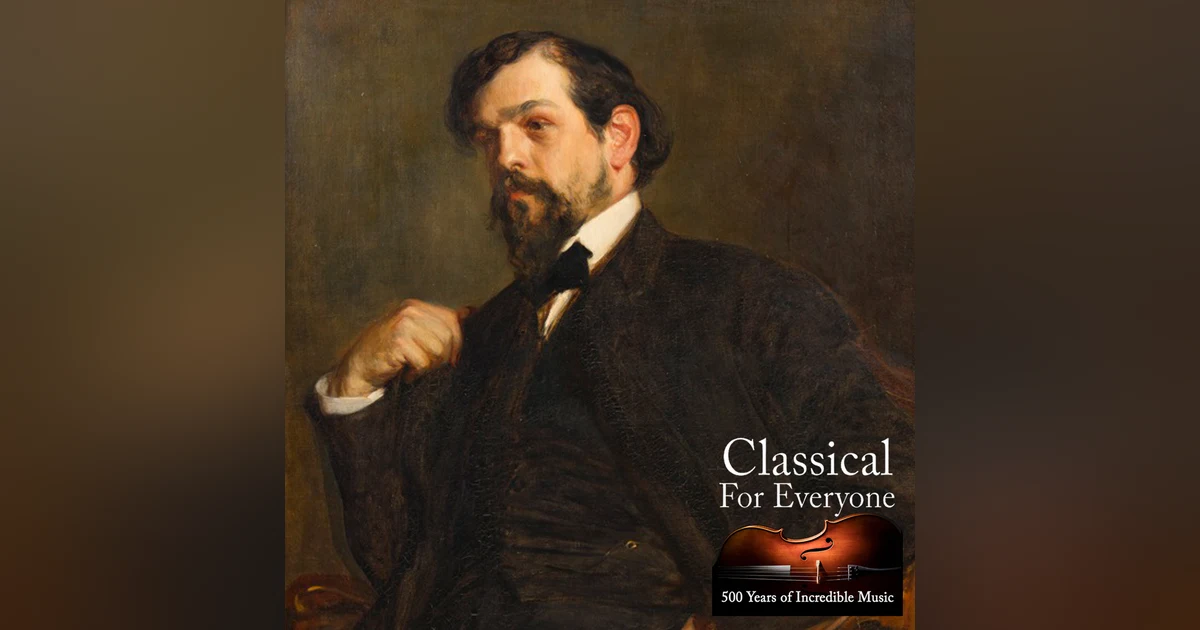

Moonlight, mist, a drowned cathedral rising from the sea, and a faun drowsing in the afternoon heat. Inspired by poetry and painting, Claude Debussy wrote music that suggests rather than states, and in doing so he changed what music could be. He won France's most conservative music prize and then spent his life breaking its rules. And as western classical music in the middle decades of the 20th century put most of its eggs in the baskets of atonal music, serialism, 12 tone music and ideas like 4 minutes and 32 seconds of silence being 'music'; Debussy's influence escaped the confines of the concert hall and the piano practice room… all the way to Miles Davis, Bill Evans and the Pet Shop Boys. The music in the episode includes the early charm of the first Arabesque, a rarely heard aria from his prize-winning cantata, the sensuous Prelude to the Afternoon of a Faun, and quite a bit more. Enjoy.
[Episode Image: Jacques-Émile Blanche: oil painting of Claude Debussy, 1902]
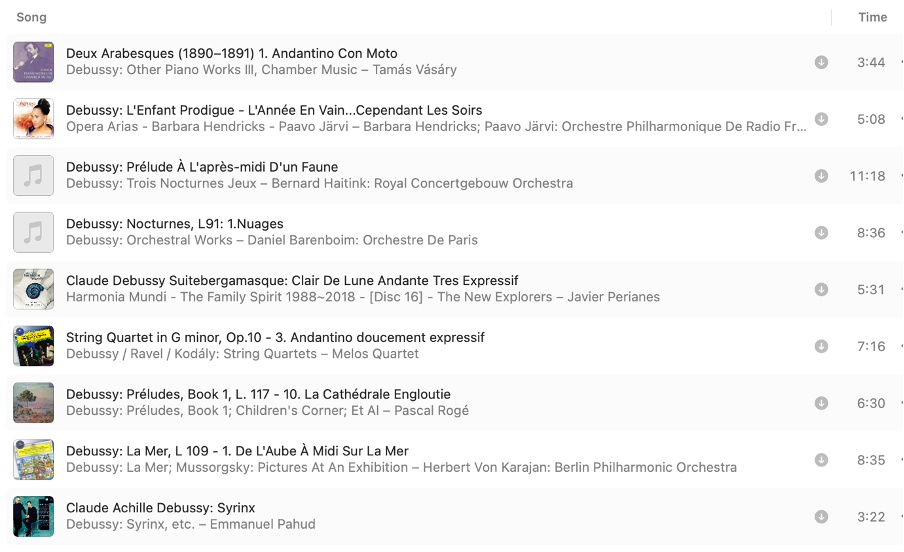
Here is a link to a playlist on Spotify with the music in the episode:
https://open.spotify.com/playlist/5FbZNpRgMMVAZ2G24G4yY3?si=7313f99846f74577
The Music
The Words
Hello everyone. Welcome to another episode of the ‘Classical For Everyone’ Podcast… five hundred years of incredible music. My name is Peter Cudlipp and… If you enjoy any music at all then I’m convinced you can enjoy classical music. All you need are ears. No expertise is necessary. If you’ve ever been curious about classical music… or explored it for a while once upon a time… or just quietly wondered what all the fuss was about… then this is the podcast for you. And because there’s a lot of music out there each episode has a theme. And for this one it is… music from the French composer Claude Debussy… and a little biography along the way. His music has turned up in a few earlier shows so please forgive some repeats.
I’m going to start with one of his earliest published works for the solo piano. He wrote his two ‘Arabesques’ in the late 1880s when he was in his late 20s. In art an arabesque is an elaborate pattern of interlaced lines, scrolling foliage, tendrils, and geometric forms inspired by plants and/or Islamic art. By the 1800s in France it was identified more with the art of the Baroque era and Debussy himself later described the Baroque as… “the age of the ‘wonderful arabesque' when music was subject to the laws of beauty inscribed in the movements of Nature herself.”
It would be fifteen years before the Arabesques would find some popularity. With Debussy’s midlife success people would begin to seek out his early work. Here is the first Arabesque. It is about 5 minutes long. And this is Tamas Vasary playing the piano
A
That was Tamas Vasary playing Claude Debussy’s first Arabesque.
Ok. Debussy was born in 1862 in a town outside of Paris to a poor family with no musical background at all. But as a child it was apparent that Claude, or Achille-Claude as his parents named him, was seriously gifted and at the age of ten he was admitted to the Paris Conservatoire, France’s leading music school. It had been established in the wake of the French Revolution by the National Convention partly to ensure that the army had enough musicians for military bands. And in the spirit of the Revolution positions were available to all on the basis of merit… and it was free. 77 years later admission was still audition based, it was still free and it took pupils as young as 9. Debussy would study there for 11 years.
There’s an adage that I think has some merit when it comes to art and it is… ‘learn the rules before you break them’. In Debussy’s later years at the Conservatoire it seems there was pretty constant friction with his teachers as he tried to break things and to hell with the rules. His emphasis had shifted from piano virtuosity to composition… and the focus of this teaching was to prepare students to enter the competition to win the Rome Prize the name of which came from a two year residency in a villa in Rome Napoleon had bought for France in 1803.
Despite his rule breaking Debussy must have been able to shape his work to meet the expectations of the judging panel and in 1884 he won the Rome Prize with his Cantata, which in this instance was a shortish multi part work for solo singers and accompaniment, he called ‘The Prodigal Son’ based on the biblical parable.
I’m going to play you the first song from the Cantata. Lia, the prodigal son’s mother, sings “L'année en vain chasse l'année!” ‘In vain, year follows year!’. The historical record is a little vague but it seems Debussy only completed a piano part for the competition performance as that is the way the work was presented. In 1907 his friend the composer Andre Caplet added parts for the orchestra, and that is the version I’m going to play.
Here is Barbara Hendricks singing Lia and Paavo Järvi conducts The Philharmonic Orchestra of Radio France. It is about five minutes long. ‘In vain, year follows year!’ from Debussy’s The Prodigal Son.
B
That was ‘In vain, year follows year!’ from Claude Debussy’s cantata
The Prodigal Son’. Barbara Hendricks was the singer and Paavo Järvi conducted The Philharmonic Orchestra of Radio France.
When Debussy returned to Paris from Rome, he sought out inspiration from literature and the visual arts. He was particularly drawn to the work of the poet Stephane Mallarmé and from 1890 attended the older man’s weekly gatherings of writers and artists many of whom described themselves as ‘symbolists’… whose works aimed to evoke moods, ideas, and inner psychological states rather than literally describing the physical world.
Mallarme had had some success with his poem ‘The Afternoon of a Faun’… ‘L’après-midi d’un faun’ about, not surprisingly, a faun… which is a mythological creature that is a cross between a human and a goat. In the poem the Faun wakes up after a particularly sensual dream and then tells its story. It begins…
Ces nymphes, je les veux perpétuer.
Si clair,
Leur incarnat léger, qu’il voltige dans l’air
Assoupi de sommeils touffus.
Aimai-je un rêve ?
These nymphs, I want to prolong them.
So clear,
Their light flesh-rose,
That it hovers in the air
Drowsy with dense slumbers.
Did I love a dream?
Mallarmé suggested to Debussy that he might be able to do something musically with the text and magic happened… Here is the eleven minute ‘Prelude to ‘the afternoon of a Faun’’ from 1894. Bernard Haitink conducts the Concertgebouw Orchestra.
C
That was Debussy’s ‘Prelude to ‘An afternoon of a Faun’’ from 1894. Bernard Haitink conducted the Concertgebouw Orchestra. Since its premiere in 1894 this music has achieved a weightily central position when people come to talk about the history of classical music and in particular the modernist developments that triggered the cacophonous variety of music created in the 20th century. ‘Prelude of to the afternoon of a faun’ is so popular (deservedly so) and so frequently performed it is hard to credit how out of left field it was for its day.
The greatest musical influences on new works at the time were probably Liszt and Wagner with the French composers Saint-Saens and Fauré alongside the late romantic traditions of Tchaikovsky, Brahms and Dvorak. But there really had been nothing to compare with the Prelude. I’m going to read a section from the French research organisation (and fine recording producers) Palazzetto Bru Zane’s description of it. I think it captures something of how unprecedented the music was…
In the Prélude à L’Après-midi d’un faune, the flute melody has a rhythmic flexibility and an improvisatory character unparalleled at the end of the nineteenth century. The themes are no longer developed but repeated in a constantly renewed harmonic and orchestral environment. Reflecting the uniqueness of the moment whose fragility it captures, the music blossoms in an atmosphere by turns evanescent and translucent, ablaze with sensuality and voluptuousness.
Ok. Some more flute at the end of the show.
In a number of instances Debussy’s pieces were composed over a period of several years. His three-part orchestral work ‘Nocturnes’ from 1899 is one of them. He probably started work on it seven years earlier; but after the success of Prelude to the Afternoon of a Faun he largely reconceived it and used that work’s advances to expand on his ideas. He was still very much finding inspiration in other art forms and the piece would owe a debt to the paintings of James McNeil Whistler who was living in Paris at the time. But he later described the first section, called Nuages, or in English ‘Clouds’, as an unmediated response to nature…
"'Nuages' renders the immutable aspect of the sky and the slow, solemn motion of the clouds, fading away in grey tones lightly tinged with white."
Here is Daniel Barenboim conducting the Orchestre de Paris with ‘Clouds’, the opening section of Claude Debussy’s ‘Nocturnes’ which was premiered in 1899. It is about 8 minutes long.
D
That was Daniel Barenboim conducting the Orchestre de Paris with ‘Clouds’, the opening section of Claude Debussy’s ‘Nocturnes’.
Now if taking seven years to complete Nocturnes seems slowish, Debussy finally settled on the music of his four part Suite Bergamasque for solo piano in 1905… 15 years after he started it. It was based on a group of poems by Paul Verlaine that celebrated the dances of commedia del Arte characters who were closely associated with the Italian town of Bergamo… hence Debussy’s title ‘Suite Bergamasque’. Of the four sections only one is directly connected to a specific Verlaine poem. It’s called ‘Moonlight’… and it includes these rather evocative lines…
Au calme clair de lune triste et beau,
Qui fait rêver les oiseaux dans les arbres
Et sangloter d'extase les jets d'eau,
With the calm moonlight, sad and lovely,
Which makes the birds dream in the trees,
And the plumes of the fountains weep in ecstasy,
There’s a good chance that this piano piece is known by a rather large slice of the world’s population though they might not know who wrote it. And I think there’s a fairly good chance you’ll recognise Claude Debussy’s ‘Moonlight’ which is a little oddly better known by its Frech title ‘Clair de lune’. This is a gorgeous performance by the Spanish pianist Javier Perianes.
E
That was ‘Clair de lune’. From Debussy’s ‘Suite Bergamasque played by Javier Perianes.
Now I earlier described the Prelude to the Afternoon of a Faun as unprecedented but Debussy himself had been working toward this very decisive escape from traditions for some time and you can hear hints of this in earlier works and especially his String Quartet from a year before.
Here is the shifting and at times unsettled but I think deeply romantic slow third section. It is about 7 minutes long and this is the Melos Quartet.
F
That was the slow third section of Debussy’s only String Quartet. And it was played by the Melos Quartet.
Ok. Back to some solo piano music. And this has been a real favourite of mine for decades. I actually put it in the very first group of episodes when I started the podcast. Partly I think it might be because the title is pretty sensational… La cathédrale engloutie… The Sunken Cathedral. The title references a myth from Brittany of a walled town that sank into the ocean from which the cathedral will sometimes rise up toward the surface and the muffled sounds of chanting and bells chiming can be heard.
But before I play it please indulge a little digression about a term you will encounter, if you haven’t already, when exploring the music of Claude Debussy. Writers and critics took the term ‘impressionism’ from painters and applied it to several composers at the end of the nineteenth century most particularly to Debussy. You could spend a significant amount of time trying to get a synthesis of all the various attempts at defining ‘musical impressionism’… but in very simple terms I see it as a way to evoke both the emotion of the experience of a place as well as hinting at the literal physical experience of it. And with that, a sort of fragmentary, dreamlike context can be a part of the composer’s intent… the idea of things being half-remembered.
So, in ‘The Sunken Cathedral’ Debussy’s music I think creates the sort of blurring effect that comes when looking at something seen underwater whilst rhythmically evoking the play of the waves. Here is the pianist Pascal Rogé with Claude Debussy’s ‘The Sunken Cathedral’.
G
That was the pianist Pascal Rogé with Debussy’s ‘The Sunken Cathedral’, published in 1910, when Debussy was in his late forties and at the height of his success. But by then he was already experiencing the first symptoms of the cancer that would kill him. In 1915, the year it was finally diagnosed, he had one last great creative burst. But the war dominated his final years, and when he died in March 1918, shells from a massive German gun seventy miles away were falling on Paris. The funeral of the man many would now call France’s greatest composer was attended by about twenty people.
But, rather than leave Monsieur Debussy at the rather sombre conclusion to his life I want to touch on his ongoing influence. I’ll try not to be too technical but as western classical music in the middle decades of the 20th century put most of its eggs in the baskets of atonal music, serialism, 12 tone music and ideas like 4 minutes and 32 seconds of silence being ‘music’; Debussy’s influence was slowly escaping the confines of the concert hall and the piano practice room.
Jazz after WWII would absorb Debussy’s musical language to the point that Bill Evans work with Miles Davis on the biggest selling jazz album of all time, ‘Kind of Blue’, is hard to imagine without the influence Debussy and Ravel. Influences acknowledged by both Davis and Evans. And in more recent times the British pop-synth duo the Pet Shop Boys directly credited Debussy in their song ‘Left To My Own Devices’ singing…
I was faced with a choice at a difficult age
Would I write a book? Or should I take to the stage?
But in the back of my head I heard distant feet
Che Guevara and Debussy to a disco beat.
My name is Peter Cudlipp and you have been listening to the ‘Classical for Everyone’ Podcast. I have another couple of pieces coming up but before I get to them I want to give you a little information that I hope you find useful…
If you would like to listen to past episodes or get details of the music I’ve played please head to the website classicalforeveryone.net. That address again is classicalforeveryone.net
On the individual episode pages of the website there are links to Spotify playlists with the full versions of most of the music played in each of the episodes.
I hope you have enjoyed this episode of ‘Classical For Everyone’ featuring the music of Claude Debussy. And if you want to get in touch then you can email… info@classicalforeveryone.net.
Alright, to finish this episode I have the opening section of Debussy’s 1905 work for orchestra 'La Mer', ‘The Sea'. At its premiere the reaction was somewhat muted and critics seemed to want something overall more forceful… more redolent of surging storms and vast cataracts of water. But Debussy’s sea is a less one dimensional and a more benign force. The titles of the three sections make the case for this… ‘From Dawn to Noon on the Sea’; ‘Play of the Waves’ and ‘Dialogue of the wind and the Sea’. Despite it’s early lukewarm reception, La Mer is now pretty popular. To the point where there are close to 200 recordings out there. So choosing one is a bit of a challenge. And after a something of semi-blind listening test, even I was a little surprised by what I have chosen. But it is sensational.
Here is Herbert von Karajan conducting the Berlin Philharmonic Orchestra with the eight minute opening section of Claude Debussy’s ‘La Mer’… ‘From Dawm to Noon on The Sea’.
G
That was Herbert von Karajan conducting the Berlin Philharmonic Orchestra with the opening section of Claude Debussy’s ‘La Mer’… ‘From Dawm to Noon on The Sea’.
Thanks for your time and I look forward to playing you some more incredible music on the next ‘Classical For Everyone’. This podcast is made with Audacity Software for editing, Wikipedia for Research, Claude for Artificial Intelligence, Cleanfeed for remote recording; and the music played is licensed through AMCOS / APRA. Classical For Everyone is a production of Mending Wall Studios. The Producers do not receive any gifts, remuneration or support of any kind from any organisation or individual mentioned in the show.
And if you have listened to the credits… here is some more music for you… I have to confess to struggling with some music written for the flute. When it is front and centre in a piece sometimes it just doesn’t quite click for me. But when Debussy wrote for the flute it is another thing altogether. It is after all a flute that dominates ‘Prelude to the afternoon of a faun’. In 1913 he wrote a three minute piece for solo flute he called ‘Pan’s Flute’ which is about a god rather than a mere dreaming faun. It relates to the myth of the goddess Syrinx escaping Pan by being turned into the reeds from which Pan makes his instrument. Here is a section of the poet Ovid’s ‘Metamorphosis’ about that encounter...
Now his loud longing sighs washing
Across the water to the changed body of his beloved
Make music from her, from the reeds.
Though apart, though transformed,
His warm breath still reaches her.
Whilst Debussy called the piece ‘Pan’s Flute’ he had actually written a song with that title years earlier so after his death his publisher gave it the title ‘Syrinx’, the name of the goddess. Here it is performed by Emmanuel Pahud.
Thanks again for listening.
H