

 Apple Podcasts

 Spotify

 Amazon Music

 iHeartRadio

 Overcast

 PocketCasts
 RSS Feed
Christopher Hogwood - Conductor
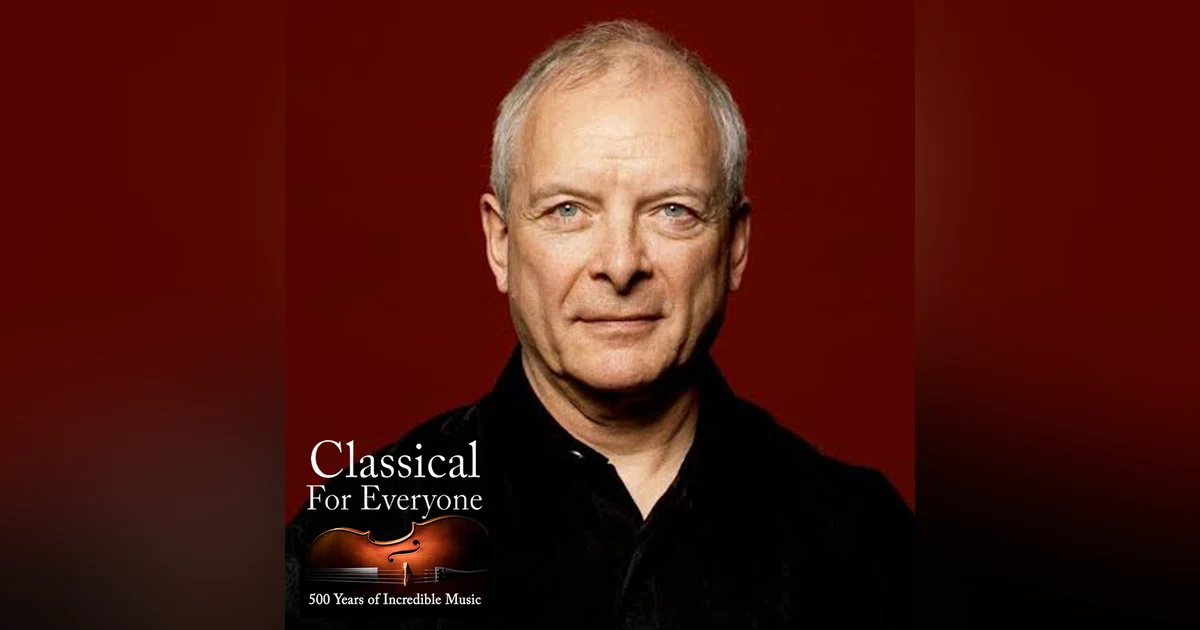

Conductor, keyboardist and academic Christopher Hogwood (1941-2014) was one of the leaders of what had become widely known by the 1970s and 1980s as the 'period instrument' movement and would later get the somewhat broader but much clunkier term of… 'historically informed performance practice'. Essentially musicians, primarily in Europe and the UK, became somewhat fascinated with what the instruments of earlier periods sounded like and by inference what composers had written for and heard at the original performances of their works. Hogwood and his contemporaries found perhaps surprising mainstream success with music that had fallen out of fashion… which was sort of everything that came before the rise of the large symphony orchestra from about 1750. So composers like Telemann, CPE Bach, Corelli and Purcell returned back into the concert hall and onto the LP after a very long absence. With success ambitions and opportunities grew and pretty soon Hogwood (and his record company) began to look to the mainstream repertoire… music by people like Joseph Haydn and Wolfgang Amadeus Mozart… and even Ludwig van Beethoven.
[Episode Image: Christopher Hogwood. Photographer: Marco Borggreve]
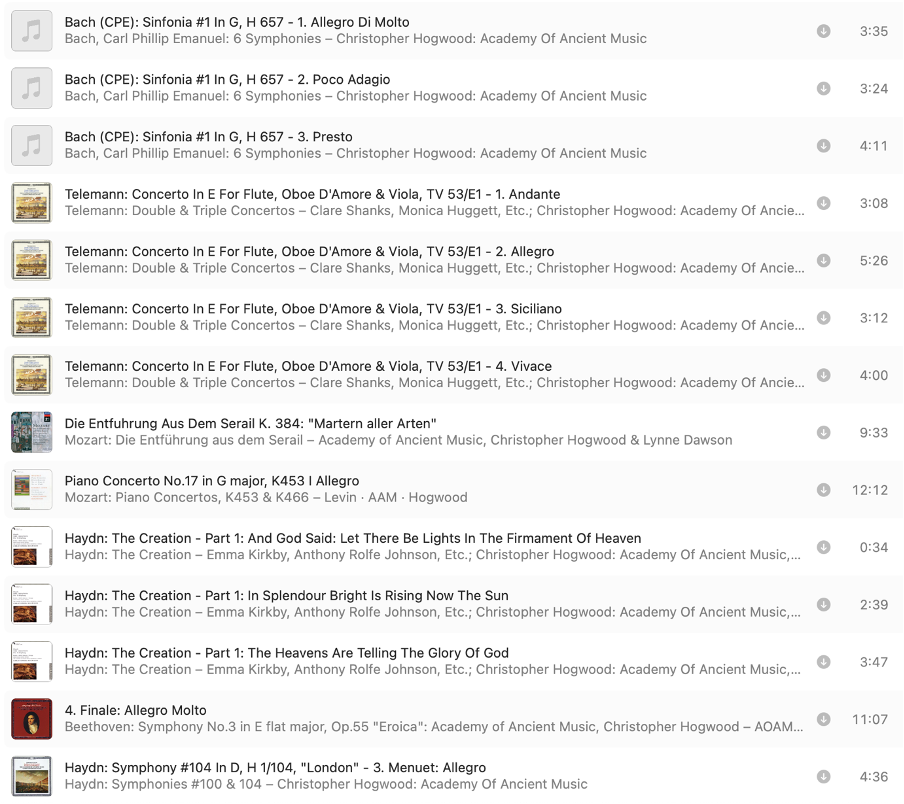
Here is a link to a playlist on Spotify with the music in the episode:
https://open.spotify.com/playlist/1jesFsYELqWF0sc34ioFzG?si=fec9512ba3214380
The Music
The Words
Hello everyone. Welcome to another episode of the ‘Classical For Everyone’ Podcast… five hundred years of incredible music. My name is Peter Cudlipp and… If you enjoy any music at all then I’m convinced you can enjoy classical music. All you need are ears. No expertise is necessary. If you’ve ever been curious about classical music… or explored it for a while once upon a time… or just quietly wondered what all the fuss was about… then this is the podcast for you.
And because there’s a lot of music out there each episode has a theme. And for this one it is… the English conductor Christopher Hogwood. Why an episode devoted to his recordings? Well, I’ll give you the major reason after I play some music but the minor reason is that I was lucky enough to hear performances he conducted a few times and I have very fond memories of them. Here is the first symphony by C. P. E. Bach from his set known as The Hamburg Symphonies written in 1773. It is in three parts and is about 11 minutes long. And this is the Academy of Ancient Music conducted by Christopher Hogwood.
A
That was the first symphony by C. P. E. Bach from his set known as The Hamburg Symphonies written in 1773. Christopher Hogwood conducted the Academy of Ancient Music… which he and a group of like-minded musician/academics founded in 1973 and which he led for 30 years. And most of the recordings today will feature that ensemble.
So why am I featuring this particular conductor? When there are so many to choose from? Well, Christopher Hogwood was one of the leaders of what had become widely known by the 1970s and 1980s as the ‘period instrument’ movement and would later get the somewhat broader but much clunkier term of… ‘historically informed performance practice’. Essentially musicians, primarily in Europe and the UK, became somewhat fascinated with what the instruments of earlier periods sounded like and by inference what composers had written for and heard at the original performances of their works.
Now this didn’t come out of nowhere but with Hogwood and his contemporaries, Ton Koopman and Reinhard Goebel in Europe among them, it was in the 1980s that performances and recordings with this approach started to come into the mainstream.
Ok. The next piece is Georg Philip Telemann’s Concerto For Flute, Oboe & Viola In E Major.
It is about 15 minutes long and was written in about 1720 and is in four parts. This is I think a good example of what I mentioned earlier… this idea of period instrument performance. All the instruments in this recording either date from the early 1700’s or are reproductions of them. More importantly everyone involved would have delved deeply into dusty archives for descriptions of the ways the work and their particular instrument were intended to be performed. The soloists are Steven Preston, Clare Shanks and Monica Huggett. They and The Academy of Ancient Music are conducted by Christopher Hogwood.
B
That was the soloists Steven Preston, Clare Shanks and Monica Huggett. They and The Academy of Ancient Music were conducted by Christopher Hogwood in Georg Philip Telemann’s Concerto For Flute, Oboe & Viola In E Major. That was a good example of the music Hogwood and his contemporaries were resurrecting… music that had fallen out of fashion… which was sort of everything that came before the rise of the larger orchestra of the Mannheim School of 1750 to 1770. So composers like Telemann, Corelli and Purcell returned back into the concert hall and onto the LP after a very long absence. This led to a certain perhaps surprising success and ambitions grew and pretty soon musicians like Hogwood (and their record companies) began to look longingly at the mainstream repertoire… music by people like Joseph Haydn and Wolfgang Amadeus Mozart.
And soon there would be some incredible recordings… many of them by Christopher Hogwood and the Academy of Ancient Music. They even wandered into the very sacred area of opera. Speaking of opera here they are with the song ‘Mattern aller Arten’ or in English, ‘Tortures of all Kinds’. Sung by the character Konstanze from Mozart’s opera ‘The Abduction from the Harem’; The words are by Gottfried Stephanie and Konstanze is making the very strong point that she’d rather die horribly than submit to the desires of the Ottoman prince who is holding her captive.
After a couple of minutes of the orchestra there is some sensational singing by Lynne Dawson along with Christopher Hogwood leading the Academy of Ancient Music. About nine minutes of Mozart.
D
That was the song ‘Mattern aller Arten’ or in English, ‘Tortures of all Kinds’. Sung by the character Konstanze from Mozart’s opera ‘The Abduction from the Harem’. The singer was Lynne Dawson and Christopher Hogwood conducted the Academy of Ancient Music.
I said a little earlier that Hogwood and his colleagues of the early music movement navigated their way into what is considered mainstream repertoire. And here is a favourite recording. In the late 1990s Hogwood joined up with the pianist Robert Levin to record a series of Mozart’s concertos for piano and orchestra. Levin plays what is called a ‘fortepiano’ from Mozart’s day, which has a slightly more delicate sound than a modern piano and I think it adds to the charm of the performance and it is I think interesting to hear this music with a sound closer to how it would originally have sounded. And perversely perhaps that gives the music a surprising freshness. The concerto was written in 1784 and here is the opening section which is about 12 minutes long. Robert Levin, Christopher Hogwood and the Academy of Ancient Music. Mozart’s Piano Concerto No. 17.
E
That was Robert Levin, Christopher Hogwood and the Academy of Ancient Music. With the opening section of Wolfgang Amadeus Mozart’s Piano Concerto No. 17.
Along with Mozart Hogwood built a reputation as a tremendous interpreter of the music of Joseph Haydn. One of the landmark recordings was of Haydn’s oratorio called ‘The Creation’. An oratorio can best be thought of as something like an opera but designed for the concert hall and frequently telling a religious story.
With ‘The Creation’ Haydn took the very beginning of the Book of Genesis from the Bible and adapted the text to music. Here is a just a small section of about seven minutes duration beginning with the words ‘And God Said Let There Be Light in the Firmament’. The soloists include Emma Kirkby and Anthony Rolfe Johnson. The Academy of Ancient Music is joined by the Westminster Cathedral Choir and the whole thing is conducted by Christopher Hogwood.
F
That was soloists Emma Kirkby and Anthony Rolfe Johnson. The Academy of Ancient Music, the Westminster Cathedral Choir and the conductor Christopher Hogwood with an excerpt from Joseph Haydn’s The Creation.
You might have been surprised that this was sung in English. The words were originally written in English for Georg Friedrich Handel but he never set them and they were given to Haydn in London in the late 1790s and he took the text back to Vienna where he had them turned into German and from that libretto he made ‘Die Schöpfung’… that is The Creation in German. But then in 1800 Haydn self-published the score with the words in both English and German under the music. Which was yet another first in that composer’s rather incredible life.
My name is Peter Cudlipp and you have been listening to the ‘Classical for Everyone’ Podcast. I have another couple of pieces coming up but before I get to them I want to give you a little information that I hope you find useful… If you would like to listen to past episodes or get details of the music I’ve played please head to the website classicalforeveryone.net. That address again is classicalforeveryone.net. On the individual episode pages of the website there are links to Spotify playlists with the full versions of most of the music played in each of the episodes. And if you want to get in touch then you can email… info@classicalforeveryone.net.
Alright, to finish this episode featuring the work of the conductor Christopher Hogwood, here is a recording that played a role in one of the silliest controversies in the already foolish enough world of classical music. Earlier I mentioned that the early music folks slowly expanded their repertoire into the domain of the big orchestras and the big recording companies. And no one’s music was considered more the intellectual property of the big orchestras than that of Ludwig Van Beethoven. So when Hogwood and his Academy of Ancient Music (and other like-minded groups) started performing and recording Beethoven symphonies people got quite upset…All sorts of hand-wringing by critics, broadcasters and audiences. Partisans for the large modern symphony orchestras playing this music against those who were excited and intrigued by the quite different sounds of smaller ensembles using original instruments and performance practices. It was all quite strange. But it really was a thing. So I am going to finish with Hogwood’s recording of the final part of Beethoven’s Third Symphony. It is a terrifically exciting performance. But first a couple of final words about Hogwood. He died at the age of 73 in 2014. The orchestra he founded, The Academy of Ancient Music continues to perform and record. And one quirky little fact. Most of Hogwood’s recording were released on the label ‘Loiseau L’yre’. The label grew out of a French music publishing house founded by an Australian… Louise Dyer. And L’Oiseau Lyre in English is… Lyre Bird. Don’t let it be said that I can’t give you useless trivia along with the best of them.
Here is the 11 minute conclusion of Ludwig Van Beethoven’s Third Symphony, performed by The Academy of Ancient Music conducted by Christopher Hogwood.
G
That was the conclusion of Ludwig Van Beethoven’s Third Symphony, performed by The Academy of Ancient Music conducted by Christopher Hogwood.
Thanks for your time and I look forward to playing you some more incredible music on the next ‘Classical For Everyone’.
This podcast is made with Audacity Software for editing, Wikipedia for Research, Claude for Artificial Intelligence, Cleanfeed for remote recording; and the music played is licensed through AMCOS / APRA. Classical For Everyone is a production of Mending Wall Studios. The Producers do not receive any gifts, remuneration or support of any kind from any organisation or individual mentioned in the show. And if you have listened to the credits… here is some more music for you…
One of Hogwood and the Academy of Ancient Music’s biggest achievements was the recording of virtually all of Joseph Haydn’s 104 symphonies. Here is the third section, the Minuet, from the final one, no 104 from1795… Also known as the ‘London Symphony’ as that was where it was premiered. The Academy of Ancient Music led by Christopher Hogwood.
Thanks again for listening.
H