

 Apple Podcasts
 Spotify
 Amazon Music
 iHeartRadio
 Overcast
 PocketCasts
  RSS Feed
 Chamber Music Three + A Festival Conversation
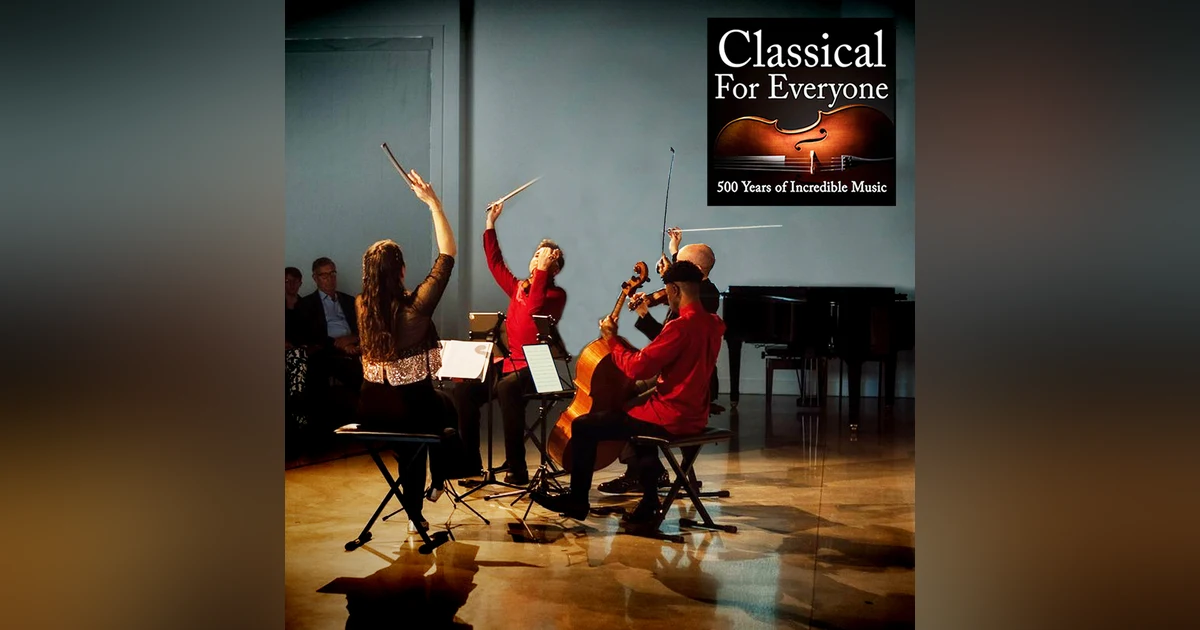
In two earlier episodes I have referred to Chamber Music as ‘Music For Small Spaces’. But if you search more broadly for that term you will come up with very little. If you want music for small groups of instruments often performed in intimate spaces then, in English at least, you are going to be looking for ‘chamber music’. And in this episode there will be chamber music from Maurice Ravel, Douglas Lilburn, Ludwig van Beethoven, Karol Szymanowski, Laurie Anderson, Johannes Brahms, Michael Norris and Antonin Dvorak. Plus I will be talking a little about chamber music festivals and playing ten minutes of a conversation I had with the violinist Justine Cormack about the At the World’s Edge Festival she co-founded in Aotearoa New Zealand.
[Episode image: Courtesy of At The World’s Edge Festival; Photographer: Nat Symonds.]
This is the link to the At The World’s Edge Festival
https://www.worldsedgefestival.com
https://open.spotify.com/playlist/5AjKszzqJFrw9EjfNqEEyh?si=2f5637185fd04039
This is a link to the website of the composer Michael Norris:
https://www.michaelnorris.info
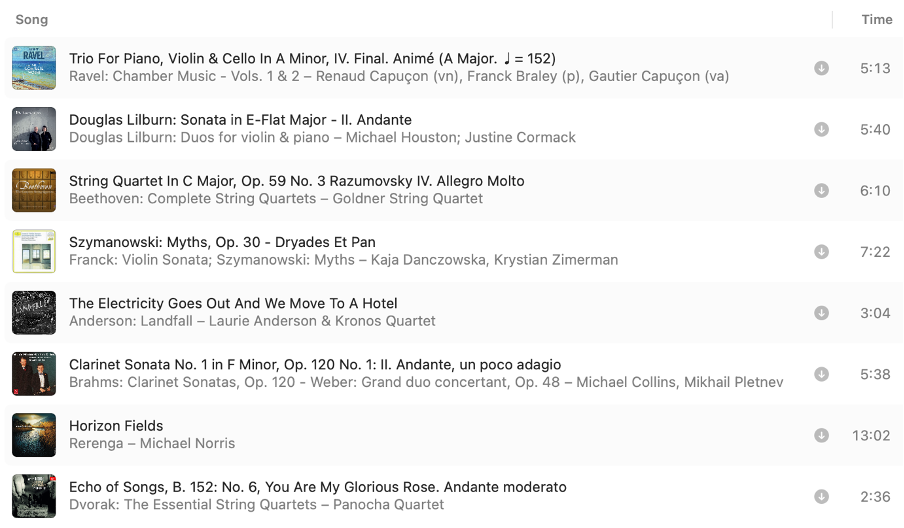
The Music
The Words
Hello everyone. Welcome to another episode of the ‘Classical For Everyone’ Podcast… five hundred years of incredible music. My name is Peter Cudlipp and… If you enjoy any music at all then I’m convinced you can enjoy classical music. All you need are ears. No expertise is necessary. If you’ve ever been curious about classical music… or explored it for a while once upon a time… or just quietly wondered what all the fuss was about… then this is the podcast for you.
And because there’s a lot of music out there each episode has a theme. And for this one it is… Chamber Music. Now I have in the past referred to this as ‘Music For Small Spaces’. But if you search for that term you will come up with very little. If you want music for small groups of instruments ideally performed in intimate spaces then, in English at least, you are going to be looking for ‘chamber music’.
And in this episode there will be chamber music from Maurice Ravel, Douglas Lilburn, Ludwig van Beethoven, Karol Szymanowski, Laurie Anderson, Johannes Brahms, Michael Norris and Antonin Dvorak.
Plus I will be talking a little about chamber music festivals and in a few minutes playing some of a conversation I had with the violinist Justine Cormack about the festival she co-founded in New Zealand called ‘At the World’s Edge’… but first some of that music for small spaces… some chamber music.
In late 1914 as World War One commenced, the French composer Maurice Ravel was determined to join the army to help defend France from the invading German army. But he was in the middle of composing a trio for piano, cello and violin… something he had been wanting to write for six years. The deadline of enlisting seems to have spurred him on and he wrote to fellow composer Igor Stravinsky… "The idea that I should be leaving at once made me get through five months' work in five weeks! My Trio is finished."
Incidentally, Ravel was 39 in 1914 and had been rejected for military service on age and health grounds but was able to overcome objections and spent much of the war as a truck driver serving very close to the front lines. Here is the final section of Maurice Ravel’s Trio for Violin, Cello and Piano performed respectively by Renaud Capuçon (vn), Gautier Capuçon (vc) and Franck Braley (p), It is about 5 minutes long.
A
That was the final section of Maurice Ravel’s Trio for Violin, Cello and Piano performed by Renaud Capuçon (vn), Gautier Capuçon (vc) and Franck Braley (p),
Ok, one of the things I perhaps don’t do often enough in the podcast is exhort you fine people to stop listening to me and to head out and enjoy some live music. And amongst the many wonderful things about chamber music is the fact that musicians frequently get together and put on chamber music festivals… usually short series of concerts over a few days very often in small spaces where the audiences are able to be really closeto the music. And there really is something very special about that close contact. An orchestra performing in a concert hall is a wonderful thing but sitting with just a hundred or so people hearing the incredible detail you get from just a handful of instruments can be an incredible experience. And very often they take place in quite remarkable places.
One such place is the central Otago region of the south Island of Aotearoa New Zealand nestled against the Southern Alps. This is where six years ago the musicians Justine Cormack and Benjamin Baker founded the ‘At The World’s Edge Festival’ which is happening this year in October in the towns of Wanaka, Cromwell, Bannockburn and Queenstown.
They got in touch with me last year and the fact that they were performing chamber music in one of the truly magical places on the planet… a place for which I have tremendous affection… made it pretty easy to get excited. And this year, with me having mastered some new technology, (always a challenge) I was able to record a conversation with Justine Cormack… and here is ten minutes from that chat. I hope, for those of you who haven’t been to a chamber music festival, it gives you a little sense of how special these events are.
Peter Cudlipp
If you could encapsulate what you would like listeners to this podcast to know about At The World’s Edge Festival, what is it that you would like people to know?
Justine Cormack
For me the festival is all about connection, human connection, and which really is what fine classical music is all about as well. But with chamber music it's a very personal one in that it's smaller, more intimate venues, you have musicians and audience really up close and personal and chamber music where you just have a few members, a few musicians performing, you very much get to know the individual musicians through their performance and so I think it's an incredibly powerful experience for anybody that comes along and the journey is one that opens up lots of different emotions and we know the programming is at the core of how we design each festival and there's a lot of different music but there's a wonderful sort of thread that plays through and yeah I just I my goal is that people leave inspired and nourished excited challenged yeah just vibrant and alive.
Peter Cudlipp
Well that's a fabulous quote to put in so that's fantastic how where did it so you started it with Ben tell me a little bit a bit about him and about your connection with him and how you hatched the two of you hatched to this idea .
Justine Cormack
Yes so uh you know the creation of at the world's edge festival was very much a stars aligning kind of thing. For 15 years from sort of early 2000s until the 2016 was playing with NZ Trio which I formed back in 2002 and was making a change. I had decided to leave the group and was moving down to the Queenstown Lakes area with my husband and I wasn't sure what I was going to be doing down there but I knew that I wanted to live down there and I also knew that I wanted to have some sort of powerful impact on the arts and culture scene down there. The week before I moved I was performing within the Michael Hill International Violin Competition in a chamber music round where I was the second violin playing with the six finalists, semi-finalists that year of which one was Benjamin Baker. I loved playing with him and we stayed in touch after that and over the following year I had moved down to the Queenstown Lakes and we discovered through our talking that we both had a very similar dream. He too wanted to do something, create a festival in the Queenstown area and so we thought well perhaps we should get together and talk through our dreams and see whether we should do this together and we did and it aligned and so from that point on this was about 2000 or yeah 2020 we were full steam ahead with setting up a chamber music festival and you know the most gorgeous part of New Zealand and here we are today about to have our sixth festival this year.
Peter Cudlipp
Fantastic I will link uh to at the World's Edge website so that people can get as much information and go ahead and organise their tickets and all the rest of it. And there's fantastic detail about the featured artists. But I also wanted to talk about Michael Norris or ask you to talk about Michael Norris. He has a spectacularly interesting sound world. I would love you to talk to me about the choice, how you landed upon him and his music.
Justine Cormack
Yeah, so the composer in residence part of the festival is a very solid pillar in terms of obviously performing New Zealand music and also commissioning new works. And each year our composer in residence writes two new works and we also perform their works that they've already written through their careers throughout the festival. So anybody coming to more than one performance and program within the festival gets a real oversight, overview into our composer in residence.
And also it's a wonderful experience for the composer themselves. Each composer that we've had has just been so appreciative of being able to experience their work, you know, like seven or eight works over the course of a week. is kind of unheard of.
And they revisit works throughout their careers. So Michael Norris, he's our sixth composer. And I have had a long relationship with him in that when NZ Trio, when I formed that, Michael was actually one of the first people that we commissioned a piece called Dirty Pixels. And it's really fun. It's intense. Wonderful.
And during his career, it's been interesting to see, because that would have been like 2003 or something. So we're talking quite some time ago. It's been interesting to watch him evolve and his music in a lot of ways change as it does as people go through their lives.
And now it has this incredible space often. I mean, there are lots of different styles. And quite frankly, the two works that he's written for us this year couldn't be more different.
So yeah, we've got a number of his works throughout. I'm playing a few of them. I'm very much looking forward to getting to know more of his music as well. And I'm sure the audience will find it fascinating.
Peter Cudlipp
It might be a slightly unfair question to ask, but amongst the seven concerts that you are presenting, Are there any particular pieces, not necessarily including you performing them, that you're really looking forward to hearing?
Justine Cormack
You know, I always find it quite hard to answer a question that I ask for favourites, because one of the things that I really do genuinely love about life, but also about music, is variety. So I pretty much always answer it, you know, I'm looking forward to the whole journey. That being said, there is a fabulous German violinist Florian Donderer coming this year and I am privileged to be playing with him in a few things, one of them being a Beethoven string quartet.
And of course that's just going to be an incredible experience for me. That's in the first concert in Wanaka. It's the third Razumovsky string quartet.
So that's a real privilege to have an opportunity like that. Then I'm doing another string quartet, again as second violin, with Ben playing first, and that's Penderecki, which in a lot of ways couldn't be more different than Beethoven. So that's an example of two incredibly different pieces, which I just can't wait to get stuck into.
And they're probably two of the bigger works that I'm playing throughout the festival. We have a wonderful chance to shuffle all of our musicians up. It's one of the aspects of festivals where we invite a group of musicians and then we all mix up in different formats for different works.
So, yeah, there's a lot of variety and different colour and energy. Yeah, so I'm just looking forward to getting stuck into everything.
Peter Cudlipp
And talking about looking forward to getting stuck into everything, do you have a problem with keeping your audience sober when they're surrounded by some of the best wine in the world?
Justine Cormack
No, we haven't had any trouble with that. We've got very well behaved audience members. Yeah, no, it's, I would like to think that people maybe are drunk on the music and the location and the mountains.
And, you know, it's a really, you know, we were very conscious about setting up this festival down there in terms of the mountains and lakes and so on. And that it's a very sensory experience. And listening to music is the ultimate sensory experience.
And we feel things emotionally. And the idea that the environment really plays into that experience is extremely important. And we feel like, you know, we really aim to harness the opportunity of the location of our festival.
Peter Cudlipp
Have you, in the last, sorry, this is the sixth year, in the last couple of years, have you been happy with the overall attendance and the excitement level around the festival?
Justine Cormack
Yeah, as we've gone through, more and more people have clued on to the value of being able to come to a number of concerts within the festival, just sort of the more you experience, the more powerful it is. And so that's been wonderful to see. at the end of one festival, people will come up and say, oh, I'm definitely coming to all of it next year.
I wish I'd done that this year, things like that. That being said, the hardest thing is really getting the word out about it. You do everything that you can, and I just have to trust that there's sort of a natural process.
In my mind, I'm working towards the day where we release the programme and it sells out instantly. but so you know I keep that in my mind but we're Ben and I are incredibly happy with how people respond to it and you know when you hear people sort of feeding back to you the experience the experience they're having and it's very much what we have in our minds to be trying to provide. When that's reflected back to you, that's incredible. And I just want more people to be able to experience it. I think one of the challenges with classical music, and this is any sort of classical music, is that there's a misconception that you need to bring an amount of knowledge or experience to um to a performance to enjoy it and my experience is that anybody that comes into the door through the door and experiences it is blown away um it's a very immediate um and natural experience so i you know i just encourage people to give it a try and I'm sure they won't be disappointed.
Peter Cudlipp
That's fantastic. We're certainly on the same page as far as that's concerned.
That was violinist Justine Cormack co-founder of the At The World’s Edge festival and also two sibling festivals held in Chicago and London and Justine is also the Concertmaster of the Christchurch Symphony Orchestra. There is a whole lot more information at the Festival’s Website which is worldsedgefestival.com… that’s worldsedgefestival.com… and there’s no punctuation in the word ‘worlds’ in the web address. The festival runs from the 3rd to the 11th of October 2026. I will put a link to the website in the show notes for this episode.
And later in the show I’ll play some music from the Festival’s composer in residence, Michael Norris.
But now here is my guest, Justine Cormack, playing the violin along with the pianist Michael Houston with the second section, the Andante, from a sonata by the New Zealand composer Douglas Lilburn written in 1943 and revised in 1984. It is his sonata in E Flat. And I completely agree with the notes the musicians wrote for the CD that this music does evoke the landscape of the south island of Aotearoa New Zealand. It is about 6 minutes long.
B
That was Justine Cormack playing the violin along with Michael Houston playing the piano with the second section, the Andante, from the E Flat sonata by the New Zealand composer Douglas Lilburn.
If by any chance you are a reader of books by the palaeontologist and science populariser Stephen Jay Gould you might have come across an essay he wrote in the 1990s called ‘The Razumovsky Duet’ where he contrasted the lives of two members of a family of Russian aristocrats to make observations about science, culture and patronage. One, Alexis Razumovsky, rebuffed all requests to help rebuild Moscow’s Museum of Natural History after Napoleon’s troops burnt it down in 1812. The other Andrei Razumovsky… was perhaps Ludwig van Beethoven’s most important patron and paid for the set of three string quartets Beethoven wrote in 1806 which have come to bear his name. I think that little digression was perhaps just a way to celebrate all the philanthropists out there.
I’m going to play the six minute conclusion of the third of Beethoven’s Razumovsky quartets from a live recording made by the Goldner String Quartet.
C
That was the Goldner Quartet playing the conclusion of Ludwig van Beethoven’s third Razumovsky quartet. And in a not really very surprising coincidence… that work will be one of the pieces performed in October at one of the concerts of the ‘At The World’s Edge Festival’.
Back to the early 20th century. Whilst Maurice Ravel was serving on the Western Front during World War One, the polish composer Karol Szymanowski was in vastly different circumstances. He had suffered a permanent leg injury as a child and throughout his life his ability to even walk was compromised. Unfit for military service he spent most of the war years on his family’s estate in the middle of what is now Ukraine.
In 1915 he wrote three virtuosic pieces for violin and piano he called Myths and he based them on ancient Greek stories. The third one is called Dryads and Pan… based on the myth of a goddess fleeing Pan and being turned into reeds from which Pan makes his flutes. Here is a section of the poet Ovid’s ‘Metamorphosis’ about that encounter...
Now his loud longing sighs washing
Across the water to the changed body of his beloved
Make music from her, from the reeds.
Though apart, though transformed,
His warm breath still reaches her.
Even though this music is over a century old, Szymanowski was using what can still sound like challenging harmonies but I think this music does evoke a sort of Arcadian otherness… a sort of secret world of strange and haunting passions.
Here is Karol Szymanowski’s ‘Dryads and Pan’ from his collection ‘Myths’. It is about 7 minutes long and is performed here by the pianist Krystian Zimerman and the violinist Kaja Danczowska.
D
That was Karol Szymanowski’s ‘Dryads and Pan’ from his collection ‘Myths’ performed by the pianist Krystian Zimerman and the violinist Kaja Danczowska.
It is understandable that when you hear the term ‘chamber music’ you might picture a pretty sedate bunch of old people listening to a small group of musicians using old instruments to play old music generally written by long dead old men.
But the truth of that cliché represents only a small part of the innovative and exciting world of chamber music today. Once a group of players has been together for a while and built something of a reputation more often than not they will start reaching out to living composers and commissioning new music. One of the most prolific in that field has been the American group, the Kronos Quartet.
In 2013 the artist Laurie Anderson wrote a work for them called ‘Landfall’ based on her experience in New York City of October 2012’s Hurricane Sandy. She uses electronics, pre-recorded voices and video as well as the four instruments of the quartet. As I was writing this I stopped for a moment and briefly wondered ‘Is this really chamber music?’. Much more qualified people than me seem to think so… the work won the Grammy Award for Best Chamber Music/Small Ensemble Performance. Here is the section called ‘The Electricity Goes Out and we Move to a Hotel’ from Laurie Anderson’s ‘Landfall’. It is about three minutes long and here is the Kronos Quartet.
E
That was ‘The Electricity Goes Out and we Move to a Hotel’ from Laurie Anderson’s ‘Landfall’ performed by the Kronos Quartet.
In the early 1890s a few years before his death Johannes Brahms told friends and colleagues that he was done with composing. That he had nothing more to say. Then, the story goes, he heard an extraordinary clarinettist playing. His name was Richard Mülfeld and he inspired Brahms to write a series of compositions for him, including the last pieces of chamber music he would write… two clarinet sonatas… that is pieces for clarinet and piano. Here is the slow second section of the first of the Brahms sonatas. It is a pretty gorgeous six minutes of music. Mikhail Pletnev is the pianist and Michael Collins is the clarinettist.
F
That was pianist Mikhail Pletnev and clarinettist Michael Collins with the slow section from Johannes Brahms 1st Clarinet Sonata. My name is Peter Cudlipp and you have been listening to the ‘Classical for Everyone’ Podcast. I have another couple of pieces coming up but before I get to them I want to give you a little information that I hope you find useful…
If you would like to listen to past episodes or get details of the music I’ve played please head to the website classicalforeveryone.net. That address again is classicalforeveryone.net. On the individual episode pages of the website there are links to Spotify playlists with the full versions of most of the music played in each of the episodes. I hope you have enjoyed this chamber music focused episode of ‘Classical For Everyone’. And if you want to get in touch then you can email… info@classicalforeveryone.net.
Earlier in this episode I mentioned I would play some music by the composer in residence for the At The World’s Edge Festival, Michael Norris. And now is the time. And the piece I am going to play is from 2022 and is for Piano, Violin and Cello and is called ‘Horizon Fields’. I think it is worth hearing a little of what the composer wrote about the piece…
“Horizon Fields takes its themes from the large-scale 2012 art installation Horizon Field Hamburg by Antony Gormley. Comprising an enormous steel platform suspended 7m above the ground in a massive converted 100 year old market hall, its mirror-like black epoxy surface created striking reflections of both the hall’s architecture and the city beyond.
For visitors who walked across it, this provided the illusion of teetering on the surface of a deep, dark (frozen?) lake. Furthermore, any sudden or coordinated movements from the participants would also initiate a gentle rocking motion in the entire structure.
Gormley’s themes of floating planes suspended in architectural space, mirror-form reflections and gentle oscillations have been freely interpreted to form the core sonic ideas and musical behaviours of this piano trio.”
There is a really quite hypnotic shifting and unsettled quality to this music. It is the sort of music you can become quite deeply immersed in. It is about 12 minutes long and is performed by the NZTrio… Somi Kim (piano), Matthias Balzat (cello), Amalia Hall (violin). Michael Norris’s ‘Horizon Fields’.
G
That was the NZTrio… Somi Kim (piano), Matthias Balzat (cello), Amalia Hall (violin). Performing Michael Norris’s ‘Horizon Fields’.
Thanks for your time and I look forward to playing you some more incredible music on the next ‘Classical For Everyone’. This podcast is made with Audacity Software for editing, Wikipedia for Research, Claude for Artificial Intelligence, Cleanfeed for remote recording; and the music played is licensed through AMCOS / APRA. Classical For Everyone is a production of Mending Wall Studios. The Producers do not receive any gifts, remuneration or support of any kind from any organisation or individual mentioned in the show. Thanks very much to Jo Mills for connecting me with Justine Cormack and to Justine for chatting with me. And if you have listened to the credits… here is a couple of minutes of more chamber music for you…
When the composer Antonin Dvorak was in his mid 20’s he wrote a series of love songs for a woman who did not return his affections. Twenty years later he took a selection of the songs and reworked them for string quartet… calling them ‘The Echo Of Songs’. Some biographers suggest that the by now married Dvorak had never stopped loving the woman he had written the original songs for and that the quartet versions were a way to express a love that had to remain unspoken. This is the sixth of the pieces… Antonin Dvorak’s ‘You Are My Glorious Rose’. And this is the Panocha Quartet.
Thanks again for listening.
H