

 Apple Podcasts
 Spotify
 Amazon Music
 iHeartRadio
 Overcast
 PocketCasts
  RSS Feed
 Before Dawn


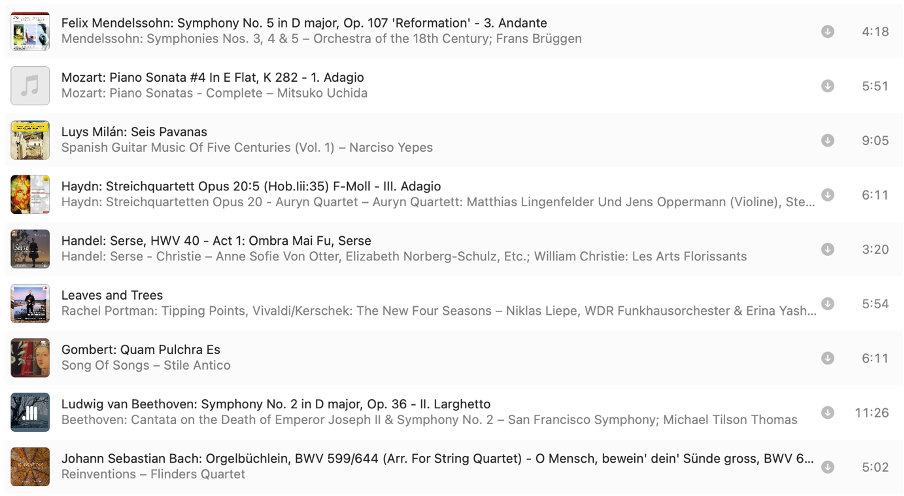
Music for the hour before dawn. Which is in no way intended to be too prescriptive… the episode can be listened to any time… but I hope it is music that has a calmness and perhaps a contemplative tone that suits the hour when there is a glow in the sky, things are at their most quiet… and you have the world to yourself. The music is by Felix Mendelssohn, Wolfgang Amadeus Mozart, Luys Milan, Josef Haydn, Georg Friedrich Handel, Rachel Portman, Nicholas Gombert, Ludwig van Beethoven and Johann Sebastian Bach. Regular listeners to the podcast might recognise a couple of pieces from earlier episodes. Forgive me for playing favourites. Now, for this show I am going to be pretty sparing in talk; but I’ll add a few paragraphs on each piece to the episode’s page at classicalforeveryone.net.
And here is a link to a playlist on Spotify with the music from this episode:
And here are a couple of paragraphs from my AI pal Claude on each of the pieces in this episode:
1. Mendelssohn: Symphony No. 5 in D major, Op. 107 'Reformation' – 3. Andante
The 'Reformation' Symphony has an unusual history for a work by a composer who was generally sure-footed and prolific. Mendelssohn wrote it in 1830 to commemorate the three-hundredth anniversary of the Augsburg Confession, the foundational document of Lutheran Protestantism — yet the premiere was cancelled, and Mendelssohn himself grew so dissatisfied with it that he refused to allow it to be published in his lifetime. It only appeared in print after his death, numbered as his Fifth Symphony despite being one of his earliest in the form. There is something quietly poignant about that: a work written for a grand public occasion that ended up hiding in a drawer.
The symphony's outer movements lean heavily on Lutheran symbolism — the famous 'Dresden Amen' appears in the first movement, and the finale is built on Luther's great hymn 'Ein feste Burg.' But the third movement Andante, which opens the 'Before Dawn' playlist, lives in a different world entirely. It is gentle, intimate, and somewhat hovering — more like a song without words than a symphonic argument. Mendelssohn was the great master of that quality of suspended, moonlit stillness, and this movement has it in abundance without calling attention to itself.
2. Mozart: Piano Sonata No. 4 in E flat, K 282 – 1. Adagio
Mozart's Piano Sonata K 282 is unusual among his keyboard works in beginning with a slow movement rather than ending with one. Most Classical-era sonatas save their Adagios for the middle, sandwiched between a brisk opening and a dancing finale. Here Mozart inverts the expectation: the Adagio comes first, and it sets a tone of quiet gravity that the subsequent movements — a pair of minuets and a lively finale — gently dispel. The effect is a little like a dream that persists into waking. The sonata was written in Munich in early 1775, when Mozart was nineteen, and it already shows his uncanny ability to hold sorrow and elegance in the same breath.
The key of E flat major carries particular associations in Mozart's sound world — it tends toward a certain warmth and depth rather than brightness. The Adagio moves with great care, its melody unfolding in long phrases that feel unhurried without ever dragging. Mitsuko Uchida, whose complete Mozart sonata cycle for Philips remains the benchmark recording for many listeners, plays this movement with extraordinary sensitivity. She understands that Mozart's slow movements require the performer to resist the temptation to interpret — to let the music arrive, rather than push it.
3. Luys Milán: Seis Pavanas
Luys Milán was a Spanish composer and poet active in the early sixteenth century, attached to the court of Valencia, and he holds a remarkable distinction: his collection El Maestro, published in 1536, is the earliest printed source of music specifically intended for the vihuela — a six-course instrument visually similar to a guitar but strung and tuned differently, and the prestige instrument of Renaissance Spain. The pavana was a slow, stately court dance of Italian origin, and Milán's six pavanas are among the most beguilingly beautiful pieces in the entire early music repertoire. That Narciso Yepes, one of the twentieth century's supreme guitarists, chose to record them speaks to their enduring resonance.
One of the things that makes Milán's pavanas so striking to modern ears is their harmonic adventurousness. For music written nearly five centuries ago, there are moments that feel surprisingly free — unexpected shifts of colour, phrases that seem to reach beyond the conventions of the period. Milán was not just a craftsman following rules but a genuine musical personality, and the pavanas have an improvisatory quality that suggests he understood the vihuela's capacity for intimate, searching expression.
4. Haydn: String Quartet Op. 20 No. 5 in F minor – III. Adagio
Haydn's six string quartets of Opus 20, composed in 1772, represent one of the great leaps forward in the history of chamber music. Before them, the string quartet was still finding its identity as a form. After them, it was established as one of the supreme vehicles for musical thought. The set is sometimes called the 'Sun' Quartets, though the name has more to do with the publisher's title page than anything in the music itself. What is beyond dispute is that they show Haydn thinking more deeply and ambitiously than before — more willing to sit with discomfort, more interested in what darkness and complexity can express.
The F minor quartet is the most emotionally intense of the set, and its slow movement — marked Adagio, in A flat major — is one of Haydn's most achingly beautiful creations. F minor was associated in the eighteenth century with a particular quality of pathos and interiority, and while the Adagio moves briefly into the relative major, it never quite shakes the feeling of something unresolved, something withheld. The Auryn Quartet, a German ensemble of great refinement, brings just the right combination of warmth and restraint to this music.
5. Handel: Serse, HWV 40 – 'Ombra Mai Fu'
'Ombra Mai Fu' is probably the most famous thing Handel ever wrote, which is remarkable given that it is an aria sung by a Persian king to a plane tree. The opera Serse opens with the king Xerxes contemplating the shade cast by a beloved tree in his garden, and singing to it in tones of such tender, unhurried beauty that the aria has become one of the touchstones of the Western vocal repertoire. Handel sets the text — which is essentially a celebration of shade, shelter, and the peace that a great tree provides — with extraordinary simplicity. There are no fireworks, no vocal gymnastics. Just a long, slowly unfolding melody of perfect poise.
The aria is often known as 'Handel's Largo,' though this is slightly misleading — the marking is actually Larghetto, which is a little less slow. But the spirit is right: this is music of supreme unhurriedness, music that seems to exist outside ordinary time. Anne Sofie von Otter, one of the great mezzo-sopranos of the late twentieth century, recorded it with William Christie and Les Arts Florissants in a performance of great nobility and warmth. Christie's period-instrument ensemble brings a lightness and transparency to the accompaniment that allows the vocal line to float freely.
"Ombra mai fu / di vegetabile, / cara ed amabile, / soave più"
Which translates to something like:
"Never was the shade / of any growing thing / so dear and lovely, / so gentle"
6. Rachel Portman: 'Leaves and Trees'
Rachel Portman is one of the most distinguished film composers working today, and in 1996 became the first woman to win the Academy Award for Best Original Score, for her music to Emma. Her work is characterised by a warmth, clarity, and melodic generosity that can make it sound deceptively simple — deceptively, because the craft involved in creating music that feels that natural and unforced is considerable. 'Leaves and Trees' comes from a newer recording that pairs her work with a Kerschek arrangement of Vivaldi's Four Seasons, a context that places her squarely in a tradition of writing about the natural world with lyrical directness.
The title itself — 'Leaves and Trees' — has a lovely plainness to it, the kind of simplicity that in the right hands becomes quietly profound rather than merely obvious. Portman has always been drawn to music that illuminates mood and atmosphere without overwhelming it, and this piece, played here by Niklas Liepe with the WDR Funkhausorchester, appears to work in that spirit. The combination of solo violin with orchestra suggests something intimate within something larger — a single voice heard against a broader landscape.
7. Gombert: 'Quam Pulchra Es'
Nicolas Gombert was one of the most important composers of the generation between Josquin des Prez and Palestrina — which is to say, one of the central figures of Renaissance polyphony — yet he remains far less known to general audiences than his reputation among specialists would suggest. He worked for much of his career in the service of the Holy Roman Emperor Charles V, and his music is characterised by a density and continuity of texture that sets it apart from Josquin's more transparent, articulated style. In Gombert, the voices weave together almost without breathing space, creating a rich, continuous sound world that can feel overwhelming and enveloping at once.
'Quam Pulchra Es' — 'How Beautiful You Are' — sets a text from the Song of Songs, chapter 7, in which the lover catalogues the beauty of the beloved in a series of vivid, sensory images: the curve of the thighs, the navel like a rounded bowl, the neck like an ivory tower. It is lush, bodily, and entirely without embarrassment. Gombert's setting matches the text's richness with music of great warmth and textural fullness. Stile Antico, the British vocal ensemble, bring their characteristic blend of purity and expressiveness to the piece — voices that seem almost sourceless, as though the music is simply present in the air.
8. Beethoven: Symphony No. 2 in D major, Op. 36 – II. Larghetto
The Second Symphony tends to be overshadowed by its neighbours — the heroic First before it and the titanic Third ('Eroica') immediately after — yet it contains some of Beethoven's most purely beautiful music. It was composed in 1801-02, during a period of acute personal crisis: Beethoven was coming to terms with his progressive deafness, and in the autumn of 1802 he wrote the devastating Heiligenstadt Testament, a letter to his brothers that reads like a farewell to life. That this period produced a symphony of such warmth, grace, and at times outright playfulness is one of the more astonishing facts in musical biography.
The Larghetto — the slow movement — is one of the longest single movements Beethoven had written to that point, and one of the most expansive in feeling. It unfolds with extraordinary generosity, the main theme appearing in different instrumental colours as though being held up to different lights. Michael Tilson Thomas, with the San Francisco Symphony, understood this music with deep affection — his recordings of the Beethoven symphonies have a humanity and a sense of living phrasing that makes them consistently rewarding. To include this performance in the episode is a quiet act of tribute to a conductor who gave so much to orchestral life over so many decades.
9. Bach: Orgelbüchlein, BWV 599/644 – 'O Mensch, bewein' dein' Sünde gross' (arr. for string quartet, Flinders Quartet)
The Orgelbüchlein — the 'Little Organ Book' — is one of Bach's most concentrated and purposeful collections. He intended it to contain 164 chorale preludes covering the entire Lutheran church year, though he completed only 45 of them. Each prelude takes a well-known Lutheran hymn tune and presents it in a short, highly organised setting, typically with the chorale melody in the soprano voice above a richly worked accompaniment. Bach described the collection as serving both devotional and pedagogical purposes — music for worship and music for teaching — but in practice the preludes transcend both functions and exist as some of the most quietly profound music ever written.
'O Mensch, bewein' dein' Sünde gross' — 'O Man, Bewail Thy Grievous Sin' — is one of the most remarkable of the set. The chorale melody is given to the top voice but ornamented with extraordinary elaboration, each note of the original hymn expanded into a long, flowering phrase that seems almost to overflow with feeling. Below it, the other voices move with characteristic Bachian purposefulness. The effect is of something familiar — a known tune, a shared devotional object — being transfigured by the intensity of attention brought to it. The Flinders Quartet's string arrangement preserves that quality entirely, the cello carrying the bass line while the violins weave above.
The Music:
The Words:
Hello everyone. Welcome to another episode of the ‘Classical For Everyone’ Podcast… five hundred years of incredible music.
My name is Peter Cudlipp and… If you enjoy any music at all then I’m convinced you can enjoy classical music. All you need are ears. No expertise is necessary.
If you’ve ever been curious about classical music… or explored it for a while once upon a time… or just quietly wondered what all the fuss was about… then this is the podcast for you.
The music is by Felix Mendelssohn, Wolfgang Amadeus Mozart, Luys Milan, Josef Haydn, Georg Friedrich Handel, Rachel Portman, Nicholas Gombert, Ludwig van Beethoven and Johann Sebastian Bach. Regular listeners to the podcast might recognise a couple of pieces from earlier episodes. Forgive me for playing favourites.
Most of the music is on the quiet side so maybe nudge the show’s volume up overall. And that is especially true of the first piece which is the third section of what has become known as Felix Mendelssohn’s 5th symphony with the nickname ‘Reformation’ written in 1830.
Here is Frans Bruggen conducting the Orchestra of the 18th Century. It is a little over 4 minutes long.
Ok, next is one of the rare occasions that Wolfgang Amadeus Mozart started a keyboard sonata with a slow section. This is the Adagio from his 4th Sonata written in 1775 when he was 19. The pianist is Mitsuko Uchida. It is about six minutes long.
The Spanish guitarist Narciso Yepes resurrected a huge amount of Renaissance music written for instruments like the vihuela an ancestor of the guitar. From a collection of works published by the composer and poet Luys Milan in 1536 this is Seis Pavanas or Six Pavanes… a pavane being a slow, stately court dance. Nine minutes of solo guitar from Narciso Yepes.
This is from Josef Haydn’s quartet that goes by the catchy title of ‘Opus 20 Number 5’. It is the third section, it was written in 1772, it is about six minutes long… and it is performed by the Auryn Quartet.
It is from the beginning of the opera where Xerxes, the King of Ancient Persia is singing the praises of the shade of a plane tree in his garden. If any listeners have ever planted a tree and seen it grow to maturity the song might resonate. And there is also a good chance the shade Xerxes sings about is a metaphor for the safe canopy thrown over one by a kindred loving soul.
Here is the mezzo-soprano Anne Sofie Von Otter performing with William Christie directing his group Les Arts Florissants.
Keeping the arboreal theme… The English contemporary composer Rachel Portman wrote her short piece for solo violin and small orchestra called ‘Leaves and Trees’ in 2020. It is about 6 minutes long. Here is the WDR Radiohouse Orchestra of Cologne. Erina Yashima is the conductor and Niklas Liepe is the violinist.
F
Ok. Leaping back close to five centuries to the Flemish-French composer Nicolas Gombert. In about 1540 he set some sections of the Latin version of the Song of Songs, one of the books that make up the Bible… for unaccompanied voices. It takes its title from the first three words of the text… ‘Quam pulcra es’ which is ‘How beautiful you are’. Gombert’s adaptation seems to be two verses, one from a man in love and one in response from the woman who is the object of his affection. He begins…
The dearest in your delights.
And when he has completed describing her physical beauty, in some detail, she replies… I’d suggest somewhat enthusiastically… beginning with…
Veni dilecte mi; egrediamur in agrum
and see if the blossoms have borne fruit,
That was the group Stile Antico with the motet ‘Quam pulcra es’ ‘How beautiful you are’ by Nicolas Gombert.
I hope you have enjoyed this ‘music for before dawn’ episode of the ‘Classical For Everyone’ podcast. And if you want to get in touch then you can email… info@classicalforeveryone.net.
Alright, next I have some Ludwig van Beethoven. This is the slow section from his 2nd symphony completed in 1802. It is about 11 minutes long. And as you might expect if it is music in this episode… it is unhurried and unforced. It unfolds gently and warmly.
Here is the San Francisco Symphony Orchestra and the conductor is Michael Tilson Thomas who died just a few days ago at the age of 81. So, apart from this being a performance I hope you will enjoy… it is also a little nod to the life and legacy of a remarkable musician.
To finish I have five minutes of Johann Sebastian Bach. Amongst his massive creative output was a collection of adaptations of Lutheran chorales for the organ. Amongst the most successful is his setting of the chorale 'O Mensch, bewein' dein' Sünde gross' — 'O Man, Bewail Thy Grievous Sin'. I cannot help but compare just that phrase with the words of the ‘Song of Songs’.
Anyway… In 2017 the composer Calvin Bowman arranged the organ work for string quartet and here is the Flinders Quartet performing it.
Thanks again for listening.