

 Apple Podcasts
 Spotify
 Amazon Music
 iHeartRadio
 Overcast
 PocketCasts
  RSS Feed
 An Exaltation of Bachs

Music written by people related to the composer Johann Sebastian Bach. That may seem an odd way put a show together. If you were to make a playlist of the greatest hits of people related to Taylor Swift, it would be a very short list. But if you ever wanted to get into a complicated debate about nature versus nurture, the Bach clan of what is now northern Germany would be an interesting place to start. Somewhere between twenty and thirty relatives of Johann Sebastian Bach wrote music still recorded and performed two and three centuries later. And these were not merchants who wrote a few choral works for fun — these were people who made their living from music. As an aside… Of the six Bach relatives you'll hear in this episode, there is only one whose first name is not Johann. This is not going to be confusing at all.
And here is a link to a playlist on Spotify with the music from this episode:
https://open.spotify.com/playlist/18SUJ3bMd4Bt4t9tyfAdAg?si=1cd6641d77f541a1
The Music
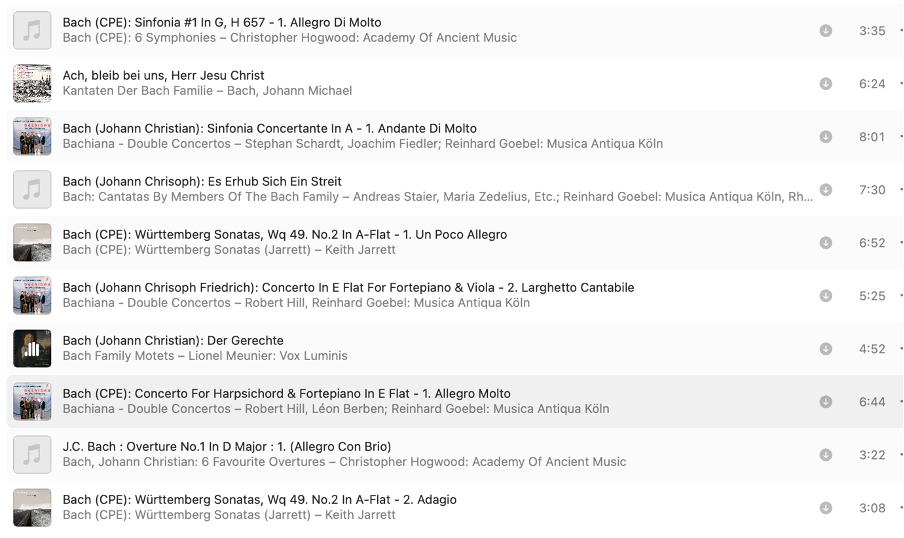
The Words
Hello everyone. Welcome to another episode of the ‘Classical For Everyone’ Podcast… five hundred years of incredible music. My name is Peter Cudlipp and… If you enjoy any music at all then I’m convinced you can enjoy classical music. All you need are ears. No expertise is necessary. If you’ve ever been curious about classical music… or explored it for a while once upon a time… or just quietly wondered what all the fuss was about… then this is the podcast for you.
And because there's a lot of music out there, each episode has something of a theme. For this one it is music written by people related to the composer Johann Sebastian Bach… which is why I have called it ‘an exaltation of Bachs’. That may seem an odd way put a show together. If you were to make a playlist of the greatest hits of people related to Taylor Swift, I suspect it would be a short list.
But if you ever wanted to get into a complicated debate about nature versus nurture, the musicians of the extended Bach family who lived in what is now northern Germany in the 1600s and 1700s would be an interesting place to start. A parallel that occurred to me — and I admit this is a stretch — is Welsh coal miners. For generations, men in Wales entered the mines. Family tradition combined with available opportunity; four or more generations following the same path underground. Now consider, alongside that, the incredible tradition of Welsh choral singing. Day job: fuelling the industrial revolution. Nights and weekends: praising the supernatural with voices so good they make you believe in the supernatural. Nature or nurture? Heredity or environment?
With that in mind, consider that somewhere between twenty and thirty relatives of Johann Sebastian Bach left compositions still recorded and performed two and three centuries later. And these were not merchants who wrote a few choral works for fun — these were people who made their living from music.
Here is some of that music. Starting with one of JS Bach's four sons who became composers: Carl Philipp Emanuel Bach. Of the six Bach relatives you'll hear today, he is the only one whose first name is not Johann. Which is not going to be confusing at all.
This is the opening section of CPE Bach’s 1st Symphony published in 1777. It is about four minutes long and is performed by the Academy of Ancient Music directed by Christopher Hogwood.
A
That was the opening section of CPE Bach’s 1st Symphony published in 1777. It was performed by the Academy of Ancient Music directed by Christopher Hogwood.
It’s tempting to say that some of the music I am going to play in this episode is only performed today because of the connection to Johann Sebastian Bach… who remains pretty central to the classical music world… in a position only equalled by Beethoven and Mozart.
But that was not the case with Carl Phillip Emmanuel Bach who lived from 1714 to 1788 and was the second surviving son of Johann Sebastian. He was one of the most influential composers of the eighteenth century. He spent nearly three decades at the court of Frederick the Great in Berlin before succeeding his godfather Georg Phillip Telemann as music director in Hamburg in 1768. His fame in his own lifetime was enormous — for many contemporaries, "Bach" simply meant C.P.E. Bach. It would be the 1800s before Johann Sebastian’s reputation would start to eclipse that of his son.
I have some more CPE Bach in a few minutes but now I’m going two generations earlier on the Bach family tree to CPE’s great uncle Johann Michael Bach. If CPE Bach had something of the equivalent of an international career and Johann Sebastian had a state-wide reputation in his day then Johann Michael was a small town figure dedicated to his community and his church. It’s worth noting in passing that like most people of the time the Bach clan were deeply devout and whilst only about a third of what I am playing today is expressly religious music… the proportion of their music the Bachs devoted to their god was considerably higher.
Here is a cantata, a work for choir and a small ensemble of musicians, by Johann Michael who died in 1694, so probably written in the late 1600s, called ‘Ach, bleib bei uns, Herr’… ‘Oh, stay with us, Lord’. This is the group Vox Luminis directed by Lionel Meunier. It is about six minutes long.
B
That was Johann Michael Bach’s cantata ‘Ach, bleib bei uns, Herr’… ‘Oh, stay with us, Lord’. The group Vox Luminis was directed by Lionel Meunier.
Ok. The next Bach in this episode is actually the least Bach-like of the Bachs whose music I am playing. Johann Christian Bach (1735–1782) was the youngest of Johann Sebastian's musically significant sons, and in some ways the most glamorous. After his father's death he converted to Catholicism, studied in Italy, and carved out a career first in Milan (where he served as cathedral organist) and then in London, where he became music master to Queen Charlotte and hence he is often referred to as the "London Bach,". His elegant, song-like style — light, polished, and built for pleasure — was enormously influential. Most famously, the young Wolfgang Amadeus Mozart met him in London in 1764 and was captivated; the two formed a genuine friendship, and Mozart's early piano concerto style owes a debt to Johann Christian's sunny manner.
Here is the eight minute opening section of one of his ‘sinfonia concertantes’ written in London in the 1770s. You can think of a ‘sinfonia concertante’ as a concerto for several soloists at once — in this case two… a cello and the keyboard — accompanied by a small orchestra. Here is Reinhard Goebel leading his group Musica Antiqua Cologne.
C
That was Reinhard Goebel leading his group Musica Antiqua Cologne with the opening of Johann Christian Bach’s Sinfonia Concertante in A.
Johann Christoph Bach (1642–1703) was another of JS Bach's uncles — the elder brother of his father, Johann Ambrosius — and by most accounts the most gifted composer of the generation before Johann Sebastian. He spent virtually his entire career as organist at St George's Church in Eisenach, the town where Johann Sebastian would be born in 1685, and it is likely that the young Bach knew his uncle's music intimately from childhood. This is his cantata ‘Es erhub sich ein Streit’ … ‘There arose a War’. Here again is Reinhard Goebel leading his group Musica Antiqua Cologne. Seven minutes from Johann Christoph Bach.
D
That was Johann Christoph Bach’s cantata ‘Es erhub sich ein Streit’ … ‘There arose a War’. It was performed by Reinhard Goebel and his his group Musica Antiqua Cologne. Now Goebel and his group as well as Christopher Hogwood’s Academy of Ancient Music and Lionel Meunier’s Vox Luminis all feature several times in this show. They were amongst the musicians who really dragged this music out of the dusty, dark corners of university libraries and private family collections and breathed life back into it.
The performer of the next piece though is really at the other end of the scale. The pianist Keith Jarrett is far better known to jazz audiences than to classical ones but he made a fine collection of releases of works by classical composers including keyboard works by Carl Phillip Emmanuel Bach. From his collection called the Württemburg Sonatas here is the first section of the 2nd sonata. Purists might be disappointed not to hear a harpsichord but I still hope you enjoy seven minutes of modern piano from Keith Jarrett.
E
That was Keith Jarrett with the first section of CPE Bach’s 2nd Württemberg sonata.
Alright I am tempted to let you know at this point that we are more than half-way through the exaltation of Bachs. And with this one (and I know it is an unfairly modern point of view) they took the naming protocol to a quite ludicrous level. If you recall that J S Bach had an uncle named Johann Christoph Bach, well he named his fifth son Johann Christoph Friedrich Bach.
Now he is perhaps the least well known of the extended Bach musical family. And one of the reasons for that is the destruction during the 2nd world war of the building in Berlin where the majority of his musical scores had been kept. A little reminder of the good fortune involved in what has actually come down to us.
Here is the 2nd section of Johann Christoph Friedrich Bach’s concerto for viola and fortepiano (the immediate predecessor of the modern piano) from probably the 1760s. It is about 5 minutes long and here is Reinhard Goebel and the Musica Antiqua Cologne.
F
That was the 2nd section of Johann Christoph Friedrich Bach’s concerto for viola and fortepiano. It was performed by Reinhard Goebel and the Musica Antiqua Cologne.
I’ve played a couple of cantatas in this show. Another popular form in this period was the motet which was generally a work for a four part choir. Often unaccompanied but sometimes, as in this case, supported by an organ.
This is another work by Johann Christian Bach. Remember he was the youngest of J S Bach’s sons to end up a composer. And I mentioned that he moved to Italy and then ended up in London with a perhaps sunnier style than his father and extended family. But with this motet titled ‘Der Gerechte’ from a verse in the book of Isiah in the Bible which begins… ‘the righteous perish’… he delivered something with the north German Lutheran dramatic power his relatives were known for. This is Vox Luminis directed by Lionel Meunier with Johann Christian Bach’s ‘Der Gerechte’. It is about 5 minutes long.
G
That was Vox Luminis directed by Lionel Meunier with Johann Christian Bach’s ‘Der Gerechte’. Ok. Back to C P E Bach. This is one of the most eccentric pieces of music I have come across. It is a concerto for harpsichord and fortepiano. It is almost as if someone knew that there would be people listening to this podcast who cannot stomach anything other than a modern piano. To them I apologise, but I have to say I think this is just a wonderfully entertaining bit of music… and to my knowledge… a remarkably rare combination of instruments.
Here are Reinhard Goebel and Musica Antiqua Cologne with the opening section of C P E Bach’s concerto for harpsichord and fortepiano from 1788. Incidentally, academics are fairly convinced this work was commissioned by Sarah Levy , the head of a prominent Prussian Jewish family whose great nephew was the composer Felix Mendelssohn… who almost single-handedly revived the reputation of… J S Bach. It is about seven minutes long.
H
That was Reinhard Goebel and Musica Antiqua Cologne with the opening section of C P E Bach’s concerto for harpsichord and fortepiano.
My name is Peter Cudlipp and you have been listening to the ‘Classical for Everyone’ Podcast. I have another couple of pieces coming up but before I get to them I want to give you a little information that I hope you find useful… If you would like to listen to past episodes or get details of the music I’ve played please head to the website classicalforeveryone.net. That address again is classicalforeveryone.net. On the individual episode pages of the website there are links to Spotify playlists with the full versions of most of the music played in each of the episodes.
I hope you have enjoyed this Bach family focused episode of ‘Classical For Everyone’. And if you want to get in touch then you can email… info@classicalforeveryone.net.
And I especially hope that Bob, the biggest fan of Bach in the Sydney suburb of Rozelle, liked this episode.
Alright, to finish I have the opening section of the first of Six Grand Overtures by Johann Christian Bach… the London / friend of Mozart / one… probably written in the 1780s. This is Christopher Hogwood directing the Academy of Ancient Music.
I
That was the opening section of first of Six Grand Overtures by Johann Christian Bach. Christopher Hogwood directed the Academy of Ancient Music.
Thanks for your time and I look forward to playing you some more incredible music on the next ‘Classical For Everyone’. This podcast is made with Audacity Software for editing, Wikipedia for Research, Claude for Artificial Intelligence and the music played is licensed through AMCOS / APRA. Classical For Everyone is a production of Mending Wall Studios and began life thanks to the enthusiasm and encouragement of Mr Jeffrey Sanders.
And if you have listened to the credits… here is a more music for you… another three minutes of the pianist Keith Jarett playing a section from one of C P E Bach’s Württemberg sonatas. This is the 2nd section of the 2ndsonata.
Thanks again for listening.
J