

 Apple Podcasts

 Spotify

 Amazon Music

 iHeartRadio

 Overcast

 PocketCasts
 RSS Feed
An American Celebration
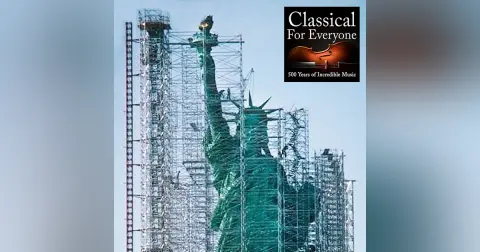
A podcast about classical music is maybe not really a place for politics but I'm recording this episode a day after the midterm elections in the US. And I think that a lot of people all over the globe are pleased and perhaps relieved that the complicated machinery of democracy in 2026 was robust enough to survive various attempts to compromise or subvert it… and regardless of one's affiliations I think that is well worth celebrating. With some help from Aaron Copland, Jennifer Higdon, Leonard Bernstein, Joan Tower, George Gershwin, Phillip Glass and John Adams.
[Episode Image: Scaffolding Liberty]
Here is a link to a playlist on Spotify with the music in the episode:
https://open.spotify.com/playlist/6kX9Pfpg8F1WUUElr8ZkFe?si=9790d29a41774791
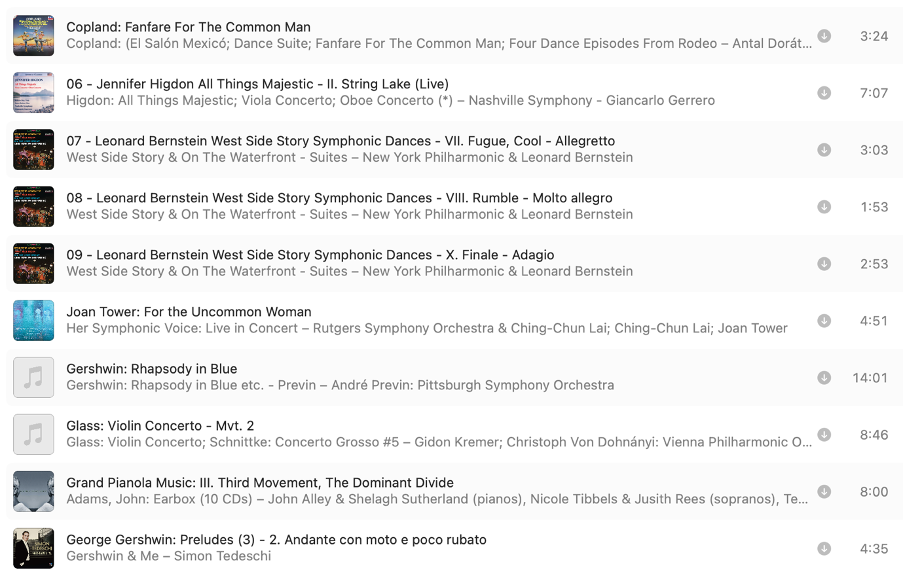
The Music
The Words
Hello everyone. Welcome to another episode of the ‘Classical For Everyone’ Podcast… five hundred years of incredible music.
My name is Peter Cudlipp and… If you enjoy any music at all then I’m convinced you can enjoy classical music. All you need are ears. No expertise is necessary.
If you’ve ever been curious about classical music… or explored it for a while once upon a time… or just quietly wondered what all the fuss was about… then this is the podcast for you.
And because there’s a lot of music out there each episode has a theme. And whilst a podcast about Classical Music is maybe not really a place for politics; I’m recording this episode a day after the midterm elections in the US. And I think that a lot of people all over the globe are pleased and perhaps relieved that the complicated machinery of American democracy in 2026 was robust enough to survive various attempts to compromise or subvert it… and regardless of one’s affiliations I think that is worth celebrating. With some help from Aaron Copland, Jennifer Higdon, Leonard Bernstein, Joan Tower, George Gershwin, Phillip Glass and John Adams.
I don’t think there will be much of a surprise in the first choice for this show… Here is Antal Dorati conducting the Detroit Symphony Orchestra with Aaron Copland’s ‘Fanfare For The Common Man’.
A
That was Antal Dorati conducting the Detroit Symphony Orchestra with Aaron Copland’s ‘Fanfare For The Common Man’.
It was written in 1942 for the Cincinnati Symphony Orchestra and commissioned by their conductor Eugene Goosens who wanted a series of patriotic fanfares to start each concert of the 1942 1943 season. Copland was inspired in part by a speech made earlier that year by then Vice President Henry A. Wallace, in which Wallace proclaimed the dawning of the "Century of the Common Man". I’m not sure how literally Copland was influenced by the speech or if he just agreed with the democratic sentiments of the speech… but I was surprised by the relevance sections of Wallace’s speech have retained… including:
The demagogue is the curse of the modern world, and of all the demagogues, the worst are those financed by well-meaning wealthy men who sincerely believe that their wealth is likely to be safer if they can hire politicians to change the -- the signposts and lure the people back into slavery. Unfortunately for the wealthy men who finance movements of this sort, as well as for the people themselves, the successful demagogue is a powerful genie who, when once let out of his bottle, refuses to obey anyone's command.
So if this show is celebrating a moment in American politics it can also be an opportunity to reflect on the extraordinary beauty of so much of that nation’s landscape
In 2011 the composer Jennifer Higdon was commissioned to write a work for the 50th anniversary celebration of the Grand Teton Music Festival held every summer in Jackson Hole, Wyoming. She called it ‘All Things Majestic’. And she described each section as a ‘musical postcard’. In her programme note she writes…
“Having grown up in the shadow of the Smoky Mountains, and having hiked many of our parks, I have come to the conclusion that the National Parks are one of America’s greatest treasures. So when asked by the Grand Teton Music Festival if I would compose a work, I jumped at the chance. ‘All Things Majestic’ is a tribute to not only the festival and its home, the Tetons, but also to the grandeur and majesty of all our parks.”
Here is ‘String Lake’ from Jennifer Higdon’s suite ‘All Things Majestic’. It is about 7 minutes long and this is the Nashville Symphony Orchestra conducted by Giancarlo Gerrero.
B
That was ‘String Lake’ from Jennifer Higdon’s suite ‘All Things Majestic’ and it was performed by the Nashville Symphony Orchestra conducted by Giancarlo Gerrero.
In the 1970s a teenage boy was cast to play the character Riff, the leader of the Jets gang of New York street toughs, in a high school production of the musical ‘West Side Story’. As some of you might know, the show opens with Riff walking onto an empty stage and whistling and snapping his fingers. Humiliation could have been avoided if proficiency in those two skills had been included in the audition process.
But not even that trauma could damage my affection for the music. This is Leonard Bernstein conducting the New York Philharmonic Orchestra with the final three sections of the symphonic suite from his music for West Side Story… ‘Cool’, ‘The Rumble” & ‘The Finale’. About seven minutes of music.
C
That was Leonard Bernstein conducting the New York Philharmonic Orchestra with the final three sections of his suite from the musical West Side Story.
I think regular listeners to the podcast may already have worked out that most of what is appearing in this episode has been played on the show before. But not everything… In the 1980s the composer Joan Tower started a series of works she called ‘Fanfare for the Uncommon Woman’ which I think is clever, pointed and entertaining all at the same time. She has added to the series over the years and recently renamed the fourth to just ‘For The Uncommon Woman’ as it was less of a fanfare and more of a regular orchestral piece.
Here is Ching-Chun Lai conducting the Rutgers Symphony Orchestra with Joan Towers’ five minute ‘For The Uncommon Woman’.
D
That was Ching-Chun Lai conducting the Rutgers Symphony Orchestra with Joan Towers’ ‘For The Uncommon Woman’.
If you are going to celebrate America with music then it would be pretty irresponsible to leave out George Gershwin’s ‘Rhapsody in Blue’. So I haven’t.
Is this the happiest classical music to come out of America in the 20th century? Well it would have to be close. Commissioned in 1924 by Jazz Band leader Paul Whiteman for a concert in New York he called ‘An Experiment in Modern Music’; Gershwin wrote the piece in about five weeks with the orchestration done by Ferdie Grofé who had been arranging works for the Whiteman group for several years.
I called the piece ‘classical music’ but by the 1920s jazz had made its way from the African American communities of the south to the musical melting pots of Chicago and then to New York where Gershwin with ‘Rhapsody in Blue’ would put jazz rhythms and harmonies together with his gift for Broadway songwriting and an ambition to wrestle with European classical forms.
Here is André Previn playing the solo piano and directing the Pittsburgh Symphony Orchestra. It is about fourteen minutes long.
E
That was André Previn playing the solo piano and directing the Pittsburgh Symphony Orchestra with George Gershwin’s ‘Rhapsody in Blue’.
So, a little change of pace. Something for a quieter, more private celebration.
Now just because something is intended to be popular does not mean it cannot portray exquisite beauty or a rare transcendent power. Here’s the composer Phillip Glass describing his first violin concerto:
"I wrote the piece in 1987 thinking, let me write a piece that my father would have liked [...] A very smart nice man who had no education in music whatsoever, but the kind of person who fills up concert halls. [...] It's popular, it's supposed to be — it's for my Dad."
Gidon Kremer is the violinist and Christoph Von Dohnányi conducts the Vienna Philharmonic Orchestra with the second section of Phillip Glass 1st Violin Concerto. It starts fairly quietly.
F
That was the violinist Gidon Kremer with Christoph Von Dohnányi conducting the Vienna Philharmonic Orchestra with the second section of Phillip Glass 1st Violin Concerto.
My name is Peter Cudlipp and you have been listening to the ‘Classical for Everyone’ Podcast. I have another couple of pieces coming up but before I get to them I want to give you a little information that I hope you find useful…
If you would like to listen to past episodes or get details of the music I’ve played please head to the website classicalforeveryone.net. That address again is classicalforeveryone.net
On the individual episode pages of the website there are links to Spotify playlists with the full versions of most of the music played in each of the episodes.
I hope you have enjoyed this ‘An American Celebration’ episode of ‘Classical For Everyone’. And if you want to get in touch then you can email… info@classicalforeveryone.net.
And I think now is the right time to say a sincere thank you to friend of the show Andrew Maiden for suggesting this episode and a very big hello to friends and family in the US.
Alright, to finish this episode I have something that I think speaks to what could be called ‘expansive American energy’ from the composer John Adams. I’m not sure that he necessarily intended this work from the early 1980s called Grand Pianola Music to also capture something of the gaudiness of the culture of California but it could just be that I was staying in the Tropicana Hotel in West Hollywood at about that time and that experience has somehow been conflated with Adam’s music over the decades. But it makes far more sense to hear from the composer.
Adams has written that he was at the time taking inspiration from his dreams… and regarding this piece… he describes a dream where he is driving along Interstate 5, when he was approached from behind by two black limousines. As the vehicles drew up beside him, they transformed into two incredibly long Steinway pianos. The dream in turn reminded him of walking down the hallways of the San Francisco Conservatory of Music, where he used to hear students practicing the piano, creating a "sonic blur of twenty or more pianos playing.
Here is the final part of the piece ‘Grand Pianola Music’ by John Adams. It is about 8 minutes long. John Alley & Shelagh Sutherland (pianos), Nicole Tibbels & Judith Rees (sopranos), Teresa Shaw (mezzosoprano), the London Sinfonietta is conducted by the composer, John Adams
G
That was John Alley & Shelagh Sutherland (pianos), Nicole Tibbels & Judith Rees (sopranos), Teresa Shaw (mezzosoprano), the London Sinfonietta is conducted by John Adams with the third and concluding section of his piece ‘Grand Pianola Music’.
Thanks for your time and I look forward to playing you some more incredible music on the next ‘Classical For Everyone’.
This podcast is made with Audacity Software for editing, Wikipedia for Research, Claude for Artificial Intelligence, Cleanfeed for remote recording; and the music played is licensed through AMCOS / APRA. Classical For Everyone is a production of Mending Wall Studios. The Producers do not receive any gifts, remuneration or support of any kind from any organisation or individual mentioned in the show.
And if you have listened to the credits… here is some more music for you…
This American celebration episode has been dominated by music with a certain grand, energetic and optimistic feel. But after a big day of fun in America perhaps the best thing to do is find a quiet bar and sit with a well-made cocktail. Just you and the barman. And maybe a guy at the piano in the corner. And if you were in the Roosevelt Hotel in New York City one night in 1926 you might have been lucky enough to hear George Gershwin try out his 2nd Piano Prelude. Here it is played by Simon Tedeschi.
Thanks again for listening.
H