


A Different Halloween.


Probably adopted from early pagan traditions, 'All Hallows Eve', which became Halloween; was, and perhaps in some places still is, a night of rituals to call on the spirits of saints and martyrs for our protection in the year ahead; and prayers for the souls of loved ones who might not yet be fully at rest. So when I call this episode 'a different Halloween' all I really mean is that some of the music in this episode is more about sincere spirituality than trick-or-treating. But there are still one or two creepy concessions to today's Halloween. The music is from Modest Mussorgsky, Franz Schubert, Sergei Prokofiev, Rodrigo de Ceballos, John Tavener, Phillip Glass and Gabriel Fauré.
And here is a link to an extended playlist on Spotify with the full versions of most of the music in the episode:
https://open.spotify.com/playlist/3wNEGxOxOPtGTEdwDXsVwl?si=88652a96ce304df7
The Music
The Words
Hello everyone. Welcome to another episode of the ‘Classical For Everyone’ Podcast… five hundred years of incredible music. My name is Peter Cudlipp and… If you enjoy any music at all then I’m convinced you can enjoy classical music. All you need are ears. No expertise is necessary. If you’ve ever been curious about classical music… or explored it for a while once upon a time… or just quietly wondered what all the fuss was about… then this is the podcast for you. And because there’s a lot of music out there each episode has something of a theme. And for this one it is… what I’m calling ‘A Different Halloween’. What do I mean?
Today, Halloween is that time of the year when young children start on the pathway to type 2 diabetes, when Cadbury, Lindt, Mars, Nestlé and Whittakers get a bump in sales… and when debatable party costuming decisions are made. But there once was another Halloween better known as ‘all hallows eve’, and, in case you’ve ever wondered; a ‘hallow’ was in Middle English both a ‘saint’ and a ‘shrine’. Probably adopted from even earlier pagan traditions, ‘All Hallows Eve’ was, and perhaps in some places still is, a night of rituals to call on the spirits of saints and martyrs for our protection in the year ahead; and prayers for the souls of loved ones who might not yet be fully at rest. So when I call this episode ‘a different Halloween’ all I really mean is that some of the music in this episode is more about sincere spirituality than trick-or-treating. But there are still one or two creepy concessions to today’s Halloween. The music is from Modest Mussorgsky, Franz Schubert, Sergei Prokofiev, Rodrigo de Ceballos, John Tavener, Phillip Glass and Gabriel Fauré.
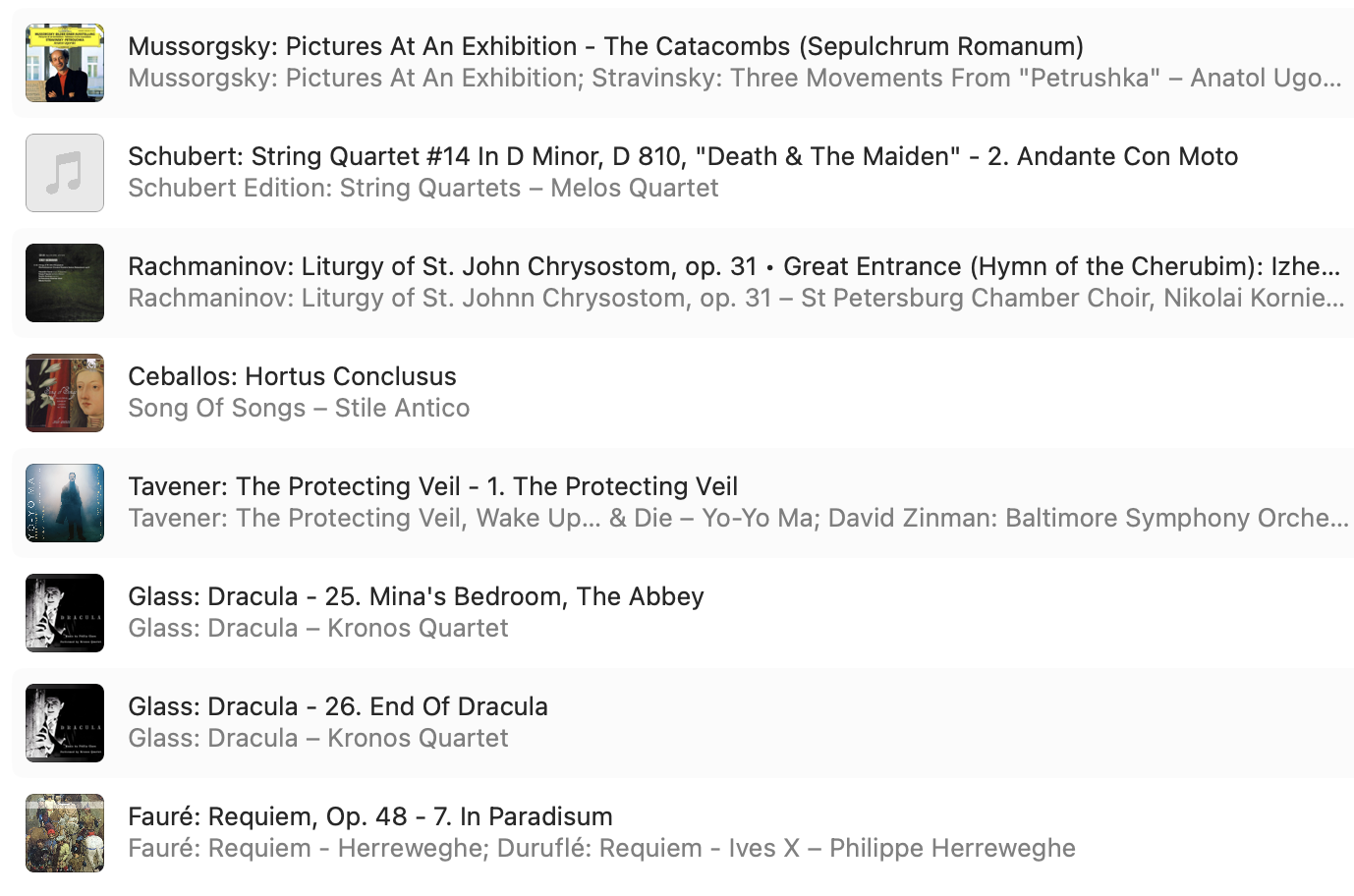
So, first up to perhaps get you in the mood, is the ‘Catacombs’ section from Modest Mussorgsky’s 1874 suite of piano pieces ‘Pictures at an Exhibition’. This performance is by Anatol Ugorski and for me, even though the piece is only two minutes long it captures a real sense of the dread of descending into a darkened crypt filled with human remains.
A
That was the ‘Catacombs’ section from Modest Mussorgsky’s ‘Pictures at an Exhibition’ performed by Anatol Ugorski. I think it can be argued that the older we get, the more real death becomes. And something that when we were younger seemed so far away as to be fantastical starts to become more clearly defined. Death is today largely a preoccupation of the elderly. But in an earlier time, death at a young age was an all-too-common experience, and despite the solace offered by the idea of an afterlife, faced with such grief some artists came to characterise Death itself as a comforting entity. In 1817 the composer Franz Schubert took a poem in that vein by Matthias Claudius called ‘Death and the Maiden’ and set it to music. Here are some of the lyrics…
The Maiden says to Death:
Pass me by! Oh, pass me by!
Go, fierce man of bones!
I am still young! Go…
And do not touch me.
Death says to the Maiden:
Give me your hand, you beautiful and tender form!
I am a friend and come not to punish.
Don’t be afraid! I am not fierce,
Softly shall you sleep in my arms!
Six years after writing the song, Schubert, now knowing his own death was now close at hand, took the musical themes from his song and used them in what would be one of his final works… His String Quartet No. 14, now known as the ‘Death And The Maiden’ Quartet. Here is the second section performed by the Melos Quartet. It is about 14 minutes long.
B
That was the Melos Quartet performing the slow section of Franz Schubert’s ‘Death and the Maiden’ string quartet. So next up in this ‘A Different Halloween’ episode of ‘Classical For Everyone’ is a piece about the messengers that travel between our world and the hidden realms that may surround us… angels. This is a section from Sergei Rachmaninoff’s setting of the text of one of the Orthodox Church’s central ceremonies, ‘The Liturgy of St John of Chrysostom’. Written for unaccompanied choir and soloists in 1910 it was deemed too modern by the Russian Church and fell into obscurity and was only rediscovered in the 1980s.
This section of the Liturgy is called the ‘Hymn of the Cherubim’. Now although ‘cherubim’ is the plural of ‘cherub’; don’t get confused with the smiling fat winged children of Renaissance art. Both words are transliterations of ancient Hebrew and the cherubs, or cherubim, in the Bible are best known as the angles that stand at the gates of the Garden of Eden with a flaming sword standing guard after Adam and Eve have been banished. These are beings high up in the hierarchy of angels and in the Liturgy the choir and soloists sing…
Let us who mystically represent the Cherubim,
and who sing the thrice-holy hymn
to the life-creating Trinity,
now lay aside all cares of this life,
that we may receive the King of All,
who comes invisibly borne by the angelic host.
Here is the St Petersburg Chamber Choir and Soloists conducted by Nikolai Korniev with the ‘Hymn of the Cherubim’ from Sergei Rachmaninoff’s setting of the text of ‘The Liturgy of St John of Chrysostom’. It starts pretty quietly and is about seven minutes long.
C
That was the St Petersburg Chamber Choir and Soloists conducted by Nikolai Korniev with the ‘Hymn of the Cherubim’ from Sergei Rachmaninoff’s setting of the text of ‘The Liturgy of St John of Chrysostom’.
Alright so where to after bones, death and angels? In many traditions the reward for living a good and observant life is to attain paradise. This is the far better option than hell or the underworld. And paradise has for millennia been described as a garden. In fact the word ‘paradise’ is from a Persian word for a walled garden. And this is one of the defining images of paradise that would seed itself into western culture through the Hebrew book later incorporated into the Christian Bible… the Song of Songs. Now for generations it was believed that the poetic text of the Song of Songs was an allegory, that the literal meaning is a disguise for a symbolic meaning… that the love described in the poem is actually that of God for Israel. Which is why the Andalusian priest Rodrigo de Ceballos in the 1500s set a Latin version of the verses about a walled garden into a very beautiful choral work I am about to play for you. But first I’ll read you an English translation of the text he set…
A garden enclosed is my bride,
and a sealed fountain.
Open to me my love,
my dove, my undefiled.
Arise my love and come.
Come my fair one, let me see your face.
Your lips distil nectar,
honey and milk are under your tongue.
Come my bride, and you shall be crowned.
Here is the group ‘Stile Antico’ performing ‘Hortus conclusus’ or ‘A Garden Enclosed’ by Rodrigo de Ceballos. It is about 5 minutes long.
D
That was the group ‘Stile Antico’ performing ‘Hortus conclusus’ or ‘A Garden Enclosed’ by Rodrigo de Ceballos. I don’t for a moment doubt the sincerity of the composer making a beautiful work trying to capture the idea of paradise. But scholars are now in reasonable agreement that the Song Of Songs is a collection of love poems, frequently erotic, and that the idea of them being allegorical was imposed sometime after their creation.
And if that argument needs a little more support, here from the New International Version of the Bible (of which over 450 million copies have been distributed) is the concluding verse of that chapter of the Song of Songs… and remember the poet in the guise of a male lover has been describing the object of his love. Now the poet gives voice to her response…
Awake, north wind, and come, south wind!
Blow on my garden, that its fragrance may spread everywhere.
Let my beloved come into his garden and taste its choice fruits.
Like I said… A Different Halloween.
Ok now, to a work that really for me captures something quite extraordinarily… a sense of the porousness between our everyday world and other unseen realms. This is ‘The Protecting Veil’ by the English composer John Tavener written in 1988 for solo Cello and Strings. Tavener wrote about the work..
In my piece I have tried to capture some of the almost cosmic power of the Mother of God. Having said this, it is perfectly possible to listen to The Protecting Veil as ‘pure’ music but I think that it may be helpful if I recount what was in my mind during the composition. It is an attempt to make a lyrical ikon in sound, rather than in wood, and using the music of the cellist to paint rather than a brush. The music is highly stylised, geometrically formed and meditative in character.
And whilst Tavener intended his work to be a musical representation of the Russian Orthodox idea of the Virgin Mary’s veil protecting the faithful.. as a non-believer, I’ve always heard something of a more abstract portrayal of transcendence. And I think it is prompted by the idea of a spiritual ‘veil’… Not a wall, not a door, but something translucent, something that both separates and partially reveals. You can sense what's on the other side even if you can't fully see it or pass through. And the old Halloween, All Hallows' Eve itself is traditionally that one night when the veil between worlds is thinnest, when the porous boundary becomes most permeable.
Here is the first section of John Tavener’s ‘The Protecting Veil’ performed by the cellist Yo-Yo Ma with the Baltimore Symphony Orchestra conducted by David Zinman. It is about 15 minutes long.
E
That was the first section of John Tavener’s ‘The Protecting Veil’ performed by the cellist Yo-Yo Ma with the Baltimore Symphony Orchestra conducted by David Zinman.
My name is Peter Cudlipp and you have been listening to the ‘Classical for Everyone’ Podcast. I have another couple of ‘Halloween’ – adjacent pieces coming up but before I get to them I want to give you a little information that I hope you find useful…If you would like to listen to past episodes, of which there are more than forty, or get details of the music I’ve played please head to the website classicalforeveryone.net. That address again is classicalforeveryone.net. And on the individual episode pages of the website there are links to Spotify playlists with the full versions of most of the music played in each of the episodes. And you can get in touch by emailing info@classicalforeveryone.net.
Alright, to finish this episode I’ve decided to return to a more expected sample of Halloween fare… those brooding sexy night-creatures of central Europe… vampires. And specifically the king of them all… Count Dracula. In the late-1990s, Universal Pictures approached the American composer Philip Glass to write a new score for Tod Browning’s Dracula from 1931 starring Bela Lugosi – as part of Universal’s Classic Monsters home video collection. “The film is considered a classic,” Glass has said. “I felt the score needed to evoke the feeling of the world of the 19th century – for that reason I decided a string quartet would be the most evocative and effective. I wanted to stay away from the obvious effects associated with horror films. With the Kronos Quartet, we were able to add depth to the emotional layers of the film.”
I can’t imagine how the home video rental market responded to this but the Kronos Quartet toured playing the Glass score live as the movie was projected. And they made a CD. From which I am going to play the the concluding 8 minutes… the sections ‘Mina’s Bedroom, The Abbey and The End Of Dracula’.
F
That was the Kronos Quartet with the final sections of ‘Dracula’ by Phillip Glass. Thanks for your time and I look forward to playing you some more incredible music on the next ‘Classical For Everyone’. This podcast is made with Audacity Software for editing, Wikipedia for Research, Claude for Artificial Intelligence and Apple, Sennheiser, Sony, Rode and Logitech for hardware… The music played is licensed through AMCOS / APRA. Classical For Everyone is a production of Mending Wall Studios and began life on Radio 2BBB in Bellingen NSW, Australia thanks to the late, great Mr Jeffrey Sanders. The producers do not receive any gifts or support of any kind from any organisation or individual mentioned in the show. But, never say never.
And if you have listened to the credits… here is a little bonus for you… Back to paradise but this time with less nectar, honey and milk. Here is the conclusion to Gabriel Fauré’s Requiem Mass. In which the choir sings…
May the angels lead you into paradise;
may the martyrs greet you at your arrival
and lead you into the holy City of Jerusalem.
May the choir of Angels greet you
and like Lazarus, who once was a poor man,
may you have eternal rest.
This is Phillipe Herreweghe conducting the Singers of St Louis and the Ensemble Musique Oblique with ‘In Paradise’ by Gabriel Fauré
Thanks again for listening.